
 Worksheets
Atomic Structure and The Periodic Table
Total questions: 49
Worksheet time: 25mins
Name
Class
Date
1.
Which statement describes the distribution of charge in an atom?
a)
A positively charged nucleus is surrounded by one or more negatively charged electrons.
b)
A neutral nucleus is surrounded by one or more negatively charged electrons.
c)
A neutral nucleus is surrounded by one or more positvely charged electrons.
d)
A positively charged nucleus is surrounded by one or more positively charged electrons.
2.
Which list includes elements with the most similar chemical properties?
a)
Br, Ga, Hg
b)
N, O, F
c)
O, S, Se
d)
Cr, Pb, Xe
3.
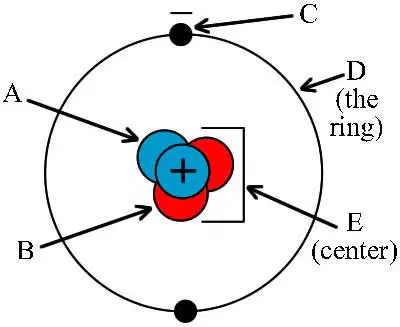
Which letter represents the atom's electrons?
a)
A
b)
B
c)
C
d)
D
e)
E
4.
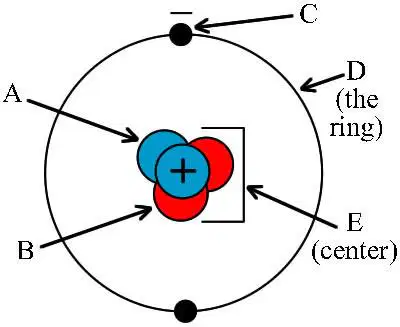
Which letter represents the atom's nucleus?
a)
A
b)
B
c)
C
d)
D
e)
E
5.
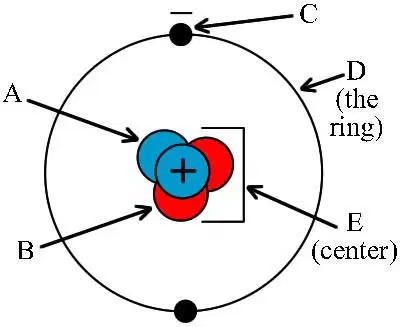
Which letter represents the atom's electron cloud or orbital?
a)
A
b)
B
c)
C
d)
D
e)
E
6.
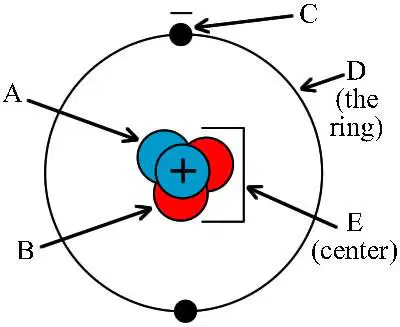
Which letter represents the atom's positively charged protons?
a)
A
b)
B
c)
C
d)
D
e)
E
7.
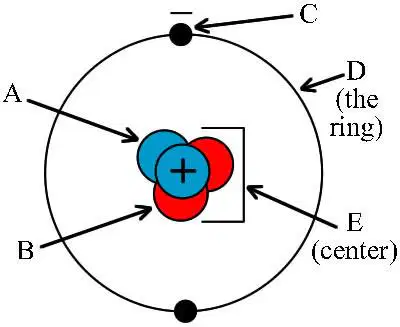
Which letter represents the atom's neutrons?
a)
A
b)
B
c)
C
d)
D
e)
E
8.
The horizontal rows of the periodic table are called
a)
periods
b)
groups
9.
The vertical columns of the periodic table are called
a)
periods
b)
groups
10.
Use the Periodic Table to determine the group number for Zirconium (Zr)
(a)
11.
Use the Periodic Table to determine the group number for Argon (Ar)
(a)
12.
Use the Periodic Table to determine the group number for Yttrium (Y)
(a)
13.
Use the Periodic Table to determine the period number for Calcium (Ca)
(a)
14.
Use the Periodic Table to determine the period number for Helium (He)
(a)
15.
What is the other known name for Group 1?
a)
Alkali Metals
b)
Alkaline Earth Metals
c)
Halogens
d)
Noble Gases
16.
What is the other known name for Group 17?
a)
Alkali Metals
b)
Alkaline Earth Metals
c)
Halogens
d)
Noble Gases
17.
Groups 3-12 are also known as the...
a)
Rare Earth Metals
b)
Transition Metals
c)
Halogens
d)
Noble Gases
18.

How many protons would Barium have?
a)
56
b)
137
c)
81
19.

How many neutrons would Barium have?
a)
54
b)
137
c)
81
20.
Elements that can be described as dull in color and as poor conductors of heat and electricity are classified as...
a)
Metals
b)
Nonmetals
c)
Metalloids
21.
Elements with properties such as being shiny or ductile, malleable and good conductors of electricity are classified as...
a)
Metals
b)
Nonmetals
c)
Metalloids
22.
True or False: Metalloids are worse conductors than nonmetals.
a)
True
b)
False
23.
True or False: Nonmetals are found to the left of the metalloids on the periodic table.
a)
True
b)
False
24.
Gold (Au), Manganese (Mn) and Copper (Cu) are all examples of...
a)
Metals
b)
Nonmetals
c)
Metalloids
25.
Germanium (Ge), Boron (B) & Antimony (Sb) are all examples of...
a)
Metals
b)
Nonmetals
c)
Metalloids
26.
Bromine (Br), Oxygen(O), and Carbon(C) are all examples of...
a)
Metals
b)
Nonmetals
c)
Metalloids
27.
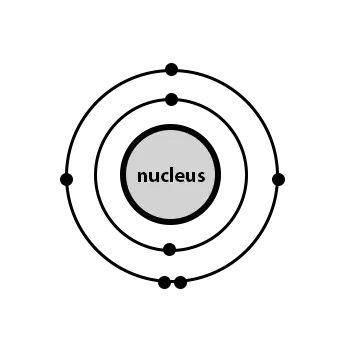
Based off our knowledge of the Bohr Model and the Periodic Table, which element does this diagram represent?
a)
Boron (B)
b)
Nitrogen (N)
c)
Helium (He)
d)
Calcium (Ca)
28.

Based off our knowledge of the Bohr Model and the Periodic Table, which element does this diagram represent?
a)
Sodium (Na)
b)
Potassium (K)
c)
Helium (He)
d)
Neon (Ne)
29.
Protons have a ____________ charge.
a)
positive
b)
negative
c)
neutral
30.
Electrons have a _____________ charge.
a)
positive
b)
negative
c)
neutral
31.
Neutrons are found in the ____________________ of the atom.
a)
nucleus
b)
electron cloud
c)
orbital
d)
energy shell
32.
What are isotopes?
a)
Elements with the same number of neutrons and protons.
b)
Elements with the same number of neutrons but a different number of protons.
c)
Elements with different numbers of neutrons and protons.
d)
Elements with the same number of protons but a different number of neutrons.
33.

Is this Lewis Dot Structure correct for Nitrogen?
a)
Yes
b)
No
34.

Which of the following is the correct lewis dot structure for Sulfur?
a)
A
b)
B
c)
C
d)
D
35.
Element A has 6 protons and a mass number of 14.
Element B has 6 protons and a mass number of 15.
What are these elements?
a)
Isotopes
b)
Different elements
36.
Element C has 10 protons and a mass number of 22.
Element D has 12 protons and a mass number of 22.
What are these elements?
a)
Isotopes
b)
Different elements
37.
Element Q has 22 protons and a mass number of 45.
The atomic number of Element X is 22 and the mass number is 44.
What are these elements?
a)
Isotopes
b)
Different Elements
38.
What is the correct name in hyphen form for an isotope of Lithium (Li) with 3 protons and 4 neutrons?
a)
Lithium-3
b)
Lithium-4
c)
Lithium-7
39.
All of the elements in a period have the same number of ____________________.
a)
valence electrons
b)
protons
c)
electrons
d)
energy levels
40.
All of the elements in a group have the same number of ____________________.
a)
valence electrons
b)
protons
c)
electrons
d)
energy levels
41.
Which group on the periodic table is the most nonreactive?
a)
Group 1 (Alkali Metals)
b)
Group 2 (Alkaline Earth Metals)
c)
Group 3-12 (Transition Metals)
d)
Group 17 (Halogens)
e)
Group 18 (Noble Gases)
42.
Which of the following elements is in Group 16?
a)
Neon (Ne)
b)
Calcium (Ca)
c)
Oxygen (O)
d)
Gold (Au)
43.
Which element is considered the most reactive?
a)
Fluorine (F)
b)
Xenon (Xe)
c)
Helium (He)
d)
Polonium (Po)
44.
Which element would be the least reactive?
a)
Hydrogen (H)
b)
Oxygen (O)
c)
Neon (Ne)
d)
Potassium (K)
45.
How many protons does Sodium (Na) have?
a)
22
b)
11
c)
1
d)
2
46.
How many electrons would a neutral atom of Chlorine (Cl) have?
a)
9
b)
17
c)
36
d)
34
47.
How many valence electrons does Polonium (Po) have?
a)
84
b)
6
c)
16
d)
8
48.
How many energy levels does Platinum (Pt) have?
a)
10
b)
6
c)
8
d)
78
49.
How many valence electrons does Barium (Ba) have?
a)
1
b)
2
c)
6
d)
56
100 %

