wayground logo

Free Printable Worksheets

NEW

Font size

S
M
L
XL
Worksheets

Periodic table

Total questions: 55

Worksheet time: 2hrs 40mins

Name
Class
Date
1.

Which of the following is a contribution of Mendeleev in the Periodic Table?

a)

used X-rays to determine atomic number of elements

b)

arranged elements according to atomic number

c)

predicted the characteristics of unknown elements

d)

grouped elements into triads with similar physical and chemical properties

2.

Which of the following is the contribution of Moseley in the periodic table?

a)

used X-rays to determine the atomic number of elements

b)

arranged elements according to atomic mass

c)

predicted the characteristics of unknown elements

d)

grouped elements with similar properties into triads

3.

What is the modern group number of Silicon (Si)? (Z=14)

a)

3

b)

4

c)

14

d)

4A

4.

What is the American group number of Iodine (I)? (Z=53)

a)

5

b)

7

c)

7A

d)

17

5.

What is the period number of Calcium (Ca)? (Z=20)

a)

2

b)

2A

c)

4

d)

4A

6.

Which of the following is NOT a metalloid?

a)

B (Z=5)

b)

Al (Z=13)

c)

Si (Z=14)

d)

Ge (Z=32)

7.

Which element occupies the f block?

a)

H (Z=1)

b)

F (Z=9)

c)

Fe (Z=26)

d)

U (Z=92)

8.

Which of the following is NOT a transition metal?

a)

Uranium (U) (Z=92)

b)

Iron (Fe) (Z=26)

c)

Tin (Sn) (Z=50)

d)

Nickel (Ni) (Z=28)

9.

Which element is a noble gas?

a)

H (Z=1)

b)

N (Z=7)

c)

O (Z=8)

d)

He (Z=2)

10.

Which of the following is an alkali metal?

a)

K (Z=19)

b)

Mg (Z=12)

c)

Al (Z=13)

d)

Si (Z=14)

11.
Each column in the periodic table is called a 
a)
period
b)
group
c)
cluster
d)
unit
12.
Elements which are shiny, conduct electricity and heat are called
a)
metal
b)
nonmetal
c)
metalloid
d)
nonexistent
13.
The atoms along the staircase are called 
a)
metals
b)
nonmetals
c)
metalloids
d)
noble gases
14.
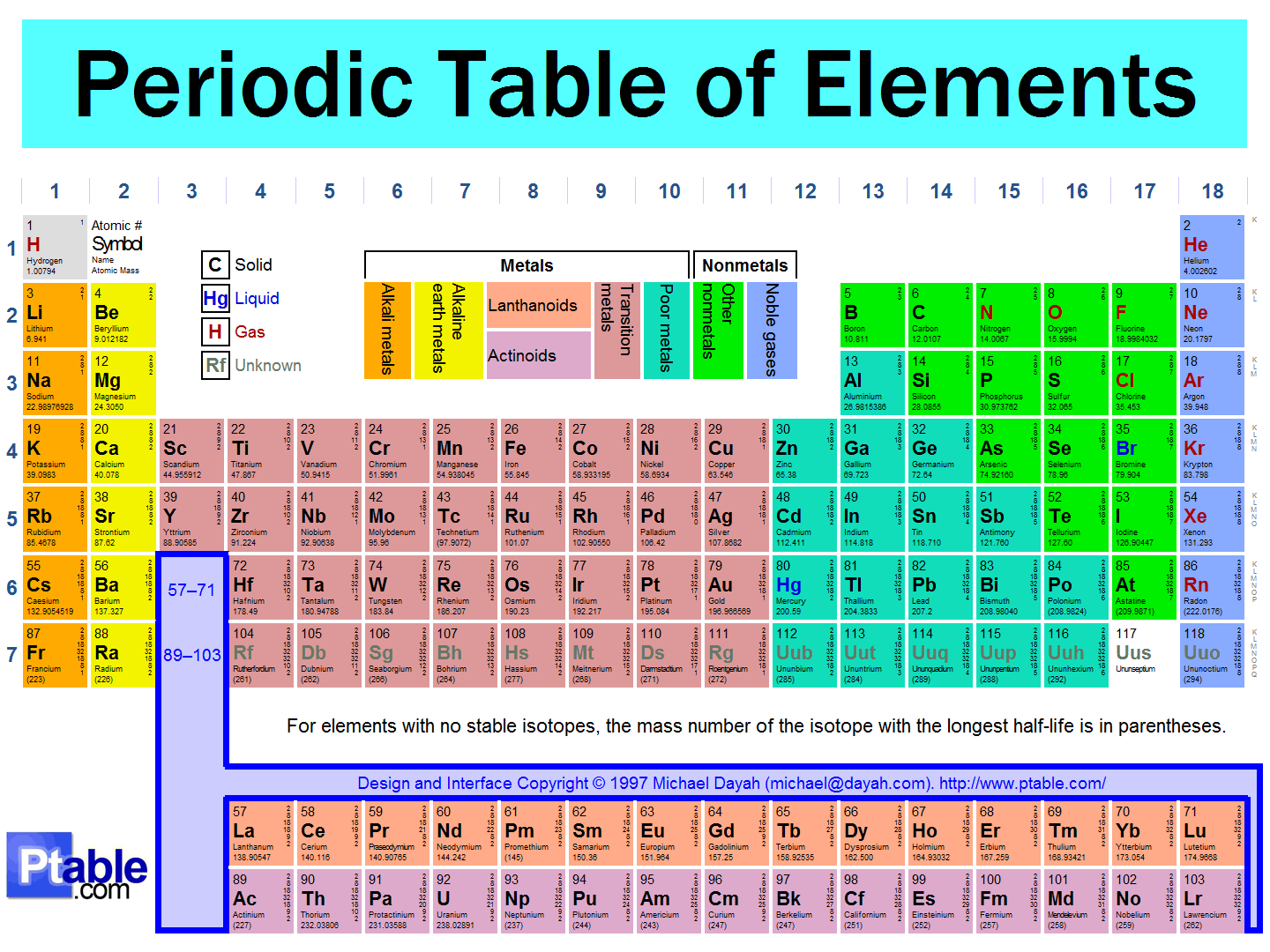
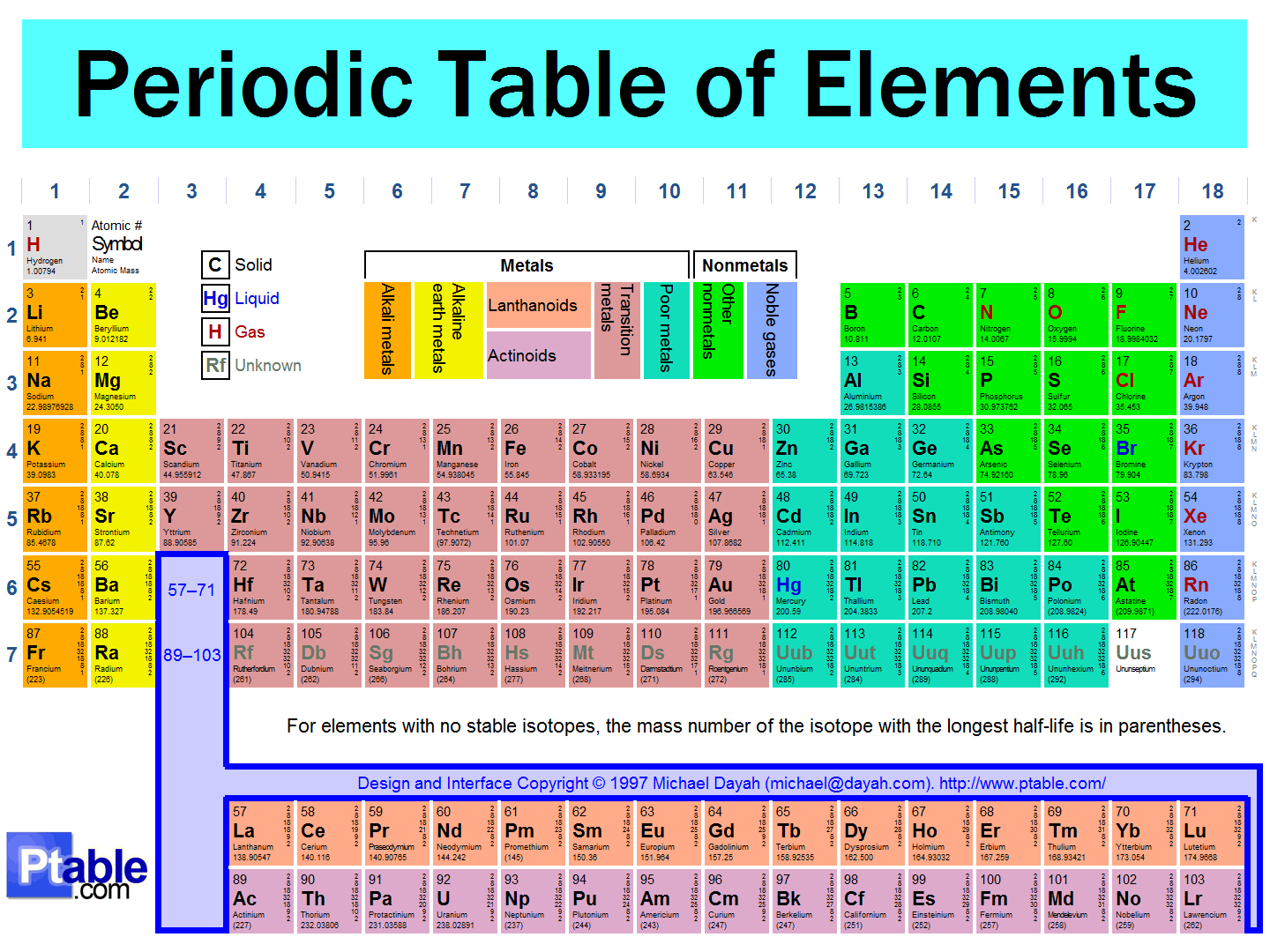
How many protons are in this element?
a)
79
b)
196
c)
117
d)
Cannot be determined
15.
What's a valence electron?
a)
electrons in the second energy level
b)
electrons in the outermost energy level
c)
the atomic number
d)
electrons in the first level
16.

one or two letters that represent the name of an element

a)

element name

b)

element symbol

c)

atomic number

d)

atomic mass

17.
How did Mendeleev arrange the elements?
a)
alphabetical 
b)
density
c)
melting point
d)
atomic mass
18.
The horizontal row on the periodic table is called a
a)
group
b)
family
c)
period
d)
atomic number
19.
This class of elements are sometimes called "semiconductors."
a)
Metals
b)
Nonmetals
c)
Metalloids
d)
Groups
20.
What does the 1.00794 stand for?
a)
Hydrogen
b)
atomic number
c)
atomic mass
d)
atomic explosion
21.
How are elements in the periodic table organized?
a)
Alphabetically
b)
Based on physical and chemical properties
c)
Increasing number of electrons
d)
Most reactive to least reactive
22.
Most elements on the periodic table are classified as __________.
a)
Metals
b)
Non-Metals
c)
Metaloids
d)
Gases
23.
Groups on the periodic table are arranged
a)
Vertically (up and down)
b)
Horizontally (left to right)
24.
Which accurately describes nonmetals?
a)
Both malleable and ductile
b)
Often used in computer parts
c)
Poor conductors of electricity
d)
Always solid at room temperature
25.
Which group on the periodic table is the most reactive Metals?
a)
Alkaline-earth metals - Group 2
b)
Alkali metals - Group 1
c)
Transition metals - Group 3-7
d)
Halogens - Group 17
26.
Which group of elements is inert?
a)
Alkaline metals - Group 1
b)
Alkaline-earth metals - Group 2
c)
Transition metals Groups 3-8
d)
Noble Gases - Group 18
27.
Which properties most accurately describe the element silicon (Si)?
a)
Highly conductive, solid at room temperature
b)
Weak conductor of electricity, solid at room temperature
c)
Poor conductor, transparent
d)
Ductile and malleable
28.
Each horizontal row on the periodic table is called what?
a)
Periods
b)
Groups
29.
Which group includes some of the most familiar elements like nickel, iron, and copper?
a)
Inner transition metals
b)
Transition metals
c)
Halogens
d)
Noble gases
30.
Elements with an atomic number higher than __ are not found naturally.
a)
58
b)
71
c)
90
d)
92
31.
Which group of elements on the periodic table are all gases at room temperature?
a)
Alkali metals - Group 1
b)
Halogens - Group 17
c)
Metalloids Groups 13-15
d)
Noble gases - Group 18
32.
Which pair of elements would have similar properties due to the position in the periodic table?
a)
Calcium (Ca), Helium (He)
b)
Copper (Cu), Gold (Au)
c)
Lithium (Li), Beryllium (Be)
d)
Aluminum (Al), Zinc (Zn)
33.
Which 2 Groups are most likely to react with each other?
a)
Groups 1 & 18
b)
Groups 1 & 17
c)
Groups 2 & 18
d)
Groups 14 & 15
34.
How Many Valence Electrons are in the element above?
a)
1
b)
3
c)
5
d)
7
35.
Which of the following statement is true?
a)
Group 18 - 18 Valence Electrons
b)
Group 15 - 1 Valence Electrons
c)
Group 13 - 3 Valence Electrons
d)
Group 11 - 8 Valence Electrons
36.
Non-Malleable, Less Dense, Insulators and Brittle describe what physical property group?
a)
Metals
b)
Non-Metals
c)
Transition Metals
d)
Metalloids
37.
Group # 13 has how many Valence Electrons?
a)
13
b)
1
c)
8
d)
3
38.
Which element shares chemical properties of Chlorine?
a)
Na
b)
Br
c)
Ar
d)
S
39.
Which of the following Physical Property statement is true?
a)
Boron(5) and Carbon(6) are both Metals
b)
Boron(5) & Silicon(14) are both Metalloids
c)
Carbon(6) & Silicon(14) are in both Non-Metals
d)
Aluminum(13) & Carbon(6) are both Metals
40.
Which of the following Chemical Property statement is true?
a)
Boron(5) and Carbon(6) are in the same Group #
b)
Boron(5) & Silicon(14) have the same # of Energy Rings
c)
Carbon(6) & Silicon(14) have the same # of Valence Electrons
d)
Aluminum(13) & Carbon(6) have the same # Energy Rings
41.
Which statement is true about the properties of metalloids?
a)
Metalloids tend to have very similar properties to metals
b)
Metalloids tend to have very similar properties to nonmetals
c)
Metalloids tend to have properties that are a mixture of those of metals and nonmetals
d)
The properties of metalloids are completely different from both metals and nonmetals
42.
Which of the following is the most reactive group of non-metals? 
a)
Oxygen family (Group 16)
b)
Noble Gases
c)
Halogens (Group 17)
d)
Nitrogen family (Group 15)
43.
What group number has 1 valence electron for each atom?
a)
group 1
b)
group 2
c)
group 10
d)
group 12
44.
How many valence electrons do atoms in group 16 have?
a)
4
b)
5
c)
6
d)
7
45.
How many valence electrons does magnesium have?
a)
1
b)
2
c)
12
d)
24
46.
Elements in the same period have
a)
same number of energy levels
b)
same number of protons
c)
same number of valence electrons
d)
similar physical and chemical properties
47.

The highlighted section is the...

a)

Actinides

b)

Lanthanides

c)

Transition Metals

d)

Halogens

48.

The highlighted section is the...

a)

Actinides

b)

Lanthanides

c)

Halogens

d)

Alkali

49.
Which group on the Periodic Table has 3 Valence electrons(electrons on last energy level)?
a)
Group 13
b)
Group 3
c)
Group 17
50.
Elements in the same group or family are expected to have  ________
a)
Similar Chemical Properties
b)
Same number of Protons
c)
Same Atomic number
51.
The highlighted group is the 
a)
alkali metals
b)
alkaline earth metals
c)
halogens
d)
noble gases
52.
The blue section is called the
a)
inner transition elements
b)
transition elements
c)
transuranium elements
d)
nonmetals
53.
The metals of group 2 are called
a)
transition metals
b)
alkaline earth metals
c)
lanthanides
d)
alkali metals
54.
In what section would Transition Metals be found?
a)
orange
b)
light blue
c)
blue
d)
white
55.
The yellow atoms are called 
a)
metals
b)
nonmetals
c)
metalloids
d)
noble gases