Wayground logo

Free Printable Worksheets

Font size

S
M
L
XL
Worksheets

Summer School 2025 Final

Total questions: 64

Worksheet time: 32mins
Name
Class
Date
1.
Why was the Cold War considered “cold”?
a)
War took place in Russia
b)
Lack of communication between countries
c)
No actual fighting took place between the US and Soviet Union
d)
Spread of isolationism
2.
America’s goal during the Cold War was to:
a)
Colonize the Philippines
b)
Return to isolationism
c)
Stop the spread of communism
d)
Limit investments to other countries to rebuild economy
3.
The Soviet Response to NATO was:
a)
NAFTA
b)
Warsaw Pact
c)
Watergate
d)
EU
4.
All of the following embarrassed the US during the Cold War except:
a)
Bay of Pigs
b)
U-2 Incident
c)
Iran Hostage Crisis
d)
Fall of the Berlin Wall
5.
The iron curtain was a metaphor for what?
a)
Newly designed tanks
b)
Berlin Wall splitting up communist East and democratic West Berlin
c)
The might of the US military
d)
Divide between communist and democratic countries in Europe
6.
The Cuban Missile Crisis was the closest the world has ever been to:
a)
Atomic War
b)
The collapse of democracy
c)
Ending communism
d)
Creating a new United Nations
7.
Joseph McCarthy used what to take out his political enemies?
a)
Pentagon Papers
b)
Watergate scandal
c)
Red Scare
d)
Political cartoons
8.
The idea that if one country falls to communism then the countries neighboring that country are now at risk of falling to communism is known as:
a)
Domino Theory
b)
Red Scare
c)
McCarthyism
d)
Imperialism
9.
One reason for the construction of the Berlin Wall in 1961 was to:
a)
promote reunification of East Germany and West Germany
b)
keep East Germans from fleeing to the Western sector of Berlin
c)
complete the post–World War II rebuilding of Berlin
d)
meet the requirements of the North Atlantic Treaty Organization (NATO)
10.
One reason Mikhail Gorbachev implemented the policies of glasnost and perestroika in the Soviet Union was to:
a)
eliminate freedom of speech and press
b)
destroy the power of the opposition party
c)
dominate the governments of Eastern Europe
d)
encourage political discussion and economic reform
11.
One way in which the Korean War and the Vietnam War are similar is that both:
a)
resulted in unification of two formerly independent nations
b)
reflected the success of the Western policy of containment
c)
attempted to remove French imperialists from power
d)
developed from Cold War tensions
12.
The primary purpose of the United Nations is to:
a)
control world grain prices
b)
promote democratic governments
c)
resolve conflicts between nations peacefully
d)
unite all nations militarily through alliances
13.
The destruction of the Berlin Wall and the breakup of the Soviet Union signify the:
a)
end of the Cold War
b)
collapse of the Taliban
c)
strength of the Warsaw Pact
d)
power of the European Union
14.
“Korea Divided at 38th Parallel” “Hungarian Revolution Crushed” “Missile Sites Spotted in Cuba” The events in these headlines contributed to the:
a)
development of peacetime alliances
b)
collapse of the Soviet Union
c)
rejection of imperialism by Western nations
d)
tensions between the US and Soviet Union
15.
Which two nations were in competition with each other during the Cold War?
a)
Spain and Portugal
b)
Germany and Italy
c)
The United States and Soviet Union
d)
China and Japan
16.
What was the end result of the Vietnam War?
a)
South Vietnam defeated North Vietnam
b)
The Nationalists defeated the Communists
c)
The United States won the Vietnam War
d)
The Communists took over Vietnam when the US withdrew.
17.
What was the name of the policy aimed at easing tensions between the United States and Soviet Union?
a)
Containment
b)
Trumanism
c)
Detente
d)
Isolationism
18.
What was the significance of Brown v. The Board of Education of Topeka, Kansas?
a)
a. It resolved the issue raised by Rosa Parks.
b)
b. It overturned Plessy v. Ferguson and legally required schools to desegregate.
c)
c. Fifteen teachers who had been arrested in Topeka, Kansas for protesting discriminatory hiring practices were released from jail.
d)
d. The University of Kansas was required to refund the tuition of over one hundred white students who did not want to attend school with Black students.
19.
What was "white flight?"
a)
a. White Americans moving from Northern states to the South to help the Civil Rights Movement.
b)
b. The declining numbers of Americans enlisting in the military in the mid-1950s.
c)
c. Shifting support among white people in the South for the Democratic Party due to Democrats' support of the Civil Rights Movement.
d)
d. The transfer of a large number of Southern white students from public schools to private schools due to a negative view of school integration.
20.
Robert F. Kennedy--
a)
a. Served as U.S. Attorney General.
b)
b. Was a U.S. senator from New York state.
c)
c. Campaigned as a candidate for President of the United States.
d)
d. Supported desegregation
e)
e. All of the above.
21.
What do Dr. King, Malcom X, and Robert F. Kennedy all have in common?
a)
a. All three were educated at Harvard University.
b)
b. They were all assassinated between 1965 and 1968.
c)
c. Each met independently with Mahatma Gandhi to discuss non-violence as a strategy.
d)
d. All of them were elected to the House of Representatives.
22.
The Civil Rights Act of 1964 was a law which --
a)
a. Was introduced and signed into law by President John F. Kennedy.
b)
b. Made discrimination based on race, religion, or ethnicity illegal.
c)
c. Made gender discrimination illegal.
d)
d. Outlawed discrimination against LGBTQ individuals.
23.
What was one major element of the Voting Rights Act of 1965?
a)
a. It outlawed literacy tests as a requirement for voting.
b)
b. It overturned Roe v. Wade.
c)
c. It allowed recent immigrants to vote even if they were still in the process of becoming a citizen.
d)
d. It gave indigenous people the right to vote, making them the last minority group in the United States to receive this right.
24.
The vast majority of new homes in the 1950s were built in __________.
a)
Small cities
b)
Rural areas
c)
Big cities
d)
Suburbs
25.
All of the following are true about the Equal Rights Amendment EXCEPT--
a)
a. It passed on August 29, 1990, fifteen years after it was first proposed.
b)
b. It included the end of legal distinctions between men and women.
c)
c. Equality in employment and property rights were an important feature.
d)
d. A woman's divorce rights were made equal to a man's in the amendment.
26.
The Voting Rights Act of 1965 ended segregation and racism when it came to:
a)
Buying or renting a house.
b)
Getting married.
c)
Applying for a job.
d)
Registering to vote.
27.
During Reagan’s presidency, federal spending increased most for
a)
defense and the military.
b)
job training and school loans.
c)
urban mass transit in major cities.
d)
environmental protection.
28.
When Nixon resigned, ___________ became president.
a)
Spiro Agnew
b)
Ronald Reagan
c)
Gerald Ford
d)
Jimmy Carter
29.
A major problem that Nixon faced was high inflation and high unemployment, known as:
a)
recession.
b)
stagflation.
c)
depression.
d)
détente.
30.
All of the following were reasons for Nixon’s resignation from the presidency except:
a)
the Watergate scandal.
b)
the Saturday Night Massacre.
c)
refusal to release the White House tapes.
d)
manipulating votes for his party.
31.
Which of the following diseases spread rapidly throughout the world during the 1980s?
a)
Hepatitis
b)
Polio
c)
AIDS
d)
Smallpox
32.
The region shown on the map below is--
a)
a. South Asia
b)
b. Central Asia
c)
c. The Middle East
d)
d. The Far East
33.
Which president made the below statement?
a)
a. Jimmy Carter
b)
b. Gerald Ford
c)
c. George H.W. Bush
d)
d. Ronald Reagan
34.
What issue has caused the most conflict for Palestinians since 1948?
a)
a. American occupation of the West Bank and Gaza Strip.
b)
b. The creation of Israel.
c)
c. The Camp David Accords.
d)
d. United Nations peacekeeping troops.
35.
Which of the following wars did NOT occur in the Middle East?
a)
a. Yom Kippur War
b)
b. Six-Day War
c)
c. Persian Gulf War
d)
d. Grenada.
36.
All of the following occurred in the 1980s EXCEPT--
a)
a. The AIDS pandemic.
b)
b. The War on Terror.
c)
c. Iran-Contra.
d)
d. The Iran-Iraq War.
37.
The photograph below was taken at the World Trade Center in 1993. These firefighters, police officers, and EMTs are responding to--
a)
a. The 9/11 Attacks.
b)
b. A bombing in the parking garage.
c)
c. A sarin gas attack.
d)
d. The first ever use of anthrax as a biological weapon.
38.
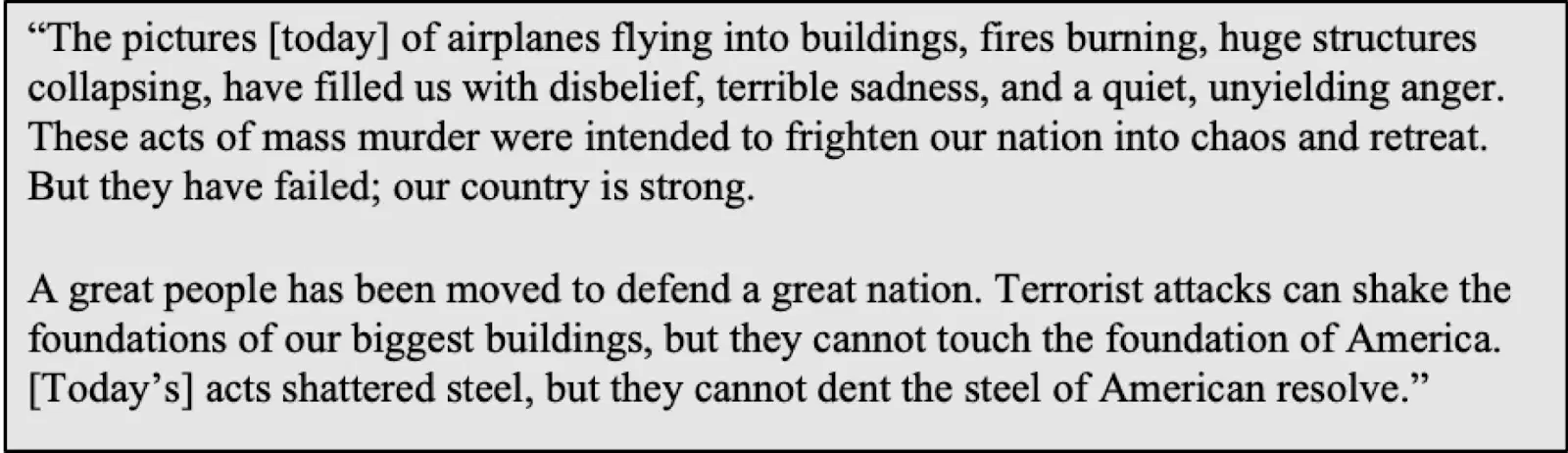
Using your knowledge from the unit, identify the American president who made the below statement.
a)
a. George H.W. Bush.
b)
b. George W. Bush
c)
c. Bill Clinton
d)
d. Barack Obama
39.
Which of the following buildings did NOT sustain damage in the 9/11 attacks?
a)
a. The Pentagon
b)
b. The U.S. Capitol
c)
c. World Trade Center South Tower
d)
d. World Trade Center North Tower.
40.
Which of the following was a reason given by the U.S. government for invading Iraq in 2003?
a)
a. The sarin attack in the subway in Tokyo, Japan.
b)
b. American hostages being held by Iraqi insurgents in Beirut, Lebanon.
c)
c. Weapons of Mass Destruction.
d)
d. The Ayatollah Khomeini's threats toward the State of Israel.
41.
The biggest group of people making up immigrant populations moving to the United States today are--
a)
a. Northern Europeans, such as Irish, Norwegians, or Germans.
b)
b. Southern European, such as Italians, Greeks, or Spanish.
c)
c. Asian or from Latin America, such as Chinese, Mexicans, or Haitians.
d)
d. There is no single "biggest group." Immigration to the United States has always been a melting pot with people coming in from all over the world.
42.
All of the following are issues that affect immigration policies in the United States today EXCEPT--
a)
a. The illegal drug trade.
b)
b. Actual strain or worry about strain on government services such as health care and education.
c)
c. The popularity of state bilingualism laws, commonly modeled after the language laws of Quebec, Canada (which make French and English the equally important and legal official languages of the province.)
d)
d. The desire of businesses to find employees for low-paying jobs.
43.
The Black Lives Matter movement initially started in response to--
a)
a. The killing of George Floyd, a Black man, who said "I can't breathe" while a white police officer kneeled on his neck for nearly 9 minutes.
b)
b. The death of Breonna Taylor, a 26-year-old Black woman who worked as an EMT and was killed by police gunfire in her own home.
c)
c. The acquittal of George Zimmerman in the killing of 17-year-old Black man Trayvon Martin.
d)
d. The killing of Michael Brown, Jr. by a white police officer in Ferguson, Missouri, which led to multiple protests, both peaceful and violent, over the following weeks.
44.

What was the primary goal of the Marshall Plan?

a)

To rebuild European economies after World War II

b)

To start the United Nations

c)

To provide military aid to Vietnam

d)

To establish NATO

45.

Which event directly led to the start of the Cold War?

a)

The fall of the Berlin Wall

b)

The Cuban Missile Crisis

c)

The end of World War II

d)

The Korean War

46.

What was the main reason for the Berlin Airlift?

a)

To supply Berlin with food and fuel during the Soviet blockade

b)

To evacuate American citizens from Berlin

c)

To drop atomic bombs on Soviet territories

d)

To transport troops to Berlin

47.

What was the primary strategy used by the United States to contain communism during the Cold War?

a)

Detente

b)

Brinkmanship

c)

The Marshall Plan

d)

Containment

48.

This political cartoon shows the conflict that existed between the United States and the Soviet Union. This event was called the _____________.

a)

American Revolution

b)

Manifest Destiny

c)

Cold War

d)

Civil War

49.
The Red Scare refers to
a)
fear of communism
b)
fear of the boogey man
c)
fear of Cuban invasion
d)
fear of Vietcong
50.

Which of the following was a major feature of the Cold War?

a)

Direct military conflict between the US and the USSR

b)

The formation of the United Nations

c)

The Space Race

d)

The signing of the Treaty of Versailles

51.

This leader was the emperor of Japan

a)

Hirohito

b)

Stalin

c)

Hitler

d)

Churchill

52.

Which leader ruled Germany during World War II?

a)

Stalin

b)

Mussolini

c)

Hitler

d)

None of the Above

53.

The leader of the Soviet Union during World War II was

a)

Churchill

b)

Hitler

c)

Stalin

d)

Mussolini

54.

What was the goal of the Lend-Lease Act?

a)

It stated the goal of the war.

b)

It allowed the United States to borrow money.

c)

It provided war materials to the Allied forces, Especially England.

d)

End the Depression

55.

What does “Blitzkrieg” mean?

a)

Lightening War

b)

Trench Warfare

c)

The use of U-boats on cargo ships

d)

None of the above

56.

The holocaust was...

a)

Germany’s war strategy

b)

An increase in German production during the war.

c)

The systematic killing of the Jewish population in Germany.

d)

None of the Above

57.

Why did the US eventually enter World War II?

a)

It’s allies were being defeated.

b)

The attack on Pearl Harbor

c)

Appeasement failed

d)

The Battle of Midway.

58.
What is the policy of giving into the demands of a country in the hopes to avoid a war?
a)
fascism 
b)
totalitarianism 
c)
appeasement 
d)
democracy 
59.

In the World War II poster, what did Rosie the Riveter

symbolize to Americans?

a)

American women who were placed in internment camps

b)

American women who fought for the right to vote

c)

American women who were opposed to the war

d)

American women who took jobs in defense plants

60.
What top-secret military project developed a new weapon & tested it at Los Alamos, NM?
a)
Manhattan Project
b)
Fat Man Project
c)
Operation Gamma
d)
Operation Gold
61.
The Office of Price Administration set up what system to prevent scarce food items from running out? 
a)
rationing
b)
price controls
c)
war bonds
d)
victory gardens
62.

[3] Which describes Pearl Harbor?

a)

June 4-7, 1942: US Navy defeats the Japanese Navy ending its naval supremacy- turning point of Pacific theater

b)

1942-1945: US strategy of taking one island at a time to build bases to put Japan in bombing range

c)

December 7, 1941: The attack of the US base in Pearl Harbor

d)

April 9, 1942: Japan tortured and force marched American Prisoners of War (POWs)

63.

Who served as president after FDR, and made the decision to drop the atomic bombs on Japan?

a)

Churchill

b)

Truman

c)

Lyndon B Johnson

d)

JFK

64.

Charles De Gaulle Led the resistance in which country?

a)

Nazi-Occupied France

b)

England

c)

Italy

d)

Canada