
Font size
 Worksheets
Unit 3: The Islamic World
Total questions: 49
Worksheet time: 29mins
How did the Umayyads change the caliphates?
The passed the caliphate down through the family line
They moved the capitol to Persia
They gave it to the Abbasids
They abolished it
How did Islam encourage learning?
it punished parents for not educating their children
building libraries and academies for studying
making all children go to school
giving people money for reading
What is calligraphy?
a pretty picture
an instrument
decorative writing
a pattern of shapes and lines resembling flowers and vines
Merchants were honored in the Islamic world.
True
False
What is the name for the Islamic law code?
Qur'an
The Sunnah
Five Pillars of Islam
Sharia
Constantinople survived the 1453 invasion of the Ottomans.
True
False
Women have equal status with men in Islamic society.
True
False
Muslim ruled reached as far west as Spain and as far east as Asia.
True
False
A souk is
a madrasa.
a group of traveling merchants.
a city.
a market place.

Which number correctly identifies the location of the region where Islam originated?
1
2
3
4

Which number correctly identifies the location of the Arabian Peninsula?
1
2
3
4
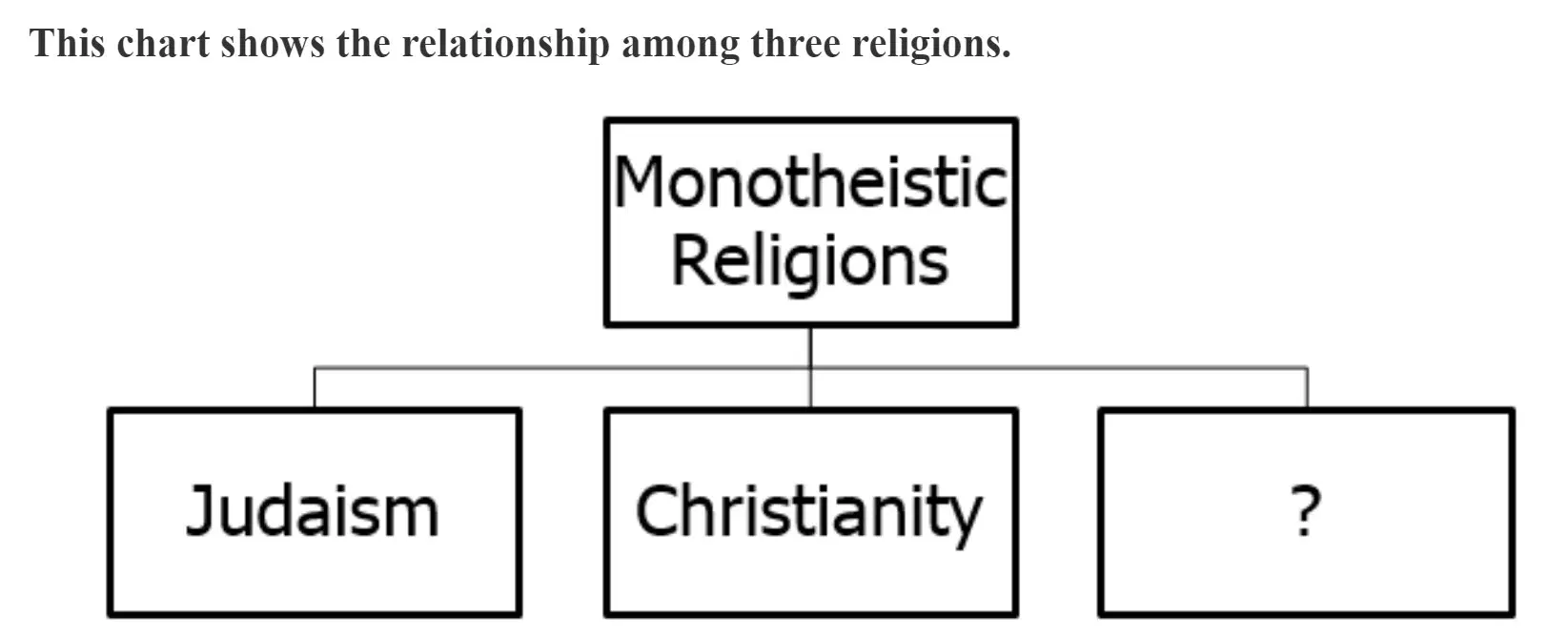
Which religion best completes the chart?
Muslimism
Islam
Hinduism
Taoism
Which are the two important sources of Islamic beliefs
Qur'an
The Five Relationships
Eightfold-paths
Sunnah
Mahabharata
The majority of Islam's teachings come from which historical figure?
Muhammad
Buddha
Confucius
Abraham
Which is considered one of the five pillars of Islam?
every member of the religion should make a pilgrimage to Mecca
every member of the religion must not eat beef
every member of the religion must dedicate their lives to memorizing the Qur'an
every member of the religion must fast during passover
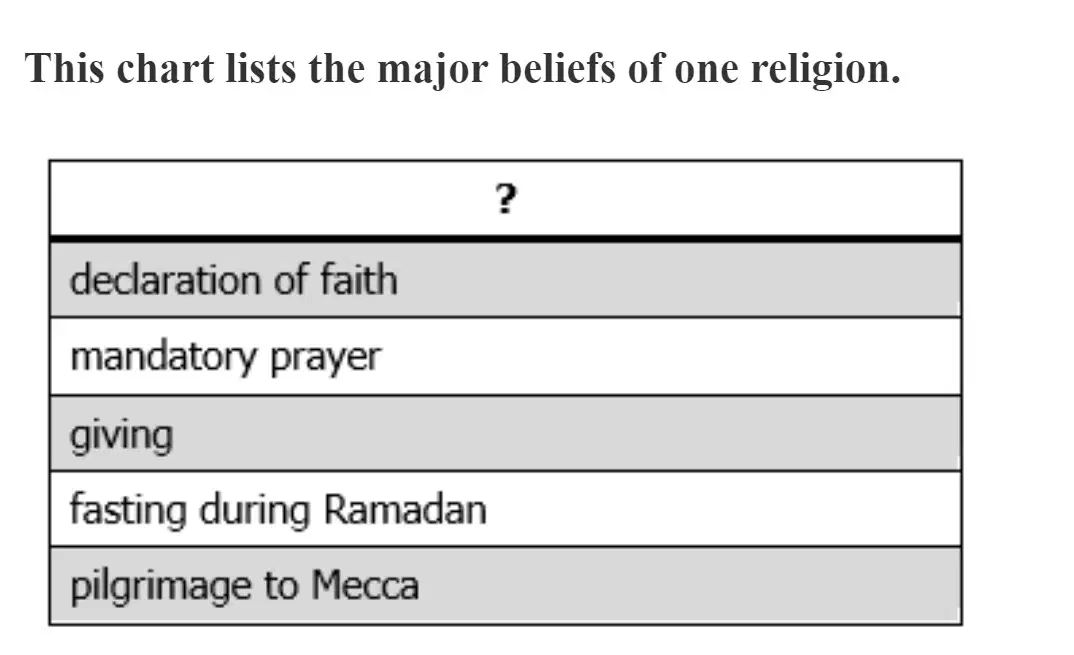
Which title completes this chart?
5 Pillars of Islam
The 10 Commandments
Four Noble Truths
Eightfold Path
Why is Muhammad a significant figure in Islam?
Muslims believe that he was the author of the Bible
Muslims believe that he was the last pharaoh of Egypt
Muslims believe that he was the last prophet of God
Muslims believe that he was the son of Jesus
How did the development of trade networks impact the development of Islam?
It blocked the spread of Islam outside of SW Asia
It forced Islam to remain in its traditional beliefs
It helped spread Islam
It increased influences of Confucianism on Islam

According to the map, how did the area under Muslim control change between 632 CE and 661 CE
the size was cut in half
it covered all of Africa
it spread into the Atlantic Ocean
It more than doubled in size
What was a major feature of the Golden Age of Muslim culture
isolationism from the Arab world
advancements in math and science
persecution of Jews
persecution of Buddhists
Which faith do Muslims follow?
Islam
Hinduism
Judaism
Catholicism
Islam was founded by:
Muhammad
Mehmed
Kublai Khan
Which of the following feature does Islamic art include:
Geometric Shapes
Mosaics
Images of Humans
Which of the following describes Islam:
Monotheism
Polytheism
An Arabic contribution to literature would be:
Thousand and One Nights
Arabia in the Light
Aladdin
A mosque is
a Muslim house of worship
a Jewish house of worship
a Christian house of worship
a Buddhist house of worship
Which of the following is not one of the five Pillars of Islam
pray five times a day
take a pilgrimage to Mecca
donate to charity
eat and drink during the holy month of Ramadan

Why was Arabia a “crossroads” location in the 600s?
It is where Islam, Christianity, and Judaism started.
People from many different cultures live there.
Trade routes linking Africa, Asia, and Europe run through it.
It is home to the mahi mahi people.

Which of the following empires ended the 1000 year old Byzantine empire?
The Abbasids
The Mughals
The Ottomans
The Safavids

What did Abu Bakr do for Islam?
he made pilgrimage a pillar
he set up Islamic law
he forced people to convert to Islam
He helped Islam survive after Muhammad's death

Tolerance was
the Muslim practice of converting others to Islam.
the Muslim practice of allowing only Christians to practice their religion.
the Muslim practice of allowing other people to practice their own religious beliefs.
a practice introduced to the Muslims by the Berbers.
Political leaders in Mecca rejected the teachings of Muhammad because
he fought to overthrow the government
they did not believe an angel had visited Muhammad.
they knew he had managed a caravan business.
he taught there was only one true God


Which of the following areas was not conquered by the Ottoman Muslims by the 1400s?
Austria
Mesopotamia
Egypt
North Africa
What two branches did Islam split into?
Sunni and Umayyads
Shia and Abbasids
Shia and Sunni
Sunni and Caliphs
What was the most important city in Arabia?
Mecca
Jerusalem
Medina
Mosul
Which of the following events happened second?
Muhammad received messages from God through the angel Gabriel
Muhammad meditated in a cave outside Mecca.
Muhammad taught that there was only one God.
Muhammad told people about the messages.
What are followers of Islam called?
Muslims
Bedouins
Byzantines
Arabs
What do Muslims believe the Qur'an contains?
record of Muhammad's words and actions
islamic law only
writings of Abu Bakr
flawless words of their God, Allah
Which of the following events happened first?
Muhammad received messages from God through the angel Gabriel
Muhammad meditated in a cave outside Mecca.
Muhammad taught that there was only one God.
Muhammad told people about the messages.

Who was Al-Khwarizmi?
He conquered the Byzantine empire.
He was the first caliph.
He designed the Kaaba.
He developed algebra
Why would you not see Statues in a Mosque?
They are old and fell apart.
art with people or animals imitates God's act of creation and is not allowed.
There isn't enough space for the large number of Muslims praying.
They were stolen by looters.
One of the greatest Muslim cities in the world was Codoba, and it was located in
Muslims and Christians disagree
that Moses existed.
that Jesus was the Messiah.
that Abraham existed.
that Jesus was a prophet.
Which of the following statements best describes the climate of the Arabian Peninsula?
It experiences heavy rainfall year-round due to its proximity to large bodies of water.
The climate varies greatly across the region, with hot summers and cold winters.
Most of the region is characterized by arid desert conditions with very little rainfall.
The Arabian Peninsula is known for its tropical rainforest climate and dense vegetation.

