
 Worksheets
Maths
Total questions: 150
Worksheet time: 38hrs 30mins

Name this image by its angles.
acute
obtuse
right
equiangular

Name this triangle by its sides.
scalene
isosceles
equilateral
obtuse

Name this triangle by its sides
scalene
isosceles
equilateral
acute

Name this triangle by its angles and sides.
acute, scalene
acute, isosceles
obtuse, equilateral
equiangular, equilateral

Name this triangle by its angle and sides.
acute, scalene
obtuse scalene
right, scalene
right, isosceles


If ∆DEF ≅ ∆ACB, then the part of ∆ACB that corresponds to angle F is :
Angle A
Angle B
Angle C
None of these
Which angle is included between the sides QR and PR of ∆PQR?
Angle R
Angle P
Angle Q
None of these
What is the side included between the angles M and N of ∆MNP?
MN
NP
MP
None of these
Under a given correspondence, two triangles are congruent if the three sides of the first are equal to the three corresponding sides of the other.
The above is known as :
SSS congruence of two triangles.
SAS congruence of two triangles.
ASA congruence of two triangles.
None of these.
Under a given correspondence, two triangles are congruent if two sides and the angle included between them of the first are equal to the corresponding sides and the angle included between them of the other triangle.
The above is known as :
SSS congruence of two triangles.
SAS congruence of two triangles.
ASA congruence of two triangles.
None of these.
Which of the following is NOT a congruency criteria for triangles ?
SSS
AAA
AAS
ASA
SAS

∆ABC ≅ ∆XYZ. By which critieria?
SAS
ASA
SSS
SSA
∆PRT ≅ ∆ZPQ. Then side PT will be equal to?
ZQ
QZ
ZP
PQ
Q1. Convert 5/100 into %. (Just writes the answer directly)
(a)
Q2. Convert 9/10 into %. (Just writes the answer directly)
(a)
Q3. Convert 20% to Fractions. (Just writes the answer directly)
(a)
Q4. Convert 650% to Fractions. (Just writes the answer directly)
(a)
Q5. Convert 7.5 into %. (Just writes the answer directly)
(a)
Q6. Convert 0.5 into %. (Just writes the answer directly)
(a)
Q7. Convert 100% to decimals. (Just writes the answer directly)
(a)
Q8. Convert 99% to decimals. (Just writes the answer directly)
(a)
Q1. What is 25% of 84?
(a)
40% of the 25 students in a class have black hair. How many students is this?
10
15
20
5
16 out of the 28 biscuits in a packet have cream centres. What percentage of the packet are cream-centred biscuits?
57%
58%
100%
30%
50% of $36
(a)
CHANGE THE FOLLOWING INTO PERCENT.
5/20
50%
20%
25%
76%
Calculate 10% of $40
40
4
10
A T-shirt costs $50. You get 10% off in the sales. How much do you pay for the T-shirt ?
$55
$10
$5
$45
The bottom of a fraction is called the?
numerator
denominator
Bottom

Convert to a decimal
0.67
6.7
0.067
6.07
Convert 19% to a fraction
19/100
9/20
1/9
9/50
Convert 30% to a fraction
Simplify as much as possible
30/100
15/50
3/10
1/3
Convert 25% to a fraction in its simplest form
2/5
25/100
5/20
1/4

Convert to a percentage
12%
25%
20%
50%
What is 1/4 as a decimal?
0.2
0.25
0.4
0.15

Express 0.2 as a percentage
20%
2%
0.2%
200%
35÷75
(a)
43÷121
(a)
118÷32
(a)
74÷16
(a)
2112÷72
(a)
12÷32
(a)
41÷5
(a)
91÷32
(a)
1110÷5
(a)
127÷32
(a)
20÷94
(a)
2110÷75
(a)
8÷92
(a)
43÷81
(a)
7÷51
(a)
Simplify to the lowest or simplest terms 1812
96
34
32
63
Simplify to the lowest or simplest terms 7221
You can't simplify
97
83
247
Simplify to the lowest or simplest terms 4832
128
86
32
64
2 31÷4832 =
3 65
623
3 21
921
Find the product of 71 X 75 *Remember 53 = 3/5
(a)

To find the product I can rewrite the expression as:
51 X 73
15 X 73
55 X 73

To find the product...
Numerator = (1x7). Denominator = (5x3)
Numerator = (5x7). Denominator = (1x3)
Numerator = (5x3). Denominator = (1+7)
Numerator = (5x3). Denominator = (1x7)

The last step is...
7 ÷ 15 = 2 71
15 ÷ 7 = 2 72
15 71 7 = 2
7 ÷ 15 = 2 72

To find the quotient the next step is...
43÷32
312÷22
314÷23
315÷23

To find the quotient the next step is...
KEEP the 2nd fraction, FLIP the 1st, and CROSS to multiply.
KEEP the 2nd fraction, FLIP the 1st, and CROSS to divide.
KEEP the 1st fraction, FLIP the 2nd, and CROSS to multiply.
KEEP the 1st fraction, FLIP the 2nd, and CROSS to divide.

The quotient is:
642
928
926
628

928 needs to be converted to...
2 910
4
3 97
3 91

The quotient is...
Three and one nine
Three and one ninth
Three and one nineth
Third and one ninth
I know how to + − × ÷ fractions
I am a master
I need more practice with + − fractions
I need more practice with × ÷ fractions
Fractions make no sense. Please help.

Convert the percentage to fraction.


Convert the percentage to fraction.


Convert the percentage to fraction.


Convert the percentage to fraction.


Convert the percentage to fraction.


State 50% as a fraction in it simplest form
41
10050
21
105
State 30% as a fraction in its simplest form.
31
10030
1030
103
State 25% as a fraction in its simplest form.
10025
51
41
251
State 20% as a fraction in its simplest form.
41
103
51
1020
State 75% as a fraction in its simplest form.
21
43
41
53
State 70% as a fraction in its simplest form.
107
1007
54
1070
State 40% as a fraction in its simplest form.
1040
104
52
51
State 90% as a fraction in its simplest form.
1009
10090
1090
109
State 80% as a fraction in its simplest form.
54
801
51
108
State 60% as a fraction in its simplest from.
106
41
53
43
State 1% as a fraction in its simplest form.
1
1001
101
1100
State 5% as a fraction in its simplest form.
51
201
1005
105
State 12.5% as a fraction in its simplest form.
81
12.51
10012.5
100125
State 3331% as a fraction in its simplest form.
333
10033
31
331
State 6632% as a fraction in its simplest form.
32
366
10066
661
State 10% as a fraction in it simplest form.
101
10010
1001
110

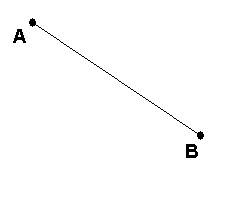
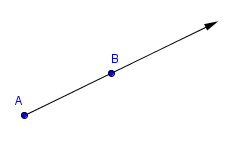
(The whole thing, not just the points)


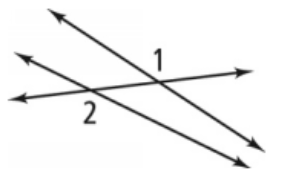
∠1 and ∠2 are __.
Alternate Interior Angles
Alternate Exterior Angles
Same-side Interior Angles
Corresponding Angles
None of these

∠8 and ∠6 are __.
Alternate Interior Angles
Alternate Exterior Angles
Same-side Interior Angles
Corresponding Angles
None of these
∠3 and ∠7 are ___.
Alternate Interior Angles
Alternate Exterior Angles
Same-side Interior Angles
Corresponding Angles
None of these
∠3 and ∠2 are ___.
Alternate Interior Angles
Alternate Exterior Angles
Same-side Interior Angles
Corresponding Angles
None of these
∠7 and ∠5 are ___.
Alternate Interior Angles
Alternate Exterior Angles
Same-side Interior Angles
Corresponding Angles
None of these
∠4 and ∠8 are ___.
Alternate Interior Angles
Alternate Exterior Angles
Same-side Interior Angles
Corresponding Angles
None of these
∠5 and ∠6 are ___.
Alternate Interior Angles
Alternate Exterior Angles
Same-side Interior Angles
Corresponding Angles
None of these
∠1 and ∠5 are ___.
Alternate Interior Angles
Alternate Exterior Angles
Same-side Interior Angles
Corresponding Angles
None of these

∠1 and ∠2 are ___.
Alternate Interior Angles
Alternate Exterior Angles
Same-side Interior Angles
Corresponding Angles
None of these
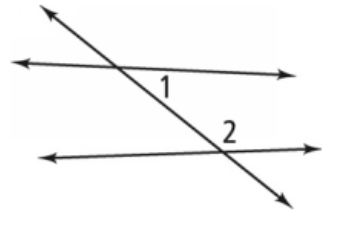
∠1 and ∠2 are ___.
Alternate Interior Angles
Alternate Exterior Angles
Same-side Interior Angles
Corresponding Angles
None of these
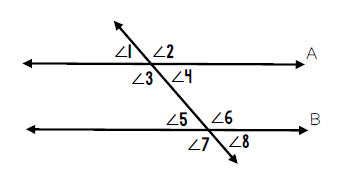
Alternate exterior angles
Alternate interior angles
Vertical angles
Corresponding angles
Alternate exterior angles
Alternate interior angles
Vertical angles
Corresponding angles
Alternate exterior angles
Alternate interior angles
Vertical angles
Corresponding angles

∠1 and ∠2 are __.
Alternate Interior Angles
Alternate Exterior Angles
Same-side Interior Angles
Corresponding Angles
None of these
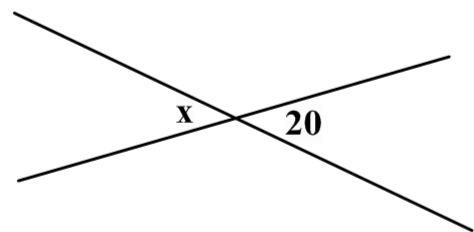
Which of the angle pairs below is a pair of alternate interior angles?
∠7 and ∠5
∠3 and ∠7
∠4 and ∠8
∠1 and ∠3
Which of the angle pairs below is a pair of corresponding angles?
∠8 and ∠6
∠2 and ∠6
∠2 and ∠3
∠8 and ∠5
∠1 and ∠2 are ___.
Alternate Interior Angles
Alternate Exterior Angles
Same-side Interior Angles
Corresponding Angles
None of these
What are complementary angles?
Angles that add up to 180°
Angles that add up to 90°
Angles that are equal to each other
Angles that are opposite of each other when lines intersect.
What are supplementary angles?
Angles that add up to 180°
Angles that add up to 90°
Angles that are equal to each other
Angles that are opposite of each other when lines intersect
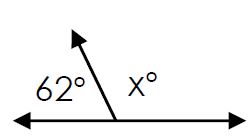


What it the measurement for angle 1?
140o
180o
40o
160o
An angle which is complement of itself is___
90°
60°
45°
55°

An angle whose magnitude lies between 180⁰ and 360⁰ is called_______
Obtuse Angle
Acute angle
Reflex angle
Complete angle
What is the angle sum of a triangle?
180°
90°
360°
270°
What are the three angles in an equilateral triangle equal to?
30°, 60°, 90°
45°, 45°, 90°
60°, 60°, 60°
35°, 55°, 90°
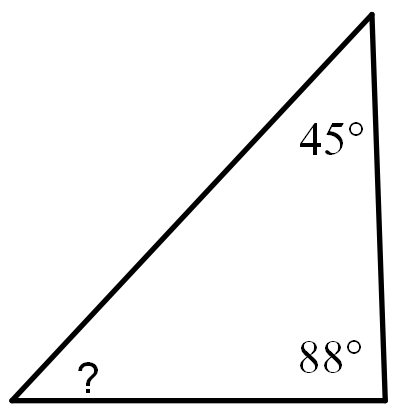
What is the size of the missing angle?
57°
53°
133°

Find the size of the missing angle.
43°
55°
180°
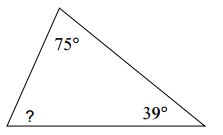
What is the size of the missing angle?
139°
66°
138°
116°

What is the size of the missing angle?
95°
85°
35°
45°
Which of the following are angles in a triangle?
60°, 60°, 61°
90°, 45°, 45°
100°, 50°, 50°
90°, 90°, 80°

What is the size of the missing angle?
8°
58°
122°
64°

What is the size of the missing angle?
26°
36°
85°
144°

Find the size of the missing angle.
90°
10°
130°
50°
The exterior angle of a triangle is equal to the sum of ____________.
two interior Opposite angles
two exterior angles
sum of all the angles
all exterior angles


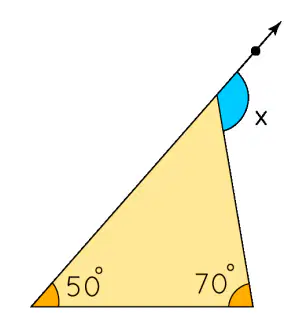
Find the value of x using the following triangle.
120
50
70
130
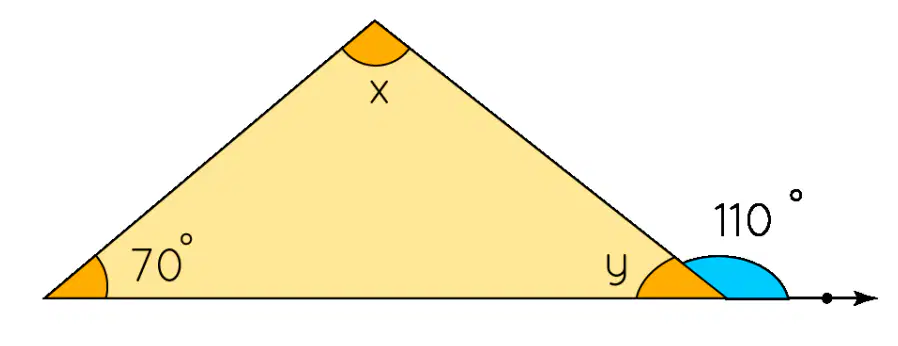
Find the value of x and y using the following figure..
x= 40 , y = 70
x = 50, y = 60
x = 30, y = 80
none
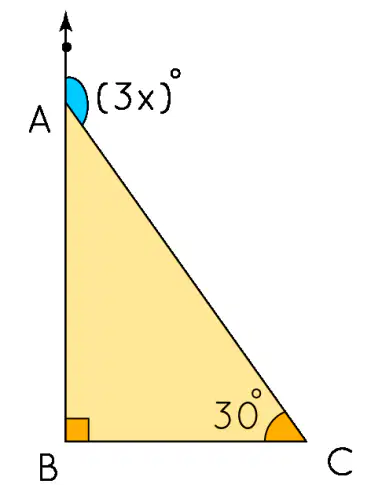
Find the value of x in the following triangle.
30
40
70
90
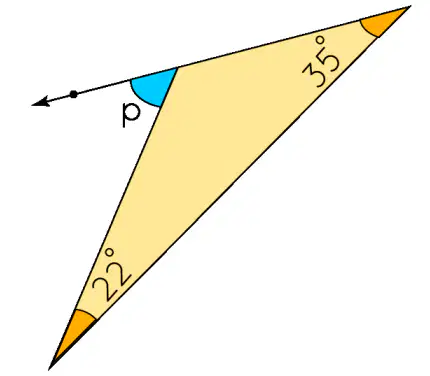
Find the value of p using the following triangle.
63
52
57
55
Which of the following statement is true about exterior angle theorem?
a) The sum of two interior angles in a triangle is equal to the third exterior angle.
b) The sum of two interior angles in a triangle is equal to any exterior angle of the triangle.
Option a
option b
none
both

