
 Worksheets
As physcs
Total questions: 100
Worksheet time: 2hrs 0mins
Rutherford's original aim of the experiment was to verify the Plum Pudding Model for the atom.
Which of the following results did Rutherford expect to observe when he first conducted his Gold Foil experiment based on the Plum Pudding Model?
When the experiment was conducted, some key observations were however made. Which of the following are the observations?
A very small fraction (~ 1 in 8000) of the alpha particles passed through the gold foil undeviated.
The observations made in the Rutherford's Alpha Scattering experiment produced new insights into the structure of the atom.
Which conclusions can be drawn from the results of the experiment?

[UCLES N95/I/28]
In repeating Rutherford's α-particle scattering experiment, a student used the apparatus shown, in a vacuum, to determine n, the number of α-particles incident per unit time on a detector held at various angular positions θ.
Which graph best represents the variation of n with θ?


[UCLES N05/I/39]
Two α-particles with equal energies are fired towards the nucleus of a gold atom.Which diagram best represents their paths?


What is the mass number of 2656Fe ?
(a)

The nucleus of one of the isotopes of nickel is represented by 2860Ni .
Which line in the table describes a neutral atom of this isotope?

[CIE 9702 Nov 2002 P1 Q38]
The numbers of protons, neutrons and nucleons in three nuclei are shown.
Which nuclei are isotopes of the same element?
X and Y
X and Z
Y and Z
None
[CIE 9702 Nov 2003 P1 Q40]
A nickel nucleus 2859Ni can be transformed by a process termed K-capture. In this process the nucleus absorbs an orbital electron.
If no other process is involved, what is resulting nucleus?
2858Ni
2758Co
2759Co
2959Cu
[CIE 9702 Nov 2007 P1 Q37]
What need not be conserved in nuclear reactions?
[CIE 9702 Nov 2002 P1 Q38]
In a nuclear reaction, energy equivalent to 10-11 kg of matter is released.
The energy released is approximately
4.5 × 10⁻⁶ J
9.0 × 10⁻⁶ J
3.0 × 10⁻³ J
4.5 × 10⁵ J
9.0 × 10⁵ J
[ CIE 9702 Nov 2001 P1 Q29]
High energy alpha-particles can transform Nitrogen -14 to Oxygen-17: 714N+24He → 817O +11H
The sum of the rest masses of the nitrogen and helium nuclei is 18.0006 u.
The sum of the rest masses of the oxygen and hydrogen nuclei is 18.007 u.
The energy equivalent of 0.001 u is 1 MeV.
What do the data show?
A nuclear decay results in a particle of mass m1 and another particle of mass m2, both moving away from each other in opposite directions.
If E is the total energy of the two particles, what is the energy associated with mass m1 ?
(Assume the parent nucleus to be stationary prior to the decay.)
m2m1E
m1m2E
m1+m2m1E
m1+m2m2E
E

Consider the following process :
82206Pb→ 80202Hg + 24He
Given the rest mass of the reactants and products, which of the following statements is correct?
Lead is unstable against α -decay as the mass of 82206Pb is smaller than the sum of the masses of 80202Hg and 24He .
The helium 24He has a mass of 4.0028 u. The mass of a proton is 1.0076 u and that of a neutron is 1.0090 u.
What is the binding energy per nucleon of helium?
[UCLES N2022 P1 Q39]
The binding energy (B.E.) per nucleon is a useful measure of the stability of a nucleus.
Which graph shows how the B.E. per nucleon varies with the nucleon number (A)?


[CIE J89/I/27]
The diagram shows a graph of the binding energy per nucleon for a number of naturally occurring nuclides, plotted against their mass numbers.
Which of the following statement(s) is/are a correct deduction from the graph?
Of the nuclides plotted, 12H is the least stable.
1827Al will not spontaneously emit an alpha particle to become 1123Na .
93238U is the stable end-point of a number of radioactive series.
Two deuterium nuclei fuse together to from a Helium-3 nucleus, with the release of neutron. The reaction is represented by 12H + 12H → 23He + 01n +energy The binding energies per nucleon of the particles in the reaction are 12H : 1.09 MeV and 23He : 2.54 MeV
How much energy is released in this reaction?
What is the amount of current flowing through an electric press, if the amount of charge passing through a conductor in 10 minutes is 300 0 C?
30 A
.3 A
.5 A
5 A
A wire of length /, made of material resistivity ρ is cut into two equal parts. The resistivity of the two parts are equal to,
(a)
A battery of 10 volt carries 20,000 C of charge through a resistance of 20 Ω. The work done in 10 seconds is
2 × 10 5 Joule
2 × 10 3 Joule
2 x 10 4 Joule
2 x 10² Joule
Two devices are connected between two points say A and B in parallel. The physical quantity that will remain the same between the two points is
Current
Voltage
Resistance
Resistivity

Which device or devices could be removed without breaking the electric circuit?
Only the bulb
Only the switch
The battery and the switch
The bulb and the switch
The shock you sometimes feel when you touch a metal doorknob on a dry day is electric ________.
Circuit
Current
Discharge
Resistance
What is Newton's first law of motion?
An object will remain at rest or in uniform motion in a straight line unless acted upon by an external force.
An object will accelerate if no force is acting on it.
An object will stop moving if no force is acting on it.
An object will change direction if no force is acting on it.
State Newton's second law of motion.
F = mv
F = m/a
F = 1/2ma
F = ma
Explain Newton's third law of motion with an example.
When you jump, the ground exerts a force on you, but you don't exert a force back on the ground
When you throw a ball, the ball exerts a force on you in the opposite direction
When you sit in a chair, your body exerts a downward force on the chair. In response, the chair exerts an equal and opposite force upward on your body, supporting you.
When you push a wall, the wall pushes back with the same force
Define momentum in physics.
The product of an object's mass and velocity.
The energy of an object
The force acting on an object
The distance an object travels
What is impulse in the context of physics?
Impulse is the distance an object travels
Impulse is the energy stored in an object
Impulse is the rate of change of momentum
Impulse is the product of force and the time over which the force acts on an object.
Describe the concept of collisions in terms of conservation of momentum.
Momentum is only conserved in elastic collisions
Collisions have no impact on momentum
The concept of collisions in terms of conservation of momentum states that the total momentum before a collision is equal to the total momentum after the collision.
Momentum is conserved only if the objects are at rest
Explain the principle of conservation of kinetic energy in collisions.
The principle of conservation of kinetic energy states that in a collision, the total kinetic energy of the system remains constant if no external forces are involved.
The principle of conservation of kinetic energy is only valid for objects of equal mass
The principle of conservation of kinetic energy only applies to elastic collisions
In collisions, kinetic energy is always converted into potential energy
How are relative velocities of approach and separation calculated in physics?
By adding the velocities of the two objects
By dividing the velocities of the two objects
By multiplying the velocities of the two objects
By considering the velocities of the two objects with respect to a common reference frame. The relative velocity of approach is the sum of the velocities of the two objects if they are moving towards each other, while the relative velocity of separation is the difference of their velocities if they are moving away from each other.
In a collision between two objects, when is momentum conserved?
When there are no external forces acting on the system.
When the objects are moving at different speeds
When the objects have different masses
When the collision is perfectly elastic
What happens to the kinetic energy in an elastic collision?
It remains constant
It increases
It decreases
It becomes zero
select two correct answers that show:
Average speed?
s = d/t
v = s/t
speed = distance/time
velocity = speed/time
Acceleration?
a = (v-u)/t
d = s/t
v = s/t
F= m/a
v = Δϰ/Δt?
average speed
force needed
average velocity
acceleration
Which formulae shows the relationship between Force, mass and acceleration?
W = mxg
F = mxa
p=mxv
ρ=mxV
Which formulae shows the rate in change of mometum?
F= mxa
F= mxv - mxu / t
F= mxg
F= Fxχ
Formula for Power?
ΔE = Fxd
KE = 1/2mxv2
W = ΔE/t
GPE = mxgxh
ΔE = Fxd?
work = force x distance
Power = Work/ time
Pressure = height x density x gravity
Kinetic energy = 1/2 mass x velocity²
Which is the correct formula for energy efficiency?
Efficiency = total input energy / useful energy output x 100
Efficiency = total input energy / useful energy output / 100
Efficiency = total input energy / useful energy output / 100
Efficiency = useful energy output / total input energy. x100
Select the two that show Refractive index of a material
Refractive index = speed of light in vacuum x speed of light in material
Refractive index = speed of light in vacuum / speed of light in material
n = v1 / v2
n = v1 x v2
Select the two that show the relationship between wave speed, frequency and wavelength
c = f x λ
Wave speed = frequency x wavelength
Wave speed = frequency / wavelength
c = f / λ
Two formulae that show the relationship between Current, charge and time
Current = charge x time
current = charge / time
I = Q x t
I = Q / t
Which will calculate the Power (W) in a circuit?
V = I x R
P = I x V
ΔE = I x V x t
I = Q / t
Which is the correct formula for Energy Transferred in a circuit?
ΔE = I x V x t
ΔE = I / V x t
ΔE = I x V / t
ΔE = I x V

Is this..........
Alpha decay
Beta decay

Is this ......
Alpha decay
Beta decay
Which formulae shows Hooke's Law?
F= mg
F= ma
F = kx
GPE = mgh
What does the relationship between mass, gravity and height show?
Resistance in a circuit
Current in a circuit
Gravitational Potential Energy
Extension of a spring
What is the unit of Work?
Newtons
Joules
Metres
Kg
What is the relationship between moment, force and distance? SELECT TWO CORRECT ANSWERS
M = F x d
M = F / d
d = M x F
F = M/d
What do ohms measure?
Current
potential difference
resistance
power
A resultant force of 4.0N acts on an object of mass 0.50 kg for 3.0 seconds.
What is the change in velocity caused by this force?
4.0 m / s
6.0 m / s
12 m / s
24 m / s
Which property of an object cannot be changed by a force?
mass
motion
shape
size
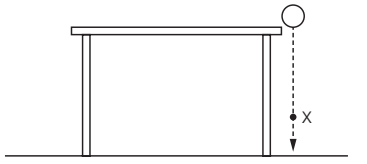
A ball is dropped from a table-top. Air resistance may be ignored.
Which row describes the velocity and the acceleration of the ball at point X
acceleration = constant; velocity = constant
acceleration = constant; velocity = increasing
acceleration = increasing; velocity = constant
acceleration = increasing; velocity = increasing

When the velocity of the car is constant, the force of friction on it is
zero
greater than the driving force
smaller than the driving force
the same size as the driving force
Which are the units for acceleration
m/s
m/s2
s/m
m/s3
The cyclist accelerates at 1.4 m/s2.
The mass of the cyclist and bicycle is 60 kg.
Calculate the resultant force.
(a)


The unit of force is...
m/s
m
N
kg
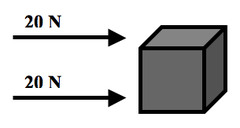
What is the resultant force?
40 N, Left
0 N, Balanced
400 N, Right
40 N, Right

What is the resultant force?
400 N, Up
400 N, Down
800 N, Up
800 N, Down

What is the resultant force?
17 N, Left
6N, Right
11N , Left
12N, Left

What is the resultant force?
40N, Left
40N, Right
0N, Balanced
75N, Right
Work is
having a job
movement
energy transfer
energy transfer to an object
The ( ) the force the ( ) work is done
less, more
smaller, more
bigger, more
bigger, less
if something is shifted a long way then there is ( ) work is being done
less
more
same
none
If the object does not move then what is happening
nothing
work
power
no work is being done on the object
the object has to be shifted or rearrange for work to occur
true
false
what is the two things that need to occur for work to have been done?
force and movement
movement and direction
constant force and power
power and work
for work to occur the object has to have a constant force causing the object to move in the same direction
False
True
____ is one of the best reflectors of light.
Gold
Silver
Brass
Aluminium
Reflection of light have___laws.
1
2
3
4
When light is available which image is formed.
Real
Virtual
Erect
If an object is placed at a distance of 10 cm in front of a plane mirror how far would it be from its image.
10cm
20cm
30cm
40cm
Which mirror has a wider field of view?
Convex
Concave
Plane
Which equation related to ohm's law?
V=IR
R=V/I
I=V/R
All of the above
When an obj is placed at focus then which type of image is formed?
Real
Virtual
Inverted
Both (1)and (3)
A ray of light is incident on a plane mirror at an angle of 30°.what is the angle of refrection?
10°
20°
30°
40°
Which type of image formed by plane mirror?
Same size
Erect
Virtual
All of the above
Real image is always
Erect
Real
Inverted
Virtual

Electromotive Force (e.m.f.) is defined as...
energy passing through a power source
energy needed to power up a circuit per unit charge
energy converted to electrical energy per unit charge
energy converted from electrical to other forms per unit charge

Potential difference is the energy converted from electrical energy to other forms per unit charge.
CORRECT
WRONG

Suggest an equation which shows the relationship between the e.m.f. (E), terminal p.d. (VR) and lost volts (Vr).

Using V = IR, suggest an expression relating the e.m.f (E), current in the circuit (I), resistance of the resistor (R) and the internal resistance of the cell (r).
A student wants to investigate the value of the e.m.f. of a cell.
A graph of terminal p.d. against current is plotted.
Which of the following are true?
E = y-intercept
E = gradient
E = gradient/current
E = Ir + IR

