wayground logo

Free Printable Worksheets

Font size

S
M
L
XL
Worksheets

Review Periodic Motion and Mechanical Waves

Total questions: 100

Worksheet time: 2hrs 46mins

Name
Class
Date
1.

Which type of harmonic motion refers to oscillatory motion with decreasing amplitude?

a)

critically damped

b)

overdamped

c)

simple

d)

underdamped

2.

What does a wave carry with it as it travels through a medium?

a)

particles

b)

wind

c)

energy

d)

water

3.

Which of these is not a characteristic of a wave?

a)

period

b)

frequency

c)

velocity

d)

mass

4.

Simple Harmonic Motion is a type of periodic motion where the restoring force is _________ to the displacement of the body from its equilibrium position.

a)

equivalent

b)

proportional

c)

inversely proportional

d)

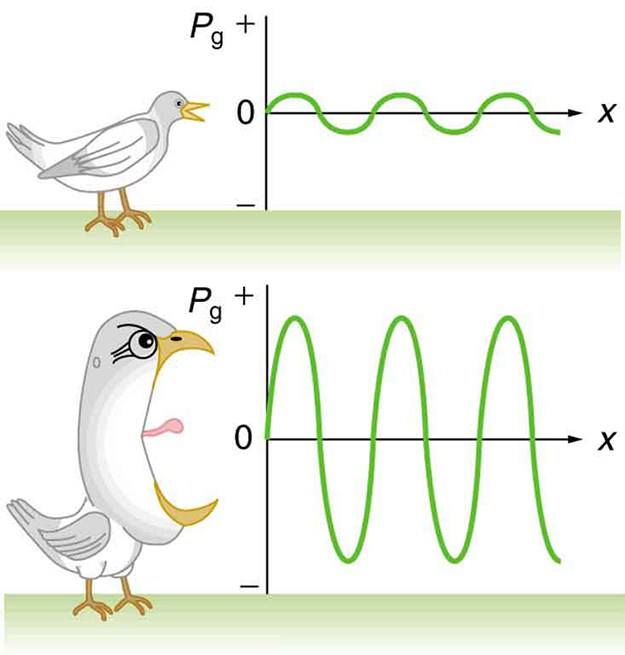
not equal

5.

In the equation, 

Fs=kxF_s=-kx  , Fs means:

a)

Static Force

b)

Dynamic Force

c)

Restoring Force

d)

Normal Force

6.

The force constant k is measure of ________ of the spring.

a)

stiffness

b)

hardness

c)

malleability

d)

composition

7.

At which position is the speed of a particle executing SHM greatest?

a)

It's extreme position

b)

at its equilibrium position

c)

at its maximum displacement

d)

somewhere between amplitude and equilibrium position

8.

The wavelength of a sinusoidal wave divided by the speed of propagation refers to what quantity?

a)

angular frequency

b)

frequency

c)

period

d)

wave

9.

Which diagram below does not represent a periodic wave?

a)
b)
c)
d)
10.

Amplitude is the _________ displacement of a vibrating particle from its equilibrium position.

a)

variable

b)

minimum

c)

constant

d)

maximum

11.

A/an ___________ is a wave in which the disturbance is parallel to the direction of propagation.

a)

longitudinal wave

b)

transverse wave

c)

aperiodic wave

d)

seismic wave

12.

Angular frequency is commonly express in __________.

a)

meters per second

b)

radians per second squared

c)

meters per second squared

d)

radians per second

13.

((y(x,t)=Asin(kx±ωt+ϕ))\left(\left(y(x,t)=A\sin⁡(kx±ωt+ϕ\right)\right)  
In the equation above,  ϕ\phi  is the  ________?

a)

angle of displacement

b)

phase constant

c)

frequency constant

d)

angular velocity

14.

Write true or replace the underlined word:


Period is the number of cycles per unit of time from its equilibrium position.

(a)  

15.

Write true or replace the underlined word:


Gravity is a force that causes body to accelerate towards the earth.

(a)  

16.

Write true or replace the underlined word:


Equilibrium refers to the position assumed by the body when it is not vibrating.

(a)  

17.

Write true or replace the underlined word:

Frequency is the maximum displacement of body from its equilibrium position.

(a)  

18.

Write true or replace the underlined word:


A simple pendulum is another mechanical system that exhibit periodic motion.

(a)  

19.

Write true or replace the underlined word:


Mechanical waves can travel through a vacuum.

(a)  

20.

Write true or replace underlined word.


The period is not dependent of the mass of the bob.

(a)  
21.
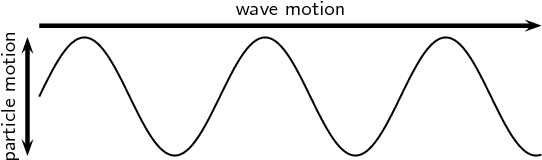
What kind of wave is pictured below?
a)
compressional wave
b)
transverse wave
c)
sound wave
d)
mechanical wave
22.
Waves are a transfer of what?
a)
Heat
b)
Light
c)
Energy
d)
Food
23.
Amplitude reflects the amount of ____________________ in a wave.
a)
energy
b)
compression
c)
rarefaction
d)
speed
24.
The units for frequency are measured in _____________.
a)
hertz
b)
seconds
c)
m/s
d)
m
25.
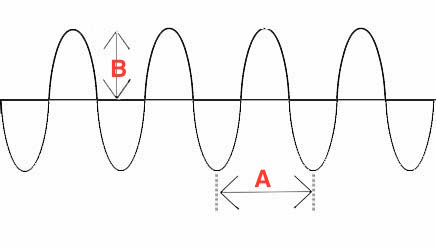
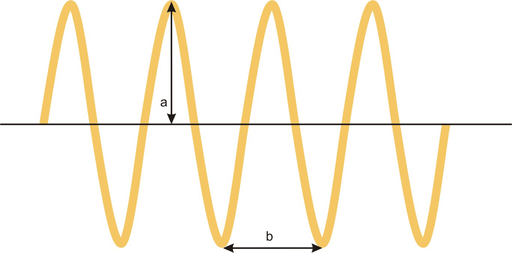
What property of this wave is represented by the letter "A"
a)
amplitude
b)
crest
c)
trough
d)
wavelength
26.
The highest point on a wave is:
a)
the crest
b)
the trough
c)
the top
d)
the coast 
27.
The lowest point on a wave is the:
a)
Amplitude
b)
Crest
c)
Trough
d)
Wavelength
28.
The number of wavelengths that pass a point each per second is:
a)
frequency
b)
period
c)
longitudinal 
d)
transverse wave 
29.
The type of waves that require medium to pass:
a)
Mechanical Waves
b)
Electromagnetic Waves
30.
When the frequency of a wave increases, what happens to the wavelength?
a)
The wavelength is not directly affected by the frequency of a wave.
b)
The wavelength increases.
c)
The wavelength decreases.
d)
More specific information is needed to form a conclusion about the wavelength.
31.
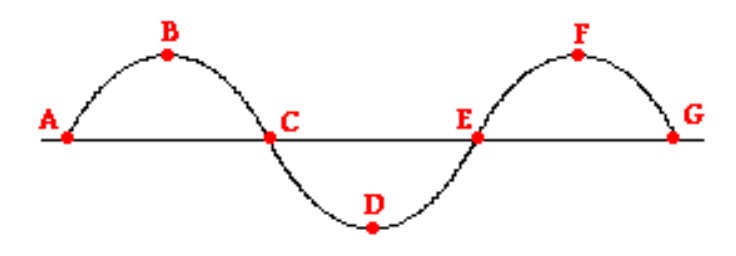
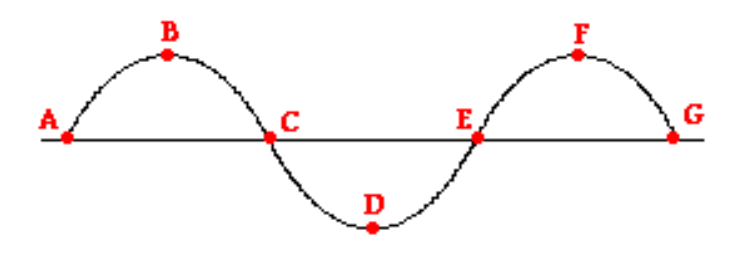
Which letter(s) represent the trough of the wave?
a)
A
b)
B & D
c)
D
d)
C & G
32.
Which letter(s) represent the crest of the wave?
a)
A
b)
B & D
c)
B & F
d)
F
33.
Which of the following can sound travel through?
a)
solid
b)
liquid
c)
gas
d)
all of the above
34.
What is the speed of a sound wave that has a frequency of 250 hertz and a wavelength of 8 meters? 
a)
31 m/s
b)
250 m/s
c)
2000 m/s
d)
5280 m/s
35.
The SI unit for frequency is ________.
a)
m
b)
m/s
c)
hertz
d)
s
36.
A wave in which the particles of the medium move perpendicularly to the direction the wave is traveling
a)
A. surface wave
b)
B. transverse wave
c)
C. electromagnetic  wave
d)
D. longitudinal wave
37.
A wave in which the particles of the medium vibrate parallel to the direction of the wave motion
a)
A. mechanical wave
b)
B. surface wave
c)
C. longitudinal wave
d)
D. wave
38.
How many waves are in this wave chain?
a)
6
b)
3
c)
4
d)
5
39.
 A wave has frequency of 50 Hz and a wavelength of 10 m. What is the speed of the wave?
a)
500 m/s
b)
50 m/s
c)
5 m/s
d)
0.5 m/s
40.
A wave has wavelength of 10 m and a speed of 340 m/s. What is the frequency of the wave?
a)
34 m/s
b)
3400 Hz
c)
3400 m/s
d)
34 Hz
41.
If you want to change the pitch of a sound, you have to change the ___
a)
frequency
b)
amplitude
c)
speed
d)
volume
42.
This is the unit used to measure the volume of a sound. 
a)
Decibel
b)
Medium
c)
Vibration
d)
Oscilloscope
43.
This is what you get when sound waves are reflected, or bounce back, off of a hard surface.
a)
Amplitude
b)
Pitch
c)
Volume
d)
Echo
44.
The speed of a sound wave depends on
a)
the frequency
b)
the medium
c)
both air temperature and medium
d)
the air temperature
45.
What is a pitch?
a)
highness or lowness of a sound
b)
the intensity of a vibration
c)
the amplitude of the sound wave
d)
volume of sound
46.

Bats use ________ to locate mosquitoes in the air.

a)

solar

b)

ecology

c)

echolocation

d)

refraction

47.
The number of wavelengths that pass a point each second
a)
frequency
b)
wavelength
c)
pitch
d)
amplitude
48.
A part in a longitudinal wave where the particles are spread apart
a)
compression
b)
rarefaction
c)
crest
d)
trough
49.
The part of a longitudinal wave where the particles of the medium are close together.
a)
rarefaction
b)
compression
c)
crest
d)
trough
50.
A disturbance that travels through a medium as a longitudinal wave
a)
sound
b)
wavelength
c)
pitch
d)
frequency
51.
The number of wavelengths that pass a point each second
a)
frequency
b)
wavelength
c)
pitch
d)
amplitude
52.
Material (matter) through which a wave travels
a)
medium
b)
Doppler Effect
c)
sound
d)
pitch
53.
When a sound is louder what measurement gets bigger?
a)
Frequency 
b)
Amplitude 
c)
Wavelength 
d)
Crest
54.
What is B?
a)
crest
b)
trough
c)
compression
d)
rarefaction
55.
Why is the school library covered with carpet?
a)
So everyone can make a lot of noise
b)
to help absorb sounds to keep it quiet
c)
because it looks good
d)
to help absorb sounds so it can stay noisy
56.

It is the reflected sound.

a)

Echo

b)

Interference

c)

Diffraction

d)

Refraction

57.

It is the highness or lowness of a sound.

a)

Pitch

b)

Intensity

c)

Timbre

d)

Doppler effect

58.

It is the change in wave frequency caused by a moving wave source.

a)

Pitch

b)

Intensity

c)

Timbre

d)

Doppler effect

59.

It is the inducing of vibrations of a natural rate by a vibrating source having the same frequency.

a)

Refraction of sound

b)

Diffraction of sound

c)

Interference

d)

Resonance

60.

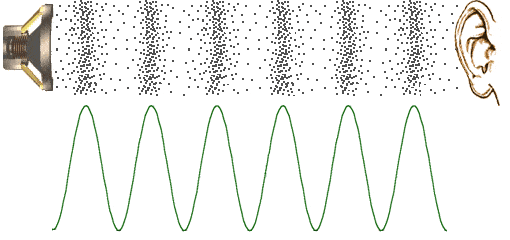
What kind of wave is in the image?

a)

transverse waves

b)

longitudinal waves

61.

What kind of wave is in the image?

a)

transverse waves

b)

longitudinal waves

62.

What is a general definition of wave interference?

a)

When a wave bounces off an object

b)

When more than on wave meet and interact in the same medium

c)

When a wave bends around a corner

d)

When a wave creates static

63.

What type of interference is being shown in the picture?

a)

Constructive

b)

Destructive

64.

What type of interference is occurring in the picture?

a)

Constructive

b)

Destructive

65.

How can resonance break an object?

a)

forcing an object to vibrate at its natural frequency for a short time

b)

forcing an object to vibrate at different frequencies for a short time

c)

forcing an object to vibrate at different frequencies for a longtime

d)

forcing an object to vibrate at its natural frequency for a long time

66.

What type of energy does a sound wave have?

a)

Mechanical

b)

Radiant

c)

Electrical

d)

Sound

67.

True or False: Sound needs a medium.

a)

True

b)

False

68.

Sound waves are also known as ----- waves.

a)

Compression

b)

Longitudinal

c)

Neither

d)

Both longitudinal and compression

69.

The measure of the amount of energy in a wave is ----

a)

Wavelength

b)

Hertz

c)

Frequency

d)

Amplitude

70.

The speed of sound depends on these two things:

a)

The type of medium and the temperature of the medium

b)

Speed of the medium and temperature of the medium

c)

Temperature of the medium and sound of the medium

d)

None of the above

71.

Sonar and echolocation use ----- to detect objects under water.

a)

Refraction

b)

Reflection

72.
Material (matter) through which a wave travels
a)
medium
b)
Doppler Effect
c)
sound
d)
pitch
73.

happens when a wave bounces back after hitting a barrier

a)

reflection

b)

refraction

c)

diffraction

d)

interference

74.

when a wave passes through a substance

a)

transmitted

b)

dispersed

c)

echo

d)

interference

75.

the bending of a wave as the wave passes from one medium to another at an angle

a)

refraction

b)

transmitted

c)

reflection

d)

echo

76.

the bending of waves around a barrier or through an opening

a)

echo

b)

diffraction

c)

refraction

d)

reflection

77.
Long sound waves are...
a)
high pitched
b)
low pitched
c)
medium pitched
78.
Short sound waves are...
a)
high pitched
b)
low pitched
c)
medium pitched
79.
When the car moves AWAY from you, its horn seems...
a)
Low pitched
b)
High pitched
c)
Normal
80.
When an ambulance move TOWARD you it sounds ________ pitched. 
a)
high
b)
low
c)
medium
81.
The Doppler effect is seen when a wave-making source moves toward an observer. 
a)
True
b)
False
82.
The Doppler effect occurs when an observer moves towards a wave-making source. 
a)
True
b)
False
83.
The Doppler effect occurs when an observer moves away from a wave-making  source. 
a)
True
b)
False
84.
What can you tell about this object's motion?
a)
Moving to the North (up).
b)
Moving to the South (down). 
c)
Moving to the West (left). 
d)
Moving to the East (right). 
85.
When a car moves towards you, the sound of its horn seems relatively...
a)
Low pitched
b)
High pitched
c)
Normal
86.
What direction is this object moving?
a)
left
b)
right
c)
up
d)
down
87.
What can you tell about the motion of this object?
a)
Moving left.
b)
Moving right quickly.
c)
Standing still. 
d)
Moving up slowly. 
88.
In the Doppler Effect Lab, we mostly observed changes in what?
a)
Velocity
b)
Wavelength
c)
Shape
d)
The Mouse Clicks
89.
What do the light waves of a galaxy that is moving TOWARD us look like?
a)
red shifted
b)
blue shifted
c)
green shifted
d)
yellow shifted
90.
What do the light waves of a galaxy that is moving AWAY from us look like?
a)
red shifted
b)
blue shifted
c)
green shifted
d)
yellow shifted
91.

This wave is found in/on a

a)

String

b)

Bar or Open Tube

c)

Closed Tube

92.

This wave is found in/on a

a)

String

b)

Rod

c)

Open Tube

d)

Closed pipe

93.

This open end tube is in the

a)

1st harmonic

b)

2nd harmonic

c)

3rd harmonic

d)

4th harmonic

94.

Which of the following bars would have the equation f=3v/2L

a)
b)
c)
d)
95.

This string is in the

a)

1st harmonic

b)

2nd harmonic

c)

3rd harmonic

d)

4th harmonic

96.

This string is in the

a)

Fundamental

b)

1st overtone

c)

2nd overtone

d)

3rd overtone

97.
How many wavelengths are there on a string vibrating at its fundamental frequency?
a)
1/4
b)
1/2
c)
1
d)
2
98.
A 1.5 m string is vibrating at its fundamental frequency of 440 Hz. What is the speed of the standing wave on the string?
a)
147 m/s
b)
293 m/s
c)
660 m/s
d)
1320 m/s
99.
The number of wavelengths that pass a point each second
a)
frequency
b)
wavelength
c)
pitch
d)
amplitude
100.
When a sound is louder what measurement gets bigger?
a)
Frequency 
b)
Amplitude 
c)
Wavelength 
d)
Crest