
 Worksheets
AP C EM Electrostatics and Fields Questions
Total questions: 98
Worksheet time: 19hrs 4mins
A hollow sphere has a charge of 9001 C distribution uniformly on its surface. Wow, that’s a lot of charge. Which graph below best shows the electric field due to the sphere as a function of r, the distance from the center of the sphere?


Three charges are arranged at the corners of an equilateral triangle as shown (lower left = -2Q, top = +Q, lower right = +2Q). What is the net electrostatic force on the top charge due to the other two chargers?
L22kQ2, right
L223kQ2, right
L23KQ2, left
L22kQ2, left
If the only force acting on electron is due to a uniform electric field, the electron moves with constant:
acceleration in a direction opposite to that of the field.
acceleration in the direction of the field.
acceleration in a direction perpendicular to that of the field.
speed in a direction opposite to that of the field.

Two point charges of Q1 = +8 C and Q2 = +8 C are situated as shown .At which labeled point above is the electric field strength the greatest?
A
B
C
D
E

Two metal spheres that are initially uncharged are mounted on insulating stands, as shown above. A negatively charged rubber rod is brought close to, but does not make contact with, sphere X. Sphere Y is then brought close to X on the side opposite to the rubber rod. Y is allowed to touch X and then is removed some distance away. The rubber rod is then moved far away from X and Y. What are the final charges on the spheres?
x - Zero Y - Zero
X - Negative Y - Negative
X - Positive Y - Negative
X - Negative Y - Positive
Suppose that an electron (charge -e and mass m) could orbit a proton (charge +e and mass M) in a circular orbit of constant radius R. Assuming that the proton is stationary and only the electrostatic force acts on the particles, which of the following gives an expression for the average speed of the electron?
eMRk
mRke
meMk
emRk
Three pith balls supported by insulating threads hang from a support. We know that ball X is positively charged. When ball X is brought near balls Y and Z without touching them, it attracts Y and repels Z. We can conclude that
Y has a negative charge.
Z has a negative charge.
Y is negatively charged or neutral (has no net charge.)
Z is neutral (has no net charge.)

In the diagram shown, sphere 2 remains at rest in the air below sphere 1, which is attached to insulating stand. Sphere is distance of d below sphere 1. The sphere have equal masses M, and opposite charges of +Q and –Q. Which the of following gives the magnitude of Q?
2dπϵ0Mg
4πϵ0dMg
2dπϵ0Mg
d22πϵ0Mg
Which of the following is Japanese for "Gauss's Law?"
C
Sugoi
Watashi wa weaboo desu
Cruel Sun
Toyota

A metal sphere with radius r1 has a total electric charge of magnitude q. An uncharged metal sphere with radius r2 (with r1 > r2) is then connected by a wire to the first sphere, as illustrated above. The separation of the spheres is much greater than the radius of either sphere. When equilibrium is reached, the spheres will have
charges on their surfaces of equal magnitude and the same sign
charges on their surfaces of equal magnitude and opposite sign
equal electric fields at their surfaces
equal capacitances
equal electric potentials
A positive electric charge is moved at a constant speed between two locations in an electric field, with no work done by or against the field at any time during the motion. This situation can occur only if the
charge is moved in the direction of the field
charge is moved opposite to the direction of the field
charge is moved perpendicular to an equipotential line
charge is moved along an equipotential line
electric field is uniform
A proton moving along the positive x-axis enters an electric field that is directed along the positive y-axis. What is the direction of the electric force acting on the proton after it enters the electric field?
along the negative z-axis
along the positive z-axis
along the negative y-axis
along the positive y-axis
The direction cannot be determined since the magnitude of the electric field is not known
A capacitor is constructed of two identical conducting plates parallel to each other and separated by a distance d. The capacitor is charged to a potential difference of V0 by a battery, which is then disconnected.
A sheet of insulating plastic material is inserted between the plates without otherwise disturbing the system. What effect does this have on the capacitance? A
It causes the capacitance to increase
It causes the capacitance to decrease
None; the capacitance does not change
Nothing can be said about the effect without knowing the dielectric constant of the plastic
Nothing can be said about the effect without knowing the thickness of the sheet.

Two small spheres are arranged along a line and carry charges of +4Q and –3Q, as shown in the figure above. The vertical lines are equally spaced.
At which of the labeled points does the electric field point toward the right with the smallest magnitude?
A
B
C
D
E

A charge +𝑄 is inside a hollow region in an electrically neutral piece of solid metal, as shown above. The dashed line represents a Gaussian surface within the metal that completely encloses the hollow region.
At which of the three labeled points is the electric field equal to zero?
B is the answer
X only
Y only
X and Z only
Y and Z only
X, Y, and Z

The conducting sphere in Figure 1 has a charge of −Q
and is electrically isolated so that there is no conducting path to or from the conducting object shown in Figure 2. The charges on the sphere are in equilibrium. The same charge −Q
is on the isolated conducting object. Which of the following correctly describes a change between the sphere in Figure 1 and the object in Figure 2?
The charge is no longer located entirely on the surface of the object.
The electric field inside the object is no longer zero everywhere
The electric potential is no longer the same at all points inside the object.
The electric field is no longer directed perpendicular to the surface at all points on the object
The magnitude of the electric field is no longer the same at all points on the surface
If the only force acting on an electron is due to a uniform electric field, the electron moves with constant
acceleration in a direction opposite to that of the field
acceleration in the direction of the field
acceleration in a direction perpendicular to that of the field
speed in a direction opposite to that of the field
speed in the direction of the field

A battery or batteries connected to two parallel plates produce the equipotential lines between the plates shown above.
The force on an electron located on the 0-volt potential line is
0 N
1 N, directed to the right
1 N, directed to the left
directed to the right, but its magnitude cannot be determined without knowing the the distance between the lines
directed to the left, but its magnitude cannot be determined without knowing the distance between the lines

A battery or batteries connected to two parallel plates produce the equipotential lines between the plates shown above.
The force on an electron located on the 0-volt potential line is
Q2 = 16Q1
Q2 = 4Q1
Q2 = Q1
Q2 = 0.25Q1

The above circuit is designed with an ideal battery and a capacitor. When the capacitor is fully charged, the charge on the capacitor plates has a magnitude Q. Which of the following is a correct hypothesis for what will happen to the capacitor when a material of dielectric constant κ is inserted between the capacitor plates?
The charge stored on the capacitor will increase
The charge stored on the capacitor will decrease
The potential difference across the plates of the capacitor will increase
The potential difference across the plate of the capacitor will decrease
The energy stored on the capacitor will remain the same
A capacitor with unknown capacitance is used for an experiment. Students connect the capacitor to a battery, allow the capacitor to become fully charged, and then isolate the capacitor. The students then insert dielectrics with different dielectric constants κ, one at a time, between the plates of the capacitor and measure the potential difference V across the capacitor. Which of the following hypotheses can be tested with this data?
For a given the potential difference V, the charge stored in a capacitor will increase as the dielectric constant of the material between the plates increases.
For a given the potential difference V, the energy stored in a capacitor will increase as the dielectric constant of the material between the plates increases.
For a given the potential difference V, the charge stored in a capacitor will increase as the capacitance of the capacitor increases.
For a given stored charge, the breakdown voltage of a capacitor will decrease as the dielectric constant of the material between the plates increases.
For a given stored charge, the potential difference across the plates of a capacitor will increase as the dielectric constant of the material between the plates increases.
If a dielectric is inserted between the plates of a capacitor while the capacitor maintains its connection to a constant voltage source, which of the following is true?
The capacitance of the capacitor is unchanged
The charge on the capacitor plates increases
The potential difference across the capacitor increases
The electric field between the capacitor plates increases
The electric field between the capacitor plates decreases

A hollow conducting sphere is surrounded by a larger concentric spherical conducting shell, as shown above. The inner sphere has a net charge of –Q, and the outer sphere has a net charge of +3Q.
What is the net charge on the outer surface of the spherical shell?
0
+Q
+2Q
+3Q
+4Q
A solid, conducting sphere with zero net charge is placed into a uniform electric field. Which of the following happens immediately after the sphere is placed in the field?
An electric field is momentarily set up on the conducting sphere, redistributing the charges until the surface again becomes equipotential.
A nonuniform electric field is permanently set up inside the conducting sphere, pushing charges to the surface of the sphere.
The external electric field redistributes the charges evenly inside the sphere, resulting in the electric field becoming zero inside the sphere.
The electric field aligns the charges inside the sphere in such a way that they create a uniform electric field inside the sphere that is equivalent to the external electric field.
The electric field does not interact with the sphere since it has zero net charge.
When two metal objects, X and Y, are connected to each other by a conducting wire, object X gains electrons. From this information, it can be inferred that before the connection was made, object X, compared with object Y, must have had
less capacitance
more electrical potential energy
a smaller dielectric constant
a greater electric charge
a greater electric potential
A uniform electric field exists in which of the following regions?
I. Around an infinite line of uniform linear charge density
II. On either side of an infinite thin sheet of uniform charge density
III. Between the spherical shells of a charged spherical capacitor
I only
II only
III only
II and III only
I, II, and III

The figure above shows an object in the shape of an arc. The object has a uniform charge distribution. The three labeled vectors show possible directions of the electric field at point P
at the center of the arc. Which of the following options indicates the vector that shows the correct direction of the electric field and provides a correct physical explanation for this direction?
Vector A: the charge distribution is positive, and there are more charges to the left of point P
.
Vector A: the charge distribution is negative, and there are more charges to the left of point P
.
Vector B: the charge distribution is positive, and there are more charges above point P
.
Vector B: the charge distribution is negative, and there are more charges above point P
.
Vector C: the charge distribution is positive, and there are no charges below and to the left of point P
to cancel the field from charges above and to the right of point P
.
Which of the following must be true for a Gaussian surface through which the net flux is zero?
I. There are no charges inside the surface.
II. The net charge enclosed by the surface is zero.
III. The electric field is zero everywhere on the surface.
I only
II only
III only
I and II only
I, II, and III

The graph above shows the electric field E as a function of x, where x is the distance from a given charge arrangement in an xyz-coordinate system. Which of the following could be the arrangement?
A positive point charge at x = 0
Positive charges uniformly distributed inside a sphere with x = 0 on the sphere’s surface
Positive charges uniformly distributed on the surface of a sphere with x = 0 on the sphere’s surface
Positive charges uniformly distributed along the y-axis
Positive charges uniformly distributed over the yz-plane
Reorder the following to show the progression of steps in Charging by Induction.


A solid conducting sphere is given a positive charge Q. How is the charge Q distributed in or on the sphere?
It is concentrated at the center of the sphere.
It is uniformly distributed throughout the sphere.
Its density decreases radially outward from the center.
Its density increases radially outward from the center.
It is uniformly distributed on the surface of the sphere only

The electrostatic interaction between three objects is as shown. Which of the following is a possible combination of the correct charges on each? Choose all answers.
A: Positive
B: Positive
C: Positive
A: Neutral
B: Positive
C: Positive
A: Negative
B: Positive
C: Negative
A: Positive
B: Neutral
C: Positive
A: Neutral
B: Negative
C: Negative
During a physics lab, a plastic strip was rubbed with cotton and became positively charged. The correct explanation for why the plastic strip becomes positively charged is that ...
the plastic strip acquired extra protons from the cotton.
the plastic strip acquired extra protons from the charging process
protons were created as the result of the charging process
the plastic strip lost electrons to the cotton during the charging process
Insulators are different than conductors in that insulators ____.
do not contain electrons or protons
do not contain any charge
have a weaker affinity for electrons
do not allow charge to freely move

Consider the conduction charging shown.
Electrons move from the insulating stand into the sphere.
Protons move from the bar into the sphere.
Electrons move from the charged metal bar into the sphere.
Protons move from the sphere into the negatively charged bar.
A glass rod becomes positively charged when it is rubbed with silk. This net positive charge accumulates because the glass rod
gains electrons
loses electrons
gains protons
loses protons
When a plastic rod is rubbed with wool, the wool acquires a positive charge because
protons are transferred from the wool to the rod
protons are transferred from the rod to the wool
electrons are transferred from the rod to the wool
electrons are transferred from the wool to the rod
Electrostatic force F exists between two point charges. If the both charges are doubled, the force between the charges will be
F
4F
2F
F/4
Like charges __________ and opposite charges ________.
attract, repel
attract, attract
repel, attract
repel, repel
The charge of an electron is
positive.
negative.
Electrons have no charge
When a balloon is rubbed on clothes it acquires a charge by ___________
Induction
reduction
friction
concuction
The law of conservation of charge states that...
all atoms have more protons than electrons
only protons can be rubbed off of an atom
charge cannot be created or destroyed
charge cannot be transferred
What is the name of the particle that is being transferred?
Proton
Neutron
Electron
Positron

The number of protons and electrons is equal
Positively charged
Negatively charged
Neutral
Coulomb's Law says that the force between any two charges depends on
(choose all that apply)
directly on the magnitude of the charges.
Inverse of the square of the distance.
the force is always the same no matter the charge value
There is no such thing as Coulomb's Law

Electrical conductors...
Prevent electrons from flowing through them
Allow protons to flow through them
Allow electrons to flow through them
Allow both protons and electrons to flow through them

Based on the diagram shown, which way will Q2 get pushed by the other charges?
Right
Up and Right
Down and Left
Left
2 charges feel a force of 40 N. if we cut the distance between them in half, what is the new force they feel
20
80
160
10

Two charges (-80 μC and +100 μC) are arranged on the x-axis as shown. What is the net force on the +100 μC charge?
2.9×10⁴ N left
2.9×10⁴ N right
7.2×10⁴ N left
8.0×10⁴ N left
8.0×10⁴ N right

Three equal charges are at three of the corners of a square of side d. A fourth charge of equal magnitude is at the center of the square as shown in Figure 19-1. Which of the arrows shown represents the net force acting on the charge at the center of the square?
A
B
C
D

Four point charges of equal magnitudes but with varying signs are arranged on three of the corners and at the center of the square of side d as shown in Figure 19-2. Which of the arrows shown represents the net force acting on the center charge?
A
B
C
D

Four point charges of equal magnitude and varying signs are arranged on corners of the square of side d as shown in Figure 19-6. Which of the arrows shown represents the net force acting on the charge at the upper right hand corner of the square?
A
B
C
D

Four point charges of equal magnitude and sign are arranged on the corners of the square of side d as shown in Figure 19-7. Which of the arrows shown represents the net force acting on the charge at the upper right hand corner of the square?
A
B
C
D

Four point charges of varying magnitude and sign are arranged on the corners of the square of side d as shown in Figure 19-8. Which of the arrows shown represents the net force acting on the point charge with a charge +Q?
A
B
C
D
Two point charges, initially 2.0 cm apart, experience a 1.0-N force. If they are moved to a new separation of 8.0 cm, what is the electric force between them?
1/2 N
4 N
16 N
1/16 N
Two point charges of magnitude + 7.00 μC and - 9.00 μC are placed along the x-axis at x = 0 cm and x = 40.0 cm, respectively. Where must a third charge, q, be placed along the x-axis so that it does not experience any net force because of the other two charges?
0.200 m
2.99 m
- 0.187 m
- 2.99 m

Four point charges of equal magnitude and sign are arranged on three of the corners of the square of side d as shown in Figure 19-5. Which of the arrows shown represents the net force acting on the charge at the upper right hand corner of the square?
A
B
C
D
A balloon holding a charge of -12.0nC is placed with its center 45.0cm from the center of a Van de Graff generator with a charge of +90.0μC. What is the magnitude of the electric force on the balloon?
0.022 N
0.040 N
0.048 N
0.053 N
0.097 N
Two pith balls, each with mass 10^-3 kg are suspended by silk threads each 0.5 m long. They are charged equally and repel each other to a distance of 0.2 m. What is the charge on each ball?
2.357 x 10^-6 C
3.75 x10^-6 C
4.7 x10^-6 C
1.6 x10^-6 C

Two pith balls are hanging as shown. The charge of the unlabeled pith ball on the right is most likely?
positive
negative
neutral and not polarized
neutral, but polarized
Two balloons are electrically charged. One balloon has a positive charge, and the other has a negative charge. Which diagram shows what would most likely happen when the two balloons are brought near each other?


What happens to the field strength as the distance between two charged objects decreases?
the strength stays the same
the strength increases
the strength decreases
the strength fluctuates between positive and negative
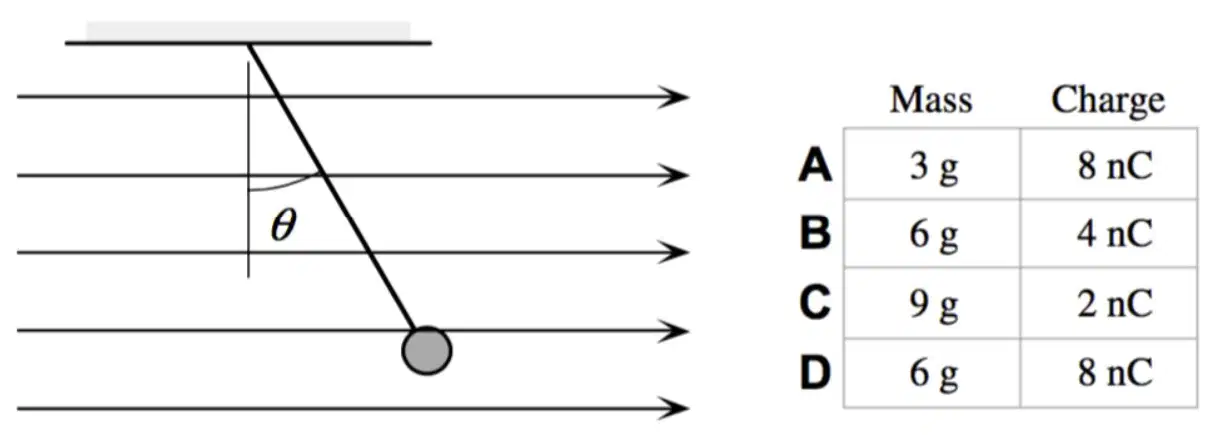
A charged sphere is suspended from a string in a uniform electric field directed horizontally. There is an electric force on the sphere to the right and a gravitational force pointing downward. As a result, the sphere hangs at an angle θ from the vertical. Combinations of sphere mass and electric charge are listed in the chart for four cases, all in the same uniform electric field.
Rank the angle θ that the string forms with the vertical for these different spheres. From greatest to least.
A
D
B
C
A positive charge placed in an electric field experiences a force in the direction of the field.
True
False
A charged particle traveling along the +x axis enters an electric field directed vertically upward along the +y-axis. If the charged particle experiences a force downward because of this field, what is the sign of the charge on this particle?
It is negative.
It is positive.
It is neutral.
None of the other choices is correct.

Three equal point charges are placed at the corners of a square of side d as shown in Figure 19-9. Which of the arrows shown represents the direction of the net electric field at the center of the square?
A
B
C
D
Three equal point charges are placed at the corners of a square of side d as shown in Figure 19-9. What is the correct expression of the net electric field at the center of the square?
E=k(d2(qQ0))
E=d2k2q
E=2d2kq

Three equal point charges of varying signs are placed on the corners of a square of side d as shown in Figure 19-10. Which of the arrows shown represents the direction of the net electric field at the center of the square?
A
B
C
D
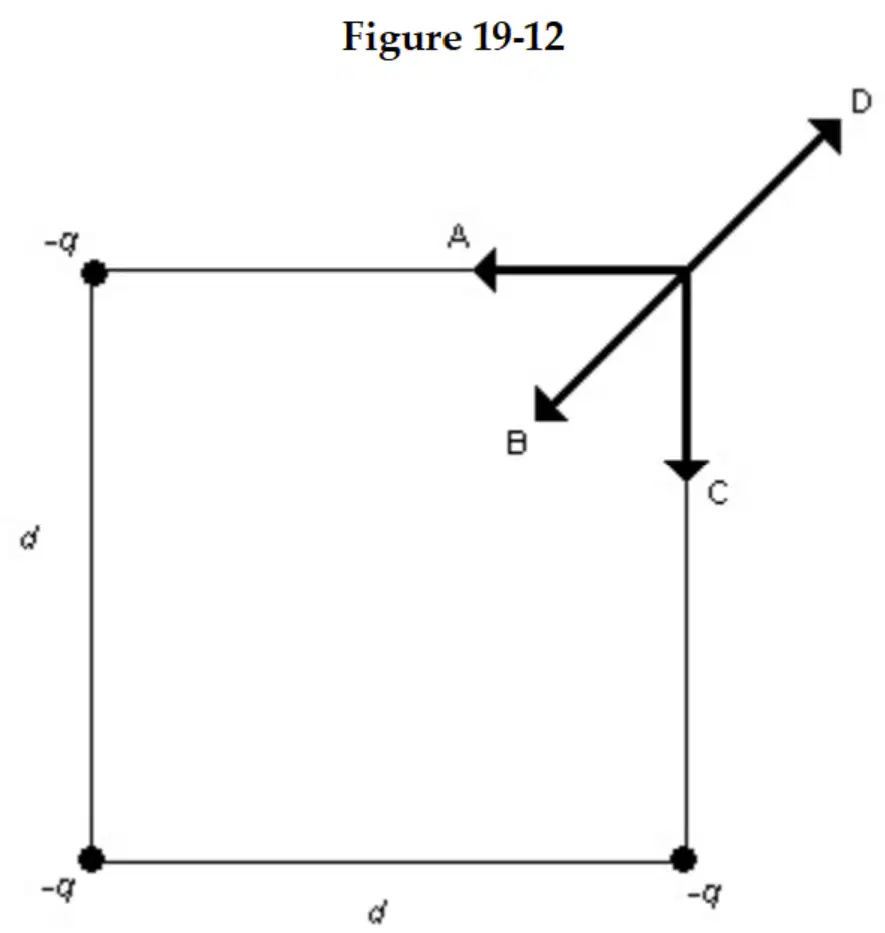
Three equal point charges are placed at three of the corners of a square of side d as shown in Figure 19-12. Which of the arrows shown represents the direction of the net electric field at the vacant corner of the square?
A
B
C
D
A proton is placed in an electric field of intensity 700 N/C. What is the magnitude and direction of the acceleration of this proton due to this field?
6.71 × 10^20 m/s2 opposite to the electric field
6.71 × 10^9 m/s2 opposite to the electric field
6.71 × 10^10 m/s2 in the direction of the electric field
67.1 × 10^10 m/s2 in the direction of the electric field
A styrofoam ball of mass 0.120 g is placed in an electric field of 6000 N/C pointing downward. What charge must be placed on the ball for it to be suspended?
-16.0 nC
-18.0 nC
-57.2 nC
-125 nC
-196 nC
An electron is released from rest in a uniform electric field of magnitude E=100N/C and gains speed. After traveling a distance of 1 meter, how fast is it moving?
4.77 x 10^6 m/s
3 x 10^8 m/s
5.93 x 10^6 m/s
9.24 x 10^7 m/s
Where can an electric field be found?
below a force field
in a gravitational field
in the space surrounding a charged object
outside of a magnetic field
Electrical field lines of a negatively charged object flow _______________.
Inwards
Outwards
Clockwise
Counter-Clockwise

Which statement best describes the electric fields in the image?
The charges are neutral.
Both charges are negative, so the field lines are alike.
The field lines move toward a positive charge and away from a negative charge.
The field lines move away from a positive charge and toward a negative charge.
TRUE or FALSE: The electric field lines for a positive charge is always directed away from the charge.
True
False

QA and QB are two charges creating an electric field. Based on the electric field lines, we can conclude that _____________.
QA and QB are both positive
QA and QB are both negative
QA is positive and QB is negative
QA is negative and QB is positive
What does it mean when the electric field lines are close together?
the field is positive
the field is negative
The field is strong
the field is weak

At which point is the electric field the strongest
A
B
C
D
What is the magnitude of the electric field at a point where proton experiences an electrostatic force of 2.3 x 10⁻²⁵ N?
1.44 x 10⁻⁶ N/C
3.68 x 10⁶ N/C
1.44 x 1044 N/C
3.68 x 10-44 N/C
An electrostatic force of 2 X 10² N is exerted on a charge of 4 Coulomb at point P in an electric field. What is the magnitude of the electric field intensity at P?
8 X 10² N/C
5 N/C
2 X 10⁻² N/C
50 N/C
A point charge Q has a distance of 2 meters from another charge with an electric field of 20 N/C. How much force does a 5 Coulomb charge feel?
4 N
100 N
40 N
10 N
What quantity remains the same everywhere between two parallel plates?
Electric Field
Electric Potential
Electric Potential Energy
Speed
The electric field inside a spherical shell of uniform surface charge density is
Constant, less than zero
Directly proportional to the distance from the centre
zero
None of the above

ABC is an equilateral triangle. Charges +q are placed at each corner. The electric intensity at O will be
4π∈01(r2q)
4π∈01(rq)
4π∈01(r23q)
zero
The distance between the two charges 25 μ C and 36C is 11 cm At what point on the line joining the two, the intensity will be zero
At a distance of 5cm from 25 microC
At a distance of 5cm from 36 microC
At a distance of 10cm from 25 microC
At a distance of 11 cm from 36 microC
In what direction will a negatively charged particle accelerate in an electric field?
In the same direction as field
In opposite direction as field
Perpendicular to field
Impossible to tell
Two point charges, +Q and -Q, are placed at a distance d from each other. What is the electric field at the midpoint between the charges?
Zero
2kQ/d^2
kQ/d^2
-kQ/d^2
What is the electric field inside a uniformly charged spherical shell?
Zero
Directly proportional to the distance from the center
Constant, less than zero
None of the above
How can a neutral object become charged?
by being dipped in water
by being stuck to the desk with tape
by allowing gravity to work on it
by having electrons added or removed

Based on the arrangement of the electric field lines in the diagram, what are the charges?
both charges are the same
the charges are opposite
they are neutral; no charge
Which statement best describes the electric fields in the image?
The charges are neutral.
Both charges are negative, so the field lines are alike.
The field lines move toward a positive charge and away from a negative charge.
The field lines move away from a positive charge and toward a negative charge.

Which diagram correctly shows the field lines between two like charges?
A
B
Both
Neither
Two small spheres are arranged along a line and carry charges of +4Q and –3Q, as shown in the figure above. The vertical lines are equally spaced.
At which of the labeled points does the electric field point toward the right with the smallest magnitude?
A
B
C
D
E
The figure above shows an object in the shape of an arc. The object has a uniform charge distribution. The three labeled vectors show possible directions of the electric field at point P
at the center of the arc. Which of the following options indicates the vector that shows the correct direction of the electric field and provides a correct physical explanation for this direction?
Vector A: the charge distribution is positive, and there are more charges to the left of point P
.
Vector A: the charge distribution is negative, and there are more charges to the left of point P
.
Vector B: the charge distribution is positive, and there are more charges above point P
.
Vector B: the charge distribution is negative, and there are more charges above point P
.
Vector C: the charge distribution is positive, and there are no charges below and to the left of point P
to cancel the field from charges above and to the right of point P
.
Particles with an electric charge can.....
Send back or Forward
Attract and Repel
Like or hate
Particles with opposite charges...
Repel
Attract
are neutral
do nothing.
Particles with like charges...
Repel
Attract
are neutral
like to go to parties.

