
NEW
Font size
 Worksheets
tutorial tonometry
Total questions: 20
Worksheet time: 5mins
Which of the following word describe the procedure of measuring IOP?
Tonometry
Tonometer
Tonomet
Tonopen
Which of the following is the word to describe the instrument used to measure IOP?
Tonometry
Tonometer
Tonomet
Tonopen
Normal IOP is __________.
8-20mmHg
6-10 mmHg
10-21mmHg
20-30mmHg
Which tonometer is the Gold Standard?
Goldmann tonometer
Tonopen
Airpuff tonometer
iCare tonometer
The diameter of the Goldmann probe is _________.
3.06mm
3.05mm
3.01mm
2.96mm
When the IOP is measured using GAT, the IOP equals the flattening force (in gram) multiplied by ______.
15
21
20
10
Which of the following eye drop is used in Goldmann tonometry?
Alcaine
Mydriacyl
Cyclogyl
Mydfrin
Thin mire caused IOP to be _______ than the usual.
increased
same
higher
lower
Which of the following action should be taken if thin mire is obtained during GAT?
Ask patient to open their eye wide
Wipe the patient's eyelid
Put more fluroscein dye
Ask patient to blink their eye
Thick mire caused _____ of IOP.
overestimation
underestimation
balance
equilibrium
Which of the following action should be taken when the mire is thick?
Put more fluorescein dye
Wipe the patient's eyelid and probe
Lower the probe
Increase the probe
Which of the following instrument is applanation tonometer?
noncontact tonometer
tonopen
Schiotz tonometer
transpalpebral tonometer
Principle of iCare tonometer is ___________
rebound
applanation
contour matching
combination of applanation and indentation
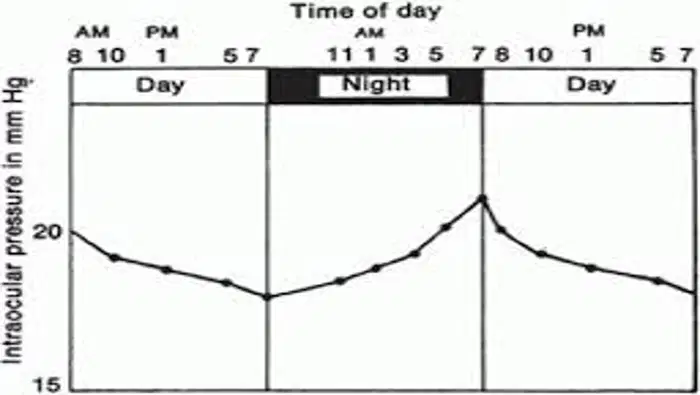
Based on the diagram, which of the following statements is TRUE about the diagram?
The pressure is highest in the evening at 5pm, lowest in the morning at 7am and increased at night
The pressure is the highest in the morning (7am) , increase at night and lowest in the evening around 5pm
The pressure is the highest in the morning (7am) , reduced at night and lowest in the evening around 5pm
The pressure is reduced at night and lowest in the evening around 5pm
IOP increase when the patient is being in ________ position
walking
sitting
supine
standing
Which of the following condition raise the IOP?
Valsalva maneuver
exercise
accommodation
retinal detachment
IOP in human follows an _______rhythm.
biological
ultradian
circadian
diurnal
What is the eye disease that is screened and diagnosed by tonometry?
Diabetic retinopathy
Glaucoma
Retinal detachment
Ocular trauma
Against the rule astigmatism >3D __________the IOP.
overestimate
underestimate
reduce
lower
What is the average of normal IOP?
23mmHg
12mmHg
20mmHg
15mmHg

