Wayground logo

Free Printable Worksheets

Font size

S
M
L
XL
Worksheets

Unit 2 Quiz

Total questions: 84

Worksheet time: 1hrs 24mins

Name
Class
Date
1.

What pH is the strongest base?

a)

1

b)

7

c)

4

d)

14

2.
Which of these pH values would indicate that a solution is a weak base?
a)
4
b)
5.6
c)
8
d)
13
3.
When dissolved in water, acids produce:
a)
bases
b)
salts
c)
hydrogen ions
d)
hydroxide ions
4.
Which type of ion does a base produce when it is dissolved in water?
a)
oxide
b)
oxygen
c)
hydrogen
d)
hydroxide
5.

pH is the measure of the concentration of ______.

a)

Acids

b)

H+ ion

c)

OH- ion

d)

Bases

6.

According to Arrhenius, what is the definition of an ACID?

a)

a substance that contains hydroxide and ionizes to produce OH-

b)

a substance that contains hydrogen and ionizes to produce H+

c)

a substance that contains hydrogen and ionizes to produce OH-

d)

a substance that contains hydroxide and ionizes to produce H+

7.

Which of the following is an Arrhenius Acid?

a)

LiOH

b)

CO32-

c)

OH-

d)

H3PO4

8.

NaOH is:

a)

an Arrhenius base

b)

an Arrhenius acid

c)

neither an acid nor a base

d)

both an acid and a base

9.
If a solution is basic which ion will be more present?
a)
H+
b)
K+
c)
OH-
d)
H-
10.

Which of the following is a strong acid?

a)

oxalic acid

b)

nitric acid

c)

carbonic acid

d)

acetic acid

11.

Neutral solutions have a pH of

a)

pH of 2

b)

pH of 0

c)

pH of 7

d)

A neutral solution does not have a pH

12.

What is true when acids and bases neutralize each other.

a)

The concentration of H+ and OH- is the same

b)

Salt Water is produced

c)

[H+] = [OH-]

d)

[H+] > [OH-]

13.

Which of the following is the correct definition for a strong acid?

a)

Partially dissociates into ions when dissolved in water and the change is not reversible

b)

Fully dissociates into ions when dissolved in water and the change is not reversible

c)

Fully dissociates into ions when dissolved in water and the change is reversible

d)

Partially dissociates into ions when dissolved in water and the change is reversible

14.

Which of the following is the correct balanced equation showing the dissociation of sulfuric acid into ions?

a)

H2SO4 (aq) → H+ (aq) + SO4–(aq)

b)

H2SO4 (aq) ⇌ 2H+ (aq) + SO42- (aq)

c)

HSO4 (aq) → H+(aq) + SO4–(aq)

d)

H2SO4 (aq) → 2H+ (aq) + SO42- (aq)

15.

Which of the following statements is true?

a)

If the H+ ion concentration in a solution increases by a factor of 10, the pH of the solution increases by 1

b)

If the H+ ion concentration in a solution increases by a factor of 10, the pH of the solution decreases by 1

16.

Weak acids and bases...

a)

do not break apart into ions (non-electrolyte)

b)

partially break apart into ions (weak electrolyte)

c)

completely break apart into ions (non-electrolyte)

d)

completely break apart into ions (strong electrolyte)

17.

For a solution, pH + pOH =

a)

7

b)

14

c)

1.0 x 10⁻¹⁴

d)

-log (1.0 x 10 -14)

18.

What is the pH of a solution that has a [H+] of 2.5 x 10⁻⁵?

a)

4.60

b)

2.5

c)

5.0

d)

7

19.

If the [H3O+] of a solution is 1 x 10⁻³ M, the pH is

a)

11

b)

-3

c)

3

d)

1

20.

The pH of a solution is 8.43. What is the [H3O+]concentration?

a)

3.7 x 10 -9

b)

1.0 x 10-8.43

c)

2.7 x 10⁻⁶

d)

1.0 x 10⁻¹⁴

21.
An acid reacts with metal to produce 
a)
Carbon dioxide 
b)
Hydrogen gas
c)
Hydrogen gas and water 
d)
Salt and hydrogen gas 
22.
A neutralisation reaction produces 
a)
An acid 
b)
A neutral substance 
c)
Only water 
d)
Salt and water 
23.
An acid reacts with a metal carbonate to produce 
a)
Salt, water and hydrogen gas
b)
Salt, water and carbon dioxide
c)
Limewater
d)
Salt and water 
24.
What type of reaction is the following: 
HCl  + Zn --> ZnCl2 + H2
a)
Neutralisation
b)
Acid and a metal 
c)
Acid and a carbonate 
d)
Ionic 
25.
Complete the following reaction:
Sulphuric acid + sodium carbonate
--> 
a)
Carbon dioxide + water 
b)
calcium carbonate + water + carbon dioxide 
c)
Sodium sulphate + water + carbon dioxide 
d)
Sodium chloride + water + carbon dioxide 
26.
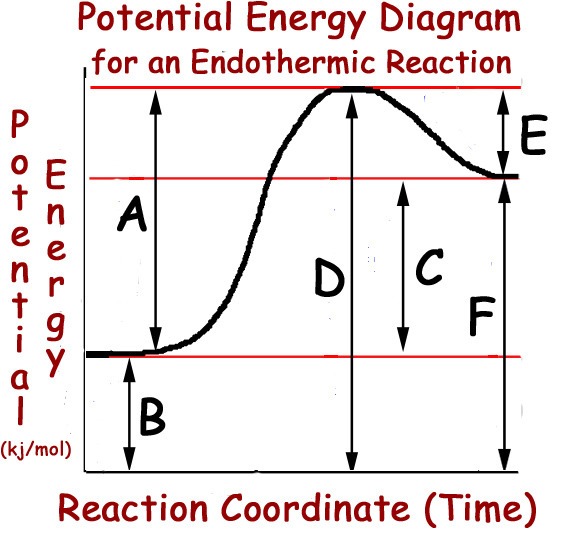
What letter represents the activation energy?
a)
A
b)
B
c)
C
d)
D
27.
Activation energy is required to start a chemical reaction. What is activation energy?
a)
The energy needed for a reaction to occur
b)
The minimum amount of energy needed for a reaction to potentially occur
c)
The energy added by a catalyst
d)
The energy possessed by the products
28.
Increase in temperature of the reactants can do one of the following
a)
Slow collision frequency
b)
Allow less effective collision between the particles
c)
Cause particles to lose speed
d)
Increase collision between the particles thus increasing the rate.
29.
Grinding a seltzer tablet into powder increases the rate of reaction due to increased
a)
concentration
b)
surface area
c)
temperature
d)
reactants
30.
Which factors increase the rate of a reaction.
a)
increasing temperature
b)
increasing concentration
c)
increasing surface area
d)
all of these
31.
A ______________ is a substance that increases the rate of a reaction without being used up during the reaction. 
a)
catalyst
b)
product
c)
reactant
d)
solute
32.
Why does a higher concentration increase the rate of reaction?
a)
it increases the amount of reactants
b)
it lowers the activation energy
c)
it increases the energy of particle collisions
d)
it increases the frequency of particle collisions because there are more collision sites
33.
Which of these will NOT speed up the rate of reaction between a strip of magnesium and hydrochloric acid?
a)
tightly coil up the strip of magnesium
b)
cut up the strip of magnesium
c)
increase the concentration of the hydrocholoric acid
d)
increase the temperature of the hydrocholoric acid
34.
Products will form faster if____________
a)
the particle size of the reactants are larger.
b)
temperature is decreased.
c)
concentration of the reactants are increased.
d)
the reaction is not stirred.
35.
The following graph shows two different reaction pathways for the same overall reaction at the same temperature. Which pathway is slower and why?
a)
Red, because the activation energy is larger
b)
Blue, because the activation energy is lower
c)
both reaction progress at the same rate
36.
What makes an effective collision?
a)
When molecules collide.
b)
When molecules collide with the proper orientation.
c)
When molecules collide with proper orientation and enough kinetic energy.
d)
High Temperature.
37.

List four factors that affects the rate of a reaction

a)

temperature

b)

concentration

c)

surface area

d)

volume

e)

catalysts

38.

Which is FALSE about catalysts?

a)

They increase the speed of the reaction

b)

They provide an alternate reaction pathway which lowrrs the activitation energy

c)

They produce more net product

d)

They are not consumed in the reaction

39.
What explains the very high melting and boiling point of water
a)
Strong dipole-dipole bonds between water molecules
b)
Strong hydrogen bonds between water molecules
c)
Dispersion forces which are present in all molecules
d)
Asymmetrical shape of the polar bonds.
40.
Hydrogen bonding occurs when hydrogen is bonded to N, O, or F.  Which of the following has hydrogen bonding?
a)
CBr4
b)
NO2
c)
H2S
d)
NH3
41.

Which is the second strongest intermolecular force, after hydrogen bonding?

a)

dipole-dipole attraction

b)

Van der Waals/Dispersion forces

42.

________________________ have the strongest intermolecular forces of attraction.

a)

Dipole- Dipole

b)

Dispersion

c)

Hydrogen Bonds

43.
Which of the following factors plays an important role in the identification of specific intermolecular forces in a molecule?
a)
bond type
b)
density
c)
solubility
d)
molecular polarity
44.
Propane is a gas at STP, while bromine is a liquid at STP. Which statement correctly explains these observations?
a)
Bromine has weaker intermolecular forces than propane does
b)
Bromine has greater molecular polarity than propane does
c)
Bromine has weaker molecular polarity than propane does
d)
Bromine has stronger intermolecular forces than propane does
45.
Which of the following statements correctly compares the behavior of a mixture of ethanol and water at STP?
a)
Water will evaporate first, because it has weaker intermolecular forces
b)
Ethanol will evaporate first, because it has weaker intermolecular forces
c)
Ethanol and water will evaporate simultaneously
d)
The aqueous solution will evaporate partially at a temperature between the boiling points of water and of ethanol
46.

When you have Br-Br, what is the polarity?

a)

Polar

b)

nonpolar

c)

Ionic

47.

When you have H-Cl, what is the polarity?

a)

nonpolar

b)

polar

c)

ionic

48.

When you have F-F, what is the polarity?

a)

nonpolar

b)

polar

c)

ionic

49.

When you have C-H, what is the polarity?

a)

nonpolar

b)

polar

c)

ionic

50.

What would solubility look like for polar covalent bond in water?

a)

soluable

b)

nonsoluable

51.

What would solubility look like for nonpolar covalent bond in water?

a)

soluable

b)

nonsoluable

52.
Choose the correct shape for this molecule:
a)
Trigonal planar
b)
Trigonal pyramidal
c)
Tetrahedral
d)
Linear
53.
Choose the correct shape for this molecule:
a)
Trigonal planar
b)
Trigonal pyramidal
c)
Bent
d)
Linear
54.
Choose the correct shape for this molecule:
a)
Bent
b)
Trigonal pyramidal
c)
Trigonal planar
d)
Linear
55.
Choose the correct shape for this molecule:
a)
linear
b)
Trigonal pyramidal
c)
Bent
d)
Tetrahedral
56.
Choose the correct shape for this molecule:
a)
Trigonal planar
b)
Trigonal pyramidal
c)
Bent
d)
Tetrahedral
57.
In covalent bonds, electrons are ___________.
a)
transferred
b)
gained
c)
lost
d)
shared
58.
How many electrons should Oxygen have around its Lewis dot model?
a)
5
b)
6
c)
7
d)
8
59.

The geometry of a molecule with 4 bonded pairs of electrons and 0 lone pairs of electrons, AB4

a)

Tetrahedral

b)

Trigonal Planar

c)

Bent

d)

Trigonal Pyramidal

e)

Linear

60.
*
a)
trigonal pyramid
b)
linear
c)
bent
d)
angular
61.
 A lone pair is defined as
a)
A pair of bonding electrons
b)
One non-bonding electron
c)
A pair of non-bonding electrons
d)
A pair of electrons on the central atom
62.
What is the VSEPR theory used to predict?
a)
Bond Strength
b)
Polarity
c)
Molecular Shape
d)
Electronegativity
63.
According to VSEPR, molecules adjust their shapes to keep which of the following as far away as possible?
a)
Pairs of valence electrons
b)
Inner shell electrons
c)
Mobile Electrons
d)
Electrons closest to the nucleus
64.
Solution where more solute can still be dissolved at the given temperature. 
a)
Saturated
b)
Unsaturated
c)
Mixture
d)
Homogeneous solution
65.
__________ are made up of solutes and solvents.
a)
Solutions
b)
Suspensions
c)
Heterogeneous Mixtures
d)
Pure Substances
66.
When a solvent contains as much of the solute as it can hold, the solution is said to be
a)
supersaturated
b)
diluted
c)
saturated
d)
unsaturated
67.
What is able to dissolve other substances?
a)
Solute
b)
Salt
c)
Suspension
d)
Solvent
68.
Which substance is MOST soluble at 0 ºC?
a)
KI
b)
NaNO3
c)
NaCl
d)
Ce2(SO4)3
69.
Which solute is the most soluble at 10 ⁰C?
a)
KI
b)
KClO3
c)
NH4Cl
d)
NH3
70.
Which solute does not increase in solubility as temperature rises?
a)
NH3
b)
NaNO3
c)
KNO3
d)
NaCl
71.
When 20 grams of KNO3 is dissolved in 100 grams of water at 80 ºC, the solution can be correctly described as:
a)
supersaturated
b)
saturated
c)
unsaturated
72.
Graph that shows the amount of solute that can be dissolved in 100 g of water at a certain temperature.
a)
Solubility curve
b)
Saturation curve
c)
Concentration curve
d)
Molarity curve
73.

Ink can be separated by a method of -----------------------------------------------

a)

distillation

b)

filtration

c)

chromatography

d)

sedimentation

74.
chromatography separates the mixture of dyes on the basis of their ----------------------------
a)
density
b)
solubility
c)
gravity
d)
boiling point
75.
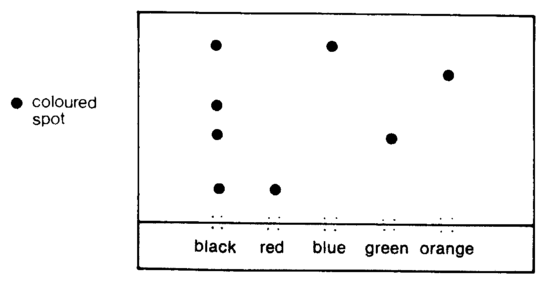
On the chromatogram given -------------- is mixture.
a)
red
b)
orange
c)
green
d)
black
76.
What is the molarity of 4 grams of sodium chloride (NaCl) in 3,800 mL of solution?
a)
0.018 M
b)
0.018 m
c)
1.052 M
d)
1.052 m
77.
What is the molarity of a solution which contains 22.41 grams of NaCl in 50.0 mL of solution?
a)
0.488 M
b)
7.66 M
c)
7.67 M
d)
0.00767 M
78.

Concentration is

a)

the amount of solute in the solvent

b)

the amount of solvent in the solute

c)

density

d)

particle size

79.

Which solution is more concentrated?

Solution 1:

500 mL of water

100 g of salt


Solution 2:

500 mL of water

90 g of salt

a)

Solution 1

b)

Solution 2

c)

They have the same concentration

d)

I have no idea

80.

Which of the following best describes a precipitate?

a)

an insoluble solid

b)

a soluble solid

c)

a soluble gas

d)

an insoluble liquid

81.

AB (aq) + CD (aq) → AD (aq) + CB(s)


Which substance is the precipitate in the reaction above?

a)

AB

b)

CD

c)

AD

d)

CB

82.

According to the solubility rules (chart), compounds containing Ammonium cations, NH4+ are:

a)

Not Soluble

b)

Sometimes Soluble

c)

Always Soluble

d)

Always insoluble

83.
What is the molarity of 3 mole of hydrochloric acid in 3 L of water. 
a)
3
b)
1
c)
6
d)
9
84.
What is the formula for molarity?
a)
moles/grams
b)
moles/kilograms
c)
moles/milliliters
d)
moles/liters