
 Worksheets
Chapter 2 Review
Total questions: 53
Worksheet time: 32mins
Which of these is true of segregation in the South after Reconstruction?
Segregation in the South ended with Reconstruction.
Only schools were segregated.
Segregation was enforced by white society but never written into law.
Segregation was written into law due to the decision of Plessy vs. Ferguson.
Segregation was enforced by white-democratic societies in the South.
What was the Great Migration?
a time when millions of black people left the segregated South and moved to the North
a time when many black people left northern US cities for European cities
a time when many white people left cities for the suburbs
a time when many Europeans immigrated to the US
Which of these people co-founded the NAACP?
Booker T. Washington
Thurgood Marshall
W.E.B. DuBois
Homer Plessy
What was the main point of the Reconstruction era?
restoration of the Union
transformation of southern society
addressing the rights of freed slaves
All of the above
What is segregation?
When land is split in between other people
When white and black people were separated from each other
When white and black people were pushed together
What are the Jim Crow laws?
Were laws that enforced racial segregation in the U.S
Were laws that made people pay Jim Crow
Were laws that got a rid of racial segregation in the U.S
The Supreme Court ruling that legalized segregation in the United States.
Plessy v. Ferguson
Brown v. Board of Education
Dred Scott v. Sanford
Plessy v. Sanford
A test given before poor whites and freedmen could vote in the United States.
Poll Tax
Literacy test
Black codes
Jim Crow Laws
A law that legally segregated blacks and whites in public places.
Poll tax
Literacy test
Sharecropping
Jim Crow Laws (Segregation Laws)
Which answer best describes the 14th amendment?
granted the right to vote to any male over the age of 18 regardless of race
granted citizenship and equal protection under the law
freedom from slavery
Which answer best describes the 15th amendment?
All males over the age of 18 earned the right to vote regardless of race.
This amendment impeached Andrew Jackson.
Granted equal protection under the law.
Which answer best describes the 13th amendment?
Granted voting rights to all African-Americans.
Granted women the right to vote.
Gave African-American men the right to vote.
Abolished slavery in the United States.

Which of the following BEST explains a social impact of the Jim Crow system?
Keep public facilities cleaner
African Americans felt inferior to White Americans in Southern Society.
keep the races pure
keep African-Americans from voting
The Reconstruction/Civil War Amendments were created after the Civil War between the North and the South. What does the word reconstruction mean?
Tear down
To rebuild
Take over
To destroy
The separation or isolation of people based on racial, ethnic, or other reasons is
Integration
Conflagration
Confederation
Segregation
African Americans who left the South and migrated to the Western States to find a better life were:
Exodusters
Indentured Servants
Freedmen
Settlers
This group used intimidation & violence to obstruct the rights of African Americans in the South following the Reconstruction Era.
Black Codes
Ku Klux Klan
Radical Republicans
Carpetbaggers
The following answers were attempts to stop African Americans from voting. (Choose all that apply)
KKK
Poll Tax
Literacy Test
Grandfather Clause
What did Black Codes do?
Limit the individual rights of African Americans in Society- they were abolished during the reconstruction era.
Take away their right to vote.
Allowed segregation.
Banned segregation.
What was the significance of the Plessy v. Ferguson decision/ruling?
It ended segregation in public schools
It legalized 'separate but equal' facilities
It granted women the right to vote
It abolished slavery
The First Morrill Land Grant Act is
giving free land to people for 10 years
when the government gave states federal land to help promote higher education and westward expansion
providing more land to move south
providing native americans with land to the west

HBCU stands for ...
Historically Better Collegesand University
Helping Blacks in Colleges and Universities
Historically Black Colleges and University
Historically Below Common Universities
National Association for the Advancement of Colored People
Angel Island
AFL
NAACP
NWO
What is the goal of the NAACP?
to lobby, protesting, and legal action to fight for the rights of African Americans
to educate people about the Jim Crow Era
to help people who have recently escaped slavery find a home, food, water, and clothing

The Second Morrill Land Grant Act focused on
Giving the states land to sell to finance colleges that concentrated on law and medicine studies
Giving the states land to sell to finance colleges that concentrated on agriculture and law studies
Giving the states land to sell to finance colleges that concentrated on medicine and mechanical studies
ensuring African Americans received access to higher education (created HBCUs)
The convict lease system
allowed business owners to pay the state to have prisoners work for them
allow convicts in state prisons to work for real estate companies
Which early Civil Rights leader went to college at Harvard University and believed that African Americans should demand social equality and full civil rights?
Which early Civil Rights leader believed that African Americans should be economically equal to white people in order to achieve equal rights in society?
What was the goal of these new laws that were added to the 1898 Louisiana Constitution- Literacy Test, Grandfather Clause, Poll Tax?
to make voting harder for children in the South
To turn every race away from the voting booths
To make voting easier for African Americans
To disenfranchise African Americans
The Civil Rights Act of 1875
Segregated all public places
Made public schools segregated for all students
guaranteed all citizens equal access to public places regardless of race- this was quickly overturned by Plessy vs. Ferguson
did not do anything for the United States Government
Which early civil rights leader focused on exposing the horrors of lynching and other injustices suffered by African Americans in the South?
W.E.B. DuBois
Booker T. Washington
Mary Church Terrell
Ida B. Wells
In what two ways listed below did African Americans respond to the discrimination of the Jim Crow Era?
They made speeches and published articles/books that called for equality.
They begged for their equal rights from white Southerners.
They lynched White Southerners.
They formed groups and joined organization that unified people to work together to fight segregation laws.
In what two ways did President Rutherford B. Hayes put an end to the Reconstruction Era in the South?
He signed the Compromise of 1877 with the Southern Democratic Leaders.
He pulled the South into another Civil war and this time the South won.
He pulled the Federal Troops out of the South and let the South "rebuild" on its own.
He kept enforcing the law and the South followed all the rules.
The Civil Rights Act of 1875 was the first act to regulate society in regards to segregation. However, the act officially stated that the Federal Government could NOT
regulate the behavior of private individuals.
interfere in society.
Deal with the African American "Problem."
Allow white business owners to make and sell what they wanted to.
Why was Homer Plessy arrested in Louisiana?
He violated the Separate Car Act of 1890 by sitting in the wrong train car.
The supreme court refused to take his case at the national level.
He was supposed to sit in the colored train car because he was African American- he got arrested for sitting in the White train car.
He was not arrested- he was let go.
How did Homer Plessy's court case make it all the way to the supreme court?
Because he appealed the decision of the Local courts and said the Separate Car Act violated his 14th Amendment right to equal protection under the law.
Because he thought that he would become famous for all of the national attention that his case would get.
Because the Supreme Court felt bad for him.
Because the Supreme Court was bored and felt like taking his case.
Give me ONE example of a Jim Crow Law that we talked about in class.
(a)
How did Jim Crow Laws make African Americans in the South feel?
Jim Crow laws made African Americans stay in the South.
They made them feel like they should all become teachers in the North.
African Americans felt inferior to White Americans because they were singled out in public and not given the same opportunities as white people in this time.
What were some of Booker T. Washington's major contributions to African American education?
Writing influential books on African American history
Founding the NAACP
Advocating for desegregation of schools
Establishing the Tuskegee Institute, advocating for educational training, and promoting self-help and economic independence for African Americans.
Which of the following believed in demanding full political, civil, and social rights for African Americans?
Which person accepted social separation and believed racial equality could be achieved through education?
Which of the following best describes Booker T. Washington’s approach to civil rights?
compromise and patience- accept segregation
persistence and noncompliance
education reform and voting rights
non-violent protest and political action
Which of the following best describes W.E.B. Du Bois’s approach to civil rights?
give and take between races
gradual attainment of civil rights
He wanted African Americans to demand complete civil rights immediately
economic equality with social segregation
What is misleading about the Supreme Court's decision- "Separate but Equal-" in the case Plessy vs. Ferguson?
Everyone ended up sharing the same spaces.
Divisions among groups were rarely enforced.
African Americans' facilities were supposed to be created equally to whites' but they were usually in poor condition.
These laws applied only to schools.
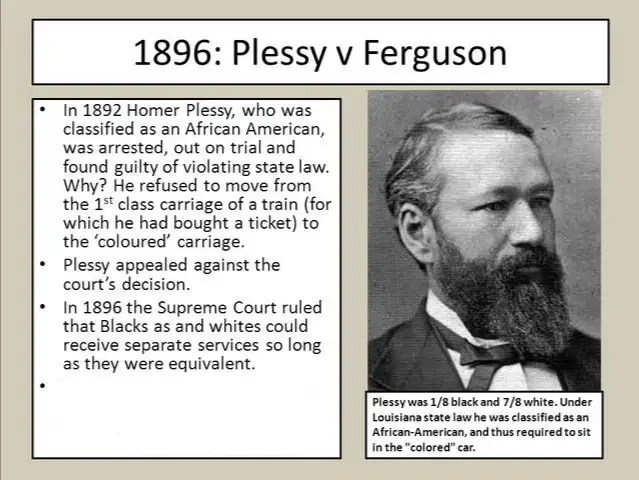
Which piece of information goes in the fourth bullet point?
Homer Plessy didn't show up to court and more time was added to his sentence.
The supreme court did not care about Homer Plessy's case.
The supreme court's decision paved the way for the Jim Crow Era in the South because it made segregation laws legal.
The supreme court redacted everything they said in the case.
What was the name of the court case that made segregation legal?
Plessy v. Ferguson
Brown v. Board of Education
Plessy v. Jim Crow
Ferguson v. Jim Crow
This term means- to take away someone's right to vote.
Segregation
Vagrancy
Disenfranchise
Minstrel Show
What was the main purpose of Jim Crow laws in the Southern United States?
To promote civil rights
To abolish slavery
To enforce racial segregation
To provide equal voting rights
Which Early Civil Rights Leader was also an activist in the Women's Suffrage movement?
W.E.B. DuBois
Mary Church Terrell
Ida B. Wells
Booker T. Washinton
What was the Niagara Movement?
A group created by a group of Black Americans including WEB Dubois.
A group that was created for women who were abused by their husbands.
A group that was created to work for FULL civil and political rights for African Americans.
A group that was created to help farmers in the United States.
What is the National Association for the Advancement of Colored People (NAACP)?
An organization founded by both White and Black Americans.
An organization created to lobby for equality and provide Legal Action for African Americans.
BONUS: CLICK ME
The NAACP still exists today.
What are Historically Black Colleges and Universities (HBCUs)?
Schools that were created by the Freedmen's Bureau
They are institutions that are similar to Federal prisons
Colleges that were created by African Americans so that they could attend college and Technical School
A free college that only African Americans can attend
Colleges that were created as a result of the First Morrill Land Grant Act being passed

