wayground logo

Free Printable Worksheets

Font size

S
M
L
XL
Worksheets

C Block: States of Matter, Safety, and Measurement Assessment

Total questions: 33

Worksheet time: 17mins
Name
Class
Date
1.
1. If you break a piece of glassware or equipment, tell the teacher...
a)
at the end of class
b)
immediately
c)
the next day
2.
2. When working with chemicals, liquids, and other lab equipment, you must wear...
a)
loose clothing
b)
goggles
c)
flip-flops
3.
3. Which of the following is NOT a safe lab practice?
a)
Handling equipment correctly.
b)
Listening to instructions and working cooperatively with your lab partner.
c)
Wearing googles around your neck.
4.
4. If you do not understand a direction or lab procedure, you should...
a)
figure it out as you go.
b)
skip the step and go to the next.
c)
ask the teacher before proceeding.
5.
5. Horseplay (playing/messing around in class) and not following directions are...
a)
okay if you're working alone.
b)
okay as long as it's not dangerous.
c)
always against the rules.
6.
6. It’s okay to mix chemicals without your teacher’s permission.
a)
True
b)
False
7.
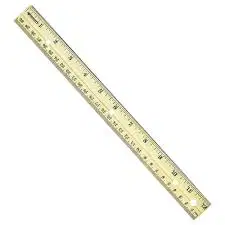
7. This object is...
a)
used to measure the mass of an object.
b)
worn whenever working with liquids or other dangerous substances.
c)
needed to measure the size of an object (length, width, height).
d)
needed to measure the volume of an irregular shaped object.
e)
needed when observing things that are very small.
8.
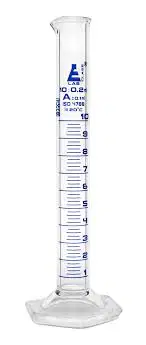
8. This object is...
a)
used to measure the mass of an object.
b)
worn whenever working with liquids or other dangerous substances.
c)
needed to measure the size of an object (length, width, height).
d)
needed to measure the volume of an irregular shaped object.
e)
needed when observing things that are very small.
9.
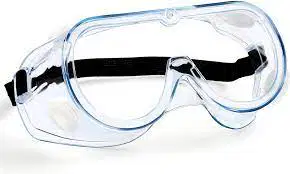
9. This object is...
a)
used to measure the mass of an object.
b)
worn whenever working with liquids or other dangerous substances.
c)
needed to measure the size of an object (length, width, height).
d)
needed to measure the volume of an irregular shaped object.
e)
needed when observing things that are very small.
10.
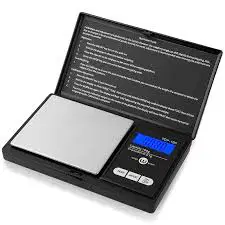
10. This object is...
a)
used to measure the mass of an object.
b)
worn whenever working with liquids or other dangerous substances.
c)
needed to measure the size of an object (length, width, height).
d)
needed to measure the volume of an irregular shaped object.
e)
needed when observing things that are very small.
11.
11. This object is...
a)
used to measure the mass of an object.
b)
worn whenever working with liquids or other dangerous substances.
c)
needed to measure the size of an object (length, width, height).
d)
needed to measure the volume of an irregular shaped object.
e)
needed when observing things that are very small.
12.
12. What is the volume of the liquid shown in this picture?
a)
3 ml
b)
2.3 ml
c)
2.6 ml
d)
2.9 cups
13.
13. What is the volume of the liquid shown in this picture?
a)
2.4 oz
b)
2.8 ml
c)
1.9 ml
d)
24 ml
14.
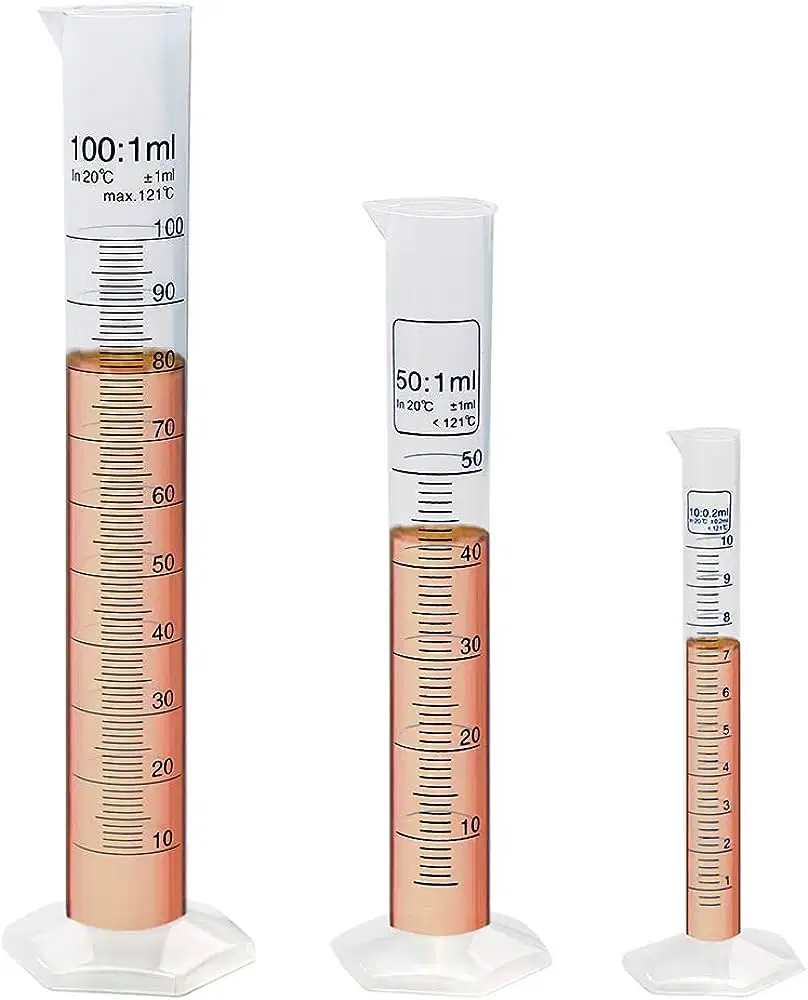
14. Which graduated cylinder shows the measurement of 80 ml?
a)
The one on the left.
b)
The middle one.
c)
The one on the right.
d)
The one that got sucked into a black hole and will never be seen again.
15.
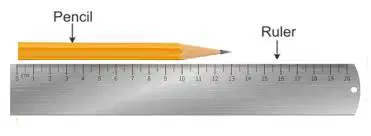
15. What is the length of the pencil?
a)
9 cm
b)
16 cm
c)
13 feet
d)
13 cm
16.
16. You are going to be conducting an experiment in class. When you walk in you see: a candle, a glass cylinder, and some unknown chemicals. What is the FIRST thing you should do?
a)
Go over and start smelling the unknown chemicals.
b)
Pick up the glass cylinder and show your friends.
c)
Sit down, listen to your teacher's instructions, and do not touch anything until your teacher tells you to.
d)
Pull a flamethrower out of your pocket and try to light the candle.
17.
17. In that same lab with a candle, glass cylinder, and unknown chemicals, what safety equipment would most likely be used?
a)
A snack, googles, and gloves.
b)
Googles, tongs, and gloves.
c)
Matches, gloves, and goggles.
d)
Straw, goggles, and an apron.
18.
18. What safety rules are being broken and what possible hazards could occur because of Bill breaking the rules?
a)
Bill is wearing goggles, so his eyes will be protected.
b)
Bill is wearing an apron, so his clothes might not get damaged.
c)
Bill is touching a beaker over a flame without wearing gloves, so he might burn himself.
19.
19. What safety rules are being broken and what possible hazards could occur because of Tom breaking the rules?
a)
Tom is tasting an unknown substance, so he might poison himself.
b)
Tom is not wearing goggles, but his eyes will be safe since he isn't leaning over the table.
c)
Tom is waiting for his turn, so he won't be in the way of other students.
20.
20. What safety rules are being broken and what possible hazards could occur because of Betty breaking the rules?
a)
Betty is using tongs to hold her test tube, so she will not get her hand too close to the flame.
b)
Betty's hair isn't tied back, so it could catch on fire from her burner.
c)
Betty is not wearing gloves, bu she is being careful to keep her hand back away from the flame.
21.
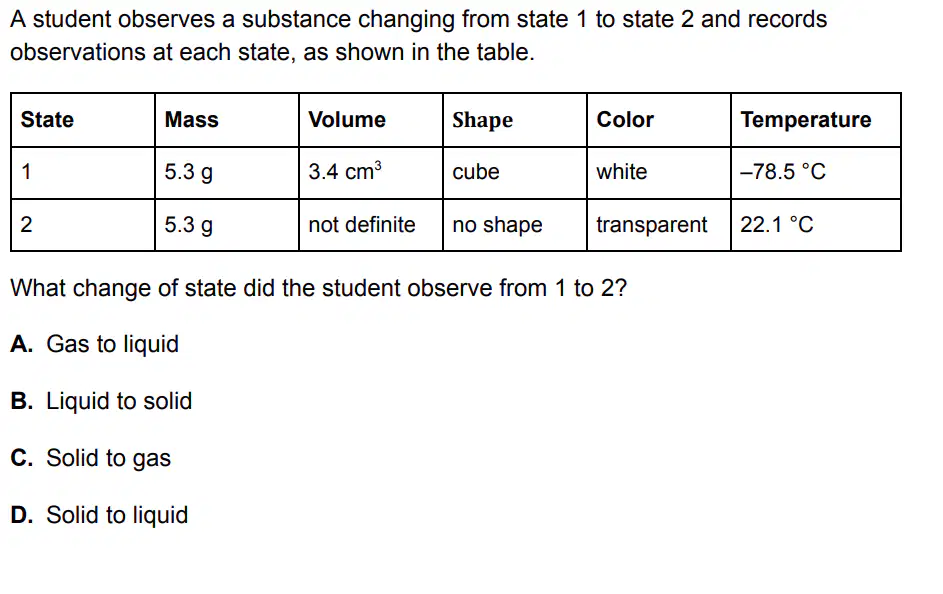
21.
a)
A
b)
B
c)
C
d)
D
22.
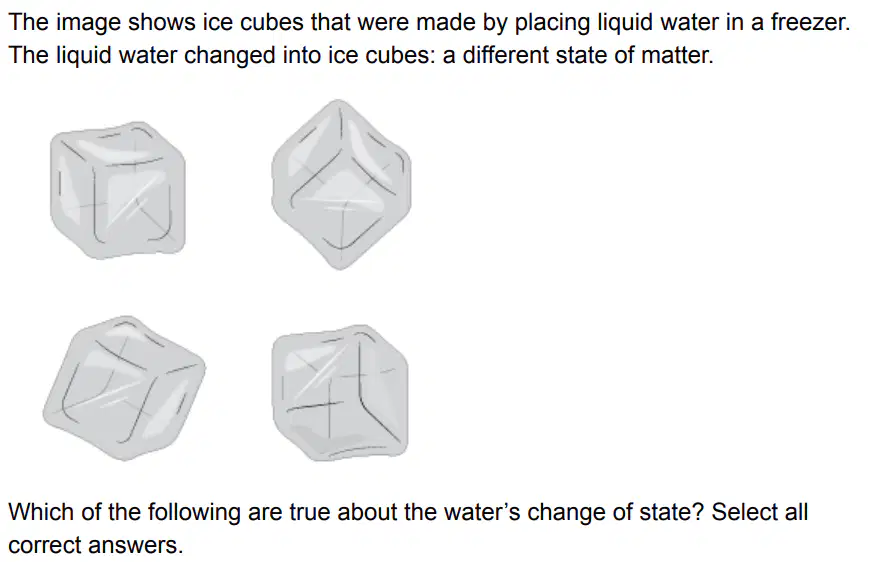
22.
a)
The substance changes from having no definite volume to having a definite volume.
b)
The particles’ kinetic energy increases.
c)
The particles start to vibrate in place.
d)
The substance changes from having a definite volume to having no definite volume.
e)
The particles’ kinetic energy decreases.
23.
23
a)
The particles moved faster in different directions.
b)
The particles’ kinetic energy decreased.
c)
The substance changed from having no definite shape to having a definite shape.
d)
The substance changed from having a definite volume to having no definite volume.
e)
The particles’ kinetic energy increased.
24.
24
a)
A
b)
B
c)
C
d)
D
25.

What state of matter are the particles moving the fastest and are farthest apart?

a)

Solid

b)

Liquid

c)

Gas

26.

In this state of matter the particles are "tightly packed" together and don't move

a)

Liquid

b)

Solid

c)

Gas

27.

This state of matter the particles "slip past" each other and take the shape of it's container

a)

Solid

b)

Gas

c)

Liquid

28.

This is the only state of matter that has a "Definite Shape"

a)

Liquids

b)

Solids

c)

Gases

29.

In order to get water in a solid form (Ice) to melt into a liquid (Water) what must be added to it?

a)

Matter

b)

Cold

c)

Heat

d)

Cheese

30.

In order for liquid (water) to turn into a solid (Ice) what must happen?

a)

Heat must be added

b)

Heat must be taken away

c)

Nothing it will happen all on its own

31.

When heat is added to particles what happens?

a)

They move quickly

b)

They slow down

c)

No Change

32.

When heat is taken away from particles what happens

a)

They speed up

b)

They slow down

c)

No Change

33.

All of these states of matter take the shape of their container EXCEPT:

a)

Liquids

b)

Solids

c)

Gases