
 Worksheets
CHAPTER 6 (PMK1213)
Total questions: 30
Worksheet time: 18mins
A company can obtain new products through new product development. Which of the following defines new products?
Original product
product improvement
Product modification
All of the above
New product development starts with _____________.
Idea generation
Idea screening
Concept development
Concept testing
What do we call a detailed version of new idea stated in meaningful customer terms?
Product idea
Product concept
Product image
Product proposal
After concept testing, a firm would engage in this stage in developing and marketing a new product.
Idea screening
Marketing strategy development
Business analysis
Product development
A review of the sales, costs, and profit projections for a new product to find out whether they satisfied the company’s objectives is called a _________.
Business feasibility
Feasibility study
Business analysis
Product acceptance
This stage in the PLC is characterized by rapid market acceptance, increasing sales, and increasing profits. What is it?
Introduction
Maturity
Growth
Decline
Sales decline in the stage of the PLc because of technological advances, increased competition, and _____ .
Shifts in the economy
Shifts in unemployment
Shifts in consumer tastes and preferences
Foreign import
The owners will begin the first idea-reducing stage called ________ to arrive at a realistic number to adopt
Idea screening
Marketing strategy development
business analysis
Product development
In ___________________, the firm must decide on introducing timing, how the product will launched, then where the product will be launched. In examples such as in single location, a region, the national market or the international market
product screening
commercialization
idea generation
all of the above
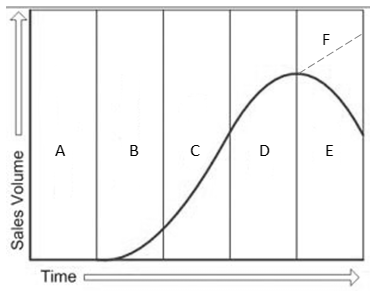
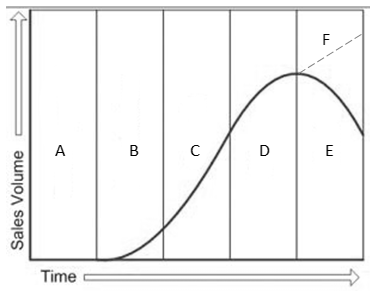
What is happening at point F of the Product Life Cycle?
Growth
Maturity
Extension Strategy
Introduction
Involves cultural trends and observing customer behaviors.
introducing the product
evaluating acceptance
testing the product
generating ideas
Eliminating possibilities until one or two ideas are selected for development.
generating ideas
screening ideas
introducing the product
evaluating customer acceptance
A prototype is made and tested.
testing the product
evaluating customer acceptance
screening ideas
generating ideas
Companies make plans relating to production, packaging, labeling, branding, promotion, and distribution.
Testing the product
developing the product
evaluating customer acceptance
generating ideas
This stage is also called "commercialization". New products are advertised to introduce benefits to consumers.
Developing the product
Testing the product
Developing a proposal
Introducing the product
Marketers track customer responses to the product.
Evaluating customer acceptance
Developing the product
Testing the product
Testing a product proposal
New product development generally involves ______ key steps.
9
8
10
5
Creativity is essential in this step of new product development.
Testing the product
Development of the product
Generating ideas
Introduction of the product
A model of a new product.
protagonist
prototype
proton
production
Which of the following phase involve selecting the best idea and dropping poor ideas?
Idea generation
Business Analysis
Market strategy development
Idea screening
Business analysis includes
review of the sales
review of the costs
profit projections
The ideas generation can come from
employees
customers
competitors
ghost

