
NEW
Font size
 Worksheets
2.4 Mechanical science principles
Total questions: 79
Worksheet time: 2hrs 59mins
In science, how is energy expressed?
As the amount of heat produced
As the amount of light emitted
As the amount of work done by a force
As the amount of sound generated
What is the unit of energy?
Newtons (N)
Joules (J)
Volts (V)
Watts (W)
Which of the following statements is true about energy?
Energy can be created and destroyed
Energy can only be created, not destroyed
Energy can only be destroyed, not created
Energy cannot be created or destroyed, only converted from one form to another

What does a transducer do?
Converts energy from one form to another
Stores energy for later use
Measures the amount of energy
Destroys excess energy
What type of energy is due to motion, such as a car accelerating?
Potential energy
Kinetic energy
Thermal energy
Chemical energy
Which of the following is an example of potential energy?
A car accelerating
A moving bicycle
A raised weight
A running person
Energy can be either kinetic or _______.
Thermal
Chemical
Potential
Electrical
What type of energy depends on the relative position within a system?
Kinetic energy
Thermal energy
Potential energy
Electrical energy
What is the definition of a force?
A push or pull that changes an object's state of motion or causes the object to deform
A measure of an object's mass
The speed at which an object moves
The energy required to move an object
Which of the following is a force that attracts items that have mass or energy?
Electromagnetism
Gravity
Weak interaction
Strong interaction
What type of interaction involves the interaction of particles with an electrical charge?
Gravity
Electromagnetism
Weak interaction
Strong interaction
At what level do weak and strong interactions occur?
At the macroscopic level
At the molecular level
At the atomic level
At the galactic level
Which of the following is NOT a way that forces act on structures?
Gravity pulling downwards
Self weight
Imposed loads
Thermal expansion
What is one of the ways forces act on structures?
Gravity pulling upwards
Self weight
Thermal contraction
Electrical resistance
Which of the following is an example of a live load?
Gravity pulling downwards
Self weight
Imposed loads
None of the above
What is the SI unit of force?
Joule
Newton
Pascal
Watt
How much force is required to give a 1kg mass an acceleration of 1m/s²?
1 Joule
1 Newton
1 Pascal
1 Watt
What two characteristics does a force have?
Magnitude and speed
Magnitude and direction
Speed and direction
Mass and acceleration
What is required for a structure to be in equilibrium?
All forces need to be in balance
All forces need to be in motion
All forces need to be in the same direction
All forces need to be of the same magnitude
What happens if imbalance occurs in a structure?
The structure will remain stable
The structure will settle and deflect, causing damage
The structure will gain strength
The structure will become lighter
According to Newton's second law, what is the formula for force?
F = ma
F = m/a
F = a/m
F = m + a
In Newton's second law, what does 'm' represent?
Mass
Force
Acceleration
Momentum
In Newton's second law, what is the unit of force (F)?
Newtons (N)
Kilograms (kg)
Metres per second squared (m/s²)
Joules (J)
What is the unit of mass in Newton's second law?
Kilograms (kg)
Newtons (N)
Metres per second squared (m/s²)
Joules (J)
What is the unit of acceleration in Newton's second law?
Metres per second squared (m/s²)
Newtons (N)
Kilograms (kg)
Joules (J)
According to Newton's second law, the acceleration of an object is:
Proportional to the mass of the object
Inversely proportional to the resultant force on the object
Proportional to the resultant force on the object
Inversely proportional to the velocity of the object
Newton's second law states that the acceleration of an object is inversely proportional to:
The velocity of the object
The mass of the object
The resultant force on the object
The distance traveled by the object
If the resultant force on an object increases, what happens to its acceleration according to Newton's second law?
The acceleration decreases
The acceleration remains the same
The acceleration increases
The acceleration becomes zero
A truck weighs 38,000 kg and accelerates at 0.3 m/s². What is the force required to reach this acceleration?
11,400 N
12,000 N
10,000 N
15,000 N
If the mass of an object increases, what happens to its acceleration according to Newton's second law?
The acceleration increases
The acceleration decreases
The acceleration remains the same
The acceleration becomes infinite
What is Newton's second law widely used for in building services engineering?
Designing machines, structures, and products
Calculating the speed of vehicles
Measuring the temperature of materials
Estimating the cost of construction
Why must the forces acting on a stationary object add up to zero?
Because the object is moving
Because the object has an acceleration of zero
Because the object is in free fall
Because the object is rotating
In designing structures, what do engineers use Newton's second law to calculate?
The temperature of materials
The speed of vehicles
The forces acting on joints in the framework of buildings and bridges
The cost of construction
What is the formula for calculating the amount of work done?
Work done = force + distance
Work done = force / distance
Work done = force x distance
Work done = distance / force
In the context of mechanical principles, what does the term "work done" refer to?
The amount of energy stored in an object
The amount of effort put into a mechanical process
The speed at which an object moves
The temperature change in a system
Why is it important to know how much work an electrical motor can produce?
To determine the speed of the motor
To match it with the process requirements
To calculate the temperature of the motor
To measure the size of the motor
Which of the following best describes the relationship between force, distance, and work done?
Work done is the sum of force and distance
Work done is the product of force and distance
Work done is the difference between force and distance
Work done is the ratio of force to distance
In the calculation of work done, which of the following is the correct formula?
Work done = force + distance
Work done = force x distance
Work done = force / distance
Work done = distance - force
What is the unit of measurement for work done?
Newtons (N)
Metres (m)
Joules (J)
Newton metres (Nm)
Force is measured in which unit?
Joules (J)
Metres (m)
Newtons (N)
Newton metres (Nm)
Distance moved is measured in which unit?
Joules (J)
Metres (m)
Newtons (N)
Newton metres (Nm)
1 joule of work is done when a force of 1 newton causes a movement of how many metres?
0.5 metres
1 metre
2 metres
10 metres
Work done can be measured in which of the following units?
Newtons (N) and Joules (J)
Metres (m) and Newtons (N)
Newton metres (Nm) and Joules (J)
Metres (m) and Newton metres (Nm)
What is the formula for calculating work done?
Work done = force + distance
Work done = force x distance
Work done = force / distance
Work done = distance / force
If a person weighs 650N and is moved 50m to the top floor of a building, how much work is done?
32,500J
3,250J
325J
32.5J
What is the weight of the person in the example provided?
500N
600N
650N
700N
What is the distance the lift moves the person to the top floor of the building in the example?
40m
45m
50m
55m
Which of the following is a measure of the rate of energy delivered to a process?
Power
Voltage
Current
Resistance
Power in construction can be specified in which of the following units?
Watts (W)
Volts (V)
Horsepower (hp)
All of the above
What is the formula for power as mentioned in the document?
Power = the amount of energy transferred per second
Power = the amount of voltage per second
Power = the amount of current per second
Power = the amount of resistance per second
Which of the following is an example of power specified in watts (W)?
A lift motor
A single-phase electrical supply
A diesel engine in an excavator
A battery
Which of the following is an example of power specified in volts (V)?
A single-phase electrical supply
A lift motor
A diesel engine in an excavator
A generator
Which of the following is an example of power specified in horsepower (hp)?
A diesel engine in an excavator
A lift motor
A single-phase electrical supply
A light bulb
What is the formula for calculating power?
Power = time taken / work done
Power = work done / time taken
Power = work done * time taken
Power = time taken * work done
In what unit is power (P) measured?
Joules (J)
Seconds (s)
Watts (W)
Newtons (N)
In what unit is work done (E) measured?
Watts (W)
Joules (J)
Seconds (s)
Newtons (N)
In what unit is time (t) measured?
Watts (W)
Joules (J)
Seconds (s)
Newtons (N)
A heater uses 48,000J of energy in 1 minute. What is the power rating of the heater?
400W
600W
800W
1000W
What is the term used to describe how well a device transfers energy input into useful energy output?
Power
Efficiency
Capacity
Voltage
What happens to the energy in a very efficient device?
It wastes a lot of energy.
It wastes very little energy.
It converts all energy into heat.
It stores all energy.
How is efficiency usually expressed?
As a fraction
As a decimal
As a percentage
As a ratio
What is the formula for calculating efficiency?
Efficiency = total energy supplied / useful energy transferred
Efficiency = useful energy transferred / total energy supplied
Efficiency = total energy supplied - useful energy transferred
Efficiency = useful energy transferred + total energy supplied
What is the efficiency of a photovoltaic cell in converting sunlight to electrical energy?
10%
20%
30%
40%
Why are large areas of solar cells required?
To store energy
To generate useful amounts of electricity
To reduce energy consumption
To increase the lifespan of the cells
What is the formula for calculating the velocity of an object?
Velocity (V) = time taken / distance travelled
Velocity (V) = distance travelled / time taken
Velocity (V) = distance travelled * time taken
Velocity (V) = time taken * distance travelled
If a car travels 300 meters in 120 seconds, what is its velocity?
2.5 m/s
3.0 m/s
2.0 m/s
1.5 m/s
In the formula for velocity, what does the "distance travelled" represent?
The time taken to travel
The speed of the object
The length of the path covered by the object
The acceleration of the object
In the formula for velocity, what does the "time taken" represent?
The distance travelled by the object
The duration over which the object travels
The speed of the object
The acceleration of the object
What is the turning effect of a force known as?
Torque
Moment
Pressure
Tension
How is a moment expressed?
As a force over the distance applied
As a force over the time applied
As a force over the area applied
As a force over the volume applied
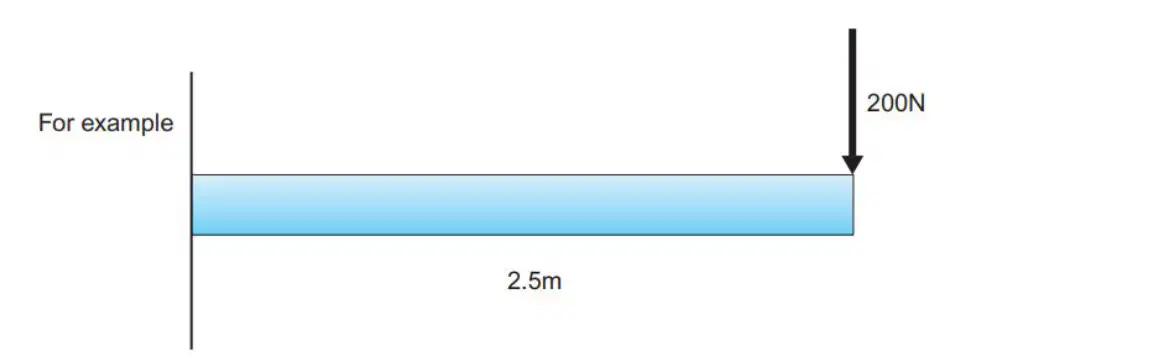
In the given example, what is the bending moment if a force of 200N is applied at a distance of 2.5m?
400 N/m
450 N/m
500 N/m
550 N/m
What is the formula for the moment of force?
Moment of force (Nm) = force (N) x perpendicular distance from the force to the pivot (m)
Moment of force (Nm) = force (N) + perpendicular distance from the force to the pivot (m)
Moment of force (Nm) = force (N) - perpendicular distance from the force to the pivot (m)
Moment of force (Nm) = force (N) / perpendicular distance from the force to the pivot (m)
Why is it easier to undo a tight nut with a spanner rather than by using your fingers?
The spanner handle increases the distance from the pivot, requiring less force to create the moment.
The spanner handle decreases the distance from the pivot, requiring more force to create the moment.
The spanner handle increases the distance from the pivot, requiring more force to create the moment.
The spanner handle decreases the distance from the pivot, requiring less force to create the moment.
What happens to the moment when the distance from the pivot to the line of action of force is large?
The moment is large.
The moment is small.
The moment is zero.
The moment is negative.
What is the unit of measurement for the moment of force?
Newton-meters (Nm)
Newtons (N)
Meters (m)
Kilograms (kg)
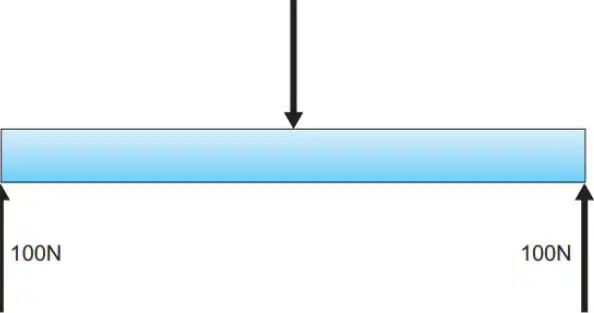
What is the magnitude of the downward force in the given diagram?
100N
200N
300N
400N
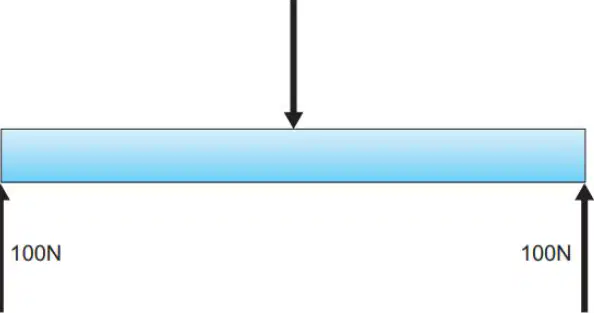
How is the downward force balanced in the given diagram?
By a single upward force of 200N
By two upward forces of 100N each
By a single upward force of 100N
By two upward forces of 200N each
What is the total upward force in the given diagram?
100N
200N
300N
400N
What principle is demonstrated by the forces in the given diagram?
Principle of moments
Principle of conservation of energy
Principle of action and reaction
Principle of work and energy

