
Font size
 Worksheets
Unit 1: Ecosystem Stability
Total questions: 231
Worksheet time: 4hrs 34mins

A pilot fish usually follows behind sharks to pick up food scraps that they leave behind. The fish gets food and the shark is unaffected. This is an example of:
Mutualism
Commensalism
Parasitism
Decomposition


A mongoose eating ticks off a warthog, or a starling eating ticks off a cow are examples of what type of symbiotic relationship?
Cooperation
Parasitism
Commensalism
Mutualism

A feeding relationship where one organism hunts and one is hunted, such as a Lynx hunting a snowshoe hare, is known as:
Commensalism
Decomposistion
Mutualism
Predator-Prey
The maximum population size of a species that the environment can sustain:
Prey
Decomposer
Carrying Capacity
Commensalist

An organism that helps to recycle nutrients within an ecosystem by eating dead or decaying organisms, such as a mushroom, is a:
Predator
Autotroph
Producer
Decomposer

In the relationship between the Giant Trevally and the seabird, the seabird is the:
Predator
Decomposer
Prey
Autotroph

A general term for a relationship that describes a close interaction between two different species is known as what?
Biodiversity
Symbiosis
Predation
Emigration


When they land in a flower, the bees get some pollen on their hairy bodies, and when they land in the next flower, some of the pollen from the first one rubs off, pollinating the plant. This is known as a relationship in which both organisms involved benefit, called:
Predator-Prey
Commensalism
Mutualism
Decomposition

A relationship between two organisms where one benefits while the other is harmed is known as what?
Decomposition
Consummerism
Mutualism
Parasitism

Another word for a plant that makes its own food using energy from sunlight…
photosynthesis
producer
heterotroph
carnivore
herbivore

Which term describes this statement: All the populations of all the different species that live together in a particular area
Mutualism
Community
Commensalism
Predator/Prey

Organisms of two species using the same limited resource and having a negative impact on one another, such as hyenas and lions both hunting zebra, represent what type of relationship?
commensalism
predator-prey
mutualism
competition

A symbiotic relationship between two species in which one benefits and the other is unaffected, such as ants living in a tree, or birds nesting in a tree, is known as:
mutualism
commensalism
parasitism
community
Which of the following statements is NOT true?
A 'host' is an organism that harbours a parasitic, a mutualistic, or a commensalist guest
Interactions between two or more species are called interspecific interactions
Many apparent commensalistic relationships actually turn out to be slightly mutualistic or slightly parasitic when we look at them more closely.
There is Always a clear division between symbiotic relationships.

The Brown-headed Cowbird is a _________ parasite, meaning that it lays its eggs in nests of other species. The foster parents then unknowingly raise the young cowbirds, usually at the expense of their own offspring.
host
decomposing
brood
mutual
Type of relationship: A wolf eating a rabbit.
Predator/prey
Parasite/host
Producer/consumer
Competitors
Type of relationship: cow eating grass.
Predator/prey
Parasite/host
Producer/consumer
Competitors
In a predator-prey relationship, when the population of the predator increases, the population of the prey will ____________.
Increase
Remain Stable
Decrease
Change unpredictably
A honeybee and flower relationship in which the flower provides nectar for the honey and the honey can help pollinate other flowers is an example of ________________.
Mutualism
Parasitism
Commensalism
Competition

An organism that obtains energy from consuming the bodies of other organisms is known as a:
Mutualist
Autotroph
Producer
Heterotroph

Which of the following is true about competition?
Controls population size
Ensures everyone eats
Keeps everyone happy
Is only between 2 males

Wasps often lay their eggs just inside the eggs of butterflies. The wasp larva (baby wasps) are able to get lots of nutrients and protection from the butterfly/caterpillar egg while its developing. After the caterpillar is born, the wasps continue lurking in the flesh of the caterpillar, soaking up more nutrients and drinking its blood. The wasp larva must keep its host alive, so it avoids damaging the vital organs.
What type of symbiosis is being described?
predator/prey
competition
commensalism
parasitism

The animal in an ecological relationship that results in another animal being hunted, killed, and eaten…
autotroph
habitat
predator
herbivore
producer

The non-living part of the natural environment where an animal, plant or other organism lives…
niche
habitat
community
ecosystem
biosphere

This is the job or role of a specific organism within its habitat...
producer
prey
carnivore
niche
photosynthesis

The name of the process that producers use to make their own food…
respiration
commensalism
food chains
photosynthesis
symbiosis

This is transferred between organisms in a food chain and is represented by arrows…
nutrients
photosynthesis
niche
energy
food web
Another word for a plant or other producer that makes its own food using energy from sunlight…
photosynthesis
autotroph
consumer
carnivore
herbivore

What is the term used to describe ALL of the populations of ALL the species of living organisms within a particular habitat?
savanna
wildlife
community
habitat
ecosystem

Where does the energy come from initially for this food chain to work?
Plants

What is the relationship shown?
Predation
Commensalism
Competition
Parasitism
Mutualism


Organisms who are members of the same species in an ecosystem.
Organism
Population
Organ
Community

Group of populations in an area.
Organism
Ecosystem
Community
Biosphere

A biological community that includes various species and their physical environment (Biotic and Abiotic Factors).
Organism
Community
Biosphere
Ecosystem

The diagram shows part of an aquatic food web for a stable lake ecosystem in Connecticut. What is the source of energy for the algae?
waves
sunlight
bacteria
rotifers, water fleas and tadpoles

For the food chain shown, which of the following changes would have the most severe consequences?
a drastic decrease in rainfall, causing a drought
the poaching of predatory hawks by game hunters
the introduction of a second predator that eats field mice
a parasitic infestation that reduces the cricket population

There would be more food for secondary consumers.
The number of primary consumers would increase.
The number of plants would increase.
The number of secondary consumers would increase.
All energy on Earth ultimately comes from what source? (a)
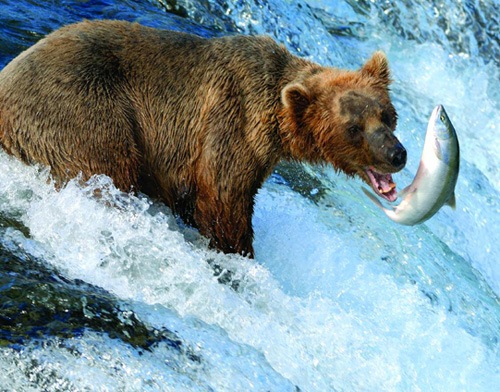


Which of the following is a food chain in the food web?
Rabbit, mountain lion, fox
Grass, grasshopper, frog, snake, hawk
Grass, caterpillar, robin, mountain lion
Tree, deer, mountain lion, fox
Which of the following is defined as a consumer that must get its food from a different source than itself?
Producer
Heterotroph
Autotroph
Homotroph
What is the purpose of a decomposer?
To break down dead materials and waste from consumers
Eat living organisms
Perform photosynthesis to make carbohydrates
Make carbohydrates using chemical energy.

A food web is a single linear path showing the flow of energy from one organism to another. It is not an interconnected relationship diagram of organisms in a community.
TRUE
FALSE

Match the following:
Producer/Autotroph
Plant
Secondary Consumer
Bird
Tertiary Consumer
Snake
Top Predator
Owl
Herbivore
Grasshopper

Why is some energy not passed on to the next trophic level?
The organisms at each level use about 90% of the available energy to live.
The statement is NOT true. All energy IS passed from one trophic level to the next.
The organisms at each level use about 10% of the available energy to live.
Most energy is absorbed by the soil instead.

Only 10% of the energy is passed on from one trophic level to the next. 90% is lost as heat due to cellular respiration or waste.
Tertiary Consumer
Biotic Factor
Abiotic Factor
10% Rule


Which is a SECONDARY CONSUMER in this food web?
Snake
Mouse
Grass
Wildflowers


Using the food web pictured, how many trophic levels does this energy pyramid have ?
5
6
3
4
The transfer (movement) of energy in one direction.
What is the correct order of trophic levels that we see in a food chain, food web, or energy pyramid?
producers --> primary consumers --> secondary consumers --> tertiary consumers
tertiary consumers --> secondary consumers --> primary consumers --> producers
primary consumers --> producers --> secondary consumers --> tertiary consumers
A (a) is a model representing the many interconnected feeding relationships and pathways in which energy flows through a group of organisms

The image depicts a (a) .

The image depicts a (a) .

This image depicts a (a) .

The arrows in a food chain or web represents what?
They point to the organism that is being eaten.
It shows how sunlight flows within an ecosystem.
They show what direction the energy is flowing between organisms.
They represent how water is transferred within a habitat.


If only 10% of the energy in the pyramid is available as you move from one trophic level to the next, what happens to the other 90%?
Passed on to decomposers
Metabolized and "lost" as heat energy and waste
Assembled into tissues of producers permanently
False statement - 100% of the energy is available
breaks down dead plants or animals and breaks down to put nutrients in the soil
Match the following.
Producer
Makes its own food
Consumer
Consume other organisms for food
Decomposer
Breaks down dead organisms into nutrients

The level in an Ecological pyramid that includes all the organisms that share the same place in a food chain.
Trophic Levels
Toxic Levels
KeKe Levels
Environmental Systems

Matter is passed up the ecological pyramid in a similar way to energy but recycled by decomposers and detritivores. This Biomass pyramid roughly follows the 10% rule as well.
Flow of energy
Flow of matter
Ecological Hysteria
Producers
What are "apex predators?"
primary consumers
top predators
producers
homeostasis (in an ecosystem)
The number of different species in an area
An environmental factor that prevents a population from increasing
ecosystem has to maintain stable condition in order for all organisms to survive
The removal of trees faster than forests can replace themselves.
keystone species
a system of interlocking and interdependent food chains.
All the living organisms that inhabit an environment
A series of steps in which organisms transfer energy by eating and being eaten
a species on which other species in an ecosystem largely depend, such that if it were removed the ecosystem would change drastically.

A species that plays a critical role in the health, maintenance, growth, or definition of an ecosystem.
keystone
invasive
engineer
predator
One of the defining characteristics of a (a) species is that it fills a critical (b) role that no other (c) can. Without them, the entire (d) would radically change-or cease to (e) altogether.

Place the energy in the correct order from the bottom of the pyramid to the top.
100 kg, 10000 kg, 1 kg
1 kg, 10 kg, 100 kg, 1000 kg
1000 kg, 100 kg, 10 kg, 1 kg
10 kg, 100 kg, 1000 kg, 1 kg

What process converts nitrogen gas into a biologically useful (fixed) form?
Respiration
Assimilation
Denitrification
Nitrogen fixation
Which organisms play the largest role in converting nitrogen into various usable forms and back to a gas form?
rabbits
bacteria
plants
worms
How do animals get nitrogen to make important biological molecules?
Breathe it in through the air
Fix it from nitrogen gas
Consume other organisms
Assimilate it through the soil
Which of the following cannot fix nitrogen?
lightning
fertilizer production
combustion
rain
Which of the following is not a possible process that results in ammonification?
photosynthesis
decomposition
nitrogen fixation
fertilizer production
Carbon moves between which two reservoirs through the process of diffusion?
atmosphere & biosphere
atmosphere & lithosphere
lithosphere & biosphere
hydrosphere & atmosphere
What happens to carbon during the process of photosynthesis?
CO2 is released by plants
CO2 is taken up by plants
organic carbon is taken up through plant roots
carbon is lost through heat
All the gases surrounding Earth are known collectively as the...
hydrosphere
biosphere
atmosphere
lithosphere
The process of breathing in oxygen and releasing carbon dioxide into the air (or water) is...
Assimilation
Decomposition
Photosynthesis
Respiration
Which of the following best describes weathering and erosion?
when it rains on rocks
decay of dead organisms
break down of rocks that wash into the water
when a volcano erupts
Which of the following best describes the Greenhouse Effect?
when solar radiation reflects off the atmosphere
heat is retained in Earth's atmosphere by greenhouse gases
plants grow better when a greenhouse is filled with CO2
when solar radiation hits Earth's surface directly
Which gas is most abundant in the atmosphere?
carbon dioxide
methane
nitrous oxide
nitrogen gas
Which of the following does NOT release carbon dioxide into the atmosphere?
volcanic activity
respiration
photosynthesis
fossil fuel combustion
The most abundant Greenhouse Gas in the atmosphere is...
carbon dioxide
nitrogen gas
nitrate
oxygen
The process of making nitrites and nitrates is...
denitrification
nitrogen fixation
nitrification
ammonification
What does denitrification do?
converts fixed nitrogen into nitrogen gas
converts nitrogen gas into fixed nitrogen
makes nitrates
makes ammonia
Which of the following is not a form of fixed nitrogen?
ammonia
nitrogen gas
nitrate
nitrite
Which of the following best describes the movement of nitrogen between reservoirs in the process of assimilation?
from the soil into plants
from the air into plants
from the air into soil
from soil into animals
The process that releases carbon and nitrogen into the soil through decay is...
erosion
photosynthesis
decomposition
assimilation
Which of the following would not be included in the hydrosphere?
ocean
trees
surface water
groundwater

How does carbon in a grass plant get into a lion?
The lion eats an antelope that ate the grass
Carbon from grass doesn't end up in a lion.
The lion absorbs the carbon given off by transpiration
The lion breathes in carbon given out by the plant
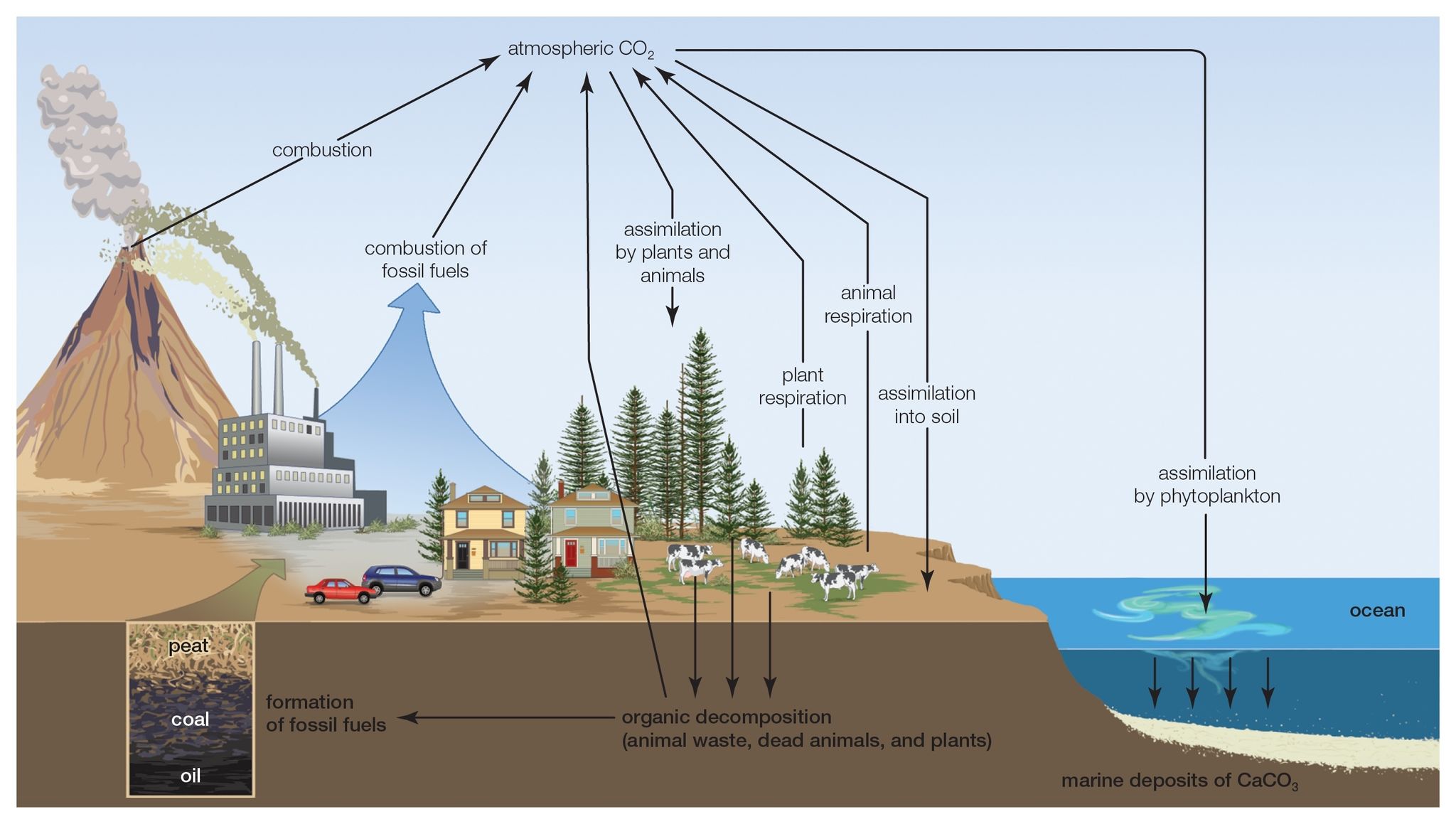
Which describes the relationship between plants and animals in the carbon cycle?
Plants produce and release oxygen that animals need
Plants produce and release carbon dioxide that animals need
Animals produce and release oxygen that plants need
Animals produce oxygen that plants turn into carbon dioxide


features of environment that are alive or were once alive
biotic
abiotic
inbiotic
biography

How nitrogen is "fixed" into useable form for plants
only through action of bacteria
only through lightning
through action of bacteria & lightning
through photosynthesis

What part of the carbon cycle is represented by A?
photosynthesis
decomposition
combustion
cellular respiration

What part of the carbon cycle is represented by cow releasing CO2 back into the atmosphere?
photosynthesis
decomposition
respiration
combustion

What part of the carbon cycle is represented by C?
combustion
decomposition
cellular respiration
photosynthesis

What part of the carbon cycle is represented by factories burning fossil fuels?
combustion
cellular respiration
photosynthesis
decomposition

Which of the following organisms is a producer?
grass
rabbit
fox
snake
Which of the following organisms is a primary consumer?
grass
rabbit
fox
snake
Which of the following organisms is a herbivore?
grass
rabbit
fox
snake


In this food web, the lion is a _________________
Producer
Primary Consumer
Secondary Consumer
Tertiary Consumer

In this food web, the skunk is a ________________________
Producer
Primary Consumer
Secondary Consumer
Tertiary Consumer
Biodiversity, aka biological diversity, usually refers to
the same species in a general location
the number of different species in a given area
the number of animal species in a given area
the number of plant species in a given area
A species that is likely to become extinct if protective measures are not taken immediately is known as
threatened species
endemic species
keystone species
endangered species
Which applies to this environmental problem:
Invasive carp are fast-growing, aggressive, and adaptable fish that are outcompeting native fish species for food and habitat in much of the mid-section of the United States.
Habitat Loss
Invasive Species
Pollution
Population Growth
Over-exploitation
Which applies to this environmental problem:
Humans produce an excessive amount of artificial light which can interfere with natural cycles of light/dark in an environment and can confuse animals.
Habitat Loss
Invasive Species
Pollution
Population Growth
Over-exploitation
How is the current decline in biodiversity different from the previous mass extinctions that Earth has experienced?
It is happening much more slowly
This time it is not really happening
It is made worse by an asteroid hitting Earth
This is being caused by humans
Which of the following is NOT a way in which humans are destroying habitats?
Gathering rain water to use to water crops
Clearing out prairies to grow a single crop
Cutting trees to use as toilet paper
Building a shopping mall with a large parking lot
The excessive use of species that have economic value is known as
pollution
habitat destruction
over - exploitation
climate change
What is an invasive species?
An organism that is new to an environment that has positive effects on the environment.
An organism that is native to an environment that has negative effects on the environment.
An organism that is new to an environment that has negative effects on the environment.
An organism that is native to an environment that has positive effects on the environment.
Which applies to this environmental problem:
The zebra mussel is outcompeting native species and causing damage in the Missouri River.
Habitat Loss
Invasive Species
Pollution
Population Growth
Over-exploitation
Which applies to this environmental problem:
As more people are added to the Earth, more resources are required to meet their needs.
Habitat Loss
Invasive Species
Pollution
Population Growth
Over-exploitation
Which applies to this environmental problem:
The albatross are dying from eating plastic items that look like food.
Habitat Loss
Invasive Species
Pollution
Population Growth
Over-exploitation
Which applies to this environmental problem:
Shark fin soup is consumed by millions of people in South East Asia.
Habitat Loss
Invasive Species
Pollution
Population Growth
Over-exploitation
The hottest spots for species diversity are close to the _____________.
Coast
Florida
Equator
Poles
True or False: Human beings are wiping out species much faster than nature creates them, causing what scientists call a "6th extinction"
true
false
If a scientist in New Zealand was studying how a group of herbivores interacted with a group of omnivores, and all of their abiotic surroundings, what level of ecology would she be studying? (a)
If there are 100 KJ of energy available at the secondary consumer level, how many KJ of energy are available at the producer level?
(a)

In this energy pyramid, which type of consumer gets only 10% of the energy stored in plants? (a)
Honey guide birds alert and direct badgers to bee hives. The badgers then expose the hives and feed on the honey first. Then, the honey guide birds eat as well.
(a)

Vines grow on a tree. The vines get light but the tree is not affected. What kind of relationship is this?
(a)

The fox in this food web would be considered a: (a)

The populations of which organisms will most likely increase as a result of a disease that suddenly reduced the population of Texas horned lizards?
Grasses and ants
Ants and grasshoppers
Grasshoppers and Texas Cottonmouths
Texas cottonmouths and red shouldered hawks
Decomposer
This is an organism that breaks down and gains nutrients from dead organisms.
Predator
This is an animal that lives by preying on other animals.
Producer
This is an organism that supplies matter and energy, also known as an autotroph.
Consumer
This is an organism that relies on other organisms for its food and energy supply; heterotroph
Parasite
This is an organism which feeds on, but usually does not kill, a larger organism
Grass > Grasshopper > Bird > Snake


To get energy
To make amino acids
To make proteins
To make carbohydrates
bacteria
fungi
rain
plants
How has the invasion of pythons affected the everglades ecosystem in terms of species numbers?
The pythons could upset the territorial boundaries of native organisms.
The pythons could adapt to overcome diseases common to native snakes.
The pythons could prey on native organisms and cause native populations to decline.
The pythons could begin to interbreed with native snakes and produce a more successful species.
Select the decomposer(s).
Select the secondary consumer(s).
Select the primary consumer(s).

A partial food web is shown above.
Which of the following will most likely occur if the grouse population decreases?
The butterfly population will increase.
The red-tailed hawk population will increase.
Emigration of grizzly bears and deer will increase.
Competition between grizzly bears and deer will increase.


If there are 100 KJ of energy available at the secondary consumer level, how many KJ of energy are available at the producer level?
10 KJ
1,000 KJ
10,000 KJ
1 KJ
1. Why is it unusual for a large number of organisms to be present at the top of an ecological pyramid?
A. Animals at the top of the pyramid are the largest.
B. Animals at the top have shorter lives.
C. The amount of energy available by the time the top of the pyramid is reached is not enough to sustain many individuals.
D. Humans are most interested in hunting animals occupying the top level of the ecological pyramid.
Reorder the following from sun to tertiary consumer


Match the following

Food Web

Food Chain

FLOW OF ENERGY
Carbon (a) is a greenhouse gas. That means that it traps (b) .
Label the following Carbon cycle.
Label the following Carbon cycle.

The amount of energy the producers in this energy pyramid provide the primary consumer is 54,000 joules. Based on this model, how much of the energy was provided to secondary consumers?
53,460 J
5,400 J
540 J
54 J

Part of a hydrothermal vent food web is represented in the diagram. Which organisms are both secondary and tertiary consumers in this food web?
Chemosynthetic bacteria and amphipods
Zooplankton and mussels
Ratfish and octopuses
Galatheid crabs and zoarcid fish
Which type of organisms produce the most amount of energy?
Producers
(plants)
Primary Consumers
(grass hopper)
Secondary Consumers
(spider)
Tertiary
Consumer
(bird)

What percent of energy is gained between each tropic level on the energy pyramid?
Type answer as _ _%
(a)

Developers bulldozed a forest to build a new subdivision. How does this effect the atmosphere?
Less carbon dioxide would be removed from the atmosphere
An increase in animal respiration would increase the release of carbon dioxide in the area
More sugars and starches would be available for animals in the area
There would be no change in the atmosphere

Which of these organisms would be placed at the top of an energy pyramid?
Racoon
Eastern mud turtle
American Alligator
Southern leopard frog
Label the biological levels of organization.
Our bodies have levels of organization that build upon each other. Our (a) make up tissues, (b) make up organs, and organs make up (c) .
Deer consume many different kinds of vegetation. Coyotes are known to eat deer. When a coyote dies, bacteria help break down the dead animal. What role do bacteria play in this environment?
Producer
Decomposer
Photosynthesizer
Consumer

Look at the food web diagram.
Based on the diagram, which would be a reasonable flow of energy in the ecosystem.
Sun ---> plant seeds ---> deer
Plant seeds ---> field mouse ---> robin
Eagle ---> deer ---> plant seeds
Grass ---> deer ---> mountain lion
Select the secondary consumer.

Which level of organization is a community of living (biotic) and non-living (abiotic) things that interact with each other?
Population
Ecosystem
Community
Biosphere
A student makes a model to represent the levels of biological organization, as shown.
If the top of the pyramid represents the basic unit of life, how should each section be labeled?

A table with four organisms and their primary role in an ecosystem is shown.
Based on the table, which trophic pyramid is correct?


Match the following levels of classification to their definitions:
1 individual
Organism
All the same species
Population
All the different living things
Community
All the biotic and abiotic things
Ecosystem

In the energy pyramid here, which organisms have the most energy available?
Producers
Carnivores
Herbivores
Top Predator
Name that ecological level!
Biome
A grassland.
Bioshpere
All of Earth.
Population
A school of clownfish in an anemone.
Community
All of the living things in Lake Ida.
Organism
Shamu the whale.
Drag each vocabulary word UNDER the picture that best describes it.
Organism
Population
Community
Ecosystem
Match the following
feeds only other animals
carnivore
feeds only on plants
herbivore
feeds on both plants and animals
omnivore
feeds on dead organisms
decomposer
feeds itself
producer
Match the following organism with an example
Grasses
Producer
Primary Consumer
Eats producers
Secondary Consumer
Eats herbivores
Decomposer
Fungi
Match the following consumers and producers?
producer
make its own food through the sun
decomposers
gets energy/nutrients from dead matter
carnivore
gets energy from eating meat
omnivore
gets energy from eating meat and vegetation
herbvivore
gets energy from eating vegetation
eats only plants
herbivore
eats only dead, decaying organisms
scavenger
eats other animals
carnivore
gets nutrients from breaking down the remains of other organisms
decomposer
eats both plants and animals
omnivore
Beneficial bacteria in our gut
Mutualism
Bacterial infection in an open wound
Parasitism
Bacteria on our skin
Commensalism
Different bacteria filling in any open space first
Competition
Shellfish feading on bacteria through filtration
Predation
Match the relationship to its example
Mutualism
The oxpecker gets a free ride on the zebra's back, the zebra gets bugs removed
Commensalism
Tree fogs use plants as projection at no expense to the plant
Parasitism
A mosquito feeds off of your blood. You are left with an itchy bug bite
Competition
The long horned rams fight for breeding territory
Predation
A shark consumes a swordfish for energy
Match the following types of relationships to their descriptions:
Both organisms are harmed by fighting over a resource
Competition
One organism benefits at the expense of the other
Parasitism
One organism benefits while the other remains neutral
Commensalism
Both organisms benefit (help each other)
Mutualism
Match the following types of relationships to their descriptions:
Both organisms are harmed by fighting over a resource
Competition
One organism benefits at the expense of the other
Parasitism
One organism benefits while the other remains neutral
Commensalism
Both organisms benefit (help each other)
Mutualism
The arrows in a food chain or web represents (a) .
Name that ecological level!
Biome
A grassland.
Bioshpere
All of Earth.
Population
A school of clownfish in an anemone.
Community
All of the living things in Lake Ida.
Organism
Shamu the whale.

Why might an organism have more than one arrow coming FROM them in a food web?
More than one organism may eat them.
They may eat more than one other organism.
This organism gets its energy from multiple sources.
The pearlfish receives protection from predators by living inside a sea cucumber. The sea cucumber is not affected during this interaction. This ecological relationship is known as -
predator-prey because the pearlfish is prey to the sea cucumber
mutualism because only the pearlfish benefits in this ecological relationship
parasitism because the pearlfish causes harm to the host sea cucumber
commensalism because only the pearlfish benefits while the sea cucumber is not affected
competition because the sea cucumber and pearlfish often fight for living space
The study of the relationships of organisms and their environment
Ecology
Population
Biosphere
Any living factor in an organism
Biosphere
Biotic Factor
Abiotic Factor
Any non living factors in an organisms environment
Biotic factor
Abiotic factor
Ecology
When some bacteria convert fixed nitrogen back to nitrogen gas
Nitrogen Fixation
Denitrification
Detrivore
An organism that eats dead matter and returns the nutrients to the soil
Detrivore
Denitrification
Trophic Level
The process of capturing nitrogen and converting it to form usable to plants
Dentrification
Detrivore
Nitrogen fixation
Makes its own food from sunlight
Autotroph
Heterotroph
Carnivore

Reorder the Trophic Levels beginning with the level that holds the MOST energy.
Producer
Primary Consumer
Secondary Consumer
Tertiary Consumer
Quaternary Consumer
FOOD WEBS show the network of ____ ____ in an ecosystem.
birth rates
mass starvation
feeding relationships
overgrazing effects

