wayground logo

Free Printable Worksheets

Font size

S
M
L
XL
Worksheets

Biogeochemical Cycles Practice

Total questions: 157

Worksheet time: 1hrs 19mins

Name
Class
Date
1.
Which is NOT a process of the water cycle?
a)
precipitation
b)
freezing
c)
transpiration
d)
evaporation
2.
The process of plants losing water through their leaves is called ____.
a)
condensation
b)
evaporation
c)
transpiration
d)
exhaling
3.

Why do living things need nitrogen?

a)

To get energy

b)

To make amino acids

c)

To make proteins

d)

To make proteins AND amino acids

4.
What is the only process that removes carbon from the atmosphere?
a)
combustion
b)
cellular respiration
c)
photosynthesis
d)
decomposition
5.
Where is carbon stored in the environment?
a)
Fossil fuels
b)
Wood of trees
c)
Calcium carbonate (shells and bones)
d)
All of the above
6.
These gases, such as carbon dioxide, trap heat in the Earth's atmosphere causing global warming
a)
Global warming gases
b)
Hot House gases
c)
Green House gases
d)
Thermal pollution
7.
A particular golf course is using large amounts of nitrogen fertilizer. What process could move this nitrogen into a local stream?
a)
volatilization
b)
nitrogen fixation
c)
runoff
d)
ammonification
8.
What converts nitrogen into a useable form for plants and animals?
a)
bacteria
b)
fungi
c)
rain
9.
Which nutrient is not cycled through the atmosphere?
a)
carbon
b)
nitrogen
c)
phosphorous
d)
water
10.
This is released by the weathering of rocks.
a)
Carbon
b)
Oxygen
c)
Phosphorus
d)
Nitrogen
11.

What cycle are fossil fuels part of ?

a)

carbon

b)

oxygen

c)

nitrogen

d)

phosphorus

12.

What is the largest reservoir for water?

a)

the ocean

b)

rocks and minerals

c)

the atmosphere

d)

glaciers

13.

Where is the largest reservoir for the phosphorus cycle?

a)

rocks and minerals

b)

the ocean

c)

the atmopshere

d)

fossil fuels

14.

What is the largest reservoir for nitrogen?

a)

the ocean

b)

rocks and minerals

c)

the atmosphere

d)

bacteria

15.
Carbon dioxide is added to the atmosphere by
a)
Burning fossil fuels 
b)
Cellular respiration
c)
Decomposing organic matter
d)
All answers are correct
16.
Which is NOT a process of the water cycle?
a)
precipitation
b)
freezing
c)
transpiration
d)
evaporation
17.
The process of plants losing water through their leaves is called ____.
a)
condensation
b)
evaporation
c)
transpiration
d)
exhaling
18.
What are the swellings found on the roots of legumes called?
a)
noodles
b)
nodularisms
c)
nodules
d)
tubers
19.
What is the only process that removes carbon from the atmosphere?
a)
combustion
b)
cellular respiration
c)
photosynthesis
d)
decomposition
20.
These gases, such as carbon dioxide, trap heat in the Earth's atmosphere causing global warming
a)
Global warming gases
b)
Hot House gases
c)
Green House gases
d)
Thermal pollution
21.
The elements carbon, oxygen, hydrogen and nitrogen combined make up about 96% of our bodies (carbon is about 18%).  Carbon is necessary for life because it is a(n)
a)
uncommon element in all living things.
b)
element found only in the atmosphere
c)
excellent bonder
d)
is found mostly in dead things.
22.
Respiration is the process by which ____________ is consumed and _______________ is produced.
a)
Carbon, Oxygen
b)
Oxygen, Carbon dioxide
c)
H20, oxygen
d)
Carbon, H2O
23.
This process is responsible for most environmental problems of excess nitrogen and phosphorus entering streams, lakes and oceans.
a)
decomposition
b)
emissions from automobiles
c)
agriculture and house hold runoff
d)
photosynthesis
24.
Which of the following is known as the "sedimentary" cycle because its reservoir is sedimentary rock?
a)
Sulfur cycle
b)
Nitrogen cycle
c)
Phosphorus cycle
d)
Carbon cycle
25.
Phosphorous is needed in organisms for the production of
a)
ADP and ATP.
b)
Cellular membranes.
c)
Deoxyribonucleic and ribonucleic acids.
d)
All of the answers are correct
26.
N03 is also known as 
a)
ammonia
b)
nitrite
c)
nitrogen
d)
nitrate
27.
This is released by the weathering of rocks.
a)
Carbon
b)
Oxygen
c)
Phosphorus
d)
Nitrogen
28.
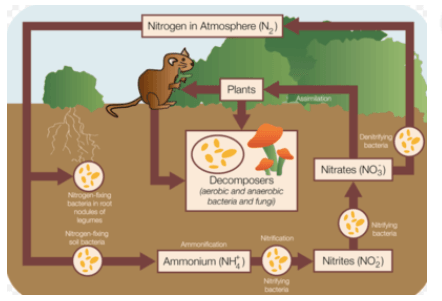
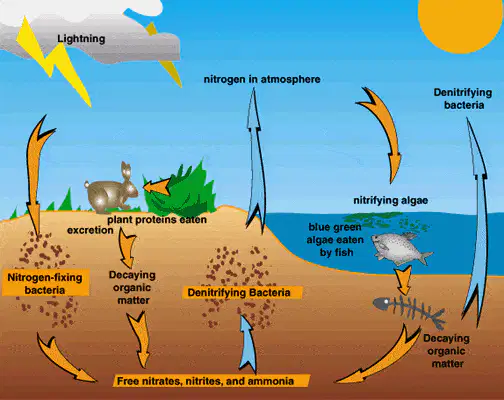
Identify the cycle pictured.
a)
The Water cycle
b)
The Carbon cycle
c)
The Nitrogen cycle
d)
The Phosphorus cycle
29.
Identify the cycle pictured.
a)
The Water cycle
b)
The Carbon cycle
c)
The Nitrogen cycle
d)
The Phosphorus cycle.
30.
How do animals get nitrogen?
a)
the atmosphere 
b)
eating other organisms
c)
rainwater
d)
lightning 
31.
What is the hydrosphere?
a)
Water on the earth's surface
b)
Oceans of the Earth
c)
Rivers, oceans and lakes of the Earth
d)
None of the above
32.
Using fossil fuels is a safe for the environment. 
a)
True
b)
False
33.
Organisms require nitrogen to make which of the following?
a)
glucose and starch
b)
lipids and nucleic acids
c)
proteins and nucleic acids
d)
carbohydrates and proteins
34.
What is the energy source for the water cycle?
a)
the sun
b)
the earth
c)
water
d)
the moon
35.
What is condensation?
a)
The part of the water cycle when the sun heats up water, turning it from a liquid into water vapor or steam. It rises from the ground into the air.
b)
The part of the water cycle when the water vapor in the air gets cold. The water turns back into a liquid and forms clouds.
c)
The part of the water cycle when clouds get heavy and can no longer hold the liquid water. This causes the water to fall from the sky to the earth as rain, snow, sleet, or hail.
36.

Where does the phosphorous cycle begin?

a)

Rocks

b)

Atmosphere

c)

Plants

d)

Animals

37.

Which cycle is considered the slowest?

a)

Carbon

b)

Hydrologic (Water)

c)

Phosphorous

d)

Nitrogen

38.

What is the process called when bacteria change nitrates into nitrogen gas, returning it back into the atmosphere?

a)

Nitrification

b)

Nitrogen Fixation

c)

Ammonification

d)

Denitrification

39.

All of the following are fossil fuels EXCEPT...?

a)

Oil

b)

Soil

c)

Natural Gas

d)

Coal

40.

Which cycle is driven by the Sun?

a)

Nitrogen

b)

Hydrologic (Water)

c)

Carbon

d)

Phosphorous

41.

Liquid water that runs along the surface and collects into a river, lake, or ocean is called?

a)

Infiltration

b)

Groundwater

c)

Surface Runoff

d)

Evaporation

42.

Rain, snow, sleet, and hail are examples of what?

a)

Precipitation

b)

Evaporation

c)

Condensation

d)

Transpiration

43.

Which of the following must occur before precipitation can occur?

a)

Surface Runoff

b)

Evaporation

c)

Condensation

d)

Transpiration

44.

Which process captures carbon dioxide from the atmosphere and uses it to make sugar?

a)

Deforestation

b)

Cellular Respiration

c)

Photosynthesis

d)

Pollution

45.

How do humans negatively impact the nitrogen cycle?

a)

Fertilizers causing Eutrophication

b)

Urinating

c)

Littering

d)

Cleaning/Purifying Water

46.

is the process in which the sun heats liquid water to vapor and it rises into the atmosphere.

(a)  

47.

What is the main thing that carries out Nitrogen Fixation?

a)

Lightning

b)

Bacteria

c)

Plants

d)

Humans

48.

Describe how human's negatively impact the water cycle (short answer- need detail)

a)

Pollution

b)

Deforestation

c)

Building on and paving areas

d)

All of the above

49.

Describe how humans negatively impact the Carbon Cycle (short answer- need detail)

a)

Cutting down trees

b)

Eating plants

c)

Combustion (putting CO2 into the atmosphere)

d)

Cellular Respiration

50.

The systems that recycle the chemical elements & water that are needed by organisms in their ecosystems are called ___. They use both abiotic and biotic factors from the environment.

a)

biogeochemical cycles

b)

exchange pool

c)

condensation

d)

photosynthesis

51.

Living things such as trees, insects, fish, and bacteria are known as

a)

Biotic factors

b)

Abiotic factors

52.

Nonliving things such as rocks, water and air are known as

a)

Biotic Factors

b)

Abiotic Factors

53.

True or False. Nitrogen is found in the atmosphere.

a)

True

b)

False

54.
The process of plants losing water through their leaves is called ____.
a)
condensation
b)
evaporation
c)
transpiration
d)
exhaling
55.
Which nutrient is not cycled through the atmosphere?
a)
carbon
b)
nitrogen
c)
phosphorous
d)
water
56.
Which is NOT a process of the water cycle?
a)
precipitation
b)
freezing
c)
transpiration
d)
evaporation
57.
The process of plants losing water through their leaves is called ____.
a)
condensation
b)
evaporation
c)
transpiration
d)
exhaling
58.
What is the only process that removes carbon from the atmosphere?
a)
combustion
b)
cellular respiration
c)
photosynthesis
d)
decomposition
59.
Where is carbon stored in the environment?
a)
Fossil fuels
b)
Wood of trees
c)
Calcium carbonate (shells and bones)
d)
All of the above
60.
What converts nitrogen into a useable form for plants and animals?
a)
bacteria
b)
fungi
c)
rain
61.
Which nutrient is not cycled through the atmosphere?
a)
carbon
b)
nitrogen
c)
phosphorous
d)
water
62.
This is released by the weathering of rocks.
a)
Carbon
b)
Oxygen
c)
Phosphorus
d)
Nitrogen
63.

What cycle are fossil fuels part of ?

a)

carbon

b)

oxygen

c)

nitrogen

d)

phosphorus

64.

Where is the largest reservoir for the phosphorus cycle?

a)

rocks and minerals

b)

the ocean

c)

the atmopshere

d)

fossil fuels

65.

What is the largest reservoir for water?

a)

the ocean

b)

rocks and minerals

c)

the atmosphere

d)

glaciers

66.

What is the largest reservoir for nitrogen?

a)

the ocean

b)

rocks and minerals

c)

the atmosphere

d)

bacteria

67.

A particular golf course is using large amounts of nitrogen fertilizer. What process could move this nitrogen into a local stream?

a)

volatilization

b)

nitrogen fixation

c)

runoff and leaching

d)

ammonification

68.

Nitrogen fixation is the process in which certain bacteria convert nitrogen gas into

a)

liquid nitrogen

b)

nitrates

c)

nitrites

d)

ammonia

69.

Plant roots directly obtain water from

a)

Water vapor

b)

Groundwater stored below the soil

c)

Precipitation

d)

Water runoff from rivers and streams

70.

Phosphorus is released from rock through ________

a)

decomposition

b)

evaporation

c)

weathering

d)

transpiration

71.
Matter can recycle through the biosphere because
a)
matter does not change into new compounds.
b)
matter is assembled into chemical compounds.
c)
biological systems do not use up matter, they transform it.
d)
biological systems use only carbon, oxygen, hydrogen, and nitrogen.
72.
What is this a picture of?
a)
Nitrogen cycle
b)
carbon cycle
c)
water cycle
d)
plant cycle
73.
The repeated movement of water between Earth’s surface and the atmosphere is called
a)
the water cycle.
b)
the condensation cycle.
c)
precipitation.
d)
evaporation.
74.

What is happening to water at D in Figure 3–3?

a)

Water is falling to the ground as precipitation.

b)

Water is evaporating from the ocean.

c)

Water is being taken up by plants through transpiration.

d)

Water is seeping into the ground to become groundwater.

75.

Which part of Figure 3–3 shows transpiration?

a)

A on the left

b)

B on the left

c)

A on the right

d)

B on the right

76.
Nitrogen fixation is carried out primarily by
a)
humans.
b)
plants.
c)
bacteria.
d)
consumers.
77.
Organisms need nutrients in order to
a)
utilize hydrogen and oxygen.
b)
carry out essential life functions.
c)
recycle chemical compounds.
d)
carry out nitrogen fixation.
78.
The movements of energy and nutrients through living systems are different because
a)
energy flows in one direction, and nutrients recycle.
b)
energy is limited in the biosphere, and nutrients are always available.
c)
nutrients flow in one direction, and energy recycles.
d)
energy forms chemical compounds, and nutrients are lost as heat.
79.
If a lake receives a large input of a limiting nutrient, which of these would happen first?
a)
An algal bloom occurs.
b)
Algae begin to die and decomposers take over.
c)
Nitrogen compounds are recycled.
d)
The concentration of oxygen drops below the necessary level.
80.
Which of the following is a limiting nutrient in an aquatic ecosystem?
a)
Nitrogen
b)
Carbon
c)
Water
d)
Oxygen
81.
How does carbon dioxide leave the atmosphere?
a)
Through transpiration
b)
Through photosynthesis
c)
Through factory emission
d)
Sunlight
82.
Which process takes Carbon Dioxide from the air and converts it into a form of carbon used by living things?
a)
Precipitation
b)
Photosynthesis
c)
Respiration
d)
Bioremdiation
83.
These gases, such as carbon dioxide, trap heat in the Earth's atmosphere causing global warming
a)
Global warming gases
b)
Hot House gases
c)
Green House gases
d)
Thermal pollution
84.
Respiration is the process by which ____________ is consumed and _______________ is produced.
a)
Carbon, Oxygen
b)
Oxygen, Carbon dioxide
c)
H20, oxygen
d)
Carbon, H2O
85.
Organisms use nitrogen to form
a)
carbohydrates and lipids
b)
proteins and lipids
c)
lipids and nucleic acids
d)
proteins and nucleic acids
86.

More carbon dioxide (CO2) is released in the atmosphere today than in the past because of

a)

the level of nitrogen in the air.

b)

the burning of fossil fuels.

c)

the breakdown of ammonia into nitrites.

d)

chemical erosion.

87.

Which of the gases below contributes most to the greenhouse effect?

a)

NO2

b)

CFCs

c)

CO2

88.

A biogeochemical cycle explains:

a)

The formation of stars and planets.

b)

why certain animals are known as keystone animals.

c)

the flow of chemical elements between living organisms and the environment.

89.

The products of respiration are:

a)

O2 + Food

b)

CO2 + H2O + Energy

c)

CO2 + H2O + Sunlight

90.

The reactants for photosynthesis are:

a)

O2

b)

C6H12O6 + O2

c)

CO2 + H2O + Sunlight

91.
Matter can recycle through the biosphere because
a)
matter does not change into new compounds.
b)
matter is assembled into chemical compounds.
c)
biological systems do not use up matter, they transform it.
d)
biological systems use only carbon, oxygen, hydrogen, and nitrogen.
92.
What is this a picture of?
a)
Nitrogen cycle
b)
carbon cycle
c)
water cycle
d)
plant cycle
93.
The repeated movement of water between Earth’s surface and the atmosphere is called
a)
the water cycle.
b)
the condensation cycle.
c)
precipitation.
d)
evaporation.
94.

What is happening to water at D in Figure 3–3?

a)

Water is falling to the ground as precipitation.

b)

Water is evaporating from the ocean.

c)

Water is being taken up by plants through transpiration.

d)

Water is seeping into the ground to become groundwater.

95.

Which part of Figure 3–3 shows transpiration?

a)

A on the left

b)

B on the left

c)

A on the right

d)

B on the right

96.
Nitrogen fixation is carried out primarily by
a)
humans.
b)
plants.
c)
bacteria.
d)
consumers.
97.
Organisms need nutrients in order to
a)
utilize hydrogen and oxygen.
b)
carry out essential life functions.
c)
recycle chemical compounds.
d)
carry out nitrogen fixation.
98.
The movements of energy and nutrients through living systems are different because
a)
energy flows in one direction, and nutrients recycle.
b)
energy is limited in the biosphere, and nutrients are always available.
c)
nutrients flow in one direction, and energy recycles.
d)
energy forms chemical compounds, and nutrients are lost as heat.
99.
If a lake receives a large input of a limiting nutrient, which of these would happen first?
a)
An algal bloom occurs.
b)
Algae begin to die and decomposers take over.
c)
Nitrogen compounds are recycled.
d)
The concentration of oxygen drops below the necessary level.
100.
Which of the following is a limiting nutrient in an aquatic ecosystem?
a)
Nitrogen
b)
Carbon
c)
Water
d)
Oxygen
101.
How does carbon dioxide leave the atmosphere?
a)
Through transpiration
b)
Through photosynthesis
c)
Through factory emission
d)
Sunlight
102.
Which process takes Carbon Dioxide from the air and converts it into a form of carbon used by living things?
a)
Precipitation
b)
Photosynthesis
c)
Respiration
d)
Bioremdiation
103.
These gases, such as carbon dioxide, trap heat in the Earth's atmosphere causing global warming
a)
Global warming gases
b)
Hot House gases
c)
Green House gases
d)
Thermal pollution
104.
Respiration is the process by which ____________ is consumed and _______________ is produced.
a)
Carbon, Oxygen
b)
Oxygen, Carbon dioxide
c)
H20, oxygen
d)
Carbon, H2O
105.
Organisms use nitrogen to form
a)
carbohydrates and lipids
b)
proteins and lipids
c)
lipids and nucleic acids
d)
proteins and nucleic acids
106.

More carbon dioxide (CO2) is released in the atmosphere today than in the past because of

a)

the level of nitrogen in the air.

b)

the burning of fossil fuels.

c)

the breakdown of ammonia into nitrites.

d)

chemical erosion.

107.

Which of the gases below contributes most to the greenhouse effect?

a)

NO2

b)

CFCs

c)

CO2

108.

A biogeochemical cycle explains:

a)

The formation of stars and planets.

b)

why certain animals are known as keystone animals.

c)

the flow of chemical elements between living organisms and the environment.

109.

The products of respiration are:

a)

O2 + Food

b)

CO2 + H2O + Energy

c)

CO2 + H2O + Sunlight

110.

The reactants for photosynthesis are:

a)

O2

b)

C6H12O6 + O2

c)

CO2 + H2O + Sunlight

111.
What is this a picture of?
a)
Nitrogen cycle
b)
carbon cycle
c)
water cycle
d)
plant cycle
112.
How does N2 get into soil?
a)
N2 diffuses into the pore spaces between the soil particles
b)
Legumes pull it in.
c)
gravity.  It's not just a good idea, it's the Law.
d)
1st Law of Thermodynamics
113.
How does carbon dioxide leave the atmosphere?
a)
Through transpiration
b)
Through photosynthesis
c)
Through factory emission
d)
Sunlight
114.
Which process takes Carbon Dioxide from the air and converts it into a form of carbon used by living things?
a)
Precipitation
b)
Photosynthesis
c)
Respiration
d)
Bioremdiation
115.
These gases, such as carbon dioxide, trap heat in the Earth's atmosphere causing global warming
a)
Global warming gases
b)
Hot House gases
c)
Green House gases
d)
Thermal pollution
116.
The elements carbon, oxygen, hydrogen and nitrogen combined make up about 96% of our bodies (carbon is about 18%).  Carbon is necessary for life because it is a(n)
a)
uncommon element in all living things.
b)
element found only in the atmosphere
c)
excellent bonder
d)
is found mostly in dead things.
117.
Respiration is the process by which ____________ is consumed and _______________ is produced.
a)
Carbon, Oxygen
b)
Oxygen, Carbon dioxide
c)
H20, oxygen
d)
Carbon, H2O
118.
A particular golf course is using large amounts of nitrogen fertilizer. What process could move this nitrogen into a local stream?
a)
volatilization
b)
nitrogen fixation
c)
runoff
d)
ammonification
119.
Growing legumes such as alfalfa or soy beans increases
a)
denitrification
b)
nitrogen fixation
c)
ammonification
d)
ammonium oxidation
120.
Which of the following describes the role of nitrogen-fixing bacteria in the nitrogen cycle? Nitrogen-fixing bacteria convert
a)
nitrates intro nitrogen gas
b)
ammonia into proteins
c)
nitrogen gas into ammonia
d)
proteins into nitrates
121.
Organisms use nitrogen to form
a)
carbohydrates and lipids
b)
proteins and lipids
c)
lipids and nucleic acids
d)
proteins and nucleic acids
122.
The nitrogen cycle is a biogeochemical cycle because it moves ?
a)
only between living things (biosphere)
b)
only in the soil (geosphere)
c)
between the 4 different spheres
d)
only in the air (atmosphere)
123.
When nitrogen gas is turned in to a form that plants and animals can use is called 
a)
Combustion
b)
Photosynthesis
c)
Decomposition
d)
Nitrogen Fixation
124.
What happens when organisms die and decay? 
a)

Their nitrogen returns to the soil as ammonium and air as atmospheric nitrogen

b)
Their nitrogen becomes tapped in clay and is unusable
c)

Photosynthesis moves carbon to the air as CO2

125.
Carbon dioxide is added to the atmosphere by
a)
Burning fossil fuels 
b)
Cellular respiration
c)
Decomposing organic matter
d)
All answers are correct
126.
During photosynthesis, carbon is moved from which reservoir (sink) to which reservoir (sink)?
a)
From the atmosphere to the terrestrial biosphere.
b)
From the troposphere to the terrestrial biosphere.
c)
From the lithosphere to the terrestrial biosphere.
d)
From the hydrosphere to the terrestrial biosphere
127.
Which of the following processes converts C6H12O6 to an inorganic molecule CO2
a)
translation
b)
photosynthesis
c)
cellular respiration
d)
excretion
128.

Denitrifying bacteria convert

a)

NO3 to N2

b)

NH4+ to NO3

c)

N2 to NH4+

d)

none of these

129.
If the atmosphere is 78% N2, why can't we just get our nitrogen by breathing?
a)
We have no mechanism to break the triple bond of nitrogen between the atoms.
b)
Our lungs would be damaged by the N2.
c)
We need Oxygen for cellular respiration.
d)
The legumes take it up first.
130.
A chlorophyll molecule, the plant pigment that facilitates photosynthesis, is necessary to all plants.  Elements in chlorophyll include carbon and
a)
aluminum
b)
boron
c)
nitrogen
d)
iron
131.

Eutrophication is a man made source when there is too much

a)

oxygen in the atmosphere

b)

phosphates in the geopsphere

c)

Nitrates in the hydrosphere

d)

carbon in the atmosphere

132.
In the carbon cycle, producers take in the gas __
a)
carbon dioxide
b)
oxygen
c)
nitrogen
d)
carbon monoxide
133.
How do living organisms return carbon to the atmosphere in the carbon cycle?
a)
respiration and photosynthesis
b)
 decomposition and respiration
134.
When nitrogen gas is turned in to a form that plants and animals can use is called 
a)
Combustion
b)
Photosynthesis
c)
Decomposition
d)
Nitrogen Fixation
135.
How do  animals get nitrogen?
a)
the atmosphere 
b)
eating other organisms
c)
bacteria
d)
lightning 
136.
What converts nitrogen into a useable form for plants and animals?
a)
bacteria
b)
fungi
c)
rain
137.
Identify the cycle pictured.
a)
The Water cycle
b)
The Carbon cycle
c)
The Nitrogen cycle
d)
The Phosphorus cycle
138.
Identify the cycle pictured.
a)
The Water cycle
b)
The Carbon cycle
c)
The Nitrogen cycle
d)
The Phosphorus cycle
139.
Identify the cycle pictured.
a)
The Water cycle
b)
The Carbon cycle
c)
The Nitrogen cycle
d)
The Phosphorus cycle.
140.
This is released by the weathering of rocks.
a)
Carbon
b)
Oxygen
c)
Phosphorus
d)
Nitrogen
141.
Which nutrient is not cycled through the atmosphere and stays only on ground level?
a)
carbon
b)
nitrogen
c)
phosphorus
d)
water
142.

A correct path that nitrogen could take would be

a)

air -> animals -> plants -> bacteria

b)

animals -> air -> bacteria -> plants

c)

bacteria -> air -> plants -> animals

d)

air -> bacteria -> plants -> animals

143.
How much of the atmosphere is composed of nitrogen gas?
a)
87%
b)
38%
c)
78%
d)
21%
144.
How does carbon dioxide leave the atmosphere and become part of the food chain?
a)
Through transpiration
b)
Through photosynthesis
c)
Through factory emission
d)
Sunlight
145.
What role do animals play in the carbon cycle?
a)
absorb carbon dioxide from the atmosphere
b)
give off carbon dioxide through respiration
c)
combustion
d)
decomposing matter
146.
How does nitrogen become part of the food chain?
a)
Through transpiration by plants
b)
Through uptake of nitrogen compounds in the soil by plants
c)
Through factory emission and combustion of fossil fuels
d)
Sunlight changes nitrogen into usable forms
147.
Where 97% of Earth's water is stored?
a)
Glaciers
b)
pH
c)
Groundwater
d)
Sea water
148.

What is the most abundant gas in the atmosphere?

a)

oxygen

b)

hydrogen

c)

nitrogen

d)

helium

149.

Identify the cycle pictured.

a)

water cycle

b)

phosphorous cycle

c)

carbon cycle

d)

nitrogen cycle

150.

Which cycle involves condensation, evaporation, and precipitation?

a)

nitrogen cycle

b)

motorcycle

c)

carbon cycle

d)

water cycle

151.

Where do you only find carbon?

a)

atmosphere

b)

ocean

c)

earths crust

d)

living things

152.

Which cycle does not include the atmosphere because it is not found as a gas?

a)

carbon

b)

phosphorus

c)

water

d)

nitrogen

153.

Can humans impact the water cycle?

a)

yes

b)

no

154.

Shells contain calcium carbonate, a mixture of calcium and carbon. As shells break down over time it releases carbon into the atmosphere. this is called

a)

erosion

b)

combustion

c)

ingestion

d)

respiration

155.

How much of the atmosphere is composed of nitrogen gas?

a)

21%

b)

1%

c)

78%

156.

If water is falling from the sky, we call it

a)

condensation.

b)

evaporation.

c)

transpiration.

d)

precipitation.

157.

Which process takes Carbon Dioxide from the air and converts it into a form of carbon used by living things?

a)

respiration

b)

photosynthesis

c)

condensation