wayground logo

Free Printable Worksheets

Font size

S
M
L
XL
Worksheets

Unit 1: Fundamentals

Total questions: 45

Worksheet time: 23mins

Name
Class
Date
1.
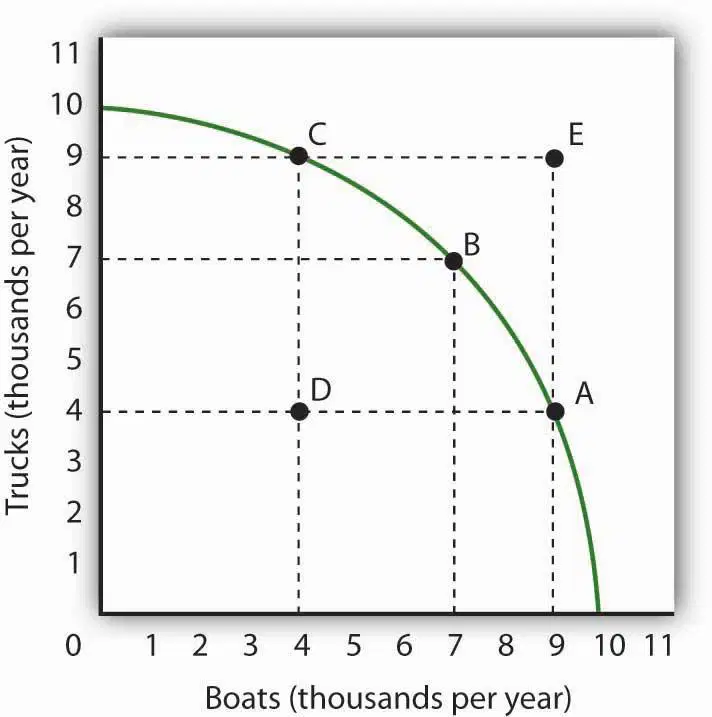
On the PPC, point "A" represents ___________________.
a)
Inefficient production of boats.
b)
Unattainable production of trucks.
c)
Efficient production of both trucks and boats.
d)
Inefficient production of trucks and boats.
2.
The opportunity costs at point A include:
a)
7 Trucks and 2 Boats
b)
6 Trucks and 1 Boat
c)
4 Trucks and 9 Boats
d)
1 Truck and 6 Boats
e)
Inefficient production of trucks and boats.
3.
A tax that imposes a flat rate on any purchased good or service is a ______________________.
a)
Progressive Tax
b)
Regressive Tax
c)
Aggressive Tax
d)
Proportional Tax
4.
Which of the following is the best example of a progressive tax?
a)
A State or Federal income tax.
b)
An excise tax on all nicotine products.
c)
A tariff on European goods.
d)
A sales tax on consumer goods.
5.
Which of the following "non-exclusion" or "shared-consumption" goods or services is NOT funded by the government?
a)
Public Education
b)
News Broadcasting Stations
c)
Municipal Fire Departments
d)
National Defense and Law Enforcement
6.
Which of the following best describes consumer sovereignty in a mixed market economy?
a)

People buy items produced in a planned economy at prices imposed by the government.

b)

Businesses collaborate to force consumers to pay retail prices that will make them the most profit.

c)

People are free to purchase goods and services based on what they like with little government interference or regulation.

d)

Consumer behavior is based mostly on bartering, so supply and demand do not effect prices.

7.
Which of the following is NOT considered a transfer payment?
a)
Welfare
b)
Tax Refunds
c)
Unemployment Checks
d)
Stimulus Checks
8.
Which of the following is NOT one way in which the government protects private property?
a)
Copyrights and Patents
b)
Property Deeds and Titles
c)
Business Licenses and Charters
d)

Car and Home Insurance

9.
A ___________________ occurs when consumption or production of a good creates spillover costs for society as a whole, creating a market failure that the government must financially account for.
a)
negative externality
b)
positive externality
c)
market equilibrium
d)
dead-weight loss
10.

Based on the additional costs to society associated with smoking, the federal government placed an excise tax on the purchase of cigarettes. This is an example of a ____________________ correction.

a)
Market-Based
b)
Monetary
c)
Regulatory
d)
Fiscal
11.
Which arrow depicts government subsidies?
a)
A
b)
B
c)
C
d)
D
12.
In which of the following economic systems does profit motive have NO influence in terms of determining what products will be produced?
a)
Traditional
b)
Command
c)
Market
d)
Communist
13.
Oil and gas shortages in the U.S. during the 1970s were a direct impact of ____________________ placed on these goods by the government, meaning gas stations could not charge above a certain price.
a)
Embargos
b)
Price Floors
c)
Production Quotas
d)
Price Ceilings
14.
In order to protect prices of many agricultural crops, the government will create a ___________________, preventing sellers from selling at or below the market clearing price. This often results in a ______________ of goods that can be stored or redistributed by the government as transfer payments or disaster relief.
a)
Price Floor / Surplus
b)
Price Ceiling / Shortage
c)
Price Floor / Shortage
d)
Price Ceiling / Surplus
15.
Allowing supply and demand to determine the monetary value at which goods and services may be sold is an example of allocating resources based on ______________.
a)
Lottery
b)
Force
c)
Majority Rule
d)
Price
16.

Which of the following corrections would the government most likely implement in order to promote a positive externality?
a)
Government subsidizes the industry to increase production.
b)
Government places an excise tax on the item being consumed.
c)
Government places a quota on the production of a good or service.
d)
Government sets a price ceiling on the specific good being produced.
17.
What is the opportunity cost of this company shifting production from point "C' to point "A" on the PPC?
a)
5 boats.
b)
9 trucks.
c)
7 boats.
d)
5 trucks.
18.
_______________ is the social science that studies the production, distribution, and consumption of goods and services in order to satisfy unlimited wants and needs with limited resources.
a)
Logistics
b)
Personal Finance
c)
Economics
d)
Specialization
19.
_________________________ is the basic economic condition of unlimited wants and limited resources; requires people to make decisions about how to allocate resources efficiently.
a)
Scarcity
b)
Incentives
c)
Opportunity Costs
d)
Trade-Offs
20.
The __________________ is the next best choice/product that is missed or given up when an investor, individual, or business chooses one alternative over another.
a)
Trade-Off
b)
Opportunity Cost
c)
Incentive
d)
Scarcity Cost
21.
Which of the following is not one of the four factors of production?
a)
Government
b)
Land
c)
Labor
d)
Capital
22.
Knowledge, skills, training, education, and experience are __________________ factors of production.
a)
Physical Capital
b)
Monetary Capital
c)
Financial Capital
d)
Human Capital
23.
Which of the following factors of production includes an individual taking out a loan to start his or her own business?
a)
Human Capital
b)
Labor
c)
Entrepreneurship
d)
Physical Capital
24.
In the restaurant business, the stove, microwave, fryer, refrigerator, freezer, tables, chairs, and silverware would all be considered _________________.
a)
Labor
b)
Natural Resources
c)
Physical Capital
d)
Opportunity Costs
25.
Which factor of production includes employees, such as teachers, administrators, and other school staff?
a)
Physical Capital
b)
Human Capital
c)
Entrepreuer
d)
Labor
26.
Which of the following factors of production would include food items purchased
a)
Capital
b)
Land
c)
Labor
d)
Entrepreneurship
27.
The _____________ shows how money moves from producers to workers as wages and flows back to producers as payment for finished products.
a)
Gross Domestic Product
b)
Production Possibilities Curve
c)
Circular Flow Model
d)
Cost-Benefit Analysis
28.
In which market do people provide labor to various businesses in return for money?
a)
Resource Market
b)
Product Market
c)
Government Market
d)
Farmers Market
29.
The _________________ measures the maximum output of two goods using a fixed amount of input, assuming there are only two products and all factors of production are fully employed.
a)
Production Possibilities Curve (Frontier)
b)
Circular Flow Model
c)
Real Gross Domestic Product
d)
Aggregate Supply and Demand
30.
When deciding how to allocate resources, which of the following is NOT one of the questions individuals, firms, and governments must ask?
a)
How am I going to make it?
b)
What am I going to make?
c)
When am I going to make it?
d)
Who am I going to make it for?
31.
Which of the following would NOT cause a shift in the PPC to the right?
a)
Purchasing new and more advanced production technology.
b)
Horizontal integration of competing companies.
c)
Implementing specialization and division of labor along an assembly line.
d)
Efficiently Increasing production of one product by decreasing production of another.
32.
_______________________ is investing in human capital to become an expert or professional in a specific task, skill, or career.
a)
Optimization
b)
Specialization
c)
Physical Capital
d)
Division of Labor
33.
Specialization allows for _________________________, or assigning individuals specific tasks, in order to maximize efficiency in production.
a)
Division of Labor
b)
Professionalism
c)
Competition
d)
Delegation
34.
In economics, when calculating the value PER UNIT of any production factor, businesses are determining the ____________________ utility of that unit.
a)
critical
b)
supplemental
c)
diminishing
d)
marginal
35.
The sum of all the satisfaction from consumption of a good is called the ____________________.
a)
marginal utility
b)
total utility
c)
marginal utility-to-price ratio
d)
aggregate util
36.
Satisfaction per dollar spent for a unit of a good is called the ______________________.
a)
marginal utility-to-price ratio
b)
total utility
c)
total utility-to-price ratio
d)
marginal utility
37.
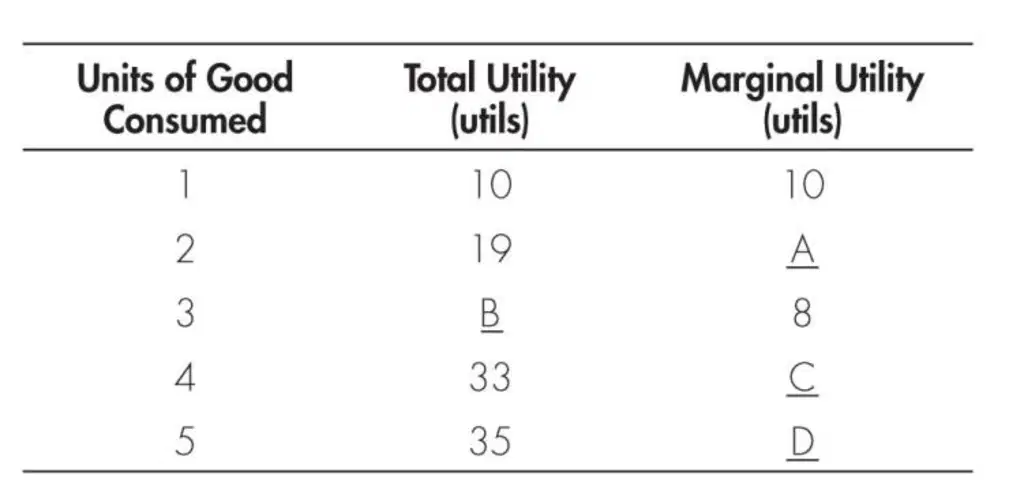
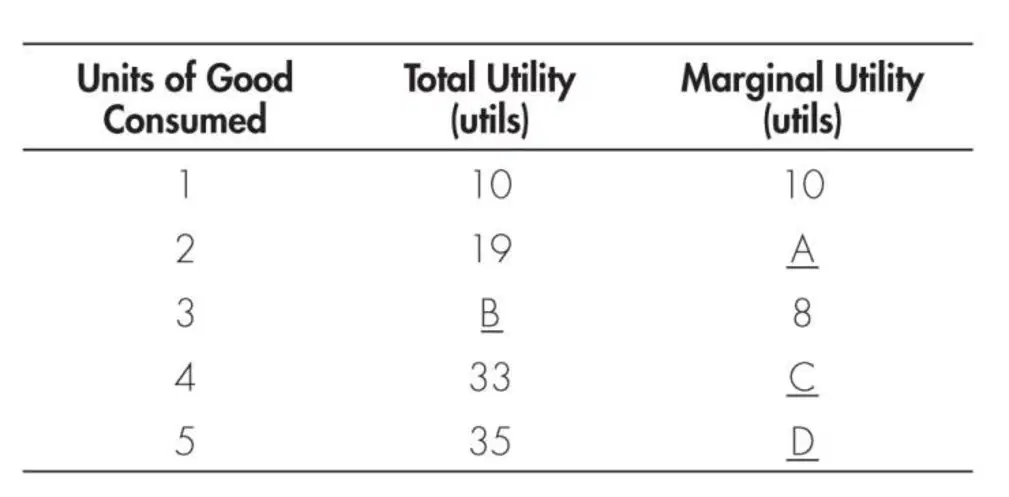
What is the marginal utility at "C" for the table below?
a)
2
b)
6
c)
7
d)
9
38.

If the unit price for the product below is $1, what is the MU/P at 5 units?
a)
1
b)
2
c)
3
d)
4
e)
5
39.
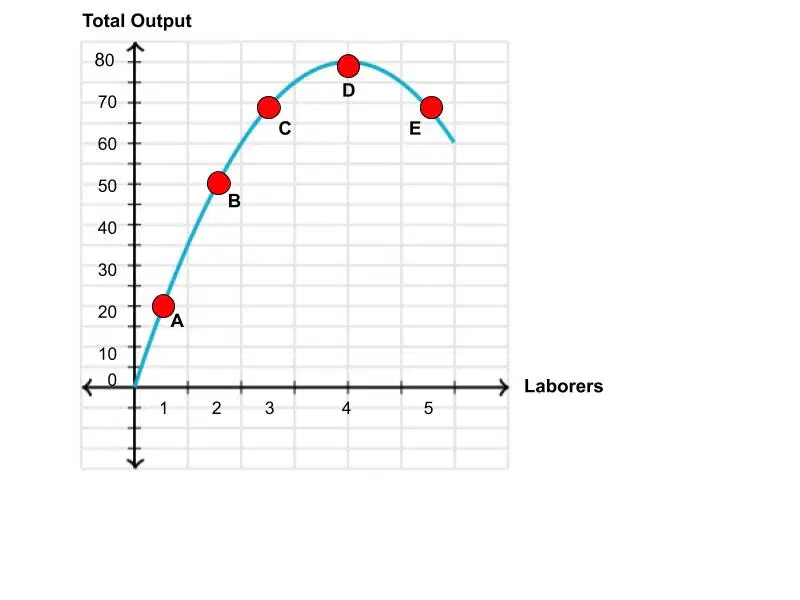
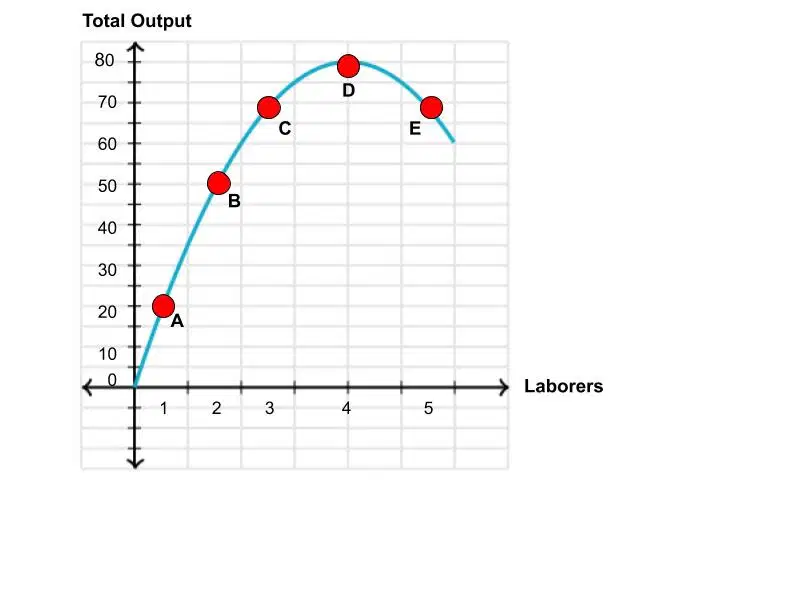
Which point on the curve represents maximum utilization of resources by the laborers?
a)
A
b)
B
c)
C
d)
D
e)
E
40.
Which point on the curve most likely represents the advantages of division of labor through specialization.
a)
A
b)
B
c)
C
d)
D
e)
E
41.
Which point on the curve represents negative returns in terms of labor utility?
a)
A
b)
B
c)
C
d)
D
e)
E
42.
Which additional laborer results in initial diminishing marginal utility?
a)
A
b)
B
c)
C
d)
D
e)
E
43.
The law of diminishing marginal utility
a)
is another way of expressing supply and demand in a market economy.
b)
states that people's inclination to consume goods falls as incomes increases.
c)
is the utility equivalent to the law of increasing costs.
d)
states that total utility decreases as consumption increases.
44.
The value of a good to a consumer depends on
a)
the marginal utility of the first unit consumed.
b)
the average utility of the units consumed.
c)
the marginal utility of the last unit consumed.
d)
the ratio of its marginal utility to total utility.
45.
A government subsidy given to Pfizer and Moderna to develop a COVID-19 vaccine is an example of a _______________ incentive that will most likely result in
a)
positive; the acceleration of research and development of a new vaccine.
b)
positive; shifting production from medicines and vaccines to medical equipment and tools.
c)
negative; both companies reducing production to avoid paying higher taxes.
d)
negative; outsourcing research and development of a vaccine to overseas labs.