
 Worksheets
Segment 1 Review 8/22
Total questions: 50
Worksheet time: 1hrs 17mins
Newton's 1st Law is also called the Law of ...
Friction
Inertia
Unbalanced forces
Newtons


A space probe that has run out of fuel in remote outer space (where there is no friction and no other planets or stars) continues moving
because some kind of force acts on it.
in a curved path.
even though no force acts on it, due to inertia
due to gravity.


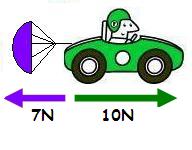
Student A is pushing at 63 newtons, and student B is pushing at 56 newtons. What is the net force (calculation).
119 N Right
7
7 N Right
119

A
B
C
D

Which of the following is experiencing the greatest net force?
A
B
C
D
All net forces are the same

Different materials, A, B, C, and D rest on a table
Which item will resist being set into motion the most
A
B
C
D

A person’s body is thrown outward as a car rounds a curve on a highway.
Newton's 1st Law
Newton's 2nd Law
Newton's 3rd Law
None of them
Jenny applies a 60 N force to a 20 Kg cart, what is the acceleration of the cart if friction can be neglected?
1200 m/s2
0.33 m/s2
20 m/s2
3 m/s2
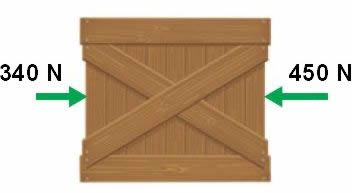

which box has more acceleration?
top
bottom
A force of 20 N acts upon a 5 kg block. Calculate the acceleration of the object.
100 m/s2
70 m/s2
15 m/s2
4 m/s2
A force of 20 N acts upon a 5 kg block. Calculate the acceleration of the object.
100 m/s2
70 m/s2
15 m/s2
4 m/s2
A cat has a mass of 200 kg and accelerates at 3 m/s2 to catch a mouse. How much force would be needed to stop the cat?
200 N
300 N
500 N
600 N
An object of mass 30 kg experiences a force of 60 newtons. Calculate the acceleration.
180 m/s2
90 m/s2
20 m/s2
2 m/s2

Calculate the missing information.
5 m/s2
8 m/s2
12 m/s2
20 m/s2
Two objects accelerate at 4 m/s2. Object 1 has a mass of 45 kg. Object 2 has a mass of 50 kg. Which object would require more force to move?
Object 1
Object 2
What is the unit for force?
kg
newton
m/s
m/s2
What is the equation needed to solve for acceleration?
A=fm
A=m/f
A=f/m


What is the unit for mass?
kg
newton
m/s
m/s2
Which of the following is an example of Newton's 3rd Law?
A rocket launching
A ball rolling down a hill
A car accelerating
A book resting on a table
What happens to an object when balanced forces act on it?
It accelerates
It changes direction
It remains at rest or moves with constant velocity
It decelerates
What is the unit for force?
kg
newton
m/s
m/s^2
Which of the following is an example of Newton's 1st Law?
A rocket launching
A ball rolling down a hill
A car accelerating
A book resting on a table
An object with a mass of 10 kg accelerates at 2 m/s^2. What is the force applied?
5 N
10 N
20 N
40 N
1st
Law of Motion
2nd
Law of Motion
3rd
Law of Motion
What does Newton's First Law of Motion state?
An object at rest stays at rest and an object in motion stays in motion with the same speed and in the same direction unless acted upon by an unbalanced force.
The acceleration of an object is directly proportional to the net force acting on the object and inversely proportional to its mass.
For every action, there is an equal and opposite reaction.
The force of gravity acting on an object is directly proportional to its mass.

A car is driving at a constant velocity of 75 m/s on the highway headed to Tucson, on a windy day. What is the force acting upon it to continue it's state of motion?
0 N, due to "the constant velocity" which means the car is already moving. It does not need force to continue it's state of motion.
Really? This question again? Obviously it is 75 m/s because of one of Newton's Laws.
Wait, I do know, I just don't know how to explain it. But, It is one of the laws... right?
75 N to the right, due to action and reaction, as well as inertia.

The girl on the sled will remain in motion unless
her motion is changed by magnetic forces.
she is stopped by an outside force.
she accelerates at a constant speed.
the force of friction forcer her to move faster.
What does it mean when forces are balanced?
The object is accelerating.
The object is moving at a constant velocity.
The object is at rest.
Both B and C are correct.
Newton's Second Law of Motion can be mathematically expressed as:
F=ma
a=mF
Both A and B
None of the above
What is the effect of mass on inertia?
More mass means less inertia.
Mass has no effect on inertia.
More mass means more inertia.
Only shape, not mass, affects inertia.

