
 Worksheets
Chemistry Safety Assessment
Total questions: 52
Worksheet time: 52mins
Flammable liquids, like ethanol or methanol, should never be dispensed or used near
an open door
an open flame
a hot plate
ABC extinguisher
When working with equipment that requires electricity…
keep electrical cords untangled and fully plugged in
use your SDS sheet
stretch the cord to the furthest outlet
use batteries instead
keep away from water sources
When your laboratory experiment requires you to use a flame as a heat source…
be sure to use chemical splash gloves to protect your hands
be sure to tie back long hair
be sure not to reach over the flame
be sure your flame is orange
roll up sleeves or loose clothing
If you injure yourself by accidentally cutting or piercing your skin with broken glass...
apply pressure on wound and immediately leave for the nurse's office.
call one of your parents/guardians.
go to the first aid kit and begin administering first aid to yourself.
clean up the broken glass.
apply pressure on wound and immediately notify the instructor.
When students are finished with an experiment, they should remove protective equipment before they clean the glassware and lab station.
True
False
If a lab experiment is not completed, you should
discuss the issue with your teacher and determine what you can do to complete it.
sneak in after school and work alone.
make up some results.
come in during lunch and finish while eating lunch.
If an acid is splashed on your skin, wash at once with
soap
oil
weak base
plenty of water
Return all unused chemicals to their original containers.
TRUE
FALSE
A student with loose clothing is heating a solution over a Bunsen burner. As the student leans over the burner to reach for something, their clothing catches fire. What the student do and what should their partners/teacher do.
Student should run for a fire blanket and partners should raise their hand to tell the teacher.
Student should stop, drop, and roll and partners/teacher should quickly grab the fire extinguisher and use it on the individual.
Student should pull out phone from backpack and call 911 and partners/teacher should evacuate the building.
Student should stop, drop, and roll and partners/teacher should quickly grab the fire blanket and use it on the individual.
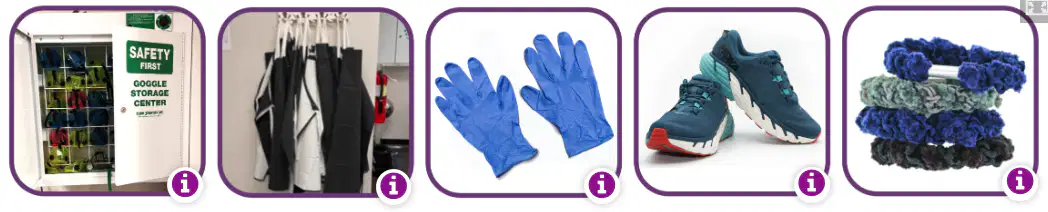
What would be the generic name used to represent the following images in a chemistry laboratory?
Lab equipment
Personal protective equipment
Polymers
Fashion articles
If glass equipment breaks you should alert your teacher, then ...
sweep it into your sink
sweep it into broken glass container
pick it up by hand and throw in trash can
cry
When in a lab room you should...
never touch equipment until instructed to do so
never remove chemicals or equipment from the room
know the locations of all safety equipment
all of the above
If you are ever unsure or confused about a lab procedure you should...
take your best guess
do nothing
ask the instructor
skip that step of the procedure
Goggles must be worn when... choose all that apply.
working with chemicals
using glassware
heating substances
taking notes in class
True or False: Before performing an experiment you are expected to read all procedures.
True
False
Made of wool, able to smother fire to put it out and act as a barrier for person using it.
Fume Hood
Fire Extinguisher
Fire Blanket
If you were cooking bacon and a fire started in the frying pan, what would be a good method to safely extinguish the flame?
Cover it with a lid.
Spray water on it.
throw it in the sink
cover it with a towel
Laboratory aprons should be worn during all lab activities.
True
False
It's okay to pick up broken glass with your bare hands as long as the glass is placed in the trash.
True
False

Click on the picture to zoom in: Imagine you are in a chemistry lab. You see a group of students performing experiments. Which student is following all lab safety rules?
H
A
E
G
D
What do you do if you spill a chemical on your skin?
Flush it with water and notify the instructor
Immediately use the safety shower
Use the eyewash station
Run in the hallway to find help
Should you wear contact lenses in lab?
Yes
No
What is the rule for mixing acid with water?
DON'T!
Always add acid slowly to water
Always add water slowly to acid
Always mix them together quickly
When should you tie long hair back?
When using fire
When using chemicals
When using sharp objects
There is no safety rule regarding hair
Where does broken glass go?
Broken glass bucket
Trash
Sink
My backpack to save for later
When you have taken too much of a chemical for an experiment you should
Rescale or resize the experiment to the new larger volume
Carefully pour the extra back into the original container
Try to share the extra with a nearby group or dispose of the chemical properly
Throw the extra in the garbage
If you receive an injury or you break lab equipment or cause a large spill you should
Text your friend and let them know
Snapchat it
Call your mom
inform your teacher

Which safety hazard does this symbol indicate?
Corrosiveness
Flammability
Radioactivity
Imagine you're a scientist with Rapunzel-like long hair in a bustling laboratory. What should you do with your hair?
Chop it off, short hair don't care!
Secure it with a hair band, hairpins, or any other confining device to keep it out of your way.
Just make sure it's always neatly groomed.
Hold it away from your experiment with one hand.
Imagine you're a scientist about to start a lab investigation. What's the one thing you should definitely NOT be wearing?
Your favorite flip flops
Your beautiful, loose, long hair
Your shiny, dangling jewelry
All of these fashion statements

What is used to protect your eyes from chemicals, broken glass, and fire?
Fire blanket
Eye wash
Goggles
Flask
Imagine you're in a science lab and you see a beaker full of clear liquid. It looks just like water. Would it be safe to take a sip?
Absolutely, it looks clean!
No way, it could be anything!

Imagine you're a scientist in a lab. Is it okay to take a big whiff of chemicals directly from their containers?
Absolutely, go ahead!
No way, that's not safe!
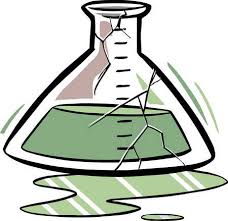
Imagine you're in a science lab and suddenly, oops! You've broken some glassware. What's your next move?
Rush to the teacher and confess your little accident. We will clean it up safely.
Swiftly clean up the mess before anyone notices. The best place to hide the broken glass is in someone's backpack.
Start screaming at the top of your lungs like you've seen a ghost

Uh-oh! Can you spot the lab safety rule that's being totally ignored here?
Wiping up spills immediately.
Wearing super cool goggles.
Snacking during lab time.
Heating a closed container.
Imagine you're a scientist in a lab. You see a container with a mysterious substance. What's the first thing you do before using it?
Check the label on the container
Just use it without checking
Imagine you're a scientist conducting an exciting experiment with acids and bases. Suddenly, you accidentally splash some acid on your face! What piece of safety equipment should you reach for immediately?
fire blanket
fire extinguisher
Throw base on your face to neutralize it
safety water spray
You accidentally break some glassware you should
Clean it up immediately
Leave it
Tell the teacher
Tell you lab partner to clean it up
You have a personal pair of prescription glasses. You do not need to wear safety goggles. True or False
True
False
The following footwear is required when conducting a lab.
slippers
open-toed shoes
closed-toed shoes
Crocs with the holes

Approved eye protection devices (such as goggles) are worn in the laboratory
to avoid eye strain
to improve your vision
only if you don’t have corrective glasses
any time chemicals, heat or glassware are used
If an acid is splashed on your skin, wash at once with
soap.
oil.
weak base.
plenty of water.
You may remove your goggles while conducting a lab...
never
If your group is finished with the lab and has cleaned up.
If you are wearing glasses or contacts.
anytime
You get a chemical in your eye. What should you do?
nothing
Rinse with water for a few seconds and tell your teacher
Immediately flush with water, continue washing for at least 5 minutes and tell your teacher
Go to the restroom and rinse with water because the water is better there
If you do not understand a direction or part of a laboratory procedure, you should
ask the teacher before proceeding.
skip it and go on to the next part.
figure it out as you do the lab.
try several methods until something works.
One of the purposes of wearing gloves in the lab is -----.
To look stylish and impress others.
To protect the skin of our hands from corrosive chemicals
To prevent the spread of COVID
To prevent the spread of disease in the classroom
Which of the following is the best way to clean your hands after using chemicals in a laboratory experiment?
Rinse your hands with distilled water.
Use a generous amount of hand sanitizer.
Wash your hands with soap and water.
Wipe your hands with a wet paper towel.
Chipped or cracked glassware is okay to use in the laboratory.
True
False
After completing an experiment, all chemcial wastes should be
disposed of according to your teacher's directions.
left a your lab station for the next class.
taken home.
dumped in the sink.
What should you do if you accidentally spill a chemical on the lab bench?
Leave it and let it evaporate.
Wipe it with a paper towel and throw it in the trash.
Inform the instructor and follow their instructions for cleaning it up.
Cover it with another chemical to neutralize it.
Which of the following is NOT a safe practice in the lab?
Wearing closed-toe shoes.
Eating or drinking during lab activities.
Tying back long hair.
Wearing safety goggles.
True or False: You should always read the Material Safety Data Sheet (MSDS) for any chemical you are using in the lab.
True
False

