
Font size
 Worksheets
As level
Total questions: 151
Worksheet time: 4hrs 25mins

A
B
C
D

A
B
C
D
A
B
C
D

A
B
C
D
A
B
C
D
A
B
C
D
A
B
C
D
A
B
C
D

A
B
C
D

A
B
C
D
A
B
C
D

A
B
C
D
A
B
C
D
A
B
C
D
A
B
C
D
A
B
C
D
A
B
C
D
A
B
C
D

A
B
C
D
A
B
C
D
A
B
C
D
A
B
C
D
A
B
C
D
A
B
C
D
A
B
C
D
A
B
C
D
A
B
C
D
A
B
C
D
A
B
C
D
A
B
C
D
A
B
C
D
A
B
C
D
A
B
C
D

A
B
C
D
A
B
C
D
A
B
C
D
A
B
C
D
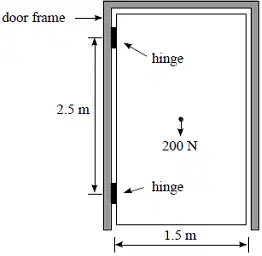
The diagram shows a uniform door hanging from two hinges 2.5 m apart. The moment of the couple that the hinges exert on the door is.....
150 Nm
200 Nm
250 Nm
500 Nm
The rectangular objects, A, B, C and D are each 2 cm long and 1 cm high. Which one of the bodies is in equilibrium?


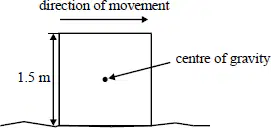
A uniform square block is sliding with uniform speed along a rough surface as shown in the diagram. The force used to move the block is 200 N. The moment of the frictional force acting on the block about the centre of gravity of the block is:
150 N m, clockwise
150 N m, anticlockwise
300 N m, clockwise
300 N m, anticlockwise
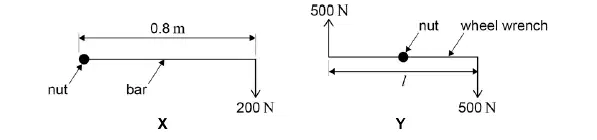
A car wheel nut can be loosened by applying a force of 200 N on the end of a bar of length 0.8 m as in X. A car mechanic is capable of applying forces of 500 N simultaneously in opposite directions on the ends of a wheel wrench as in Y.
What is the minimum length l of the wrench which would be needed for him to loosen the nut?
0.16 m
0.32 m
0.48 m
0.64 m
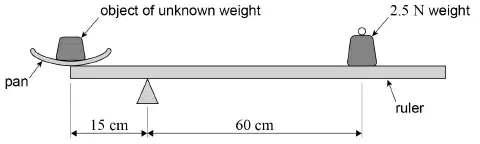
The diagram shows a uniform metre ruler of weight 1.5 N pivoted 15 cm from one end for use as a simple balance. A scale pan of weight 0.5 N is placed at the end of the ruler and an object of unknown weight is placed in the pan. The ruler moves to a steady horizontal position when a weight of 2.5 N is added at a distance of 60 cm from the pivot as shown.
What is the weight of the object?
9.5 N
10.0 N
13.0 N
13.5 N
A light uniform rigid bar is pivoted at its centre. Forces act on the bar at its ends and at the centre.
Which diagram shows the bar in equilibrium?


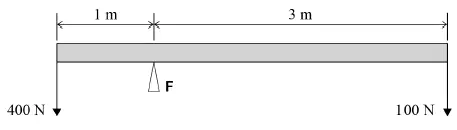
A uniform rod is balanced horizontally about a support F. Forces of 400 N and 100 N act at the ends of the rod, as shown. What is the reaction force acting on the rod at support F?
100 N
500N
550N
600N
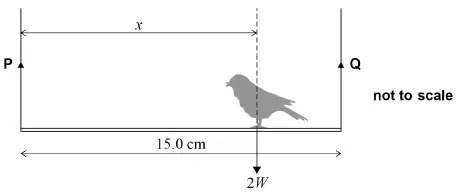
bird sits on a uniform rod suspended from vertical wires P and Q. The rod has a weight W and is 15.0 cm long.
The weight of the bird is 2W and acts at a distance x from P.
What is the value of x when the tension in P is half the tension in Q?
7.50 CM
10 CM
11.3 CM
15.0 CM
A uniform beam of weight 23.5 N is attached by a hinge to a vertical wall and supported by a string.
The string makes an angle of 35° to the wall. What is the tension in the string?
14 N
21 N
29 N
41 N
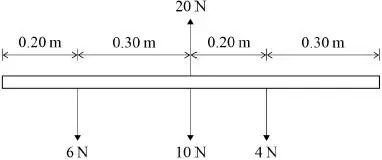
The diagram shows the forces acting on a uniform rod. Which statement is correct?
The rod is in equilibrium
For equilibrium, an anticlockwise moment of 1.0 N m is needed.
For equilibrium, a clockwise moment of 1.0 N m is needed.
For equilibrium, the 10 N force should be increased to 20 N.

Which description of a couple and its unit is correct?
A
B
C
D
P and R are uniform spheres of mass 3 kg and 4 kg respectively.
P and R are joined by a rod of negligible mass.
The distance between their centres is L.
The centre of mass of this system is at Q.
Which diagram shows the position of the centre of mass?


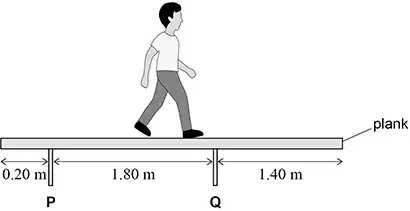
A uniform plank weighs 1200 N and rests on two pillars P and Q.
P and Q are 1.80 m apart.
P is 0.20 m from one end of the plank. Q is 1.40 m from the other end of the plank.
A man weighs 800 N and walks along the plank away from pillar P. What is the horizontal distance between pillar P and the centre of mass of the man when the plank starts to tip?
0.45 M
2.25 M
2.45 M
3.15 M
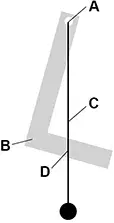
A uniform piece of card in the shape of the letter L is suspended freely from a horizontal pin.
A plumb line is also suspended from the pin. The diagram shows the card in its equilibrium position. What is the position of the centre of mass of the piece of card?
A
B
C
D
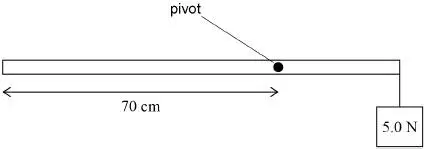
A uniform metre ruler of weight 2.0 N is freely pivoted at the 70 cm mark.
A student holds the ruler in a horizontal position and suspends a 5.0 N weight from the 100 cm end. What is the magnitude of the resultant moment when the student releases the ruler?
0.15 Nm
0.19 Nm
1.1 Nm
1.9 Nm
Each diagram shows two horizontal forces acting on a solid square object seen from above.
All the forces have the same magnitude. Which system produces a couple about any point inside the object?


A
B
C
D
A
B
C
D

A
B
C
D

A
B
C
D
A
B
C
D
A
B
C
D
A
B
C
D
A
B
C
D
A
B
C
D
A
B
C
D
Which of the following waves cannot be polarized?
Visible light
Radio waves
Ultrasonic
Gamma
2 points on a progressive wave are 1/3 of a wavelength apart. The distance between the two points is 2cm. If the speed of the wave is 10 ms-1 what is the frequency of the wave?
5Hz
20Hz
167Hz
1500Hz

What is the approximate phase difference between the waves shown?
2π
3 π/2
π
π/2
When comparing X rays with visible light, which statement is correct?
X-rays travel faster in a vacuum
X rays have a higher frequency
Only X rays can be polarised
X rays do not show diffraction effects
Which of the following describes the type of wave produced on a stretched guitar string after it has been plucked?
Stationary, longitudinal, electromagnetic
Stationary, transverse, mechanical
Progressive, longitudinal, electromagnetic
Progressive, transverse, mechanical
Two light wave sources with the same frequency and with a constant phase difference are said to be ….
Polarised
Diffracted
Coherent
Longitudinal
The product of the frequency of a wave and its period is always equal to
π
1
2 π
3 π
Longitudinal waves
travel fastest in solids.
travel fastest in a vacuum.
travel more rapidly in gases than liquids.
vibrate perpendicular to the medium through which they pass.
are similar to waves of the electromagnetic spectrum.
v = 10 m/sec
Determine the frequency.


Which wave has the shortest wavelength?
1
2
3
4

Which statement is correct about the wave shown in the diagram?
It is a transverse wave because the particles are moving perpendicular to the motion of the wave.
It is a transverse wave because the particles are moving parallel to the motion of the wave.
It is a longitudinal wave because the particles are moving perpendicular to the motion of the wave.
It is a longitudinal wave because the particles are moving parallel to the motion of the wave.
Do waves carry energy or matter?
Energy
Matter
I'm not sure

Two masses hang at rest from a spring, as shown in the diagram. The string separating the masses is burned through. Which of the following gives the accelerations of the two masses as the string breaks?
acceleration of free fall = g
A
B
C
D
Which one of the following could not be used as a unit of force?
A T m
W s–2
kg m s–2
J m–1

A truck of mass 2.1 × 10³ kg tows a car of mass 1.3 × 10³ kg along a horizontal road.
The total resistive force on the car is 1100 N.
The acceleration of the car and truck is 2.3 m s−2. What is the tension in the tow rope?
3000 N
4100 N
7800 N
8900 N

A lift and its passengers with a total mass of 500 kg accelerates upwards at 2 m s–2 as shown. Assume that g = 10 m s–2
What is the tension in the cable?
1000 N
4000 N
5000 N
6000 N
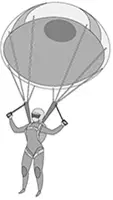
A parachutist descends to the ground at a constant speed with the parachute open. Which force, together with the parachutist’s weight, makes a pair according to Newton’s third law of motion?
the drag force on the parachutist from the air
the tension in the strings of the parachute
the gravitational force of the parachutist on the Earth
the lift force on the parachute from the air
A suitcase weighing 200 N is placed on a weighing scale in a lift.
The scale reads 180 N when the lift is moving.
The lift is
moving down at a constant velocity
moving down with a decreasing velocity.
moving up at a constant velocity.
moving up with a decreasing velocity.
A rocket of mass 12 000 kg accelerates vertically upwards from the surface of the Earth at 1.4 m s−2.
What is the thrust of the rocket?
1.7 × 10⁴ N
1.7 × 10⁵ N
1.3 × 10⁵ N
1.6 × 10⁵ N
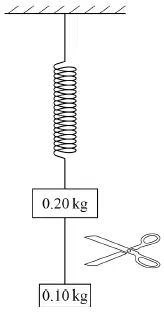
A 0.20 kg mass is suspended from a spring. A 0.10 kg mass is suspended from the 0.20 kg mass using a thread of negligible mass.
The system is in equilibrium and the thread is then cut. What is the upward acceleration of the 0.20 kg mass at the instant that the thread is cut?
3.3 m s–2
4.9 m s–2
6.5 m s–2
9.8 m s–2
A lift of mass M is suspended from a cable. The lift descends with a downward acceleration, a. A frictional force F acts on the lift.
What is the tension T in the cable?
T = Ma + F
T = Ma – F
T = M (g + a) – F
T = M (g – a) – F
What kind of force holds the nucleus together?
Strong Nuclear Force
Weak Nuclear Force
Gravitational Force
Electromagnetic Force

What are radiations X, Y and Z?
X = alpha
Y = beta
Z = X-rays
X = gamma
Y = alpha
Z = beta
X = gamma
Y = beta
Z = alpha
X = X-rays
Y = alpha
Z = beta
Which set of radioactive emissions corresponds to the descriptions given in the table headings?


Which type of radiation shown by X?
alpha
beta
gamma

Which type of radiation shown by P?
alpha
beta
gamma
Which statement about alpha, beta and gamma radiation is correct?
Beta radiation has the greatest ionising power.
Alpha radiation has the greatest ionising power.
Gamma radiation has the greatest ionising power.
Alpha, beta and gamma radiation have nearly equal ionising powers.
Which word equation represents β- decay?
neutron → proton + electron + electron antineutrino
neutron → proton + electron + electron neutrino
neutron → proton + positron + electron antineutrino
neutron → proton + positron + electron neutrino
What is a positron?
A positively charged electron
A small part of a proton
A particle collider
What Happens when Matter and Antimatter collide
Nothing Happens
They form a new substance
It DOESNT release energy
They Annihilate
Which word equation represents β+ decay?
proton → neutron + electron + electron antineutrino
proton → neutron + electron + electron neutrino
proton → neutron + positron + electron antineutrino
proton → neutron + positron + electron neutrino

The nuclear equation shown has a term missing.
What is represented by the missing term?
a positron
a neutrino
an electron
an antineutrino
What remains constant during β-emission from a number of identical nuclei in a substance?
proton number of the nuclei
nucleon number of the nuclei
neutron number of the nuclei
energy of the β-particles

A nucleus of magnesium-23 undergoes β+ decay, as represented by the nuclear equation shown.
What is nucleus X?


For the decay of each nucleus of radon, how many α -particles and β - particles are emitted?


Name the interaction responsible for beta-decay
Strong Nuclear Force
Weak Nuclear Force
Gravitational Force
Electromagnetic Force

A ball is kicked from point P on level ground. The ball initially travels at 45° to the horizontal.
The ball reaches its maximum height after a time of 2.0 s.
Air resistance can be ignored. What is the displacement of the ball from P when at its maximum height?
20 m
40 m
45 m
60 m

A ball X is projected horizontally from a certain point at the same time as a ball Y of the same diameter but twice the mass is released from rest and allowed to fall vertically from the same level. Air resistance is negligible. Which one of the following will occur?
Y will hit the floor just before X
X will hit the floor just before Y
X and Y will hit the floor at the same time
Y hits the floor while X is half way to the floor

P and Q are two balls of the same diameter. P has a greater mass than Q.
Both balls are projected at the same time from the top of a tall building that stands on horizontal ground.
Both balls are projected with the same horizontal velocity.
P reaches the ground after time tP and at a horizontal distance dP from the building.
Q reaches the ground after time tQ and at a horizontal distance dQ from the building.
The air is still and air resistance is not negligible.
Which row is correct?
A
B
C
D
A golf ball was hit from the surface of the Moon. The time of flight was 4.0 s.
What is the best estimate for the maximum height reached by the ball?
acceleration due to gravity on the Moon = 1.6 m s–2
3 m
15 m
40 m
80 m
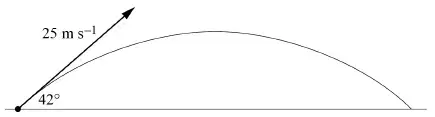
The diagram shows the path of a projectile launched from ground level with a speed of 25 m s–1 at an angle of 42° to the horizontal. What is the horizontal distance from the starting point of the projectile when it hits the ground?
23 m
32 m
47 m
63 m
Two identical balls, X and Y, are at the same height and a horizontal distance of 25 cm apart.
X is projected horizontally with a velocity of 0.10 m s–1 towards Y at the same time that Y is released from rest. Both X and Y move freely in the absence of air resistance.
What is the distance between the balls 1.0 s later?
0.15 m
0.25 m
2.4 m
4.9 m
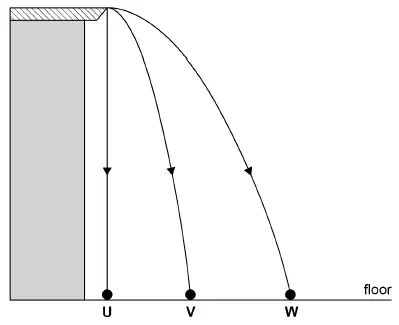
Three objects U, V and W leave the edge of a bench at the same time.
The objects fall in the same vertical plane with negligible air resistance.
U is released from rest so that it falls vertically.
V and W are projected horizontally.
The paths of the three objects are shown. Which statement is correct?
U hits the floor before V and W.
W hits the floor before V.
W hits the floor with the greatest speed.
U hits the floor with the greatest speed.
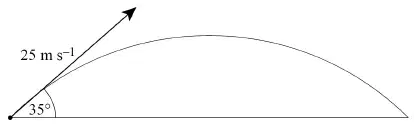
A projectile is launched with a speed of 25 m s–1 at an angle of 35° to the horizontal, as shown in the diagram.
Air resistance is negligible.
What is the time taken for the projectile to return to the ground?
1.5 s
2.1 s
2.9 s
4.2 s

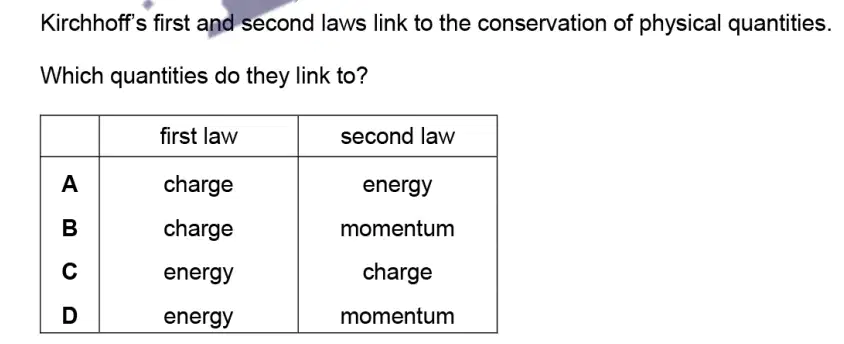
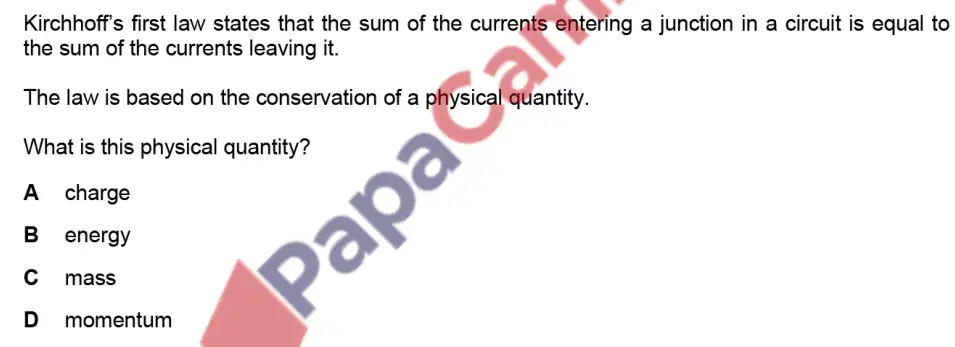
Kirchoff's First Law states
the sum of the currents entering any junction in an electric circuit must equal the sum of the currents leaving that junction
the sum of the charges entering any junction in an electric circuit must equal the sum of the charges leaving that junction
the sum of the emfs entering any junction in an electric circuit must equal the sum of the pds leaving that junction
none of these

Kirchoff's second law states
in any closed loop in an electric circuit the algebraic sum of the electromotive forces in the loop is equal to the algebraic sum of the potential differences in that loop
in any closed loop in an electric circuit the vector sum of the electromotive forces in the loop is equal to the vector sum of the potential differences in that loop
in any closed loop in an electric circuit the algebraic sum of the currents in the loop is equal to the algebraic sum of the potential differences in that loop
none of these
Select all true statements
Kirchoff's second law depends on the conservation of energy principle
Kirchoff's first law depends upon the conservation of charge
Kirchoff's second law depends on the conservation of charge principle
Kirchoff's first law depends upon the conservation of energy

Select all true statements
In the dark an LDR has very high resistance in the MΩ range
The output p.d. will be low in the dark
In the light an LDR has very high resistance in the MΩ range
The output p.d. will be high in the dark

Select all true statements
This is a thermistor circuit symbol
This component is a semiconductor
This component resistance decreases as temperature increases
This component resistance decreases as temperature decreases

Select all true statements
This component is a light emitting diode
It only allows current to flow one way
It is temperature dependent
It depends on light intensity

i1 + i5 +i4 = i2 + i3
i1 + i5 +i3 = i2 + i4
i5 + i2 +i4 = i1 + i3
i1 + i5 = i2 + i3 + i4

Which equations are correct?
ε1 - i1R1 - i2R2 = 0
ε1 + ε2 + i3R3 - i2R2 = 0
ε1 - i2R1 - i2R2 = 0
ε1 - ε2 - i3R3 + i2R2 = 0

For this circuit select the correct statements
i1 = 2 A
i3 = 8 A
i2 = 6 A
i2 = i1 + i3

V1 = 17 V
V3 = 15 V
V3 = 4.5 V
V1 = 3.0 V
emf stands for
electron motion force
potential difference
electromotive force
electromagnetic force
The defining word equation for the Volt
energy per unit charge
rate of flow of charge
work per unit time
product of electrical resistance and current
If three 1.5 V cells are connected in series
the combined emf is 4.5 V and it will last as long as a single 1.5 V cell
the combined emf is 1.5 V and it will last as long as a single 1.5 V cell
the combined emf is 4.5 V and it will last longer than a single 1.5 V cell
none of these
If three 1.5 V cells are connected in parallel
the combined emf is 4.5 V and it will last as long as a single 1.5 V cell
the combined emf is 1.5 V and it will last longer than a single 1.5 V cell
the combined emf is 4.5 V and it will last as long as a single 1.5 V cell
none of these
five 100 Ω resistors are connected parallel
20 Ω
120 Ω
200 Ω
500 Ω
Two 4000 Ω are connected in parallel, and then these are connected in series to another pair of parallel wired resistors to give a total circuit resistance of 6000 Ω. What are the possible values of the other pair?
both 8000 Ω
both 4000 Ω
one 5500 Ω and the other 8000 Ω
one 6000 Ω and the other 12000 Ω
To measure the emf of a cell accurately use a
slide wire potentiometer
voltmeter
ammeter
power pack

What current would flow?
0.36 A
1.04 A
0.021 A
0.82 A

What is the equation for work?
Ep= mgh
W = F x d
F = mg
F = ma

Bob (80 kg) uses 180 N of force to get him up the slope. The vertical distance is 2 m and the diagonal is 10 m. Calculate the work he does.
1600 J
160 J
3600 J
1800 J

A
B
C
D

A
B
C
D

A
B
C
D

A
B
C
D

A
B
C
D

A
B
C
D
During the Powerhouse lab, Jerome runs up the stairs, elevating his 102 kg body a vertical distance of 2.29 meters in a time of 1.32 seconds at a constant speed. Determine the power generated by Jerome.
1.73 x 10³ W
1.48 x 10³ W
1.91 x 10³ W
1.27 x 10³ W
The Taipei 101 in Taiwan is a 1667-foot tall, 101-story skyscraper. The skyscraper is the home of the world’s fastest elevator. The elevators transport visitors from the ground floor to the Observation Deck on the 89th floor at speeds up to 16.8 m/s. Determine the power delivered by the motor to lift the 10 passengers at this speed. The combined mass of the passengers and cabin is 1250 kg.
2.06 x 10⁵ W
6.19 x 10⁶ W
2.10 x 10⁴ W
3.45 x 10⁵ W
The area under a force vs. displacement graph tells you the
mass of the object
momentum of the object
work done on the object
impulse of the object
Which equations do you need to be able to derive?
Work done
GPE
KE
Efficiency
Tick all the parts that should be written if asked to define "work done"
Force
Displacement in direction of force
Time
Distance moved
Define power
Watt are you talking about
Work done per unit time
Total energy transferred
Work done x time

Mike and Ian move 50 m on a snow lift which uses 750 N of force to move them in 75 seconds. Calculate the power of the lift.
750 W
500 W
7500 W
2812500 W

