
 Worksheets
Food Industry Safety Quiz
Total questions: 63
Worksheet time: 5hrs 4mins
What is the required internal temperature for cooking beef, veal, lamb roasts, and steaks?
145°F (63°C)
160°F (71°C)
165°F (74°C)
170°F (77°C)
How often should storage areas be cleaned out to avoid storing spoiled or expired foods?
Daily
Weekly
Periodically
Annually
What type of system is HACCP?
A financial system
A management system
A marketing system
A transportation system
What should be determined during a hazard analysis according to the Seven HACCP Principles?
Critical control points
Corrective actions
Safety hazards and applicable preventative measures
Record-keeping procedures
What should be recognized when identifying critical control points?
Maximum or minimum values
Points, steps, or procedures to prevent, eliminate, or reduce a hazard
Corrective actions
Procedures for documenting HACCP plan
What might the compliance officer do during the walkthrough?
Consult with employees
Develop new products
Create marketing plans
Review financial audits
What is discussed during the closing conference of a workplace safety inspection?
Employee benefits
Unsafe or unhealthful conditions
Company profits
Employee attendance
How often must high-risk facilities be inspected according to the FDA?
Every year
Every two years
Every three years
Every five years
What do scores or grades from health inspections indicate?
The popularity of the business
The degree to which the business is operating safely
The number of employees
The type of food served
Who keeps health inspection records?
Restaurant owners
Local health departments
Customers
Food suppliers
Which of the following is a direct consequence of bad publicity from a failed health inspection?
Increased customer visits
Damage to reputation
Higher food quality
Better employee performance
What are the two most common knives used in a kitchen?
Chef and Utility
Chef and Paring
Utility and Paring
Chef and Serrated
What are factors to consider what choosing a knife
ease of use
handle comfort
handle weight and material
all of the above
What is the tang of the knife?
One continuous piece of metal that extends to the end of the knife
Handle of the knife
The top of the knife blade
Working part of the knife
What is the tip of the knife blade?
Working part of the knife
Used for rocking motion, scoring food item and delicate cutting
Junction between the handle and the knife blade
The top of the knife blade
What is the knife edge?
Pointed part of the knife
The junction between the handle and the knife blade
The working part of the knife
The top of the knife blade
Where is the spine of the knife?
One continuous piece of metal that extends to the edge of the handle
Pointed part of the blade
The top of the knife blade, opposite the knife edge
Working part of the knife
Cutting boards must be cleaned and sanitized after each use to avoid cross-contamination?
True
False
What knife is used for chopping, slicing, and most other cutting tasks?
Utility knife
Chef knife
Paring knife
Serrated knife
What knife is 5 to 7 inches, flexible, and not wide enough for chopping tasks?
Serrated knife
Chef knife
Paring knife
Utility knife
Which knife is useful for cutting breads and pastries?
Utility knife
Serrated knife
Paring knife
Chef knife
Which knife is designed to cut away skin and peel, also useful for cutting intricate garnishes and other detail work?
Chef knife
Utility
Serrated knife
Paring knife
A knife does a better job of cutting or slicing food when it is sharp?
True
False
What should be placed underneath a cutting board to prevent it from slipping?
Damp paper towel
Dry paper towel
Damp wash cloth
Dry cloth towel
How should you wash your knives?
Leave knives in sink to clean later
Wash, rinse, dry, and put away
Damp towel
How should you pass a knife to another person?
Put knife on counter with handle away from you
Put knife on counter with blade away from you
Near edge of counter
How should you carry a knife through the kitchen?
In front of you
Down and away from you
With both hands
What is the correct way to hold any food product with the off hand?
Fingers straight
Fingers bent
Fingers in a claw position
Flat hand
How should a knife be positioned if it is not in use?
Knife block
In sink
In drawer
Away from the edge of the counter near cutting board
Are you allow to share a cutting board?
True
False
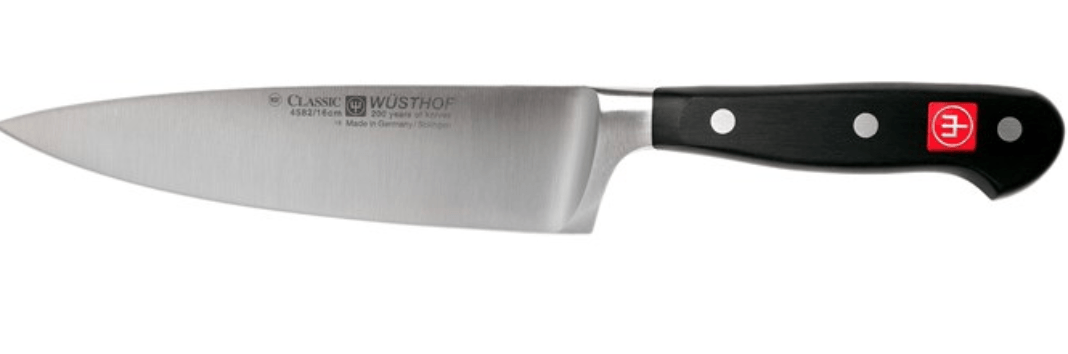
Chef's Knives are mostly used for..
slicing tomatoes and soft foods
Chopping, Dicing, and mincing
Small items like fruits and vegetables
removing bones from fish
A _____ knife is a safe knife.
Dull
Small
Large
Sharp
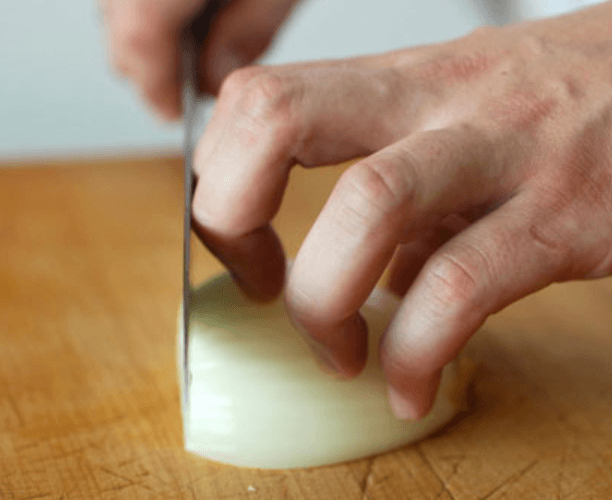
use the _________ technique to protect fingers while cutting foods.
Claw grip
flat fingers
Nuckle grip
Palm grip
Not cutting foods on a cutting board can cause your knife to ____________.
become sharper
slip while cutting
Dull/Damage the blade.
Ruin your countertops
Never put knives in __________.
Hot water
Soapy Water
Cold Water
the dishwasher

A course chop is a type of
Precision Cut
Common Cut

True or false: a mince is smaller than a course chop.
True
False
What size is a minced food?
Large, irregular sized pieces
Medium, irregular sized pieces
Small, irregular sized pieces
Which type of cut has a specific, measurable size?
Precision Cuts
Common Cuts

A medium dice measures at _____________.
½ x ½ x ½ inches
¼ x ¼ x 2 inches
¼ x ¼ x ¼ inches
1/8 x 1/8 x 2 inches
A Batonnet is a _________ shaped cut.
"french fry"
Cube
Very fine matchstick
Very fine cube

Batonnet and Julienne are always _____" in length.
1 inch
2 inch
3 inch
4 inch
What types of food would a chiffonade cut be appropriate for?
Breads
Carrots
Meats
Herbs
What type(s) of equipment would you use if you were going to crush graham crackers?
Chefs Knife
Rolling Pin
Serrated Knife
Food Processor

What type of cut is this?
Chiffonade
Julienne
Dice
Mince
What are the 3 basic techniques used to cut food?
slicing, dicing, mincing
slicing, cutting, cubes
cutting, slicing, cut
slicing, mincing, trimming
Finely sliced or shredded leafy veggies is commonly made using what type of cutting technique?
Mincing
Dicing
Chiffonade
Julienne
Mincing is commonly used for what type of food?
Spinach
Carrots
Potatoes
Garlic

What knife cut is this?
Chiffonade
Dice
Julienne
Mince
How should you clean a knife?
drop in sink of soapy water and let soak
wipe with towel
clean right away with sink water and leave it out of sink when done.
dunk in sink
Which term refers to preparing a product for cutting by removing the uneven sides?
batonnet
mise en place
dicing
squaring off
Why is it important to cut foods into uniform shapes?
Improves flavors
Conserves nutrients
Ensure that the foods are safe to eat
Helps cooks food evenly

What is this knife cut?
Chiffonade

This is a ________ knife.
Tourne
Granton/Santoku
Chef's
Cleaver
To stack, tightly roll, and slice leafy vegetables is to _________ them.
Dice
Julienne
Chiffonade
Brunoise
Correct way to hold a knife


Correct way to hold a knife


Why do you cut the side off of your vegetable first?
You don't have to.
To get the peeling off
To stabilize it while you cut
To keep your knife hsarp
True or False: It is okay to use a dull knife if you're not confident with your knife skills
True
False
If you are prepping food and the knife drops, what do you do?
try and catch it
let it fall
scream and panic
pick it up and continue using it
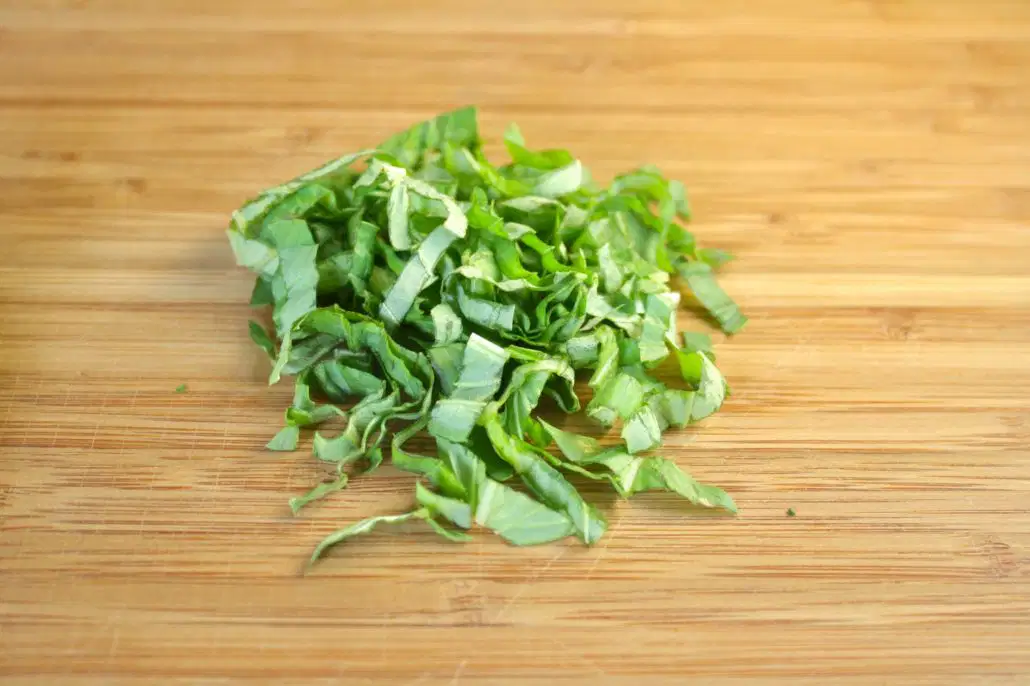
What is this knife cut?
Chiffonade
Dice
Julienne
Mince
The safest way to pass a knife to another person is
to lay the knife on the counter and let the other person pick it up
to hand it to them with the blade facing them
to throw it and hope they catch it

