
 Worksheets
U203Principles of manufacturing tech Quiz
Total questions: 35
Worksheet time: 9mins
Which of the following is NOT a type of manufacturing organization?
Jobbing
Batch
Continuous
Retail
What is the main activity of a jobbing workshop?
Mass production of identical items
Custom manufacturing of unique items
Continuous production of goods
Batch production of identical items
Which of the following is NOT a property of materials?
Ductility
Hardness
Flexibility
Straightness
Which type of manufacturing organization is characterized by the production of goods in small quantities, often customized?
Jobbing
Batch
Continuous
Mass
Which of the following is NOT listed as a function in manufacturing technology?
Design
Planning
Marketing
Quality
Which of the following is a correct description of the ability of a metal to undergo deformation without breakdown under tensile loading?
Hardness
Ductility
Brittleness
Elasticity
Which of the following materials is known for its ability to resist wear and indentation?
Aluminium
Carbon steel
Copper
Mild steel
Which of the following is NOT a type of Engineering?
Plant
Process
Installation
Construction
Which of the following is NOT a form of stock material?
Sheet
Wire
Bar
Screw
Which of the following is NOT part of indirect factory costs?
Electricity for factory equipment
Depreciation of equipment
Direct labour
Production supplies
Which of the following is NOT a permanent joint?
Welding
Soldering
Brazing
Bolting
Which of the following are examples of a non-permanent engineering joint?
Nails
Pins
Screws
Bolts
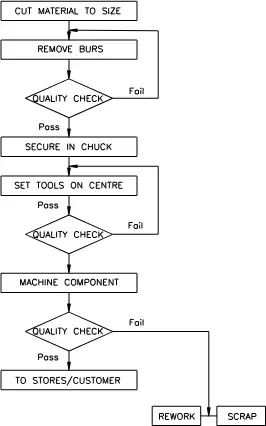
What is the final step in the process flow diagram if the quality check passes?
Rework
Scrap
To stores/customer
Secure in check
What is the primary purpose of a flowchart in manufacturing?
To design products
To plan marketing strategies
To visualize process steps
To manage finances
Which of the following is a characteristic of batch production?
Continuous production of goods
Production of unique items
Production in large quantities
Production in set quantities
Which of the following is NOT a type of material testing?
Tensile testing
Hardness testing
Flexibility testing
Color testing
In Business what is calculated by dividing the fixed costs by the contribution per unit sold?
Answer: (a)
Which of the following is NOT a method of joining materials?
Welding
Riveting
Gluing
Painting
Which type of production is characterized by the continuous output of products?
Jobbing
Batch
Continuous
Project
Which of the following is NOT a property of metals?
Conductivity
Elasticity
Transparency
Malleability
Which of the following are production requirements to manufacture components?
(a) (b) (c)
Which of the following is a property of metals?
Transparency
Brittleness
Conductivity
Elasticity
Which of these are thermo plastics?
ABS
PVC
GRP
CFC
Which of these are plastic-fibre composites?
ABS
PVC
GRP
CFC
Which of these are ferrous metals?
Aluminium
mild steel
cast iron
Bronze
Which Department solves problems and improves the product before manufacture?
Design (R&D)
Purchasing
Which Department inspects the product after manufacture?
Design (R&D)
Purchasing
Which of the following is a process used to harden the surface of a metal?
Annealing
Tempering
Case hardening
Normalizing
Which type of production is characterized by the creation of products in large quantities, often standardized?
Jobbing
Batch
Mass
Project
Which type of manufacturing process involves the production of goods in groups?
Jobbing
Batch
Continuous
Mass
Which of the following materials is known for its high electrical conductivity?
Aluminium
Carbon steel
Copper
Mild steel
a material's ability to withstand rupture under the influence of compressive loading is called:
Toughness
malleability
hardness
brittleness
a material's ability to withstand shock (impact) and withstand the effects of bending and shear stresses without fracture, is called:
Toughness
malleability
hardness
brittleness
Which of the following processes is used to improve the toughness of a metal?
Annealing
Quenching
Tempering
Normalizing
Which of the following is a characteristic of mass production?
Production of unique items
Production in small quantities
Production in large quantities
Production in set quantities

