
 Worksheets
American Revolution
Total questions: 23
Worksheet time: 12mins
Name
Class
Date
1.
Which of the following was NOT a cause of the French and Indian War?
a)
The French and British were already at war in Europe and those tensions spilled over into North America.
b)
The British were concerned about French forts being built in the Ohio River Valley.
c)
The population of the British colonies was growing rapidly and pushing westward in search of more land.
d)
All of the above statements are TRUE
2.
Which indigenous group/s was allied with the British during the French and Indian War?
a)
Ottawa
b)
Algonquin
c)
Iroquois
d)
All of the above
3.
Which indigenous group/s was allied with the French during the French and Indian War?
a)
Huron
b)
Ottawa
c)
Algonquin
d)
All of the above
4.
A major difference between the activities of the French colonists and the English colonists in North America is that the French –
a)
were primarily farmers and grew large amounts of corn for shipment back to France.
b)
had a well-established fur trading industry.
c)
occupied most of southern Florida.
d)
were primarily interested in fishing rights in the Great Lakes.
5.
British general sent to drive the French out of the Ohio Valley in 1755
a)
William Pitt
b)
George Washington
c)
Edward Braddock
d)
James Wolfe
6.
British foreign minister who made peace with important indigenous allies and adopted indigenous fighting techniques.
a)
William Pitt
b)
George Washington
c)
Edward Braddock
d)
James Wolfe
7.
British officer who was defeated by the French and forced to return to Virginia.
a)
William Pitt
b)
George Washington
c)
Edward Braddock
d)
James Wolfe
8.
British general who led a surprise attack on Quebec in 1759
a)
William Pitt
b)
George Washington
c)
Edward Braddock
d)
James Wolfe
9.
Which of the following was NOT a result of the 1763 Treaty of Paris?
a)
France lost Canadian colonies and claims to land east of the Mississippi River.
b)
Spain got French territory west of the Mississippi River.
c)
England got all French territory in Canada, Florida & rights to Caribbean slave trade.
d)
French forces were pushed into the American Southwest.
10.
A direct result of British involvement in the French and Indian War was that the –
a)
British had a lot of war debt and decided to set new taxes for the colonists.
b)
British switched their political focus from mainland North America to the Caribbean.
c)
French took Vermont from the British.
d)
French abandoned their control over Boston.
11.
What was the result of the Sugar Act of 1764?
a)
Molasses became illegal in the colonies and people were forced to use sugar instead.
b)
It provided New England colonists with new land for their growing sugar plantations.
c)
It was intended to eliminate the illegal sugar trade between the Spanish and French West Indies and the British colonies.
d)
Sugar became the dominant product traded in the colonies.
12.
*Closed the port of Boston until the colonists paid for destroyed tea.
*Revoked Massachusetts' charter
*Allowed the Royal governor to order trials of accused to take place in Great Britain
*Allowed British troops to be housed in private buildings
The above actions describe the -
a)
Intolerable Acts.
b)
Currency Act.
c)
Townshend Acts
d)
Quebec Act.
13.
Which of the following is TRUE about the Stamp Act of 1765?
a)
It provided free stamps for the colonists, which helped the economy.
b)
Merchants, lawyers, tavern owners, and printers were all hurt economically by the Act.
c)
It was welcomed by the colonists, who had been asking for more freedom in the use of stamps.
d)
Patrick Henry of Virginia was a strong supporter of the Act.
14.
Which of the following was NOT part of the Townshend Acts?
a)
An act requiring colonists to provide housing and supplies to British troops.
b)
A tea tax.
c)
A tax on fish caught in British waters.
d)
A duty that taxed paint, lead, and paper.
15.
Which of the following is NOT one way the colonists showed their anger at unfair British taxes?
a)
Colonial women refused to shop at British-owned shops and market stalls, leading to a drop in income for British Loyalist merchants.
b)
The Sons of Liberty dumped British tea into Boston Harbor.
c)
Colonists boycotted British products, such as cotton fabrics woven in British mills, and chose American-made fabrics instead.
d)
All of the above were methods used to show colonial anger at British taxes.
16.
Which of the following events served as an inspiration to the colonists when they started thinking about breaking away from Britain?
a)
The Enlightenment.
b)
The success the Puritans had leaving behind religious persecution in England and starting their own free colony in North America.
c)
The Whig political party in England standing up against the Tory political party, which backed King George.
d)
All of the above
17.
Thomas Paine, “Common Sense,” 1775
“Small islands, not capable of protecting themselves, are the proper objects for kingdoms to take under their care; but there is something absurd, in supposing a continent to be perpetually governed by an island.”
What situation is Thomas Paine criticizing in the above excerpt?
a)
American colonists moving north to French Canada.
b)
Britain’s control over large parts of North America.
c)
Spain’s illegal control of Long Island, which was part of the British colony of New York.
d)
None of the above
18.
“The history of the present King of Great Britain is a history of repeated injuries and usurpations, all having in direct object the establishment of an absolute Tyranny over these States…”
The Declaration of Independence, 1776
Thomas Jefferson
Which “injuries” was Thomas Jefferson most likely writing about?
a)
Unfair taxes and British army violence against colonists.
b)
The thousands of colonists wounded in the French and Indian War.
c)
Damage to infrastructure, such as the Custom House in Boston.
d)
The kidnapping of British sailors for forced service on American ships.
19.
“…that they are endowed by their Creator with certain unalienable Rights, that among these are Life, Liberty and the pursuit of Happiness.--That to secure these rights, Governments are instituted among Men, deriving their just powers from the consent of the governed…”
The Declaration of Independence, 1776
Thomas Jefferson
What is the main idea of this excerpt from the Declaration of Independence?
a)
People give power to their leaders in government, who protect the people’s natural rights.
b)
Rights are only for those who believe in a Creator.
c)
The government must give consent before the people have rights.
d)
Everyone has rights, including enslaved peoples, indentured servants, and indigenous groups.
20.
Which of the following is TRUE about the Battle of Saratoga?
a)
It was a decisive British win, which convinced the Spanish to ally with Great Britain.
b)
It was a decisive American win, which convinced the French to officially support the colonists.
c)
Neither side won because a dangerous winter snowstorm interrupted the battle.
d)
It was a decisive American win and the victors went on to invade British Canada.
21.
In October 1781, Lord Cornwallis surrendered to the Continental Army after the Battle of -
a)
Saratoga.
b)
Monmouth.
c)
Trenton.
d)
Yorktown.
22.
The Marquis de Lafayette, from a letter written to the abolitionist Thomas Clarkson
“I would never have drawn my sword in the cause of America, if I could have conceived that thereby I was founding a land of slavery.”
Although French, the Marquis de Lafayette was a hero of the American Revolution and supporter of American independence. Based on his words above, what aspect of the new country did he NOT support?
a)
Slavery
b)
Treaties with the Spanish
c)
Trade agreements with France
d)
Assimilation of indigenous groups
23.
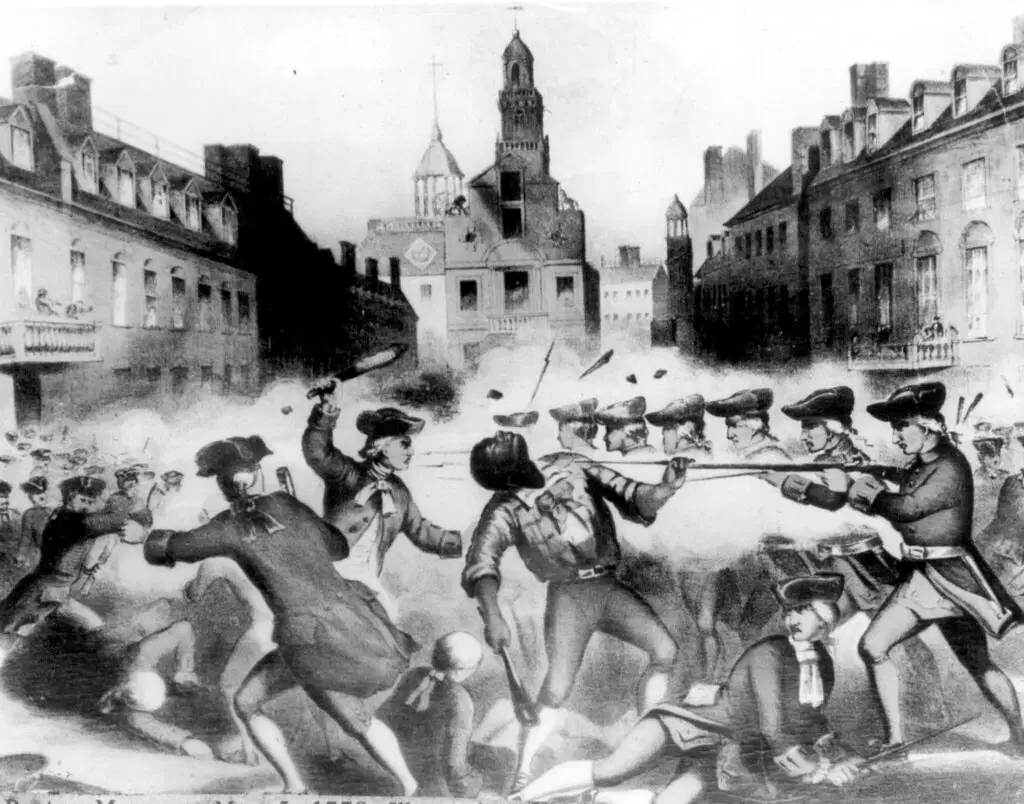
Using the details in the above picture of the Boston Massacre, which of the following is TRUE about life in Boston during this time period?
a)
It was a small, relatively undeveloped town of mostly farms.
b)
The British forces lacked organization and weapons.
c)
American women took an active role in the violence between the British and the colonists.
d)
One of the Patriots killed at the Boston Massacre was a free Black man.
100 %

