
 Worksheets
S24 CT Wind Classfication
Total questions: 30
Worksheet time: 15mins
How do wind loads typically act on buildings?
Only laterally on walls
Only up and down on roofs
Both laterally on walls and up and down on roofs
Only diagonally on walls
What is the result of wind blowing against a building?
Negative pressure which pulls at the building
Positive pressure which pushes against the building
No pressure change
Both positive and negative pressure
What does a vortex (whirl) result in?
Positive pressure which pushes against the building
No pressure change
Negative pressure which pulls at the building
Both positive and negative pressure
What type of building will be affected by the wind load more than masonry, timbers, and slate tiles?
Heavyweight building
Lightweight building
Reinforced concrete building
Steel-framed building
What can wind produce when it flows around a building?
Low pressure at the base
High suction pressures mainly at the leading edges
Increased temperature inside the building
Reduced air circulation
What is necessary to prevent a building from being blown away by wind?
Painting the building
Bracing the structure and anchoring it to the ground
Using lightweight materials
Increasing the height of the building
What is necessary for maintaining the stability of a building against wind loads?
Careful placement of bracing or other means
Using glass windows
Increasing the number of doors
Reducing the height of the building
What type of wind pressure will a roof surface experience if it has a slope greater than 30 degrees and faces into the wind?
Positive wind pressure
Negative wind pressure
No wind pressure
Equal wind pressure
What is the effect of a flatter roof on the suction forces exerted on it?
Higher suction forces
Lower suction forces
No suction forces
Equal suction forces
What is important to tie the roof materials to?
Supporting battens or rafters
The ground
The walls
The ceiling
What types of weather phenomena do high wind areas experience?
Earthquakes and tsunamis
Tornadoes, thunderstorms, and extensive deep pressure systems
Droughts and heatwaves
Snowstorms and blizzards
What is the purpose of understanding wind loads and their potential impact on a building?
To increase the aesthetic appeal of the building
To safeguard people from injury caused by structural failure
To reduce the cost of construction
To improve the energy efficiency of the building
According to the document, which building classes should be assessed for wind load requirements according to AS/NZS 1170.2 Wind Actions or AS 4055?
Building class 1 & 10
Building class 2-9
Building class 1-4
Building class 5-10
What does ULS stand for in the context of wind loads?
Ultimate Load State
Ultimate Limit State
Uniform Load State
Uniform Limit State
What is the requirement for a structure under SLS?
The structure must collapse under routine conditions
The structure must remain functional for its intended use subject to routine loading
The structure must be aesthetically pleasing
The structure must be energy efficient
What does NCC define as the "design gust wind speed"?
The average wind speed over a year
The maximum wind speed recorded in a decade
The design wind speed for the area where the building is located
The minimum wind speed required for construction
What does "N" stand for in Table 4 Wind classes?
Normal winds
Non-cyclonic winds
Northern winds
Neutral winds
What does "C" stand for in Table 4 Wind classes?
Cyclonic winds
Calm winds
Coastal winds
Central winds
Which of the following factors affects wind loads in different locations?
Geographic location
Time of day
Population density
Soil type
What is one of the factors that influence wind speeds according to the document?
Building color
Terrain category
Temperature
Humidity
What is the distance range for Region B (Intermediate) wind classification?
50 kms
100 kms
150 kms
200 kms
What is the characteristic of Terrain Category 1 (TC1)?
Open terrain with numerous closely spaced obstructions
Very exposed open terrain with few or no obstructions
Terrain with a few trees or isolated obstructions
Open water surfaces subjected to shoaling waves
Which terrain category is described as having open water surfaces subjected to shoaling waves?
TC1
TC2
TC1.5
TC3
What is the height range of obstructions in Terrain Category 2 (TC2)?
1.5m to 5m
3m to 10m
Less than 1.5m
More than 10m
Which terrain category represents terrain with a few trees or isolated obstructions and is intermediate between TC2 and TC3?
TC1
TC2
TC2.5
TC3
What is the classification for a slope that is less than a 1 in 20 rise?
T0
T1
T2
T3
How is the maximum slope measured for topography classification?
At the bottom of the hill
At the steepest part of the hill
At the middle of the hill
At the flattest part of the hill
What happens to wind pressures over the top of a hill?
They increase
They remain constant
They drop down
They fluctuate
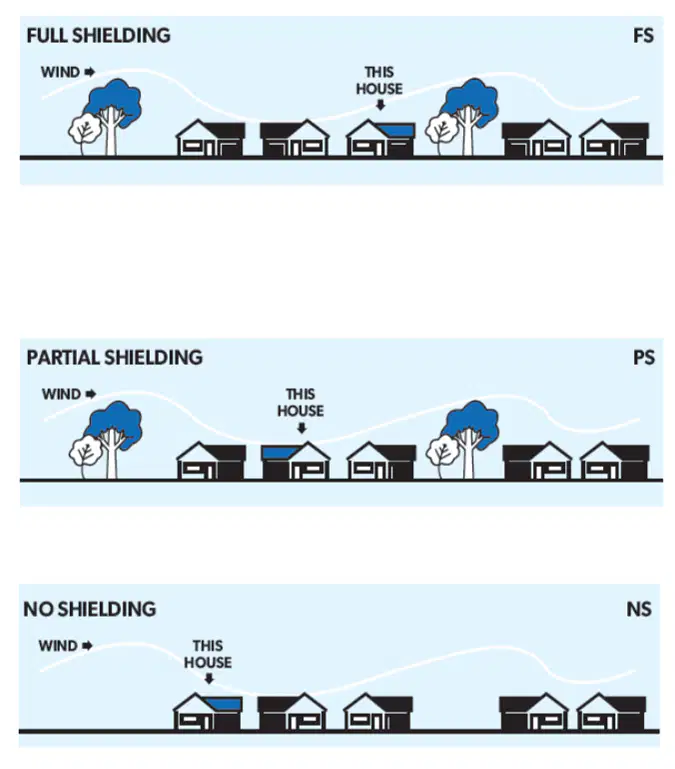
What is the minimum number of rows of houses or similar size permanent obstructions required to provide full shielding (FS) for a house?
At least 1 row
At least 2 rows
At least 3 rows
At least 4 rows
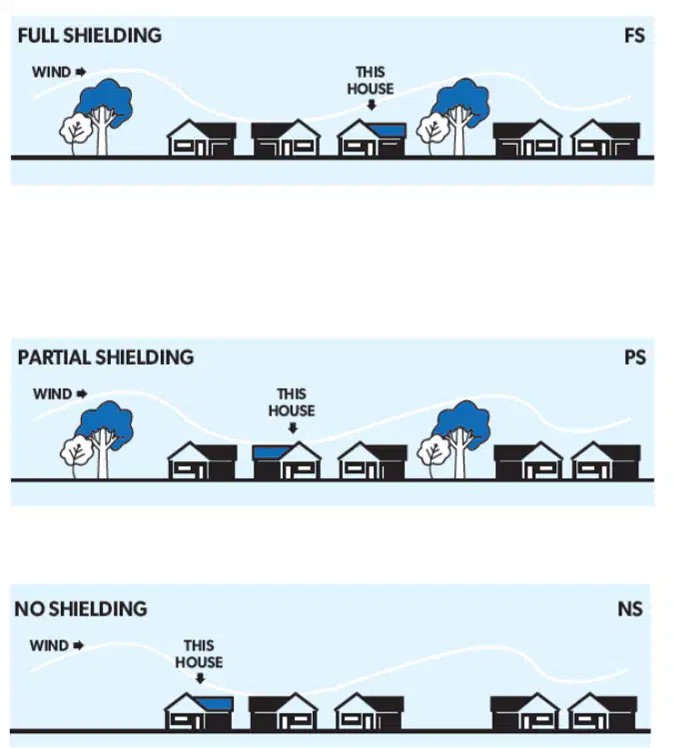
What type of shielding is provided where there are at least 2.5 houses, trees, or sheds per hectare?
Full shielding (FS)
Partial shielding (PS)
No shielding (NS)
Complete shielding (CS)

