
 Worksheets
PFL&E (TX) Unit 1 Review
Total questions: 40
Worksheet time: 29mins

When there is a shortage the price will usually?
rise
fall
remain the same
equilibrium
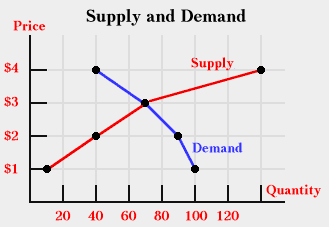
What is the Equilibrium Price?
1
2
3
4
The amount of a good or service that producers are willing and able to sell at all possible prices during a given period of time.
Supply
Demand
Factor of Production
Production
What causes a shift in the demand curve?
change in number of consumers
the complement to the product is on sale
all of these
an increase in income for people
Which explains why a supply line is upward sloping?
the Law of Demand states there is an indirect relationship between price and quantity
the Law of Supply states there is a direct relationship between price and quantity
the Law of Supply compares marginal costs and marginal benefits in a constant rate
the Law of Demand shows a positive relationship between two goods, creating the slope
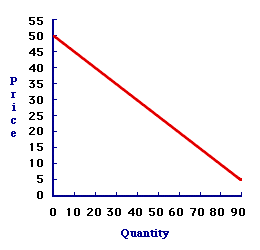
Which statement describes the law of demand?
As prices rise, quantity demanded decreases
As prices rise, demand decreases.
As prices fall, quantity demanded decreases.
As prices fall, demand decreases.


Because of scarcity, people are forced to make _________ about how to use resources.
Choices
Opportunities
Houses
Desires
Amber was shopping at the mall looking for an outfit for a night out. She had $80 to spend. She found items she liked: $75 for a pair of shoes, $70 for a jacket, $60 for a dress. After shopping for a couple hours, she decide to buy the jacket for $70 and wear a dress she already had. What was her opportunity cost?
Shoes
Jacket
Dress
Purse
Tom was shopping for a car. He has looked at a Ford, Honda, Toyota, and Dodge. After a lot of debate, he narrowed it down to either the Ford or the Honda. He selected the Ford, because he liked the interior a little better. What was his opportunity cost?
Ford
Honda
Toyota
Dodge
Limited Resources + Unlimited Wants =
Scarcity
Productivity
Opportunity Cost
Efficiency
A trade-off is
a purchase in a marketplace.
lose some of one item while gaining another.
any good or service a consumer needs.
a factor of production.
True or False: Everything that is scarce requires a choice, and these choices always involve a tradeoff.
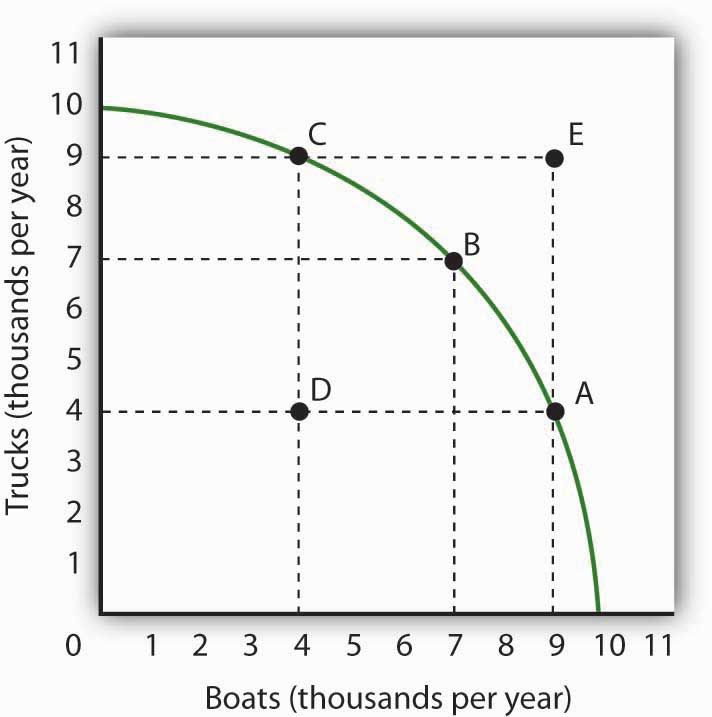
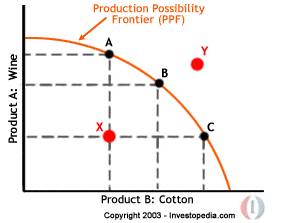
a graph that shows how much an economy can produce between 2 goods at 100% efficiency
Factors of Production/Resources



Businesses provide government with...
taxes
sales
private goods & services
interest

In terms of resources, what do households provide for businesses?
loans
savings
labor/resources
private goods
Where are factors of production (land, labor, etc) exchanged in the circular flow model?
Resource Market
Product Market
Firms
Individuals
Someone buys a car in exchange for a large amount of money. They have completed an exchange in which part of the circuclar flow model?
Product Market
Factor Market
Firms
Individuals
Do business supply or demand from the product market?
Supply
Demand
Neither
Both
Do individuals supply or demand from the product market?
Supply
Demand
Both
Neither
Public sector is
all businesses and individuals participating in the economic system
all government programs
all local businesses
all corporations
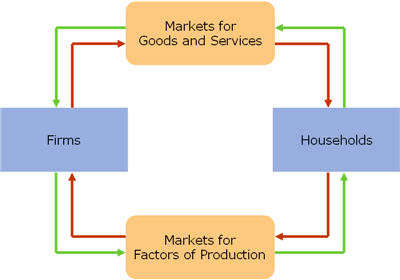
Identify which items below are correctly matched. Choose 3
Labor sold by households = Resource Market
Labor sold by households = Product Market
Computers sold by businesses = Product Market
Computers bought by households = Product Market

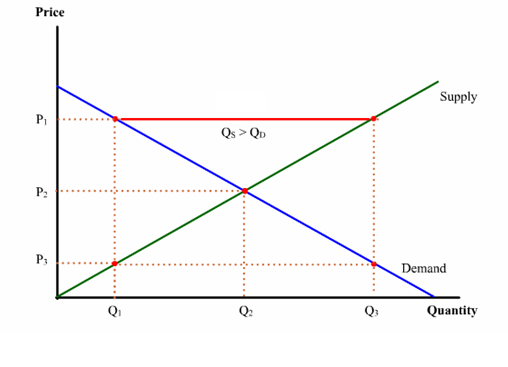
Refer to Graph 4-5. According to the graph, What occurs at a price of $7?
there would be a shortage of 40 units.
there would be a surplus of 40 units.
there would be a surplus of 20 units.
the market would be in equilibrium.

Suppose that the market for coats is described as follows: What is the equilibrium price of coats?
120
100
80
60

