
 Worksheets
Inorganic Chemistry
Total questions: 77
Worksheet time: 2hrs 20mins
Which of the following is NOT a form of electromagnetic radiation?
Beta radiation
Gamma radiation
Ultra-violet radiation
Infra-red radiation
Compared to visible radiation, ultra-violet radiation has
longer wavelength and higher velocity
higher frequency and longer wavelength
lower frequency and shorter wavelength
shorter wavelength and higher frequency
Which of the following lists electromagnetic radiation bands in order of increasing frequency?
Ultraviolet, visible, infra-red, radio
Radio, infra-red, visible, ultraviolet
Radio, microwave, ultraviolet, visible
Visible, ultraviolet, X-ray, microwave
Which area of the electromagnetic spectrum has the longest wavelength?
Red light
Radio waves
X-rays
Blue light
Light from a sodium street lamp is found to have a frequency of 5.09 x 10¹⁴ Hz. Calculate the wavelength of this light in nanometres.
Potassium compounds produce a lilac colour when heated in a bunsen flame. Use the data booklet to find the wavelength of the light associated with potassium and calculate the frequency of this radiation.

When hydrogen is subjected to a high voltage in a gas discharge tube and the emitted light is passed through a prism the atomic emission spectrum produced is as shown below.
Explain how the lines on the spectrum are produced.
To cause caesium atoms on the metal surface to lose electrons energy equivalent to 200 kJ mol⁻¹ must be supplied. Calculate the wavelength of light, in nanometres, that will cause caesium to lose electrons.

The following technique is used to detect trace elements in steels and other alloys. The metal sample is sparked as shown in the diagram.
The output of one sample is also shown.
In which region of the electromagnetic spectrum do these lines lie?

Calculate the energy, in kJ mol⁻¹, of the line due to tin.

Explain how this sparking procedure relates to the formation of the lines in the spectrum.
Which of the following values of the angular momentum quantum number represents a p orbital?
0
1
2
3
How many atomic orbitals make up the 4d subshell?
1
3
5
7
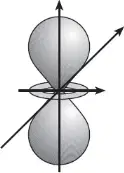
The diagram represents
a specific p orbital
any p orbital
a specific d orbital
any d orbital
Which of the following statements is correct?
The 2s and 3s subshells are degenerate
The 2s orbital has more energy than the 3s orbital
There are 5 p orbitals in the second energy level
The value of l for a 2s orbital is zero
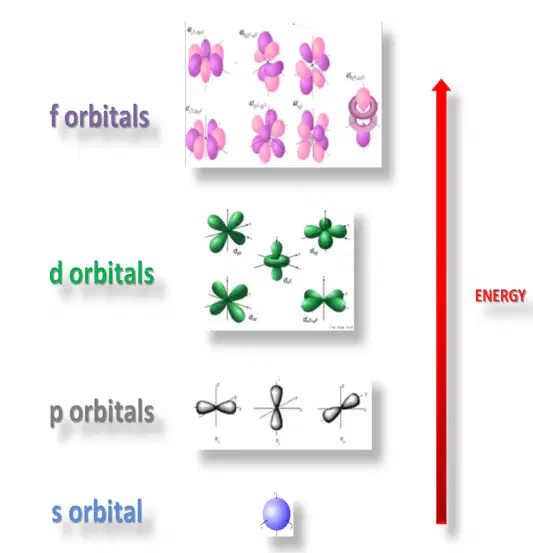
The diagram shows how the energies of s, p, d and f orbitals are related.
All 7 orbitals are degenerate. What is meant by degenerate?
State the maximum number of electrons the f subshell can hold.
What are the values of the magnetic quantum number for the 3 p orbitals?
What is the smallest value of the principal quantum number in which a d subshell exists?
In a sodium vapour lamp electrons are promoted from the 3s orbital to the 3p orbital. This requires electromagnetic radiation with a wavelength of 454 nm. Calculate the energy, in kJ mol⁻¹, associated with light of this wavelength.
State the number of orbitals which make up: (i) the s subshell (ii) the d subshell.
State the number of electrons that are needed to completely fill: (i) the p subshell (ii) the first energy level (iii) the third energy level.
State the number of subshells in the fourth energy level.

Explain which set of numbers is not allowed according to quantum theory.
A
B
C
D

Which set of numbers represents an s subshell?
A
B
C
D

Which set of numbers could belong to a hydrogen atom in its ground state?
A
B
C
D
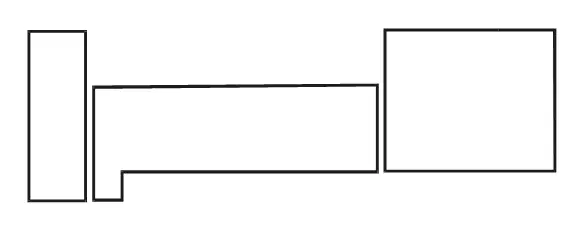
Copy the diagram of the Periodic Table and mark on it ‘s’, ‘p’ and ‘d’ to show which type of orbital is being filled in each part of the table.
Write the electron configuration in terms of s, p and d electrons for the following atoms and ions: a. V b. V³⁺ c. S²⁻ d. Mn⁴⁺ e. Cr f. Ca g. Br⁻ h. Zn²⁺ i. Cr⁶⁺ j. Fe²⁺
The statement that “an orbital can accommodate, at most, two electrons, and if so, they must be of opposite spin” is based on
Hund’s rule
the Pauli exclusion principle
the aufbau principle
the Heisenberg uncertainty principle
An atom has the electronic configuration 1s² 2s² 2p⁶ 3s² 3p¹. What is the charge of the most likely ion formed from this atom?
-1
+1
+2
+3
The number of unpaired electrons in a gaseous Ni²⁺ ion is
0
2
4
6

An atom of iron contains 26 electrons. Which of the following diagrams below correctly represents the distribution of electrons in the 3d and 4s orbitals in an atom of iron in its ground state?
A
B
C
D
According to the aufbau principle, electrons fill orbitals in the order
1s 2s 2p 3s 3p 4s 4p 3d
1s 2s 2p 3s 3d 3p 4s 4p
1s 2s 2p 3s 3p 3d 4s 4p
1s 2s 2p 3s 3p 4s 3d 4p
A detector in a Geiger counter contains argon which ionises when nuclear radiation passes through it. Write the electronic configuration for argon in terms of s and p orbitals
The first ionisation energy of argon is 1530 kJ mol−1. Calculate the wavelength of the radiation, in nm, corresponding to this energy.
Write the equation for the first ionisation of argon.
Using your knowledge of chemistry discuss the following electronic configuration. 1s2 2s2 2p6 3s2 3p6 3d6 4s2
Suggest a set of values for the four quantum numbers n, l, m, and s for an electron in the 2p subshell of an oxygen atom in its ground state.
Explain why the first ionisation energy of potassium is less than the first ionisation energy of lithium.
Explain why the first ionisation energy of potassium is less than the first ionisation energy of calcium.
Which one of the following processes requires the largest input of energy?
He(g) → He⁺(g) + e⁻
Ne(g) → Ne⁺(g) + e⁻
Na(g) → Na⁺(g) + e⁻
Ca(g) → Ca⁺(g) + e⁻
The second ionisation energy for calcium is represented by the equation
Ca(s) → Ca²⁺(g) + 2e⁻
Ca(g) → Ca²⁺(g) + 2e⁻
Ca⁺(s) → Ca²⁺(g) + e⁻
Ca⁺(g) → Ca²⁺(g) + e⁻
The electronic configurations, X and Y, for two uncharged atoms of sodium are as follows. X 1s² 2s² 2p⁶ 3s¹ Y 1s² 2s² 2p⁶ 4s¹ Which of the following statements is true?
A. X is an excited state.
B. Both X and Y have vacant 2d orbitals.
C. Energy is absorbed in changing Y to X.
D. Less energy is required to ionise Y compared to X.
The electronic configurations, in spectroscopic notation, of nitrogen and oxygen in their ground states are shown below. Nitrogen 1s² 2s² 2p³ Oxygen 1s² 2s² 2p⁴ (i) Draw the electronic configurations, using orbital box notation, for both nitrogen and oxygen.

The electronic configurations, in spectroscopic notation, of nitrogen and oxygen in their ground states are shown below. Nitrogen 1s² 2s² 2p³ Oxygen 1s² 2s² 2p⁴ (ii) Use the orbital box notation for nitrogen’s 2p subshell to illustrate Hund’s rule.
Use the orbital box notation for oxygen’s 2p subshell to illustrate the Pauli exclusion principle.
Write an equation which represents the first ionisation energy of oxygen.
Explain why the first ionisation energy of oxygen is less than that of nitrogen.
What is the oxidation number of manganese in the ion MnO₄²⁻?
-2
+4
+6
+7
In which of the following reactions does the oxidation state of copper remain the same?
Zn + CuSO₄ → ZnSO₄ + Cu
CuSO₄ + Na₂CO₃ → 2NaCl + CuCO₃
FeCl₂ + CuCl₂ → FeCl₃ + CuCl
Cu + 4HNO₃ → Cu(NO₃)₂ + 2H₂O + 2NO₂
Which of the following could not act as a ligand?
Na+
Cl-
H2O
NH3
The correct formula for the tetraamminedichlorocopper(II) complex is
[Cu(NH3)4Cl2]2-
[Cu(NH3)4Cl2]
[Cu(NH3)4]2+
[Cu(NH3)4Cl2]+
The correct name for the complex ion [Fe(CN)6]4- is
tetracyanoiron(II)
tetracyanoferrate(IV)
hexacyanoiron(IV)
hexacyanoferrate(II)
The coordination number of cobalt in the complex [Co(NH3)4Cl2]Cl is
1
2
4
6
The oxidation number of iron in the complex ion [Fe(OH)(H2O)5]2+ is
+2
+3
+5
+6
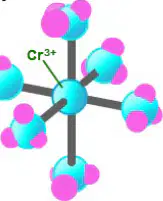
What shape is this complex ion?
Square planar
Tetrahedral
Octahedral
Triganol bipyramid
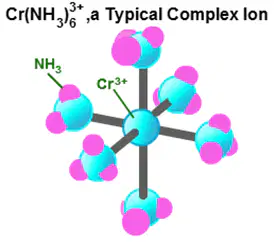
The name of this complex ion is
hexaminechromium(II)
triamminechromium(VI)
hexaamminechromium(III)
triamminechromate(III)
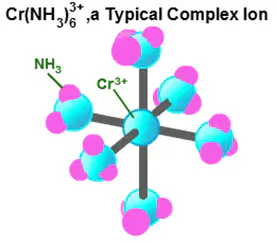
The electronic configuration of chromium in this complex ion is
1s² 2s² 2p⁶ 3s² 3p⁶ 3d²
1s² 2s² 2p⁶ 3s² 3p⁶ 3d³
1s² 2s² 2p⁶ 3s² 3p⁶ 3d⁴
1s² 2s² 2p⁶ 3s² 3p⁶ 3d⁵
Solutions of some complex ions are acidic. For example, an aqueous solution of iron chloride can have a pH of 3.0. One of the processes occurring is: Fe(H₂O)₆³⁺ + 3Cl⁻(aq) + H₂O ⇌ [Fe(H₂O)₅OH]²⁺ + H⁺(aq) + 3Cl⁻(aq) a. Name the two ligands in the complex structure on the right of the equation above.
Solutions of some complex ions are acidic. For example, an aqueous solution of iron chloride can have a pH of 3.0. One of the processes occurring is: Fe(H₂O)₆³⁺ + 3Cl⁻(aq) + H₂O ⇌ [Fe(H₂O)₅OH]²⁺ + H⁺(aq) + 3Cl⁻(aq) b. Draw a diagram showing the shape of the complex ion on the left of the equation and name its shape.
Solutions of some complex ions are acidic. For example, an aqueous solution of iron chloride can have a pH of 3.0. One of the processes occurring is: Fe(H₂O)₆³⁺ + 3Cl⁻(aq) + H₂O ⇌ [Fe(H₂O)₅OH]²⁺ + H⁺(aq) + 3Cl⁻(aq)
Use the oxidation number of iron in the reactant and product to explain whether this reaction is a redox reaction.
Name the following transition metal complexes. a. [Cr(OH)6]3- b. [Co(NH3)6]Cl3 c. [Cu(NH3)4(H2O)2]2+ d. [Pt(NH3)4]2+ e. [Fe(Br)6]4-
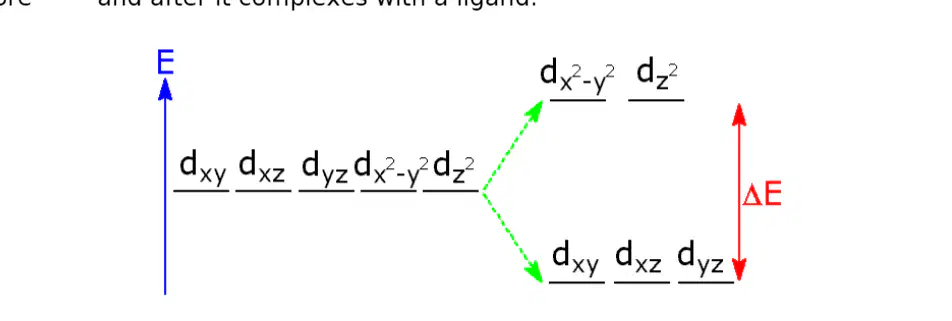
The diagram shows the relative energies of the 3d orbitals of a transition metal before and after it complexes with a ligand. Use your knowledge of chemistry to explain this diagram and why this is important in the observed colours of some transition metal complexes.
The table shown gives information about complex ions containing vanadium.
What name is given to the shape of the green complex ion [V(H2O)6]3+?

Give the electronic configuration for vanadium in the [VO2]+ ion.
What is the change in the three dimensional arrangement of the bonds around the oxygen atom in the following reaction? H₂O + H⁺ → H₃O⁺
Non-linear to pyramidal
Linear to pyramidal
Linear to tetrahedral
Non-linear to tetrahedral

The following diagram represents a square planar structure. Which of the following species could have a square planar structure?
SF₄
NH₄⁺
XeF₄
AlH₄⁻
In which of the following molecules will all the bond angles be 90 degrees?
H₂O
NH₃
CH₄
SF₆
Which of the following species have the same number of valence shell electron pairs?
NH₄⁺ and CH₄
NH₄⁺ and BF₃
BF₃ and NH₃
PF₅ and BF₄⁻
Which shape best describes the arrangement of electron pairs around the central iodine atom in the I₃⁻ ion?
Linear
Tetrahedral
Trigonal bipyramid
Octahedral
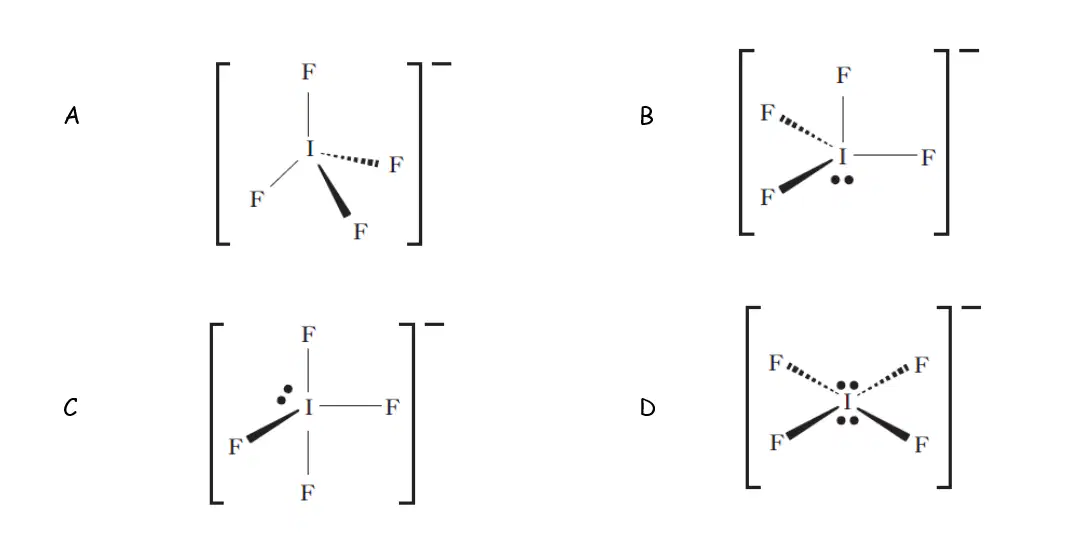
Which of the following diagram best represents the arrangement of electron pairs in the IF₄⁻ ion? Note that ●● represents a lone pair of electrons.
A
B
C
D
What is the likely structure of an antimony(V) chloride molecule?
Linear
Tetrahedral
Trigonal bipyramidal
Octahedral
What is the arrangement of electron pairs around the iodine atom in IF₅?
By considering the electron pairs in both molecules, explain why the bond angle in BF₃ is greater than the bond angle in NH₃.
State the shape of the BCl₃ molecule.
In terms of electron-pair repulsions, account for the difference in bond angle between the C and Cl in CCl₄ and between the N and Cl in NCl₃.
Sketch the shape of the NCl₃ molecule.

