wayground logo

Free Printable Worksheets

Font size

S
M
L
XL
Worksheets

Chem Final Review

Total questions: 75

Worksheet time: 3hrs 15mins

Name
Class
Date
1.
Change from standard form to scientific notation: 12,000,000
a)
12.0  x  107
b)
0.12  x  107
c)
1.2  x  106
d)
1.2  x  107
2.
Change from standard form to scientific notation:  450,000
a)
4.5  x  105
b)
45  x  105
c)
4.5  x  104
d)
4.5  x  106
3.
Try to change the number back to standard form:  6.79  x  104
a)
679,000
b)
6,790
c)
67,900
d)
6,790,000
4.
Try to change the number back to standard form:  6.79  x  104
a)
679,000
b)
6,790
c)
67,900
d)
6,790,000
5.
How do you write
8.317 x 10⁶
in standard form?
a)
8, 371, 000
b)
83, 170, 000
c)
837, 100
d)
8, 317, 000
6.
What is the formula for density?
a)
density = mass x volume
b)
density = mass / volume
c)
density = mass + volume
d)
density = mass - volume
7.
Frank has an eraser. It has a mass of 4g, and a volume of 2cm3. What is its density?
a)
8 g/cm3
b)
2 g/cm3
c)
1/2 g/cm3
d)
24 g/cm3
8.
Why do some substances float on water?
a)
they are warmer than water
b)
they are cooler than water
c)
they are more dense than water
d)
they are less dense than water
9.
Jack has a rock. The rock has a mass of 14 g and a volume of 2 cm3. What is the density of the rock?
a)
7 mL
b)
7 g/cm3
c)
28 g/cm3
d)
1/7 g/cm3
10.

What is the formula for Mass?

a)

Mass/Volume

b)

Density x Volume

c)

Mass/Density

11.

What is the formula for Volume?

a)

Mass/Volume

b)

Density x Volume

c)

Mass/Density

12.

The law of Conservation of Energy states ..

a)

Energy can created or destroyed but not transformed

b)

Energy cannot be created or destroyed, it can only transformed

c)

Energy can't be created, destroyed or transformed

13.
The positively charged particles of an atom are the ________.
a)
electrons
b)
protons
c)
neutrons
d)
protons & neutrons
14.
What does the nucleus of an atom contain?
a)
Electrons and neutrons
b)
Protons and neutrons
c)

DNA and RNA

15.

Atoms are made up of ________________

a)

energy

b)

electrons

c)

subatomic particles

d)

gasses

16.

__________ are negatively charged particles that are in the orbitals around the nucleus.

a)

protons

b)

nucleus

c)

neutrons

d)

electrons

17.
Which is an electron?
a)
A
b)
B
c)
C
18.
What is the atomic number of Boron?
a)
5
b)
11
c)
6
19.
How many electrons does Sodium have?
a)
11
b)
23
c)
12
20.
How many neutrons does Fluorine have?
a)
9
b)
19
c)
10
21.
How many protons does Boron have?
a)
5
b)
11
c)
6
22.

Water is a universal....

a)

solvent

b)

solute

c)

tension

d)

capillary

23.

The tightness across a substance caused by polar molecules pulling on each other.

a)

capillary action

b)

water tension

c)

solvent

d)

surface tension

24.
What word describes when water is attracted to other substances?
a)
cohesion
b)
adhesion
c)
capillary action
d)
surface tension
25.
What two elements make up water?
a)
Helium and oxygen
b)
Hydrogen and oxygen
c)
helium and carbon
d)
oxygen and carbon
26.
Attractions between the negative Oxygen atom of one water molecule and the positive Hydrogen atom of another water molecule are called
a)
Covalent bonds
b)
Ionic bonds
c)
Polar bonds
d)
Hydrogen bonds
27.
Why does ice float?
a)
As water freezes, it expands and its density decreases.
b)
As water freezes, it takes up more hydrogen from the atmosphere, causing it to have a greater buoyancy.
c)
As water freezes, air becomes trapped between the hydrogen bonds of water molecules.
d)
As water freezes, it takes up more oxygen from the atmosphere, causing it to have a greater buoyancy.
28.
Which end of the water molecule has a slightly positive charge?
a)
the oxygen end
b)
the hydrogen end
c)
both ends are slightly positive
d)
neither end is positive
29.
The fact that ice floats on liquid water is due to the fact that water's solid is ___________ than it's liquid form
a)
less polar
b)
more polar
c)
less dense
d)
more dense
30.
molecule in which opposite ends have opposite electric charges
a)
cohesion
b)
polar molecule
c)
hydrogen bond
d)
solution
31.

Material that PREVENTS electricity from flowing.

a)
electromagnetic field
b)
electric current
c)
insulator
d)

Conductors

32.

Which of the following is a good conductor of electricity?

a)

newspaper

b)

copper wire

c)

glass plate

d)

plastic bottle

33.

A conductor

a)

Doesn't allow electricity to pass through it

b)

Only conducts electricity in an open circuit

c)

Does not light up a bulb if attached to a circuit

d)

Allows electricity to pass through it
34.
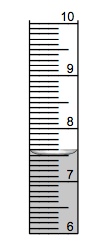
What is the correct value?
a)
5 ml
b)
15 ml
c)
20 ml
d)
25 ml
35.
What is the volume of the liquid in this graduated cylinder?
a)
8.5 mL 
b)
7.5 mL 
c)
8 mL 
d)
.1 mL
36.

This variable in an experiment is the one being deliberately changed by the scientist.

a)

dependent variable

b)

independent variable

c)

data

d)

control group

37.

Identify the Independent variable in the hypothesis stated below.


If a person increases the amount of sugar in their bodies then it can lead to health problems in the future.”

a)

Health problems

b)

Amount of Sugar

c)

None of the above

38.
When you charge a balloon by rubbing it on your hair this is an example of what method of charging?
a)
Friction
b)
Conduction
c)
Grounding
d)
Induction
39.
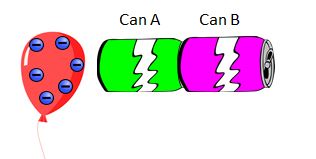
The negatively charged balloon is brought near the two cans. What happens?
a)

The negative charges in Can B move towards the balloon

b)

The negative charges in Can A move away from the balloon

c)

The positive charges in Can B move away from the balloon

d)

The positive charges in Can A move away from the balloon

40.
Which of these is the best definition of polarization?
a)
The object gains a positive or negative charge from another object.
b)
The charges in a neutral object separate due to a nearby charged object.
c)
Charges on a neutral object jump off onto a charged object due to attraction of opposite charges.
d)
Two objects attract each other because they are both charged.
41.
If a negatively charged rod touches a conductor, the conductor will be charged by what method? 
a)
Friction
b)
Conduction
c)
Induction
d)
Convection
42.
A charged balloon is brought near an electroscope but DOES NOT touch the electroscope.  This is an example of charging by
a)
Conduction
b)
Convection
c)
Friction
d)
Induction
43.
What happens when ice cubes melt in a glass?
a)
Heat travels from the ice to the warmer water.
b)
No energy is transferred.
c)
Heat is transferred from the warmer water to the ice cubes.
44.

Which takes in information using the five senses?

a)

Observation

b)

Inference

c)

Prediction

45.

Which is a conclusion based on observations

a)

Qualitative observation

b)

Quantitative observation

c)

Inference

d)

Prediction

46.

T/F - Observations are based on facts only

a)

True

b)

False

47.

Which is an educated guess about future events that you think will happen

a)

Qualitative Observation

b)

Quantitative Observation

c)

Inference

d)

Prediction

48.

Which uses measurements and numbers

a)

Qualitative observations

b)

Quantitative observations

c)

Inference

d)

Prediction

49.

Which is NOT an observation

a)

There is a dog

b)

The dog made the mess

c)

There are feathers all over the floor

d)

The dog is going to get in trouble

50.

Which is an inference?

a)

There is a dog

b)

The dog made the mess

c)

There are feathers all over the floor

d)

The dog is going to get in trouble

51.

Which is a prediction?

a)

There is a dog

b)

The dog made the mess

c)

There are feathers all over the floor

d)

The dog is going to get in trouble

52.

The plant is 12 cm tall, has 24 blooms, and has dark green leaves.

a)

inference

b)

qualitative observation

c)

quantitative observation

53.
Observations like the color or texture of an object are ________________ observations.
a)
quantitative
b)
qualitative
c)
operational
d)
scientific
54.

If an atom loses electrons, the charge will be positive.

a)

true

b)

false

55.

An atom with 2 protons, 3 neutrons, and 4 electrons has a charge of ____.

a)

+2

b)

-2

c)

+3

d)

0

56.
Ions are: 
a)
atoms with a positive or negative charge
b)
atoms with no charge
c)
atoms with ONLY a positive charge
d)
atoms with ONLY a negative charge
57.

Potassium is a metal, therefore it will

a)

lose electrons

b)

gain electrons

58.
Elements on the LEFT side of the periodic table will most likely form:
a)
Positive ions
b)
Negative ions
c)
Neutral Ions
d)
None of these
59.
How many total electrons does O-2 (an oxide ion) have?
a)
8
b)
10
c)
6
d)
18
60.
How many protons are in this element?
a)
79
b)
196
c)
117
d)
Cannot be determined
61.
Which particles make up the nucleus of an atom?
a)
protons and neutrons
b)
electrons and protons
c)
electrons, protons, and neutrons
d)
electrons and neutrons
62.
An element with a mass number of 11 and an atomic number of 5 has how many neutrons?
a)
11
b)
5
c)
6
d)
16
63.
Who was the first person to come up with the Atomic Theory?
a)
John Dalton
b)
Democritus
c)
Ernest Rutherford
d)
Niels Bohr
64.
Who discovered that the nucleus contains positively charged particles called protons?
a)
Ernest Rutherford
b)
James Chadwick
c)
Democritus
d)
Niels Bohr
65.
Atoms of the same element must always have the same number of _________
a)
electrons
b)
neutrons
c)
isotopes
d)
protons
66.
Two like charges
a)
 neutralize each other.
b)
repel each other. 
c)
must be neutrons. 
d)
attract each other.
67.
When a balloon is rubbed on clothes it acquires a charge by ___________
a)
Induction
b)
reduction
c)
friction 
d)
concuction
68.
Insulators are different than conductors in that insulators ____.
a)
do not contain electrons or protons 
b)
 do not contain any charge
c)
have a weaker affinity for electrons 
d)
do not allow charge to freely move 
69.
If two balloons have the same charge, what will happen if you place them close to each other?
a)
Nothing
b)
They will be attracted
c)
They will pop
d)
They will push each other away.
70.

The accumulation of excess electric charge on an object is called

a)

Static electricity

b)

Electric discharge

c)

Resistance

d)

Circuit

71.
The Electric Force is strongest when charges are...
a)
close together
b)
far apart
c)
the electric force is constant everywhere
72.
What is the volume of the liquid in this graduated cylinder?
a)
8.6 mL 
b)
86 mL 
c)
8.06 mL 
d)
.86 mL
73.
What is the volume of the liquid in this graduated cylinder?
a)
21 mL 
b)
2.1 mL 
c)
.21 mL 
d)
2.01 mL
74.

What is volume?

a)

How warm or cold a liquid is

b)

The amount of space a liquid takes up

c)

How dense a liquid is

d)

The amount of air trapped inside a liquid

75.
What is the scale on this graduated cylinder?
a)
.1 mL per line
b)
.2 mL per line
c)
.5 mL per line
d)
1 mL per line