wayground logo

Free Printable Worksheets

NEW

Font size

S
M
L
XL
Worksheets

Unit 1 Review

Total questions: 75

Worksheet time: 4hrs 19mins

Name
Class
Date
1.
How many sig. fig. are in the number below:
106.00
a)
2
b)
3
c)
4
d)
5
2.
How many sig. fig. are in the number below:
0.056
a)
1
b)
2
c)
3
d)
4
3.
How many sig. fig. are in the number below:
100.5
a)
1
b)
2
c)
3
d)
4
4.
How many sig. fig. are in the number below:
0.678
a)
1
b)
2
c)
3
d)
4
5.
How many sig. fig. are in the number below:
0.0005
a)
1
b)
2
c)
3
d)
4
6.
9.845 - 6.5
a)
10
b)
3.3
c)
3.35
d)
3.345
7.
2.12 + 3.5
a)
5
b)
5.6
c)
5.62
d)
5.620
8.
8-5
a)
3
b)
3.0
c)
3.00
d)
3.000
9.
25 * 5
a)
125
b)
120
c)
100
d)
130
10.

1000 x 12

a)

12,000

b)

10,000

c)

1

d)

12,000.0

11.
How many Significant Figures in the number below?
4,500
a)
3
b)
4
c)
2
d)
1
12.

Solve & Round to Correct Sig Figs.

4.5 x 2.34 =

a)

11

b)

10.52

c)

10.5

d)

1

13.
What are the three states of matter?
a)
solid, volume, mass
b)
density, volume, mass
c)
solid, liquid, gas
d)
density, gas, volume
14.
A state of matter that has a definite volume and shape.
a)
solid
b)
liquid
c)
gas
d)
matter
15.
Solids have a definite _______________.
a)
smell
b)
shape
c)
picture
d)
sound
16.
Liquid matter takes the shape of _______.
a)
a gas
b)
water
c)
a pet
d)
Its container
17.
Water in its solid form is _____________.
a)
a vapor
b)
ice
c)
a liquid
d)
boiling
18.

Which example is a compound?

a)

N2

b)

O2

c)

Cu

d)

H2O2

19.
Salt has a chemical formula of NaCl.  Salt is a...
a)
Compound
b)
Element
c)
Mixture
d)
None of the Above
20.
What cannot be broken down into other substances?
a)
Compound
b)
Mixture
c)
Solids
d)
Element
21.
A combination of substances that are not chemically combined is called a(n)____________. 
a)
mixture
b)
compound
c)
physical
22.
Mixtures are separated through ___________changes.
a)
mixture
b)
compound
c)
physical
23.
What type of mixture is this?
a)
heterogeneous 
b)
homogeneous
24.
What type of mixture is this?
a)
heterogeneous 
b)
homogeneous
25.
To separate the sugar and lemonade what method should you use?
a)
filtration 
b)
sorting
c)
magnet
d)
boiling
26.
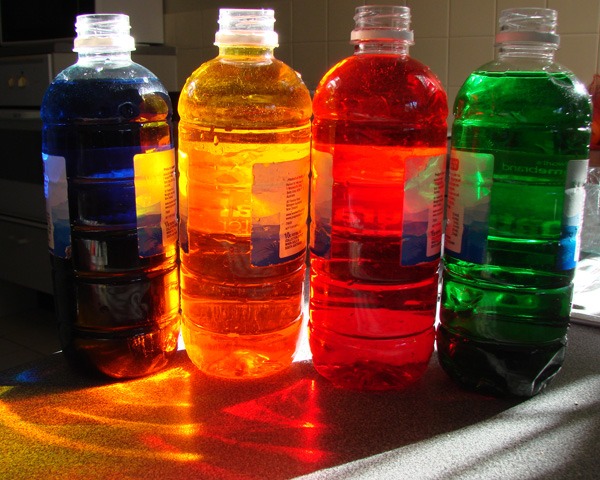
Coloured water is an example of a
a)
homogeneous mixture
b)
heterogeneous mixture
27.
M&M's is an examples of a
a)
homogeneous mixture
b)
heterogeneous mixture
28.
Chocolate milk is an example of a
a)
homogeneous mixture
b)
heterogeneous mixture
29.
Type of mixture that DOESN'T HAVE the same composition in every part.
a)
Homogeneous
b)
Heterogeneous
30.
Type of mixture that has the SAME COMPOSITION in every part.
a)
Homogenous
b)
Heterogeneous
31.
Soil is an example of a
a)
homogeneous mixture
b)
heterogeneous mixture
32.
Chicken noodle soup is an example of a
a)
homogeneous mixture
b)
heterogeneous mixture
33.
Is burning wood a chemical or physical change?
a)
chemical
b)
physical
34.
A change in the size, shape, or state of matter.
a)
chemical change
b)
physical change
c)
chemical reaction
d)
electron change
35.
Kim puts an ice cube in a beaker and it melts. This is a good example of:
a)
a physical change.
b)
a chemical change.
c)
an experiment.
d)
an analysis.
36.
Adding baking soda and vinegar together and it fizzes and creates carbon dioxide.
a)
Chemical
b)
Physical
37.
What is an example of a Chemical change?
a)
Ripped paper 
b)
boiled egg
c)
cracked egg
d)
sugar in water
38.
Which is a chemical change?
a)
freezing fruit juice
b)
slicing a potato
c)
boiling water
d)
copper metal turning green
39.
what is burning?
a)
physical change
b)
physical property
c)
chemical change
d)
chemical property
40.
One cup of water is left outside for two days when it was checked there was only half a cup left. What happened?
a)
evaporation; chemical change
b)
condensation; physical change 
c)
evaporation; physical change
d)
condensation; chemical change
41.
Boiling is a chemical change
a)
true 
b)
false
42.
No Definite Shape and No Definite Volume
a)
Gas
b)
Liquid
c)
Solid
43.
Phase change from a solid to a gas.
a)
sublimation
b)
deposition
c)
condensation
d)
evaporation
44.
What is the phase change of a solid to a liquid?
a)
freezing
b)
melting
c)
boiling
d)
condensation
45.
2. A change of state from a liquid to a solid is called....
a)
Melting
b)
Freezing
c)
Evaporation
46.
Change from Gas to Solid is called........
a)
Sublimation
b)
Deposition
c)
Fusion
d)
condensation
47.
Change from gas to liquid...
a)
condensation
b)
evaporation
c)
expansion
d)
movement
48.
Change from Liquid to Solid is call......
a)
fusion
b)
Freezing
c)
sublimation
d)
evaporation
49.
change from liquid to gas is called....
a)
expansion
b)
evaporation
c)
condensation
d)
sublimation
50.
The phase change from water vapor to liquid water is known as...
a)
evaporation
b)
precipitation
c)
condensation
d)
sublimation
51.
Boiling is ...
a)
liquid to gas
b)
gas to solid
c)
gas to liquid
d)
solid to liquid
52.

What does SDS stand for?

a)

Super Destructive Substance

b)

Specialized Data Systems

c)

Safety Data Sheet

d)

Safe Determined Substance

53.

What does the blue color on the NFPA diamond stand for?

a)

Special Information

b)

Health Hazard

c)

Flammability Hazard

d)

Reactivity Hazard

54.

What does the white color on the NFPA diamond stand for?

a)

Special Information Hazard

b)

Health Hazard

c)

Flammability Hazard

d)

Reactivity Hazard

55.

What does the red color on the NFPA diamond stand for?

a)

Special Hazard

b)

Health Hazard

c)

Flammability Hazard

d)

Reactivity Hazard

56.

What does the yellow color on the NFPA diamond stand for?

a)

Reactivity Hazard

b)

Radioactivity Hazard

c)

Flammability Hazard

d)

Health Hazard

57.
Which hazard does this pictogram represent?
a)
Flammable
b)
Oxidizing
c)
Health Hazard
d)
Danger to the Environment
58.
Which hazard does this pictogram represent?
a)
Danger to the Environment
b)
Health Hazard
c)
Corrosive
d)
Explosive
59.
Which hazard does this pictogram represent?
a)
Compressed Gas
b)
Health Hazard
c)
Corrosive
d)
Toxic
60.
Which hazard does this pictogram represent?
a)
Health Hazard
b)
Danger to the Environment
c)
Toxic
d)
Oxidizing
61.
Which hazard does this pictogram represent?
a)
Harmful/Irritant
b)
Explosive
c)
Health Hazard
d)
Toxic
62.
Safety Data Sheets provide some basic health information in addition to information about chemicals.
a)
True
b)
False
63.

Acid in stomach, breaking down food.

a)

physical change

b)

chemical change

64.

What happens when a new substance is produced during a reaction?

a)

chemical change

b)

physical change

65.

rusty nail

a)

chemical change

b)

physical change

66.

broken glass

a)

physical change

b)

chemical change

67.

Soured milk

a)

physical change

b)

chemical change

68.

How would you write 0.0005 in scientific notation?

a)

50 x 10-5

b)

5 x 10⁻⁴

c)

5 x 10³

d)

.5 x 103

69.
How would you write 4.3756 x 10in standard form?
a)
437,560,000
b)
0.00043756
c)
43,756
d)
4,3756
70.
Which of the following is correct scientific notation?
a)
20.35 x 10⁴
b)
.2035 x 104
c)
2035 4
d)
2.035 x10⁴
71.
Express the following in scientific notation:
.000457
a)
457 x 106
b)
457 x 10-6
c)
4.57 x10⁴
d)
4.57 x 10⁻⁴
72.

Convert to scientific notation:

520,000,000

a)

52 x 107

b)

5.2 x 10⁻⁷

c)

5.2 x 10⁸

d)

0.52 x 10⁹

73.

If the exponent is a positive number the original number was...

a)

a really big number.

b)

a really small number.

74.

If the exponent is a negative number the original number was...

a)

a really large number.

b)

a really small number.

75.
Which hazard does this pictogram represent?
a)
Explosive
b)
Corrosive
c)
Flammable
d)
Compressed Gas