
 Worksheets
Unit 1 Test Review
Total questions: 70
Worksheet time: 2hrs 42mins
Name
Class
Date
1.
In the Electron Cloud Model, where are electrons located?
a)
Nucleus
b)
Cloud
c)
Electrons
d)
Protons
2.

How many electrons does Si contain? (click to see image)
a)
14
b)
28
c)
2
d)
None of these
3.

What element is represented in this Bohr Model?
a)
Carbon
b)
Hydrogen
c)
Aluminum
d)
Lithium
4.

What's a valence electron?
a)
electrons in the second energy level
b)
electrons in the outermost energy level
c)
the atomic number
d)
electrons in the first level
5.
How many electrons do atoms need to be stable (except H and He)?
a)
1
b)
2
c)
6
d)
8
6.

What contribution did John Dalton make to atomic theory?
a)
He discovered that every atom was positively charged.
b)
He discovered that every element consisted of one type of atom.
c)
He discovered that atoms had nuclei.
d)
He discovered that atoms could be divided into smaller parts.
7.

What are electrons?
a)
Negatively charged particles
b)
Neutrally charged particles
c)
Positively charged particles
d)
Uncharged particles
8.

What does the nucleus of an atom contain?
a)
Electrons & Neutrons
b)
Protons & Neutrons
c)
Neutrinos & Positrons
d)
Protons and Electrons
9.
How many protons are in an atom that has an atomic number of 34, an atomic mass of 74 and a charge of -2?
a)
34
b)
74
c)
40
d)
36
10.
How many electrons are in an atom with an atomic number of 20, an atomic mass of 45, and a charge of +2?
a)
20
b)
45
c)
18
d)
2
11.
When an atom loses a valence electron, it becomes a(n) _____________ ion.
a)
positive
b)
negative
c)
neutral
d)
polyatomic
12.
There are ___ meters in 25 kilometers (km)
a)
250 m
b)
2500 m
c)
25000 m
d)
.025 m
13.

Place the following scientists in order, from earliest to latest:
A) Ernest Rutherford
B) J.J. Thomson
C) John Dalton
A) Ernest Rutherford
B) J.J. Thomson
C) John Dalton
a)
B,C,A
b)
C,A,B
c)
A,C,B
d)
C,B,A
14.
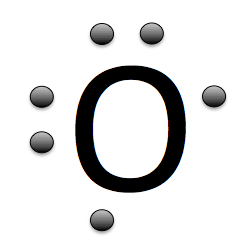
What does oxygen need to do to be happy?
a)
Gain one electron
b)
lose one electron
c)
lose two electrons
d)
gain two electrons
15.
According to the octet rule, who needs three more electrons?
a)
Group 1
b)
Group 13
c)
Group 15
d)
Group 3
16.
Takes two small nuclei and combines them into a larger nucleus
a)
fission
b)
fusion
17.
The splitting of a nucleus into smaller nuclei is
a)
fusion
b)
fission
c)
half-life
d)
gamma radiation
18.

This is an example of...
a)
Fission reaction
b)
Fusion reaction
c)
Decomposition reaction
d)
Decay
19.
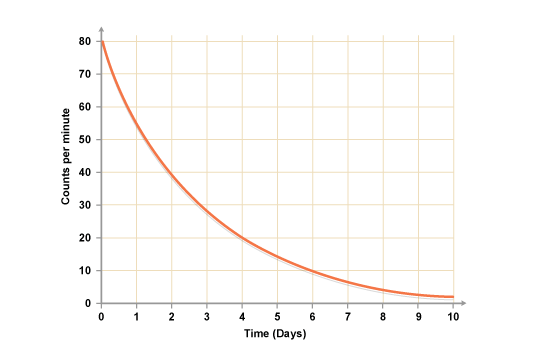
What is the half life substance in the graph?
a)
80 cpm
b)
2 days
c)
10 days
d)
3.5 days
20.
What is it called when atoms have different number of neutrons?
a)
Isotopes
b)
Ions
c)
Not possible
d)
PEN
21.
Jack has a rock. The rock has a mass of 14g and a volume of 2cm3. What is the density of the rock?
a)
7 mL
b)
7 g/cm3
c)
28 g/cm3
d)
1/7 g/cm3
22.

If this substance takes up 6ml of space, what is its mass?
a)
6 ml
b)
6 grams
c)
0 grams
d)
4 grams
23.

What is the volume of Object X?
a)
10.0 cm3
b)
15.0 cm3
c)
20.0 cm3
d)
25.0 cm3
24.
Find the density of a 2 cm x 2 cm x 2 cm cube with a mass of 64 g.
a)
6 cm3
b)
12 g/cm3
c)
128 g/cm3
d)
8 g/cm3
25.
What number is the greatest in following scenarios?
a)
Number of protons Flourine
b)
Number of neutrons Oxygen
c)
Number of neutrons Neon
d)
Number of electrons Fluorine
26.
Which of these elements are the most stable?
a)
Hydrogen
b)
Oxygen
c)
Neon
d)
Chlorine
27.
The atomic number ALWAYS tells you the number of...
a)
protons
b)
electrons
c)
neutrons
d)
protons and electrons
28.
Which forms the largest anion?
a)
Oxygen
b)
Phosphorus
c)
Magnesium
d)
Boron
29.
How do nuclear power-plants work?
a)
Fusion
b)
Half-life
c)
Fission
d)
Fusion or fission
30.
Iron is a good conductor, malleable and magnetic. What type of element is Iron?
a)
Metal
b)
Nonmetal
c)
Metalloid
d)
Pretty
31.
Silicon is a semiconductor and has properties of both metals and nonmetals. What type of element is Silicon?
a)
Metal
b)
Nonmetal
c)
Metalloid
d)
Pretty
32.
Which elements are found on the left to middle of The Periodic Table?
a)
Metals
b)
Nonmetals
c)
Metalloids
d)
Candles
33.
Which elements are found on the right side of The Periodic Table?
a)
Metals
b)
Nonmetals
c)
Metalloids
d)
Water
34.
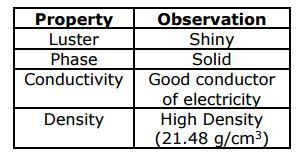
How would this element be classified?
a)
Metal
b)
Nonmetal
c)
Metalloid
d)
Metamorphic
35.
Each row in the periodic table is called a
a)
group
b)
period
c)
cluster
d)
unit
36.
Each column in the periodic table is called a
a)
period
b)
group
c)
cluster
d)
unit
37.
Generally, as you move from left to right across the periodic table, elements become
a)
less stable.
b)
more stable.
38.

The yellow atoms are called
a)
metals
b)
nonmetals
c)
metalloids
d)
noble gases
39.

The blue atoms are called
a)
metals
b)
nonmetals
c)
metalloids
d)
noble gases
40.

The atoms along the staircase are called
a)
metals
b)
nonmetals
c)
metalloids
d)
noble gases
41.
An ion that has a positive charge.
a)
cation
b)
anion
c)
oxyanion
d)
monoatomic ion
42.
What is the mass number?
a)
the number of protons
b)
the number of protons and neutrons
c)
the number of neutrons
d)
the number of protons and electrons
43.
If you had 300 centimeters, how many meters would you have?
a)
3
b)
30
c)
300
d)
.3
44.
Convert 8 inches to cm, if 1 inch equals 2.54 cm.
a)
20.32 cm
b)
3.15 cm
c)
80 cm
d)
96 cm
45.
14 pounds equals ______ kilograms?
(1kg = 2.2lb)
(1kg = 2.2lb)
a)
6.8 kg
b)
6.36 kg
c)
198 kg
d)
0.63 kg
46.
Takes two small nuclei and combines them into a larger nucleus
a)
fission
b)
fusion
47.
The splitting of a nucleus into smaller nuclei is
a)
fusion
b)
fission
c)
half-life
d)
gamma radiation
48.
How do nuclear power-plants work?
a)
Fusion
b)
Half-life
c)
Fission
d)
Fusion or fission
49.
Where does fusion occur naturally?
a)
Underwater
b)
All around us
c)
In the radioactive waste
d)
On the sun
50.
When an atom loses a valence electron, it becomes a(n) _____________ ion.
a)
positive
b)
negative
c)
neutral
d)
polyatomic
51.
What is the definition of isotope?
a)
atoms of an element with different numbers of neutrons.
b)
materials break down over time at a very consistent rate
52.

What do these isotopes of carbon all have in common?
a)
neutrons & mass number
b)
atomic number and neutrons
c)
atomic number and electrons
d)
protons, atomic number, and mass number
53.
How many dots would a Lewis Dot structure of Helium have?
a)
1
b)
2
c)
8
d)
0
54.
How many valence electrons are in Phosphorus?
a)
15
b)
4
c)
5
d)
31
55.

How many electrons are in the outer shell of Sodium (Na)?
a)
3
b)
1
c)
2
d)
4
56.
What does an atom's period tell us?
a)
Number of protons
b)
Number of electrons
c)
Number of valence electrons
d)
Number of shells
57.
What does an atom's group tell us?
a)
Number of protons
b)
Number of electrons
c)
Number of valence electrons
d)
Number of shells
58.
K is a
a)
metal
b)
nonmetal
c)
metalloid
d)
gas
59.
From the following elements, which has the largest atomic radius?
a)
Na
b)
Mg
c)
Si
d)
Cl
60.
From the following elements, which is the heaviest( greatest mass)?
a)
Na
b)
Mg
c)
Si
d)
Cl
61.
These items are on the right side of the Periodic Table.
a)
Metals
b)
Metalloids
c)
Nonmetals
62.
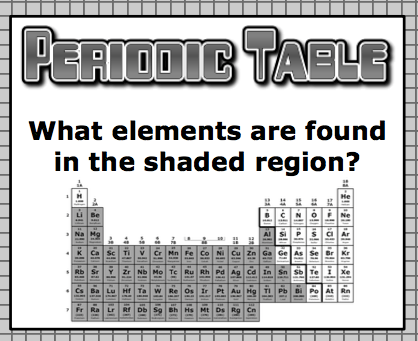
a)
Metals
b)
Nonmetals
c)
Metalloids
63.
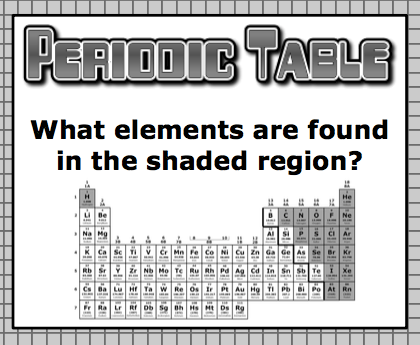
a)
Metals
b)
Nonmetals
c)
Metalloids
64.
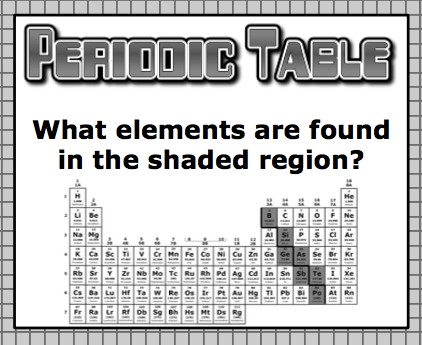
a)
Metals
b)
Nonmetals
c)
Metalloids
65.
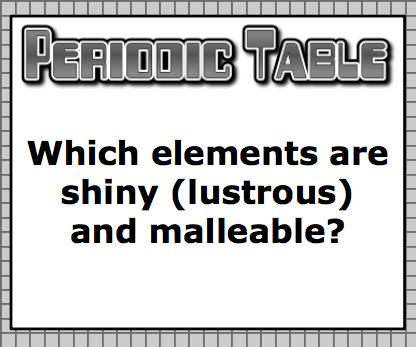
a)
Metals
b)
Nonmetals
c)
Metalloids
66.
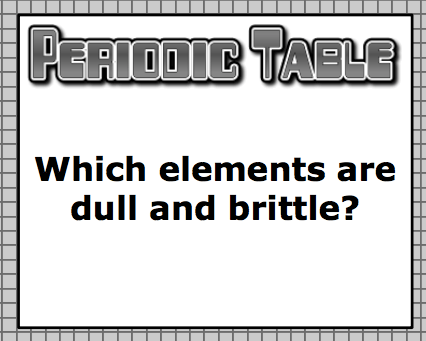
a)
Metals
b)
Nonmetals
c)
Metalloids
67.
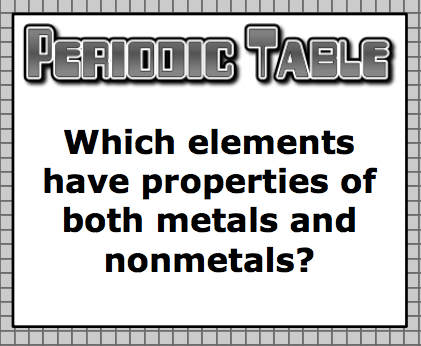
a)
Metals
b)
Nonmetals
c)
Metalloids
68.
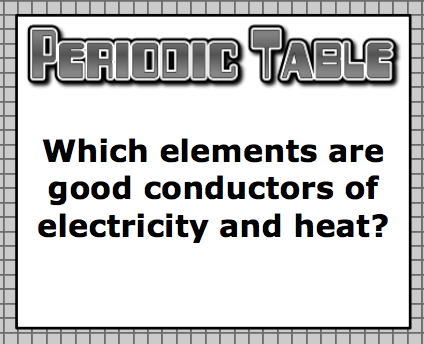
a)
Metals
b)
Nonmetals
c)
Metalloids
69.
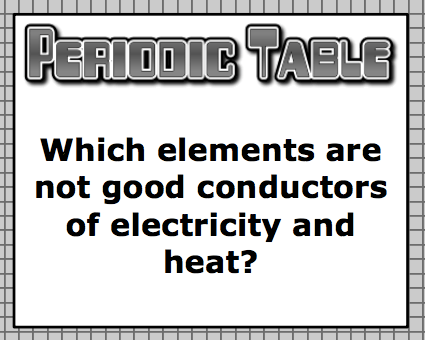
a)
Metals
b)
Nonmetals
c)
Metalloids
70.
Which element will become the largest cation: Aluminum, Lithium, or Fluorine? Think about what they will do to become happy. Thank about the octet rule.
a)
Aluminum
b)
Lithium
c)
Fluorine
100 %

