
Font size
 Worksheets
13. Basic Chemistry: Chemical Equilibrium
Total questions: 25
Worksheet time: 2hrs 42mins
Calculate the equilibrium constant (Kc) for the given reaction and tell whether equilibrium lies to the left or the right. PCl5 (g) ↔ PCl3 (g) + Cl2 (g)
Equilibrium concentrations are: [PCl5] = 0.25 M, [PCl3] = 9.7 × 10⁻⁴ M, and [Cl2] = 3.2 × 10⁻³ M.
Kc = 2.5 × 10⁻³; equilibrium lies to the right.
Kc = 5.0 × 10⁻⁶; equilibrium lies to the right.
Kc = 3.2 × 10⁻²; equilibrium lies to the left.
Kc = 1.24 × 10⁻⁵; equilibrium lies to the left.
Kc = 1.0 × 10⁻⁴; equilibrium lies to the left.
What is the Kc expression for this reaction?
2NO(g) + O2(g) ⇌ 2NO2(g)
Kc = [NO2]2 / ([NO]2 x [O2])
Kc = [NO]2 x [O2] / [NO2]2
Kc = [NO2] / ([NO]2 x [O2])
Kc = [O2] / ([NO]2 x [NO2]2)
Kc = [NO]2 / ([NO2]2 x [O2])
When 0.40 mole of SO2 and 0.60 mole of O2 are placed in an evacuated 1.00–liter flask, the reaction represented below occurs.
2SO2 (g) + O2 (g) ↔ 2SO3 (g)
After the reactants and the product reach equilibrium and the initial temperature is restored, the flask is found to contain 0.30 mole of SO3. Based on these results, the equilibrium constant, Kc, for the reaction is ..................
1.5
2.5
H2(g) + Cl2(g) ⇌ 2HCl(g)
The forward reaction is exothermic. What will happen to the equilibrium if the temperature is increased?
The concentration of H2 will not change.
The equilibrium will shift to the left, favoring H2 and Cl2.
What is the equilibrium expression (Kc) for this reaction?
Fe3O4(s) + 4H2(g) ⇌ 3Fe(s) + 4H2O(g)
Kc = [Fe]3 [H2O]4 / [Fe3O4] [H2]4
Kc = [Fe3O4] [H2]4 / [Fe]3 [H2O]4
Kc = [H2]4 / [Fe]3
Kc = [Fe] [H2O] / [Fe3O4] [H2]
Kc = [H2O]4 / [H2]4
What are the two factors to look for when determining if the reaction is at equilibrium?
Forward reaction rate is faster than the reverse and concentrations are equal
2SO2(g) + O2(g) ⇌ 2SO3(g)
Removing O2(g) will ............
produce more SO3
increase the concentration of SO2
For the reaction N2 (g) + 3 H2 (g) ⇌ 2 NH3 (g)
If the pressure in the system is increased, which substance(s) will increase in concentration?
N2 and H2
H2
no change in substances
NH3
N2
When the rate of the forward reaction is equal to the rate of backward reaction, the system is said to be in ...............
stoichiometry
balance

Which chemical species is the reactant and why?
A, as concentration decreases
A and B, as concentration remains unchanged.
A, as concentration increases
B, as concentration decreases
B, as concentration increases
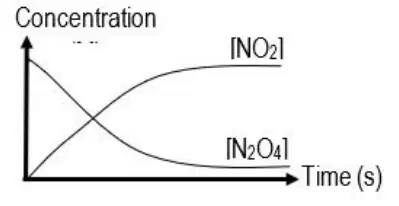
For the graph, choose the correct statement(s).
The rate of reaction slowly increase.
The systems never reach equilibrium.
At equilibrium, more NO2 is present than N2O4.
At start of reaction, only NO2 was present.
There is no movement between the reactants and the products corresponding to the chemical reaction.
What is the Kc expression for the reaction below:
SOCl2(g) + H2O(g) ⇌ SO2(g) + 2HCl(g)
Kc = [HCl]2 / [SOCl2] [H2O]
Kc = [H2O] [SO2] / [SOCl2] [HCl]2
Kc = [SOCl2] [HCl]2 / [SO2] [H2O]
Kc = [SOCl2] [H2O] / [SO2] [HCl]2
Kc = [SO2] [HCl]2 / [SOCl2] [H2O]
According to Le Chatelier's principle, what factors cause predictable changes to a system in equilibrium?
Changes in reaction rate and phase of the reactants or products.
Changes in molecular weight.
Changes in color, odor, or taste of the products.
Changes in solubility and energy.
According to Le Chatelier's principle, what will happen if additional reactant is added?
A + B ⟺ C + D + heat
If A is removed, the reaction will run in the ............................... direction, to generate more .................
forward; C, D, and heat.
right; C and D.
left; C and D.
left; reactant.
right; heat.
A + B ⟺ C + D + heat
If B is added, the reaction will run in the .................... direction, and generate more ...................
left; A, B, and heat.
right; heat.
left; A and B.
right; C, D, and heat.
left; C, D, and heat.
For the reaction below:
A + B ⟺ C + D + heat
Predict what cause the equilibrium shift to the left?
Decrease temperature
For the reaction below:
A + B ⟺ C + D + heat
Predict what cause the equilibrium shift to the right?
Increase the concentration of A or B.
Remove C or D.
2SO2(g) + O2(g) ⇌ 2SO3(g) + Heat
For the reaction above, increasing the volume of the container will .........
shift equilibrium to the left
shift equilibrium to the right
2SO2(g) + O2(g) ⇌ 2SO3(g) + Heat
For the reaction above, increasing the pressure on the system will ..........
favor the formation of SO3
favor the formation of SO2
What is the effect of adding a catalyst on the position of equilibrium according to Le Chatelier's Principle?
Given the reaction: 2A(s) + B(l) <=> 3C(s) + 2D(g)
The equilibrium pressure constant in the reaction is ….....
Kp = (PC)3 / (PA)2
Kp = (PC)3 x (PD)2 / (PA)2 x (PB)
Kp = (PD)2
Kp = 1/(PD)2
Kp = (PA)2 x (PB) /(PC)3 x (PD)2
In a 1 liter room there is an equilibrium between N2, H2 and NH3 gases according to the following reaction.
2NH3(g) <=> N2(g) + 3H2(g)
At this equilibrium there are 0.01 mol N2, 0.01 mol H2 and 0.05 mol NH3. The value of the reaction equilibrium constant is …...............
4 x 10⁻⁶
2 x 10⁻⁸
5 x 10⁻¹⁰
2 x 10⁻¹⁰
At a temperature of 700 K, an equilibrium reaction occurs:
CO2(g) + H2(g) <=> CO(g) + H2O(g)
with a Kc value of 0.11. The Kp value for this reaction is ..........…
0,99
9,99
Of the following equilibria, the reaction that will shift to the left in response to a decrease in volume is …......
4Fe(s) + 3O2(g) ⇌ 2Fe2O3(s)
H2(g) + Cl2(g) ⇌ 2HCl(g)
2SO3(g) ⇌ 2SO2(g) + O2(g)
2HI(g) ⇌ H2(g) + I2(g)
CO(g) + 2H2(g) ⇌ CH3OH(g)

