
 Worksheets
Colonial Regions and Government
Total questions: 61
Worksheet time: 44mins

What is the blue region called?
New England
Middle
Southern
What is the pink region called?
New England
Middle
Southern
What is the green region called?
New England
Middle
Southern
What region does Massachusetts belong to?
New England
Middle
Southern
What region does Pennsylvania belong to?
New England
Middle
Southern
What region does Virginia belong to?
New England
Middle
Southern
What region has rocky soil and it was difficult to farm?
New England
Middle
Southern
What region relied on farming on large plantations as part of its economy?
New England
Middle
Southern

Which of the 13 Colony Regions would be considered the "bread basket" of American because of their vast food production and easy distribution opportunities?
New England Colonies
Middle Colonies
Southern Colonies

Check all that apply to describe the New England Colonies
An abundance of cash crops
Religious Freedom
Rocky soil bad for growing
Incredibly cold winters
Great port cities, like Boston
In 1215, a document called the __________ limited
the power of the king.
Mayflower Compact
Magna Carta
Cato's Letters
parliament
The Pilgrims needed a government—fast!
The men agreed to create a new government and to
follow its rules. This is the _________________________
Magna Carta
Mayflower Compact
Cato's Letters
none of the above
The men agreed to create a new government and to
follow its rules. In exchange, they would all protect each
other. This is an example of _________________
a dictatorship
a monarchy
self government
none of the above
In 1689. like the Magna Carta, the ____________ expanded
the rights of the Parliament and the people, while
limiting the powers of the king even more.
English Bill of Rights
Parliament
Cato's Letters
none of the above
*Mayflower Compact
*Town hall meetings
The factors listed above contributed most to the
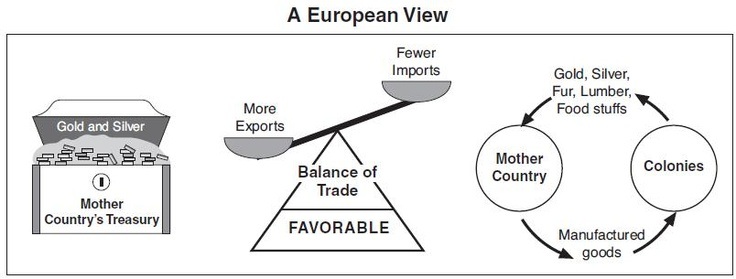
What is mercantilism?
A system where a mother countries gains money and power from natural resources that come from its colonies.
where colonies trade gold and silver with each other.
Wars that start over money.
Plantation colonies trading slaves for money.
What was salutary neglect?
Britain was strictly controlling the colonies
Britain left the colonies to govern themselves
Britain sent an army to the colonies
Britain sold the colonies to France
The trade pattern between the colonies, Africa, and Europe was called what?
Middle Passage
Navigation Acts
Triangular Trade
Columbian Exchange
Which group benefited the most from Mercantilism?
The colonies
Africa
England
The majority of slaves that were brought to the American colonies were brought to...
Work on building houses
Work on Plantations
Work on the railroad
Work on building ships
What is the term that refers to the relationship between Europe, Africa, and the Americas in which slaves were traded for raw goods or money?
Mercantilism
Triangular Trade or Transatlantic Slave Trade
Market economics
Feudalism
What was the economy of the South based on?
Agriculture
Mining
Shipbuilding
Whaling
The unofficial British policy that allowed the colonies to be left alone with little British interference.
Quid pro quo
free to be you and me
salutary neglect
Colonial Renaissance

English philosopher who wrote about the natural rights of all people and the contract theory of government.
Francis Bacon
Thomas Hobbes
John Locke
Anthony Ashley Cooper

Which of the following best replaces the question mark in the diagram?
created a general council to manage the colonies
experienced strict control by Parliament
established their own representative governments
appointed governors who reported to the King

Which of the following completes the sentence above?
limited property ownership to church members
extended voting rights beyond church members
restricted trade with neighboring colonies
asked the king to appoint a governor for the colony
From 1690 to 1760, Parliament and the king of England allowed colonists in America to exercise a great deal of control over local and regional matters. Historians have described this practice as “salutary neglect.”
Which of the following happened as a direct result of this policy?
The colonies developed a strong tradition of self-government.
Many proprietary colonies were converted to royal colonies.
The colonies refused to participate in a system of common defense.
Many colonies sought economic aid from other countries.

The factors listed above contributed most to the —
creation of alliances between British settlers and American Indians
election of British colonists to Parliament
growth of representative government in the British colonies
expansion of British trade in the Americas

Which statement explains the significance of this colonial institution?
The assembly served as a model for other colonial legislatures.
Colonists used the assembly to overrule decisions of the royal governor.
The assembly sent delegates to Parliament to represent Virginia.
The king revoked Virginia’s charter because the assembly became too powerful.

Which factor most contributed to the creation of the documents in this list?
The opportunity for trade with American Indians
The distance of the colonies from Great Britain
The doctrine of the Church of England
The economic system of mercantilism
The First Great Awakening led to...
A focus on the individual, and democratic feelings.
A focus on the group, a love of kings.
A focus on the economy and push for oligarchy
None of the above
The English philosopher who said we are all born with natural rights is ________________
King John
John Rolfe
John Smith
John Locke
A government document that expanded the powers of the English Parliament and expanded the rights of the people, as well as further limited the rights of the king; written by the members of the English Parliament in 1689
Common Sense
English Bill of RIghts
Cato's Letters
Mayflower Compact
Who was the founder of Rhode Island?
William Bell
Roger Williams
John Cotton
All Puritans
This person believed and taught that the government should have no part in the operations of the church.
Roger Williams
Anne Hutchinson
What religion was William Penn?
Catholic
Quaker
Cristian
Puritain
Discuss the impact of Quaker beliefs on the legal system in Pennsylvania.
They established a legal system based on military law.
They implemented laws that required religious ceremonies.
They influenced the development of laws promoting religious tolerance.
They enforced strict penalties for non-Quakers.
How did Quaker beliefs influence their approach to governance in Pennsylvania?
They established a theocracy with strict religious laws.
They promoted democratic principles and religious freedom.
They enforced a caste system based on religious status.
They restricted voting rights to Quakers only.
Which of the following best describes the Quaker approach to religious tolerance?
They enforced a single state religion.
They allowed freedom of worship for all religious groups.
They prohibited non-Quaker religious practices.
They required attendance at Quaker meetings.
What did the First Great Awakening affect in the American colonies?
The economic policies
The political atmosphere
The scientific advancements
The agricultural practices
What major historical event did the First Great Awakening help lead to?
The Civil War
The American Revolution
The Industrial Revolution
The French Revolution
Which statement best explains the First Great Awakening’s influence?
It helped to make American colonial society more democratic.
It led to a closer relationship between churches and colonial governments.
Led to online churches

