
 Worksheets
S.V.A Quiz
Total questions: 77
Worksheet time: 1hrs 26mins
Speed = _______________
Distance + time
Distance – time
Distance x time
Distance / time
This occurs when an object speeds up, slows down, or changes direction.
Speed
Velocity
Acceleration
Another way to explain the speed and direction of a object would be to describe it’s ________
Speed
Velocity
Acceleration
Velocity = _______________
Speed – direction
Speed + direction
Speed x direction
Speed / direction


What is this?
"This airplane is traveling at 500 mph, West"
Speed
Velocity
Acceleration
Which two factors does speed depend on?
distance and direction
direction and time
distance and time
distance, time and direction
Which is an example of speed?
A car driving 55 miles per hour south.
A bicyclist traveling 10 meters per hour toward the next town.
A roller coaster is traveling 10 meters per second.
A rocket blasting off at 2,500 meters per second toward space.
Which is an example of velocity?
A car driving 55 miles per hour south.
A bicyclist traveling 10 meters per hour.
A roller coaster is traveling 10 meters per second.
A rocket blasting off at 2,500 meters per second.
Acceleration is a speeding up, slowing down or a change in direction. Is the following acceleration and if so, which one?
A swimmer has 10 meters left in the race and he is neck-in-neck with his competitor. He has a surge of adrenaline and pulls ahead to win.
Yes, this is acceleration since the swimmer starts to speed up to pull ahead.
Yes, this is acceleration since the swimmer uses the wall to change directions.
No, this is not acceleration since there is no speeding up, slowing down, or change in direction.
Acceleration is a speeding up, slowing down or a change in direction. Is the following acceleration and if so, which one?
A dancer is warming up. She turns on music with a good beat and does 10 pirouettes in a row perfectly on the beat. (pirouette is a body spin in ballet)
Yes, this is acceleration since the dancers is going a certain speed.
Yes, this is acceleration since the dancer is changing direction when she spins.
No, this is not acceleration since there is no speeding up, slowing down, or change in direction.
True or False: You are standing at the bus stop and not moving at all. Since you are not moving, your acceleration would be 0 (zero). Support with how you know.
True since you are not speeding up, slowing down or changing directions.
True since you are traveling no distance in a certain amount of time.
False since you are speeding up, slowing down and/or changing directions.
False since you were going to get on a moving bus.

When did the object have the highest average speed?
Between 0 and 30 seconds
Between 30 and 60 second
Between 60 and 120 seconds
Between 120 and 180 seconds
When did the object have the lowest average speed?
Between 0 and 30 seconds
Between 30 and 60 second
Between 60 and 120 seconds
Between 120 and 180 seconds

What is the average speed between 40 and 50 minutes?
20 mi/min
2 mi/min
80 mi/min
100 mi/min
It took 2 hours for a car to drive 140 miles. How fast was the car traveling?
240 mph
75 mph
70 mph
50 mph
_____ is the speed in a given direction.
Acceleration
Speed
Force
Velocity
A storm moving southeast at 35 mph is an example of?
acceleration
speed
force
velocity


Green object is moving at a faster constant speed than Red
Red object is moving at a faster constant speed than Green
Green object is moving at a slower constant speed than Red
Red object is moving 2 times faster than Green

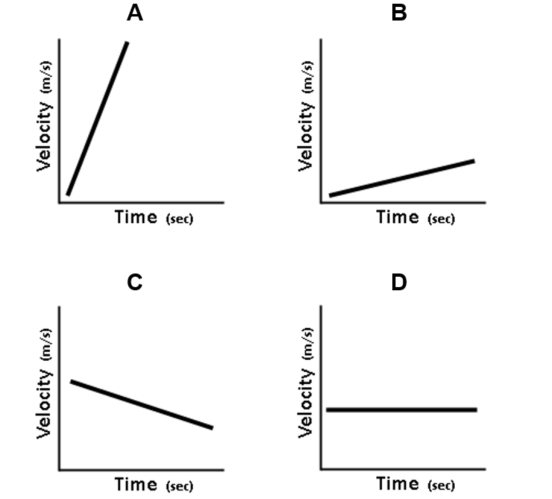
Which graph represents slowing down?
A
B
C
D


What was the bicyclist's speed if they biked 60 miles in 5 hours?
12 miles/hour
300 miles/hour
55 miles/hour
0.083 miles/hour
Acceleration =
Time(FinalVelocity − InitialVelocity)
(FinalVelocity − InitialVelocity)
(FinalVelocity − Initial Velocity)Time
Time(InitialVelocity − FinalVelocity)
A car speeds up from 25 m/s to 45 m/s in 4 seconds. What was its acceleration?
1.8 m.s^2
11.25 m/s^2
5 m/s^s
5 m/s
Andrea is walking at 3 m/s. She sees the ice cream truck and starts running towards it. In 5 seconds, she speeds up to 7 m/s. What is her acceleration?
0.8 m/s^2
0.667 m/s^2
0.295 m/s^2
0.295 m/s
A biker speeds up from 10 m/s to 30 m/s in 10 seconds. What was their average acceleration?
20 m/s^2
2 m/s^2
20 m/s
0 m/s^2
Lulu is standing at the starting line for a race. She starts running and speeds up to 3 m/s in 30 seconds. What was her acceleration?
0.1 m/s^2
0.1 m/s
10 m/s^2
10 m/s
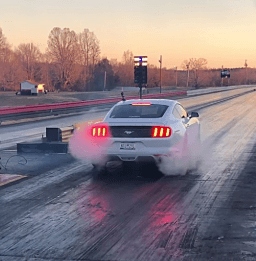
What is this?
"This car is speeding up"
Speed
Velocity
Acceleration

What is this?
"Rocky is running 8mph North"
Speed
Velocity
Acceleration
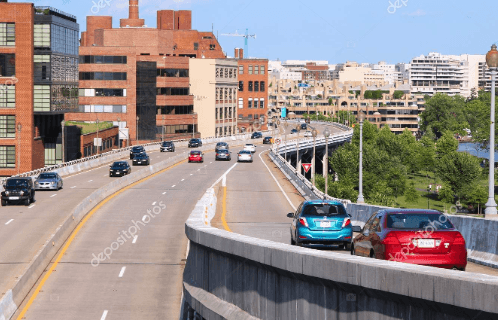
What is this?
"The car has to go from 40mph to 60mph when entering the freeway"
Speed
Velocity
Acceleration


Match the following
A city bus travels distance of 10 km in 30 minutes.
Speed
A city bus travels 50 km/min to a stop for a red light.
Acceleration
A city bus travels 30km/min to the eastside of town.
Velocity

What is the initial speed of the plane in the diagram?
0 m/s
8 m/s
16 m/s
24 m/s
Acceleration is the rate of change of (a) over (b) .
Match the following
Positive Acceleration
When an object speeds up
Negative Acceleration
When an object slows down
No Acceleration
When an object stays a constant speed
What is the formula for acceleration?
Acceleration can be negative.
True
False
How would you set-up the following problem?
A car traveling 35 km/hr accelerates to a speed of 45 km/hr in 0.25 hr. What is its acceleration? (note: you do NOT type the answer, but you do need to use parentheses, and you need to include the unknown variable and an equal sign)
How would you set-up the following problem?
A jet is traveling at 80 m/s when it starts to approach a runway. It is able to land and park in 10 s. What is its acceleration?
(note: you do NOT type the answer, but you do need to use parentheses, and you need to include the unknown variable and an equal sign)
Which is the correct set up for the following problem?
A car accelerates from a standstill to 60 km/s in 10 s.
a=10(60)
a = (60−10)
a=10(60−0)
a=10(0−60)
Which of the following is the correct set up for this problem:
A car accelerates from 25 mi/hr to 55 mi/hr in 0.0083 hr.
a=0.0083(55−25)
a=55−0.008325
a = 0.0083(25−55)
a=25−0.008355
What is the correct set up for this problem?
A runner has a velocity of 11.1 m/s for 9 seconds until he finishes the race and comes to a stop. What is his acceleration?
a=11.19
a=911.1
a=9(11.1−0)
a=9(0−11.1)
Match the following Velocity vs Time graphs:

Negative acceleration, slowing down

Constant speed, no acceleration

Not moving, no acceleration

Positive acceleration, speeding up
Match the following
the speed of an object with a specific direction
velocity
the rate that something or someone moves
speed
the change in velocity over a certain amount of time
acceleration


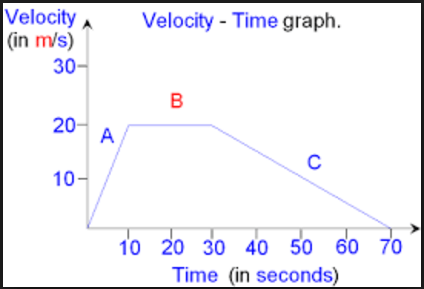
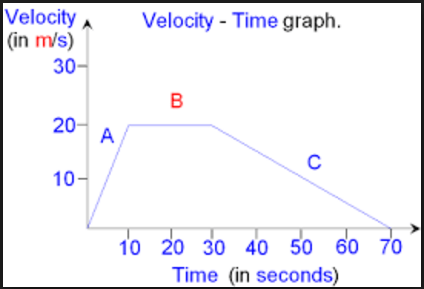
Match the motion terms to their definitions.
Distance
The total amount an object moves.
Displacement
The difference from where an object starts to where it ends.
Speed
How far an object moves per unit of time.
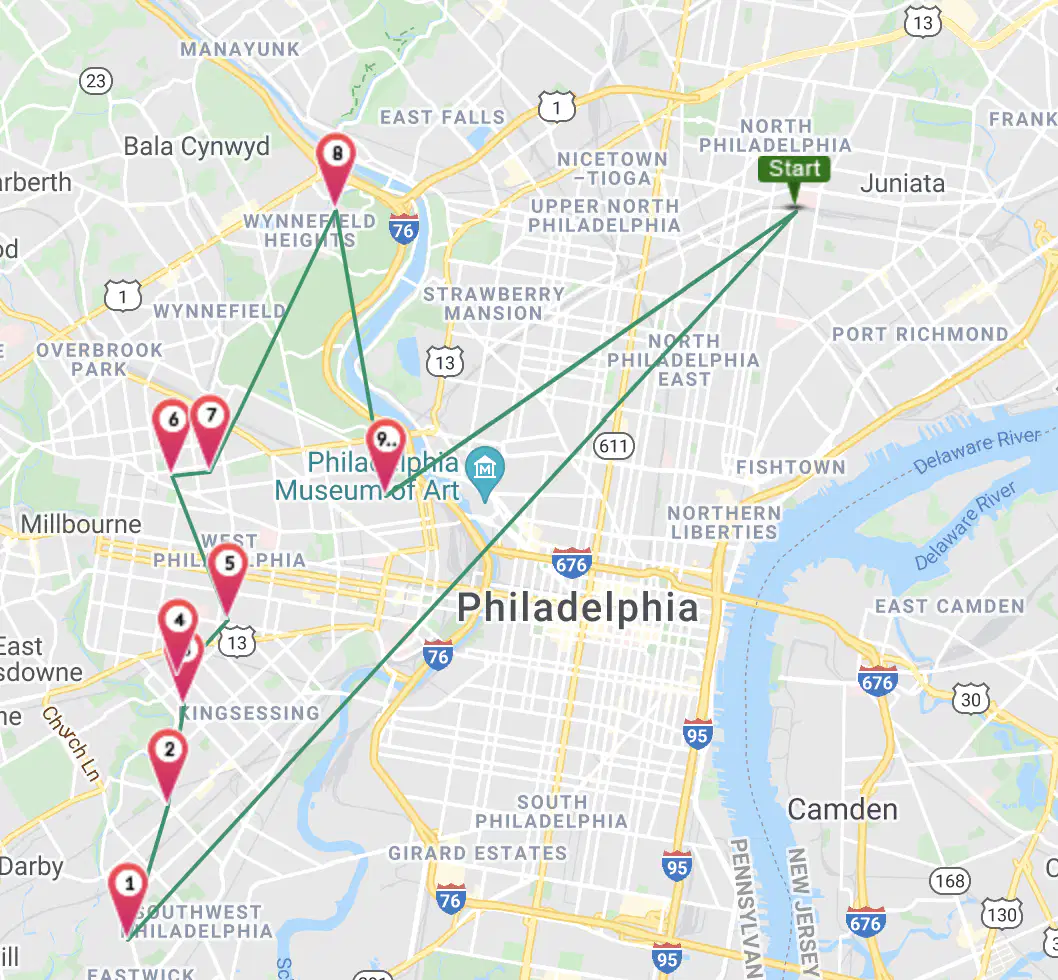
Juan is standing at the entrance of a park. If the distance and direction between Juan and a reference point (like a tree or a bench) in the park is considered as Juan's _____, what would that be?
displacement
neutral point
position
velocity

4 Points - Look at the vector arrows.
Because the velocity vector is pointing to the right, the car is (a) .
Because the acceleration is to the left, the car is (b)
2 Points
The velocity-time graphs represent the motion of four different objects. Identify any object that is changing its velocity or accelerating. Check all that apply.


The velocity-time graphs represent the motion of three different objects. Identify any object that is changing directions. Check all that apply.


None of the above
2 points
Identify which 2 objects are speeding up. SELECT BOTH GRAPHS!


If an object starts "at rest" in a problem, what is its INITIAL velocity?
Depends on the problem
0
Always positive
Always negative

