
 Worksheets
Lesson 2 Review
Total questions: 47
Worksheet time: 37mins
What type of energy is associated with motion?
Potential Energy
Chemical Energy
Kinetic Energy
Elastic Energy
Which of the following is an example of potential energy?
A moving car
A stretched rubber band
A swinging baseball bat
A rolling ball
What happens to the potential energy of a rubber band when it is released?
It remains the same
It transforms into kinetic energy
It transforms into chemical energy
It disappears
Which form of potential energy is stored in the bonds between atoms?
Gravitational potential energy
Electrical potential energy
Chemical potential energy
Elastic potential energy
What is gravitational potential energy?
Energy due to an object's position relative to Earth
Energy due to an object's motion
Energy due to an object's temperature
Energy due to an object's chemical composition
What happens to a pencil's potential to do work if it is dropped from a higher position?
It decreases
It remains the same
It increases
It disappears
What does the kinetic energy of an object depend on?
Only the mass of the object
Only the speed of the object
Both the mass and speed of the object
Neither mass nor speed
Which of the following will increase an object's kinetic energy more significantly?
Increasing the object's mass
Increasing the object's speed
Decreasing the object's mass
Decreasing the object's speed
What is the equation for kinetic energy?
kinetic energy = (1/2) × mv²
kinetic energy = m × v
kinetic energy = m + v
kinetic energy = (1/2) × m²v
What is the formula for calculating kinetic energy?
(1/2) × mv²
mgh
mv
(1/2) × mgh
If a 2 kg ball is moving at 3 m/s, what is its kinetic energy?
9 J
6 J
12 J
3 J
What factors affect the gravitational potential energy of an object?
Mass and height
Speed and mass
Height and speed
Gravity and speed
What is the value of acceleration due to gravity on Earth used in calculations?
9.8 m/s²
10 m/s²
8.9 m/s²
9.0 m/s²
How do you calculate gravitational potential energy?
mgh
(1/2) × mv²
mv
gh
What type of energy does a moving ball have?
Gravitational potential energy
Kinetic energy
Thermal energy
Chemical energy
What happens to the gravitational potential energy of a ball as it falls?
It increases
It remains the same
It decreases
It transforms into chemical energy
What is the gravitational potential energy of an object with a mass of 98 kg at a height where gravitational acceleration is 9.8 m/s²?
98 J
960 J
980 J
9.8 J
What happens to the kinetic energy of a ball as it accelerates toward Earth?
It decreases
It remains the same
It increases
It transforms into thermal energy
What happens to energy in a system according to the conservation of energy?
It is created and destroyed.
It is only created.
It is only destroyed.
It is conserved and transferred.
In the context of a roller coaster, what type of energy transformation occurs as the cars move up and down the hills?
Thermal to chemical energy
Potential to kinetic energy
Electrical to mechanical energy
Nuclear to thermal energy
Why can't roller coaster cars go higher than the peak of the first hill?
Because energy is added to the system
Because energy is lost due to friction
Because energy is created
Because energy is destroyed
What happens to the energy when it leaves the system of cars in a roller coaster?
It disappears completely
It is transferred to other objects or systems
It is destroyed
It remains within the system

The faster an object moves, the ________ kinetic energy it has.
more
less
What is the kinetic energy of a ball with a mass of 5kg rolling at 10m/s
50 J
500 J
250 J
25 J
If a football player wants to become better at tackling by increasing his or her kinetic energy, how can the player do this?
Increase his/her height
Increase his/her speed
Increase his/her mass
Decrease his/her speed

In order to increase the gravitational potential energy of a roller coaster car, you could...
increase the car's height
decrease the car's height
increase the car's velocity
decrease the car's mass

A roller coaster car, 500 kg with its passengers, reaches the top of the first hill, 20 meters above the ground. (g = 9.8 m/s2) What is the GPE?
(a)
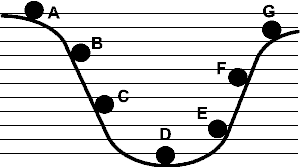
At which point does the ball has the greatest gravitational potential energy (GPE)?
A
G
D
C
G
What is the gravitational potential energy (GPE) of a 1 kilogram book that is 1 meter above the ground?
g = 9.8 m/s2
9.8 Joules
1.0 Joule
0.10 Joule
11.8 m/s2
What is the correct equation for gravitational potential energy
m x g x h
m x g / h
m x h / g
Which has more gravitational potential energy?
A 0.25 kg apple sitting on a countertop 1 meters off the ground
A 1000 kg car sitting the driveway on the ground.
They have the same gravitational potential energy
If the height is zero, gravitational potential energy
is zero
at its maximum
100J
200J
Energy stored because of gravity is called:
Gravitational Potential Energy
Kinetic Energy
Mechanical Advantage
Chemical Energy
How could you increase the gravitational potential energy of an object without changing its mass and gravity?
Make the object larger
Lower the object towards the ground
Raise the object farther off the ground
Allow the object to roll on the ground
Which is the correct unit for expressing gravitational potential energy?
Joule
Newton
m/s2
meter
What happens to the gravitational potential energy of an object as it is lifted higher above the ground?
It decreases
It remains the same
It increases
It transforms into kinetic energy
Which of the following factors does NOT affect the gravitational potential energy of an object?
Mass of the object
Height above the ground
Speed of the object
Gravitational acceleration
If a 5 kg object is lifted to a height of 10 meters, what is its gravitational potential energy? (g = 9.8 m/s2)
49 Joules
98 Joules
490 Joules
980 Joules
What type of energy is stored in a compressed spring?
Gravitational potential energy
Elastic potential energy
Chemical energy
Thermal energy
Which of the following factors does not affect the kinetic energy of an object?
Mass
Speed
Height
Velocity
What happens to the kinetic energy of a car as it comes to a stop?
It increases
It remains the same
It decreases
It transforms into potential energy
What is the potential energy of a 10 kg object at a height of 5 meters, assuming gravitational acceleration is 9.8 m/s²?
49 J
490 J
98 J
980 J
Which of the following is an example of kinetic energy?
A book on a shelf
A car driving on a highway
A compressed spring
A battery in a remote
How does increasing the height of an object affect its gravitational potential energy?
It decreases
It remains the same
It increases
It transforms into kinetic energy

