
 Worksheets
Warren MS Ch7 2024
Total questions: 50
Worksheet time: 32mins
Choose the best response that describes that describes a pyramid pattern if 90% of energy lost from level to next but 10% of the energy from the lower level is passed to the higher level.
Energy is generated at each level
A small amount of the energy at the trophic level is passed to the next level
Most of the energy at the trophic level passes to the next level
An equal amount of energy is available at each other
Decomposition is an important process in many of the cycles that _______.
returns nutrients and matter to the soil
returns only carbon to the soil
moves nutrients from the soil to the atmosphere
breaks down dead organisms to return nitrogen back to the atmosphere
Respiration and exhalation are important processes in the carbon cycle. During photosynthesis, plants release _____ into the air. Animals require oxygen to survive. When animals exhale, they release _____ into the air. During photosynthesis, plants take in carbon dioxide from the air.
Matter (a) through the ecosystem.
Energy used for body processes are given off as heat and is not passed to other organisms in a usable form best explains what?
Some energy at each level is destroyed and cannot be passed to other organisms.
Less energy is generated by the organisms in higher trophic levels,
The organisms at each level are less efficient at using energy than those in the previous levels.
Energy used for body processes are given off as heat and is not passed to other organisms in a usable form.
Which correctly compare the amount of available energy in different trophic levels in an ecosystem?
Select all correct responses
First-level consumers have less available energy than second-level consumers
Producers have more available energy than third-level consumers
Third-level consumers have more available energy than first-level consumers
Second-level consumers have less available energy than first-level consumers
The producers are the trophic levels with the _____ amount of available energy.
least
same
greatest
equal

Choose the response that is NOT an important role of carbon for organisms in an ecosystem?
It makes up compounds in soils that are important for plant growth and health
It is used to make up sugars like glucose
It is used by plants in photsynthesis
It makes up part of nitrogen gas which is important for plant growth

This global food web shows how parts of a meadow ecosystem interact with parts of a marsh ecosystem.
Which of these is a food chain that is part of the global food web?
meadow grass → rabbit → fox → hawk
marsh grass → snail → small fish → hawk
marsh grass → grasshopper → mouse → fox
meadow grass → grasshopper → praying mantis → small fish
What happens during an energy transformation in a living thing?
Energy is created.
Energy is destroyed.
Energy is permanently stored.
Energy changes from one form to another.
What is the difference between a food web and an energy pyramid?
There is no difference; food webs and energy pyramids show the same types of relationships between organisms.
Food webs show all the feeding relationships between organisms, while energy pyramids show how energy moves from producer to consumer.
Food webs show an animal at the top of the energy pyramid, while energy pyramids show only how producers get their energy.
Energy pyramids show how energy flows between organisms, while food webs show only the different organisms in an ecosystem.

An organism that gets its energy by eating secondary consumers
Consumer
Primary Consumer
Secondary Consumer
Tertiary Consumer

An animal that eats other animals
Omnivore
Herbivore
Carnivore
Human

An organism that must consume other organisms for nutrients
Horse
Consumer
Decomposer
Carnivore

Organisms such as bacteria and fungi that break down the remains of dead plants and animals without need for internal digestion
Mushroom
Decomposer
Funji
Buzzard

A diagram that shows the total amount of energy contained within each trophic level
Food Chain
Food web
Energy Pyramid
Ecosystem

Overlapping food chains with different pathways to show the flow of energy in an ecosystem
Food Chain
Food Web
Energy Pyramid
Ecosystem

An organism that consumes only plants
Vegetarian
Omnivore
Carnivore
Herbivore

An organism that gets its energy by feeding on producers in the food chain
Primary consumer
Producer
Secondary Consumer
Herbivore

An organism that transforms energy from the Sun and uses carbon dioxide and water to make food
Primary Consumer
Herbivore
Producer
Secondary consumer

An animal that eats primary consumers (i.e., other animals that eat plants)
Herbivore
Primary Consumer
Producer
Secondary Consumer
An organism that gets its energy by eating secondary consumers
Consumer
Primary Consumer
Secondary Consumer
Tertiary Consumer

The position an organism occupies on the food web
Level up
levels
trophic levels
Top of the pyramid

Which organism is a 3rd order (tertiary) consumer?
Fox
Grasshopper
Bird
Rabbit

Which level of the energy pyramid contains the most available energy?
Hawk (3rd order consumer)
Snake (2nd order consumer)
Grasshopper (1st order consumer)
Grasses (Producer)

Which organism in this food chain is a producer?
Orca
Sea Otter
Fishes
Seaweed

Which organism is a 1st order (primary) consumer?
Fox
Birds
Rabbit
Grasses

This diagram is showing which natural process?
Carbon Cycle
Water Cycle
Nitrogen Cycle
by supplying food to the grey wolf
by giving companionship to the grey wolf
by eliminating competitors of grey wolf
by protecting the grey wolf from predators
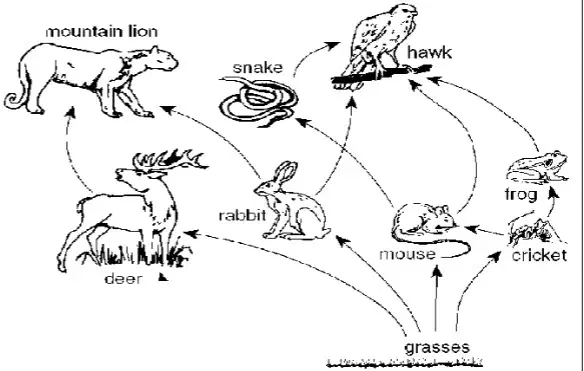
The diagram shows a food web.
Which two organisms share the same trophic level?
Hawk and Rabbit
Deer and Frog
Cricket and Mouse
Deer and Cricket
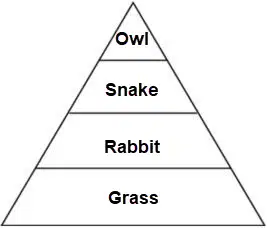
What does the shape of the energy pyramid indicate about the flow of energy in an ecosystem?
Energy flows from trophic level 1 to trophic level 4.
Energy flows from trophic level 4 to trophic level 1.
The energy available to each trophic level is equal.
The energy available to trophic level 1 and 2 is less than tropic levels 3 and 4.
The flow of energy through living systems can be modeled as food chains, food webs, or energy pyramids. The energy organisms need to live and grow first enters the ecosystem when which of the following occurs?
Plants take in light energy from the sun
Decomposers break down dead organisms
Primary consumers eat plants for food
Secondary consumers eat primary consumers

Mr. Smith provides a diagram of a food web and asks the students to identify the various ways matter is flowing through these relationships. The diagram is provided. Based on the diagram, it is reasonable to conclude that matter could follow which of the following paths as it cycles through this ecosystem?
Plant seeds --> grass --> deer
Plant seeds --> field mouse --> robin
Eagle --> deer --> plant seeds
Grass --> deer --> mountain lion

Food webs diagram the complex relationships of energy flow in an ecosystem containing a variety of producers and consumers. A diagram is provided. Which of the following correctly shows one path that energy would flow through this ecosystem?
Star grass --> termite --> wildebeest --> aardvark
Hyena --> aardvark --> impala --> harvester ant
Grasshopper --> termite --> warthog --> hare
Red oat grass --> termite --> wildebeest --> lion

A food web diagram is provided. Based on this diagram, which three consumers all get their energy from the same producer?
Squirrel, robin, and field mouse
Squirrel, deer, and mountain lion
Prairie grass, deer, and mountain lion
Plant seeds, field mouse, and snake
Noah has collected a mold specimen found on a tree in his backyard. Noah knows the mold is a decomposer, but what role does mold play in a food web?
Breaks down organic wasters and dead organisms
Uses sunlight and water to produce its own food
Releases oxygen into the atmosphere for respiration
Provides the energy that animals need for food

The flow of energy in some Australian food chains is modeled in the energy pyramid below.
(Look at your picture)
Based on the model, which consumers would receive the greatest amount of energy captured by the producers in their food chains?
A. Wedge-Tailed eagles
B. Chuditch
C. Ring-Tailed opossums
D. Eucalyptus trees
The process when plants release water vapor from their leaves is called _____________.
precipitation
evaporation
transpiration
condensation
Which of the following is an example of condensation?
Water boiling on a stove
Puddles on the sidewalk after a hard rain
water droplets on the outside of a cold drink
Snow falling in Colorado
Which of the following are forms of precipitation? Click ALL that apply.
Rain
Snow
Dew
Hail
Condensation occurs when water vapor_____________.
heats up and becomes liquid water
cools off and becomes liquid water
freezes and becomes ice
rains on the land
What step of the water cycle occurs when liquid water changes into water vapor?
precipitation
accumulation
condensation
evaporation

What Earth cycle is this?
Carbon Cycle
Nitrogen Cycle
Water Cycle
Lunar Cycle
anything that has mass and occupies space
atom
matter
molecule
volume
Which flows through an ecosystem?
Matter
Energy
True or False: Energy cycles in an ecosystem.
True
False
Energy ________________ as you move upward in an energy pyramid
stays the same
increases
decreases
gets destroyed


