
 Worksheets
Term 3 Exam Revision Quiz (Unit 1-3)
Total questions: 200
Worksheet time: 5hrs 37mins

NUMBER 6 is
Lungs
Trachea
Mouth
Alveoli

NUMBER 3 is
Pharynx
Trachea
Bronchi
Alveoli
Which are the main organs in the respiratory system?
Heart
Stomach
Lungs
Nose
What is the function of the respiratory system?
Take in oxygen only
Remove carbon dioxide only
Take in oxygen and remove carbon dioxide
Make sugar
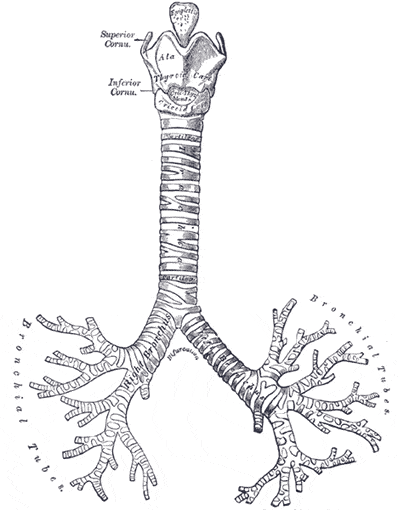
What is the tube called that is also known as your wind pipe?
Oesophagus
Bronchi
Trachea
Alveoli
Which of these organs is not a part of the respiratory system?
Trachea
Lungs
Heart
Pharynx
The muscles that helps to expand and contract the lungs, forcing air in and out
Pharynx
Nasal cavity
Alveoli
Diaphragm

Diagram shows a model of human respiratory system. K represents....
lung
rib cage
diaphragm
thoracic cavity
Exchange of gases in the body cells occurs in the bronchioles.
TRUE
FALSE
During inhalation....
intercostal muscles contract
air pressure in the thoracic cavity to decrease
rib cage moves downwards and inwards
diaphragm muscles relax and curve upwards
diaphragm muscles contract
During exhalation....
intercostal muscles contract
air pressure in the thoracic cavity to decrease
rib cage moves downwards and inwards
diaphragm muscles relax and curve upwards
intercostal muscles relax
"Movements of the rib cage and diaphragm make the thoracic cavity smaller and cause the air pressure in the thoracic cavity to increase"
The situation happens during....
inhalation
exhalation
excretion
blood circulation
Which of the following are features of the alveoli that adapt them to gas exchange?
I. High surface area
II. Thin walls
III. Dry surfaces
I and II only
I only
II and III
I, II, and III
Given the following structures:
1. alveoli
2. bronchi
3. bronchioles
Which of the following is the correct order in which air would flow after inhalation?
1,2,3
2,1,3
2,3,1
3,2,1
what is found around alveoli?
capillaries
pleura
lymphatic nodes
saliva
What adaptations does the alveoli have for efficient gas exchange?
thick walls
thin walls
small surface area

Gas exchange is needed to supply _____________ to cells and remove __________________
carbon dioxide; oxygen
oxygen; food
oxygen; carbon dioxide
carbon dioxide; water
Which two muscles are responsible for BREATHING?
The Diaphragm
The Lungs
The Heart
The Intercostal Muscles
The Lungs are made of muscles.
True
False
During Expiration (breathing out) the intercostal muscles _____________________ and the chest becomes smaller.
contract
relax
Another word for breathing in is:
Indulgating
Inspiration
Expiration
Respiration is a vital function that all living things carry out.
True
False
Respiration takes place in
the cells
the lungs
the heart
the brain
Is respiration the same as breathing?
Yes
No
Respiration is a chemical reaction.
True
False

For respiration to take place glucose needs to react with substance A. Select substance A.
Carbon dioxide
Water
Oxygen
Ozone

When respiration takes place, energy is produced along with another two substances B and C. Select substances B and C.
Carbon dioxide
Water
Oxygen
Ozone
The glucose used during respiration is provided by our
digestive system
respiratory system
circulatory system
The oxygen used during respiration is provided by our
digestive system
respiratory system
circulatory system
The glucose and oxygen used during respiration is delivered to each and every cell by the
digestive system
respiratory system
circulatory system
While exercising our body needs to produce
more energy
less energy

During exercise our body needs to produce more energy by respiration thus it needs
less oxygen
more oxygen
During exercise our body needs to produce more energy by respiration thus it needs more oxygen. Our breathing rate
increases
decreases

Do plant cells carry out respiration
Yes
No

Which of the following structure is where cellular respiration occurs in the cell?
nucleus
cytoplasm
mitochondria
vacuoles
What carries oxygen around the body?
Plasma
Red Blood Cells
Platelets
White Blood Cells
What causes the blood to be the distinct red colour?
Haemoglobin
Glucose
Hormones
Oxygen
Which of the following is NOT a type of blood vessel?
Artery
Capillary
Vein
Ventricle
What is the function (job) of the platelets?
To form clots (i.e. scabs) when you have cuts and grazes.
To transport oxygen to the muscles
To carry dissolved sugars.
To produce antibodies
What is the function (job) of the white blood cells?
To transport oxygen around the body.
To carry dissolved sugars.
To clot and cover wounds like cuts and grazes.
To release antibodies to help destroy infections.
What is the function (job) of the plasma?
To release antibodies to fight infections.
To transport oxygen around the body.
To carry dissolved nutrients and sugars.
To transport oxygen around the body.
What is the function (job) of the red blood cells?
To transport oxygen around the body and to the muscles.
To release antibodies to fight infections.
To carry dissolved nutrients and sugars.
To clot and form scabs if there is a wound on the body.
Which blood vessels take blood TO the heart?
Veins
Arteries
Capillaries
Which blood vessels take blood AWAY from the heart?
Veins
Arteries
Capillaries
Which is the smallest of the 3 blood vessels?
Veins
Arteries
Capillaries
What type of blood do the arteries usually carry?
Oxygenated Blood
Deoxygenated Blood
Which blood vessel has valves to prevent the back-flow of blood?
Veins
Arteries
Capillaries

What is blood made of?
oxygen and plasma
red blood cells and white blood cells
plasma, red blood cells, white blood cells, and platelets.
plasma and platelets

What is plasma?
only white blood cells
only red blood cells
fluid part of blood
hemoglobin
A condition that develops when your blood lacks enough healthy red blood cells or hemoglobin
Lymphatic System
Not Anemia
Platelets
Anemia
Fight bacteria and viruses by entering infected tissue, destroying bacteria/viruses and absorb dead blood cells
White Blood Cells
Red Blood Cells
Platelets
Plasma
Platelets are cells.
True
False
Red blood cells have a nucleus.
True
False

Why do platelets clump together?
to produce oxygen
to reduce oxygen
to produce blood loss
to reduce blood loss

What are pathogens?
disease-causing bacteria, viruses, and other microorganisms
large platelets
antibodies
tiny fibers

What destroys pathogens?
antibodies
red blood cells
platelets
plasma

The force of blood pushing on walls of arteries.
antigens
blood type
blood pressure
dark matter
solute + solvent =
solution
equation
Solutes dissolve quicker in _________ water.
cold
warm
Solutes dissolve quicker if you stir them.
true
false
Fish breathe oxygen, which is dissolved in water. Is the oxygen the fish breathe considered to be the solute or solvent?
Solute
Solvent
You make a pitcher of lemonade by adding lemon juice, sugar, ice and water. Which of the following are the solutes in the solution?
Lemon juice
Sugar
Water
Ice

Which would NOT increase the rate at which a sugar cube dissolves?
Reducing the amount of solvent
Crushing the sugar cube
Stirring the solution
Heating the solvent
You can make a solute dissolve more quickly in a solvent by
adding more solute.
adding ice.
heating the solvent.
removing some solvent.
A solution that contains all of the solute it can hold at a given temperature is
diluted.
saturated.
supersaturated.
unsaturated.
The amount of solute that can be dissolved in a specific amount of solvent at a given temperature is its
concentration.
density.
dilution.
solubility.

Three 10 g samples of sugar are represented below.
Sample A dissolves in water more slowly than sample B.
Sample B dissolves more slowly than sample C.
Which of the following best explains why sample A dissolves more slowly than the other two?
It has the most volume.
It has the smallest surface area.
It has the largest number of sugar molecules.
It has the fewest bonds between sugar modules.
A student pours mineral salts into a bottle of cold water. Which of the following best explains why shaking the bottle will affect the dissolving rate of the salt?
Shaking exposes the salts to the solvent more quickly.
Shaking helps more water evaporate.
Shaking equalizes the water temperature.
Shaking causes more ions to precipitate out of solution.

Students in Ms. Alvarez’s science class are investigating how temperature, in degrees Celsius (C), affects the solubility of a compound in 100 milliliters (mL) of water. Ms. Alvarez provides the students with a graph that shows the solubility of a certain compound, as shown below.
She then tell the students that she will demonstrate how many grams (g) of the compound will dissolve in 100 mL of water at 40 C. Based on the information in the graph, which of the following is the best prediction of how many grams of the compound will dissolve at 40 C?
40 g
65 g
85 g
100 g
A solution is defined as
A mixture of oil and water
A mixture where a substance is dissolved
A mixture that contains two solids
None of the above
Select all the factors which can affect the solubility of a substance
temperature
size of solute or the surface area of the solute
the amount of stirring
colour of the solute
Which method below is used to get back the salt from a solution of salt and water?
Condensation
Photosynthesis
Freezing
Evaporation
Choose the correct methods if you want to prepare a cup of coffee in a short time.
Use cold water
Use hot water
Use crystal cube sugar
Stirring the drink faster
Use powdered sugar

Ink can be separated by a method of -----------------------------------------------
distillation
filtration
chromatography
sedimentation
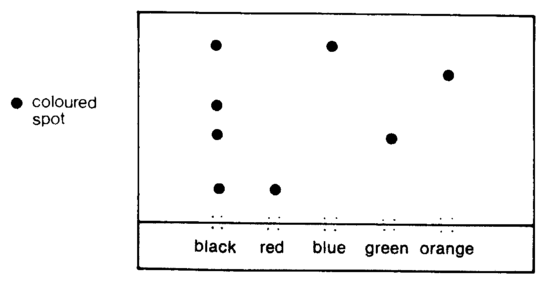
A pure substance shows ------------------ spot on chromatogram
0
1
2
3
A substance is soluble if it can be dissolved.
In paper chromatography, the most soluble solute _____________________ .
does not move from the start point
stays closest to the start point
travels furthest away from the start point
can be found in the middle of the chromatogram
Two or more substances that are mixed together but not chemically combined create a...
solvent
compound
mixture
Which of the following mixture/s is/are separated by chromatography?
Pigments from natural colours
Colours in a dye
Colours of flowers extracts
All the above
Which of the following is correct about chromatography?
It separates those solutes that dissolve in the same solvent.
It separates those solutes that dissolve in different solvents.
It separates a solute that dissolves in a solid solvent.
It separates gaseous solutes from liquid solvents.
If a substance is not soluble in the solvent, what happens to the spot placed on the start line?
a) Dot moves to the top of the paper
b) Dot does not move at all
c) Dot moves to the left or right
d) Dot moves down to the bottom of the paper
In paper chromatography, the LEAST soluble solute ____.
does not move from the start point
stays closest to the start point
travels furthest away from the start point
can be found in the middle of the chromatogram

If an unbalanced force acts on an object at rest, the object will move in the direction of the force. Which of the following best models an object with unbalanced forces acting on it?


A student wished to design an investigation to determine the effect of changing the mass of an object when an unbalanced force is applied the object.
What should she use as the independent variable in her investigation?
Time
Force
Mass
Speed


What causes a change in an object's motion?
Balanced forces
Acceleration
Unbalanced forces

A runner races in the 100 meter dash. It takes her 10 seconds to finish. What is her average speed?
10 m/s
1000 m/s
100 seconds
10 seconds


Describe the motion in the graph:
Constant Speed (positive slope)
Stopped (at rest)
Acceleration (increasing speed)
Return Home (negative slope)

Describe the motion in the graph:
Constant Speed (positive slope)
Stopped (at rest)
Acceleration (increasing speed)
Return Home (negative slope)

Describe the motion in the graph:
Constant Speed (positive slope)
Stopped (at rest)
Acceleration (increasing speed)
Return Home (negative slope)

Describe the motion in the graph:
Constant Speed (positive slope)
Stopped (at rest)
Acceleration (increasing speed)
Return Home (negative slope)

Describe the motion in the graph:
Constant Speed (positive slope)
Stopped (at rest)
Acceleration (increasing speed)
Return Home (negative slope)

Describe the motion in the graph:
Constant Speed (positive slope)
Stopped (at rest)
Acceleration (increasing speed)
Return Home (negative slope)
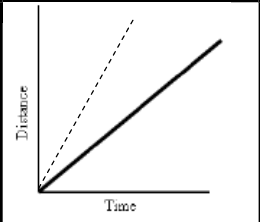
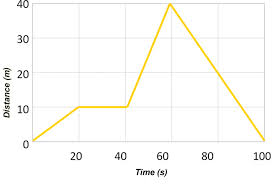

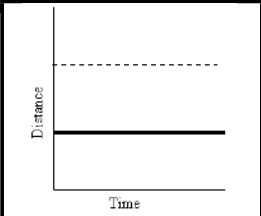


In which of the following graphs below are both runners moving at the same speed?


Match the description to the graph:
"The car is coming back."


Match the description to the graph:
"The car is traveling at a constant speed."

Segment B-C The bus is _________________.
at rest
returning (to original position)
moving forward
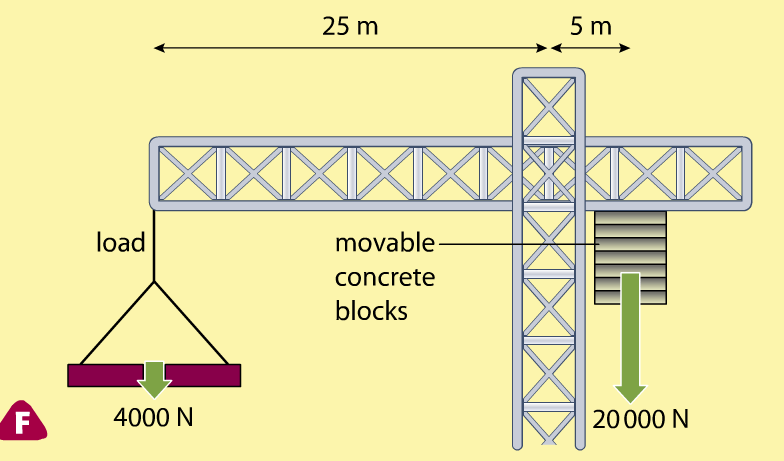

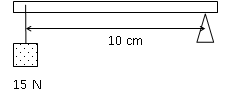

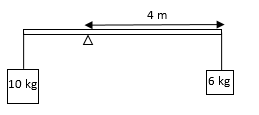
Two masses of mass 10.0 and 6.0 kg are hung from massless strings at the end of a light rod. The rod is virtually weightless. A pivot (fulcrum) is placed off center and the system is free to rotate. If the 6.0 kg mass is 4.0 m away from the pivot, how far away is the 10.0 kg mass if the system is not rotating?
0.42 m
2.4 m
4.8 m
4.2 m
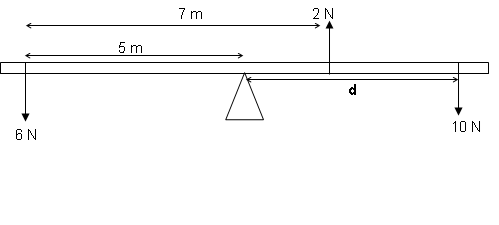
Assuming the system is in equilibrium, calculate the missing distance d
3.4 m
2.8 m
4.4 m
1.6 m
A nut can be loosened more easily with
a short spanner because a larger turning effect can be produced.
a long spanner because a larger turning effect can be produced.
a long spanner because a larger force can be produced.
a short spanner because a larger force can be produced.
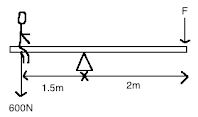
A boy of weight 600N sits on the see-saw as shown at a distance of 1.5m from the pivot. What is the force F required at the other end to balance the see-saw?
450 N
350 N
4.5 N
200 N
Moment (Nm) =
Force (N) x distance (m)
Angular Force (N°) x distance (m)
Work done (J)
Force (N) x distance (s)

What are the units for Moment?
N
kgm/s
kN
Nm
State the principle of moments.
When a system is in equilibrium, the sum of the total clockwise moment is equal to the sum of the total anti-clockwise moment about the same pivot.
When a system is in equilibrium, the sum of the total clockwise moment is greater the sum of the total anti-clockwise moment about the same pivot.
When a system is in equilibrium, the sum of the total clockwise moment is less than the sum of the total anti-clockwise moment about the same pivot.
When a system is in equilibrium, the sum of the total clockwise moment is equal to the sum of the total anti-clockwise moment about the different pivot.
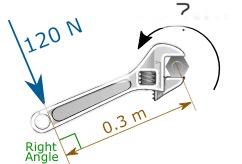
What is the size of the moment shown by the black arrow?
30 Nm
36 Nm
40 Nm
60 Nm

Two equal and oppositely directed forces acting on an object will be in equilibrium
Only if they act on the same point on the object
If they are separated by a distance
When they are balanced by a third force
when their moments about the same point are equal

At what distance should a 2N load placed from the pivot so that the see saw won't move?
0.2m
0.5m
0.45m
0.42m

Army tank tracks are useful for travelling through the mud because..
they decrease the force the vehicle exerts on the ground
they increase the force the vehicle exerts on the ground
they decrease the pressure the vehicle exerts on the ground
they increase the pressure the vehicle exerts on the ground


In the image which hole will allow the water to travel furthest?
A
B
C

What is the term for the weight of air molecules pushing down on Earth?
gravity
wind
air pressure
oxygen
If a hairspray can is heated, what can be expected of the pressure of the gas inside the can?
The pressure will increase
The pressure will decrease
The pressure will remain constant
The pressure will equalize

The pressure inside the syringe will decrease if we move the plunger in:
Direction A
Direction B
We don't have to move the plunger as the pressure will change on its own.
None of the above answers.

The reason gases can be compressed is because:
The particles are very close together.
The particles are merely vibrating.
The particles are unable to move.
The particles are very far apart.
In which one the ballon will burst for sure
With a small force on a nail
on many nails with a small force
On many nails with a big force
On a single nail with a big force
Check true one about pressure
If you doubled the area you doubled pressure
Pressure will be halved if you halved the arae
Pressure is tripled if you doubled the force
Pressure is doubled if you halved the area

check all true information about the figures
same pressure acts to the bottom
The middle one has the least pressure at the base
Since they have same density and same height they have the same pressure
Pressure is independent of the shape of the container


How do you Calculate Pressure
Force(N)/Area(m2)
Force(kg)/Area(mi2)
Area(m2)/Force(N)
Diffusion occurs only in solids
True
False
How do the particles move in diffusion?
From a region of low concentration to a region of high concentration
From a region of high concentration to a region of low concentration
From a region of low concentration to a region of low concentration
From a region of high concentration to a region of high concentration
How long does diffusion last?
Until the concentration of particles in the system is equal
(Select this answer and I swear i'll make it harder for you in the assessment task)
Until a region in the system has a greater concentration of particles than the other
Until the particles disappear from the system
The movement of particles is __________, resulting in the particles being spread throughout the container
Structured
In a straight line
Random
In curved, way motions
What happens to the coffee particles when coffee is added to hot water?
They sink to the bottom of the cup
They spread out
They clump together
What does a 'region with high concentration' mean?
An area with a SMALL number of particles
An area with a LARGE number of particles
An area with an UNEVEN number of particles
An area with no particles
When does diffusion stop?
After a day and a night
When the particles are evenly spread out
When there are no particles left
When all the particles leave the system

