wayground logo

Free Printable Worksheets

Font size

S
M
L
XL
Worksheets

Y11 Chemistry Mock Quiz (CC1-CC17) (Edexcel)

Total questions: 201

Worksheet time: 3hrs 32mins

Name
Class
Date
1.

What is being described here? Random, far apart.

a)

arrangement of particles in a solid

b)

arrangement of particles in a liquid

c)

arrangement of particles in a gas

d)

movement of particles in a liquid

2.

How are particles arranged in a solid?

a)

random and far apart

b)

random and close together

c)

regular and close together

d)

regular and far apart

3.

What word described a gas changing into a liquid?

a)

evaporation

b)

sublimation

c)

freezing

d)

condensation

4.

What word describes a solid turning into a gas?

a)

sublimation

b)

subtraction

c)

subsection

d)

substandard

5.

What word describes a liquid changing into gas?

a)

evaporation

b)

boiling

c)

melting

d)

freezing

6.

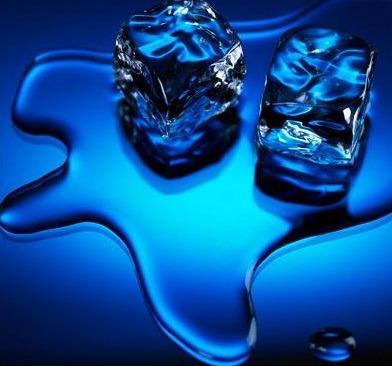
What happens to the temperature of a substance when it melts or boils?

a)

The temperature remains constant while the substance changes state.

b)

The temperature increases while the substance changes state.

c)

The temperature decreases while the substance changes state.

7.
Particles of a liquid
a)
are tightly packed together and stay in a fixed position
b)
have no viscosity
c)
decrease in volume with increasing temperature
d)
are free to move in a container but are in close contact with one another
8.
The change from a  liquid to solid, or the reverse of melting, is called
a)
condensation
b)
boiling
c)
sublimation
d)
freezing
9.

The freezing point of water is the same as its

a)

melting point

b)

boiling point

c)

sublimation point

d)

evaporation point

10.
2.5: Which is a pure substance?
a)
Steam
b)
Sea Water
c)
Soil
d)
Lemonade
11.
2.7b: What method would you use to separate a mixture of liquids?
a)
Fractional Distillation
b)
Chromatography
c)
Distillation
d)
Filtering
12.
2.5: The image is an example of...
a)
One compound
b)
Mixture
c)
Element
d)
single atom
13.
2.7a: Salt dissolved in water.  
What method would you use to separate this mixture?
a)
sorting by hand
b)
distillation
c)
chromatography
14.
2.5: Can a mixture be separated? 
a)
No
b)
Yes
15.
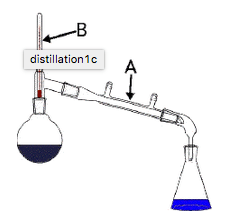
2.7a: In the distillation apparatus shown, what are the parts labelled A and B?
a)
A = funnel, B = thermometer
b)
A = thermometer, B = funnel
c)
A = condenser, B = flask
d)
A = condenser, B = thermometer
16.
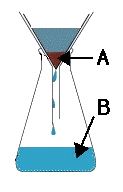
2.7c: The diagram shows the apparatus for separating soil and water. What are the labelled parts?
a)
A = distillate, B = filtrate
b)
A = filtrate, B = residue
c)
A = residue, B = filtrate
d)
A = residue, B = distillate
17.
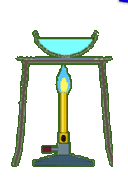
2.7d: Which one of the following is the name for separation technique in the picture below
a)
distillation
b)
dissolving
c)
crystallisation
d)
decanting
18.
2.7d: Which one of the following is a disadvantage of evaporation?
a)
It always requires heat
b)
It cannot be used for insoluble solids
c)
All of the solute is recovered
d)
The solvent (liquid part) is not recovered
19.
2.8: No matter what you do, sand will not dissolve in water, sand is _________ ?
a)
dissolved
b)
soluble
c)
insoluble
d)
aqueous
20.
2.8: Filtration can be used to separate...
a)
an insoluble solid from a solution
b)
a soluble solid from a solution
c)
a dissolved solid from a solution
21.
2.5: An example of a mixture is 
a)
Water and oil
b)
Cereal and Milk 
c)
Sand and water 
d)
All of the above
22.
2.10c: The Rf value of a substance is ...
a)
always less than 0.5
b)
always less than 1
c)
always greater than 1
d)
always a whole number
23.
2.12a: What is the purpose of chlorination in purifying drinking water?
a)
cleaning the water
b)
removing bacteria
c)
removing fine particles
d)
removing large particles
24.

What is the correct charge and mass for a proton?

a)

Charge = -1 Mass = 1

b)

Charge = + 1 Mass = 1

c)

Charge = +1 Mass = Negligible

d)

Charge = -1 Mass = Negligible

25.

What is the correct charge and mass for a Neutron?

a)

Charge = -1 Mass = 1

b)

Charge = + 1 Mass = 1

c)

Charge = 0 Mass = 1

d)

Charge = -1 Mass = Negligible

26.

What is the charge of the nucleus of atoms and why.

a)

Positive because the nucleus only consists of protons and neutrons

b)

Positive because the nucleus only contains protons

c)

Negative because the nucleus contains electrons

d)

Neutral because the charges of the protons and neutrons cancel each other out

27.

In Rutherford's gold foil experiment to determine the structure of an atom one observation was: Most of the alpha particles passed straight through. What is the explanation for this?

a)

Nearly all the mass of at atom is found in the nucleus

b)

An atom has electrons on shells

c)

The nucleus is positive

d)

An atom is mostly made up of empty space

28.

Where do you find the mass number of an element and what does it mean?

a)

Top of the symbol it shows the number of protons and neutrons

b)

Top of the symbol it shows the number of protons and electrons

c)

Bottom of the symbol it shows the number of electrons and neutrons

d)

Bottom of the symbol it shows the number of protons

29.

Where do you find the atomic number of an element and what does it mean?

a)

Top of the symbol it shows the number of protons and neutrons

b)

Top of the symbol it shows the number of protons and electrons

c)

Bottom of the symbol it shows the number of electrons and neutrons

d)

Bottom of the symbol it shows the number of protons

30.

What is an isotope?

a)

A different element that has the same number of neutrons

b)

The same element with a different mass as it has a different number of neutrons

c)

The same element with a different mass as it has a different number of protons

d)

A different element that has the same number of protons

31.

How did Mendeleev arrange the elements in his version of the periodic table?

a)

Increasing atomic mass

b)

Decreasing atomic mass

c)

Decreasing atomic number

d)

Decreasing atomic number

32.

Why did Mendeleev leave gaps in the periodic table?

a)

For elements that hadn't yet been discovered

b)

For elements that had different forms

c)

To allow elements to be moved around easier

d)

Because there are isotopes of some elements

33.

What is the electronic configuration for the element in the picture?

a)

2.8.6

b)

1.8.7

c)

2.8.7

d)

3.6.8

34.

What does the period number tell you on the periodic table?

a)

The number of protons

b)

The number of neutrons

c)

The number of electrons

d)

The number of electron shells

35.

What does the group number on the periodic table tell you?

a)

The total number of electrons

b)

The number of electrons in the nucleus

c)

The number of electrons on the shells

d)

The number of electrons on the outer shell

36.

Why did Mendeleev swap the positions of iodine and tellurium around, even though tellurium has a higher mass number?

a)

The chemical properties of iodine matched the rest of the new group

b)

The chemical properties of iodine matched the rest of the new period

c)

He thought it looked better there

d)

The physical properties of iodine matched the rest of the group

37.

Which two statements about isotopes are correct.

a)

They have different atomic numbers

b)

They all have the same atomic number

c)

They have different mass numbers

d)

They all have the same mass numbers

38.

Which statement is not part of John Dalton's atomic theory?

a)

All matter is made up of tiny particles called atoms

b)

Atoms cannot be created or destryed

c)

The atoms in an element are identical but each element has its own type of atom

d)

Atoms can be broken down into smaller parts

39.
What can link 2 atoms together
a)

forces

b)

a bond

c)
electrons
40.
How do positive and negative charges affect each other?
a)

No effect

b)

repel each other

c)

attract each other

41.
What is an ion?
a)
atoms that have gained or lost protons and become positive or negative
b)

Atoms of the same element with different numbers of neutrons

c)
a charged atom that has lost or gained one or more electrons.
42.
What happens when an ionic bond is formed?
a)
One atom loses electrons to another atom to form oppositely charged ions that attract each other.
b)
One atom loses protons to another atom to form oppositely charged ions that attract each other.
c)
One atom loses neutrons to another atom to form oppositely charged ions that attract each other.
43.
Which kinds of elements are usually involved in the formation of ionic bonds?
a)

Metals and non-metals

b)

non-metals only

c)
Metals only
44.
How is a negative ion formed and what is it called?
a)
atom gains electrons; called a cation
b)
atom gains electrons; called an anion
c)
atom loses electrons; called an anion
45.
Explain why group 1 elements such as sodium and lithium form a 1+ ion.
a)

They have too many protons so lose them to become stable 

b)
They have one electron in outer shell and lose it to become stable.
c)

They have a full outer shell so gain electrons to become stable

46.
What is the charge on the ions of elements in group 6 of the periodic table?
a)

-2

b)

+2

c)

-1

47.
What two types of atoms make a covalent bond?
a)
2 Nonmetals
b)
1 Nonmetal and 1 Metal
c)
2 Metals
d)
2 Noble Gases
48.

How many electrons are shared in a single covalent bond?

a)

2 pairs

b)

4

c)

2

d)

1

49.

Which is stronger...

a)

N − N

b)

N = N

c)

N ≡ N

50.
Ionic or covalent?
H2O
a)
Ionic
b)
Covalent
51.
What is the basis of a metallic bond?
a)
the attraction of neutral metal atoms.
b)
the attraction between protons and neutrons.
c)
the attraction between positive metal ions and interlocking electrons.
d)
the attraction between positive metal ions and free floating electrons.
52.
At room temperature, most metals are
a)
liquid
b)
solid
c)
gas
d)
an alloy
53.
Electrons that are free to move in metals
a)
delocalized electrons
b)
oxidation number
c)
chemical bond
d)
salts
54.
What structure is shown in the diagram?
a)
Diamond
b)
Graphite
c)
Carbon fiber
d)
Carbon nanotubes
55.
What element are diamond and graphite made up of?
a)
A.     Sodium
b)
B.     Carbon
c)
C.     Carbon dioxide
d)
D.     Silicon
56.
Why does graphite conduct electricity?
a)
Ions are free to move to carry the charge
b)
Aoms can move
c)
Free electrons that can carry the charge
57.
Define the term allotropes
a)
Atoms with same proton number but different number of neutrons
b)
Atoms with same proton number but different mass number
c)
Atoms in different arrangement in structure
d)
Atoms in different arrangement and different physical form
58.
Why do simple molecules have low melting points?
a)
A.  The intermolecular forces are very strong
b)
B.  The intramolecular forces are very weak.
c)
C.  The intramolecular forces are very strong.
d)
D.  The intermolecular forces are very weak.
59.
Diamond and graphite are allotropes 
a)
True 
b)
False 
60.
What is a valence electron?
a)
an electron that is found in the outermost shell of an atom. 
b)
an electron found in the innermost shell of an atom.
c)
an electron found in the middle shell.
61.
Why do atoms share electrons?
a)
To attain the electron configuration of a noble gas.
b)
To become ions and take a charge
c)
to increase the mass
d)
it's a nice thing to do.
62.
Which of the following word pairs correctly completes the sentence below?
_______ are corrosive substances characterized as having a strong smell, a sour taste, and a _______.
a)
Acids; pH less than 7
b)
Acids; pH greater than 7
c)
Bases; pH greater than 7
d)
Bases; pH less than 7
63.
Holly has an unknown substance in a beaker. She wants to determine the relative pH of the unknown substance. She places a piece of blue litmus paper into the substance, and the litmus paper stays blue.
The substance in the beaker
a)
is a base.
b)
has a neutral pH.
c)
is an acid.
d)
does not have a pH.
64.
Turns blue litmus paper red
a)
acid
b)
base
c)
neither
d)
both
65.
Creates a colorless solution with phenolphthalein
a)
acid
b)
base
c)
neither
d)
both
66.
Which of the following substances contain acid?
a)
An orange
b)
Bleach
c)
Distilled water
d)
Washing powder
67.
Which of the following substances contain an alkali?
a)
Baking powder
b)
Coca cola
c)
Distilled water
d)
Vinegar
68.
alkalis have a ph ..
a)
above 7
b)
below 7
69.

Example of a Strong Acid

a)

Lactic acid

b)

Citric acid

c)

Ethanoic acid

d)

Hydrochloric acid

70.

What is the pH of a strong Alkali?

a)

14

b)

9

c)

7

d)

1

71.

What pH is closest to Neutral?

a)

7.0

b)

6.8

c)

7.2

d)

8.0

72.

Which pH is closest to a strong acid?

a)

1

b)

5

c)

7

d)

14

73.

What ion is found in acids?

a)

H+

b)

OH-

c)

H-

d)

OH+

74.

Which ion can be found in bases?

a)

H+

b)

H-

c)

OH-

d)

OH+

75.

How is an alkali different to a base?

a)

It looks different

b)

It doesn't react

c)

It is soluble in water

76.

What gas is produced when a metal and acid react?

a)

Oxygen

b)

Hydrogen

c)

Carbon Dioxide

d)

Nitrogen

77.

What test is used to test for hydrogen gas?

a)

Squeaky pop

b)

Limewater

c)

Glowing splint

78.

Complete the word equation metaloxide + acid -->

a)

Salt + Hydrogen

b)

Salt + Water

c)

Salt + Water + Carbon Dioxide

79.

What two things could you react together to form copper sulfate crystals?

a)

Copper + sulfuric acid

b)

Copper oxide + sulfuric acid

c)

Copper oxide + hydrochloric acid

80.

What kind of reaction occurs between an acid and an alkali?

a)

Explosion

b)

Exothermic

c)

Neutralisation

81.

If 2 g of salt is dissolved in 250 cm3 of solution, what is its concentration in g dm–3?

a)

18 g dm–3

b)

8 g dm–3

c)

1.8 g dm–3

82.

How can a solution be made more dilute?

a)

Add more water

b)

Add more salt

c)

Add more acid

83.

What happens to the pH as the H+ ion concentration increases?

a)

It decreases

b)

It increases

c)

There is no change

84.

If 24 g of acid is dissolved in 600 cm3 of solution, what is its concentration in g dm–3?

a)

4 g dm–3

b)

40 g dm–3

c)

24 g dm–3

85.

What kind of substances can form electrolytes?

a)

Ionic

b)

Metallic

c)

Covalent

86.

What is the positive electrode in electrolysis called?

a)

Cathode

b)

Anode

c)

Positrode

87.

Which of the following is a true statement about the electrolysis of sodium chloride solution?

a)

Hydrogen forms at the positive electrode

b)

Chlorine forms at the positive electrode

c)

Sodium forms at the negative electrode

88.

What is formed at each electrode during the electrolysis of dilute sulfuric acid?

a)

Hydrogen at the positive electrode and oxygen at the negative electrode

b)

Hydrogen at the negative electrode and oxygen at the positive electrode

c)

Hydrogen at the negative electrode and sulfur dioxide at the positive electrode

89.

What can happen to the carbon electrodes during the electrolysis of copper sulfate solution?

a)

The negative electrode loses mass

b)

The negative electrode gains mass

c)

The positive electrode gains mass

90.

Which of these describe a property of the gas formed during the electrolysis of copper sulfate solution using inert electrodes?

a)

The gas relights a glowing splint

b)

The gas pops when lit

c)

The gas turns limewater milky

91.

Which of the following is a true statement about the purification of copper by electrolysis?

a)

The positive electrode is impure copper

b)

The positive electrode is pure copper

c)

The negative electrode is impure copper

92.

Which of these changes occurs during electrolysis?

a)

Negative ions lose electrons at the negative electrode and are oxidised

b)

Negative ions lose electrons at the positive electrode and are oxidised

c)

Negative ions gain electrons at the negative electrode and are oxidised

93.

Which of these statements about reduction is correct?

a)

Reduction involves the loss of electrons

b)

Reduction involves the gain of electrons

c)

Reduction involves a reaction in which oxygen atoms are gained by another atom

94.

HIGHER TIER - Which of these is a correct half equation for the oxidation of copper metal?

a)

Cu → Cu2+ + e-

b)

Cu2+ + 2e- → Cu

c)

Cu → Cu2+ + 2e-

95.
The negatively charged ions migrate toward the ________.
a)
anode
b)
cathode
96.
Which series is used to predict the reactions of metals with carbon and other elements?
a)
reactionary series
b)
reaction series
c)
redox series
d)
reactivity series
97.
What is the name of the process that uses electricity to separate the elements in a compound?
a)
reduction
b)
electrolysis
c)
extraction
d)
mining
98.
What is the product formed at the cathode during the electrolysis of molten magnesium fluoride?
a)
magnesium
b)
hydrogen
c)
fluorine
d)
oxygen
99.
Explain why the electrolyte has to be a liquid.
a)
So the ions can move
b)
So the electrons can move
c)
So that it doesn't get too hot
d)
So the fish are ok
100.

The rule for products at the anode (positive electrode) is that ____________ always forms unless there are halide (group 7) ions.

a)

O2

b)

H2

c)

OH-

d)

H+

101.
Which of the following is NOT an advantage of recycling metals?
a)
Natural reserves of metal ores will last longer.
b)
Less waste metal ends up in landfill sites.
c)
We need to mine more ores, which is good for the environment as it removes metals from the ground.
d)
Less pollution may be produced.
102.
Which of the following is NOT a disadvantage of recycling?
a)
Recycling has to be sorted by hand.
b)
Less energy is used to recycle metals than to obtain them from their ores.
c)
More refuse collections must be made.
d)
It can be a hassle for households.
103.
What does LCA stand for?
a)
Life council of America
b)
Life cycle of amnesty
c)
Little cycle analysis
d)
Life cycle analysis
104.
Which is the following is NOT part of a life cycle analysis?
a)
Using the product.
b)
Obtaining and processing raw materials.
c)
Advertising a product.
d)
Disposing of the product
105.

What is the best way to deal with our waste?

a)

throw it in the bin

b)

recycle it

c)

reduce it

d)

reuse it

106.
How do we obtain aluminium from its ore?
a)
Reduction with carbon.
b)
Electrolysis.
c)
Thermal decomposition.
107.
Name a metal that reacts vigorously with cold water.
a)
potassium
b)
copper
c)
iron
d)
lead
108.
What gas is produced when a metal reacts with water?
a)
carbon dioxide
b)
oxygen
c)
hydrogen
d)
helium
109.

A formula with the lowest whole number ratio of elements in a compound is called

a)

Molecular Formula

b)

Chemical Formula

c)

Empirical Formula

d)

Distance Formula

110.
What is the empirical formula for C3H8
a)
CH
b)
C3H8
c)
C6H16
d)
CH2.7
111.
Which pair has the same empirical formula?
a)
NaCrO4 and Na2Cr2O7
b)
C2H4O2 and C6H12O6
c)
C3H6Oand C2H6O2
d)
CH4 and C2H6
112.

The empirical formula for a compound is CH2 and its relative atomic mass (Ar) is 70. What is its molecular formula? Use the periodic table to help you.

a)

CH2

b)

C5H10

c)

C70H140

113.

6.1: Alkali metals are found in which group of the periodic table?

a)

Group 1

b)

Group 2

c)

Group 7

d)

group 8

114.

6.3: What is the symbol equation for the reaction between sodium hydroxide and water?

a)

2Na + 2H2O → 2NaOH + H2

b)

Na + H2O → NaOH + H

c)

Na + H20 → NaCl + CO2

d)

2Na + 2H2O → 2NaH2 + O2

115.

6.3: What is formed when sodium reacts with water?

a)

sodium oxide and hydrogen

b)

sodium hydroxide and hydrogen

c)

sodium hydroxide and oxygen

d)

sodium hydroxide and carbon dioxide

116.

6.1: What is another name for the elements in group 7?

a)

The Halogens

b)

The Noble gases

c)

The Oxides

d)

The Alkali Metals

117.
Alkali are so reactive to air they are generally stored in what?
a)
Water
b)
Oil
c)
Vaults
d)
Cotton
118.

6.6: At room temperature, iodine is a....

a)

Gas

b)

Liquid

c)

Solid

119.

6.1: The Group 7 elements are all..

a)

metals

b)

non-metals

c)

metalloids

120.

6.6: What state is fluorine at room temperature?

a)

solid

b)

liquid

c)

gas

121.

6.6: What colour is bromine?

a)

orange-brown

b)

orange-red

c)

yellow-green

d)

yellow

122.

6.1: Which of these is not a noble gas?

a)

Helium

b)

Argon

c)

Nitrogen

d)

Krypton

123.

6.1: In which group would you find the Noble Gases?

a)

5

b)

6

c)

7

d)

8

124.

6.15: Which of these is not a property of noble gases?

a)

Colourless

b)

Odourless

c)

Flammable

d)

Gas at room temperature

125.

6.1: Which element is inert

a)

Nitrogen

b)

Krypton (Kr)

c)

Manganese (Mn)

d)

Plutonium (Pu)

126.

6.8: What is the chemical test for chlorine

a)

Bubble it through limewater

b)

Place a lit splint near it and wait for a 'pop'

c)

Use copper chloride paper and wait for it to turn blue and then white

d)

Add cobalt chloride paper to it, wait for it to turn blue and then white

127.
This family is HIGHLY reactive and do not occur freely in nature. These metals are very soft and the least dense
a)
Halogen
b)
Alkali metals
c)
Alkali Earth Metals
d)
Noble Gases
128.

6.9: If: sodium + chlorine → sodium chloride, what would you get if you reacted lithium with chlorine?

a)

Lithium chloride

b)

Chlorine lithium

c)

Sodium chloride

d)

Chlorine sodium

129.

6.10: What is a hydrogen halide?

a)

Hydrogen reacting with an alkali metal

b)

Hydrogen reacting with a noble gas

c)

Hydrogen reacting with a halogen

130.

6.13: why do the halogens get less reactive as you move down the group?

a)

They get bigger, so it is easier to gain electrons

b)

They get smaller, so it is easier to gain electrons

c)

They get larger, so it is easier to lose electrons

d)

They get larger, so it is harder to gain electrons

131.

6.14: Why are the noble gases classed as inert?

a)

They react too quickly to record information about them

b)

They have 5 electrons in the outer shell

c)

They have a full outer shell, so don't need to gain electrons

d)

They are gases

132.

Rate of chemical reaction means

a)

amount of product formed

b)

speed of reaction

c)

concentration of reacting particles

d)

combining reactants with products

133.

Rate of chemical reaction means

a)

amount of product formed

b)

speed of reaction

c)

concentration of reacting particles

d)

combining reactants with products

134.

7.4: Which factors increase the rate of a reaction.

a)

increasing temperature

b)

increasing concentration

c)

increasing surface area

d)

all of these

135.

7.3: Increase in temperature of the reactants can do one of the following

a)

Slow collision frequency

b)

Allow less effective collision between the particles

c)

Neutralise the reaction

d)

increase collision between the particles thus increasing the rate.

136.

7.4: Why does a catalyst increase the rate of reaction?

a)

it produces extra energy for the reactants

b)

it increases the speed of the reactant particles

c)

it increases the frequency of particle collisions

d)

it reduces the activation energy of the reaction

137.

7.4: Which of the following increase the reaction rate?

a)

less surface area

b)

lower temperature

c)

an inhibitor

d)

increased concentration

138.

7.3: Why don't all collisions between particles cause a reaction?

a)

the particles also need to collide with a catalyst

b)

not all the particles collide with enough energy

c)

not all the particles collide at a high enough temperature

d)

the particles need to collide with each other twice

139.

7.4: Why does a higher temperature increase the rate of a reaction?

a)

it increases both the frequency and energy of particle collisions

b)

it only increases the frequency of particle collisions

c)

it only increases the energy of particle collisions

d)

it reduces the activation energy of the reaction

140.

7.7: B represents

a)

energy absorbed

b)

energy released

c)

activation energy

141.

7.7: C represents

a)

energy absorbed

b)

energy released

c)

activation energy

142.

7.4: To slow down a chemical reaction you will do one of the following:

a)

Place the reactants in hot water

b)

Place the products in ice bath

c)

Place the reactants in a ice bath

d)

Keep stirring the reactants with a stirring rod

143.

7.4: Will increasing the surface area of a catalyst make a difference to the speed of the reaction?

a)

yes

b)

no

144.

In an endothermic reaction, energy is _________.

a)

absorbed

b)

released

145.

_____ reactions usually feel hot!

a)

endothermic

b)

exothermic

146.

____ reactions usually feel cold.

a)

endothermic

b)

exothermic

147.

Solid --> liquid --> gas is what type of reaction?

a)

endothermic

b)

exothermic

c)

catalytic

d)

inhibited

148.

gas --> liquid --> solid is what type of reaction?

a)

endothermic

b)

exothermic

c)

catalytic

d)

inhibited

149.

Endo means in or _______.

a)

absorbed

b)

released

150.

Exo means out or ________.

a)

absorbed

b)

released

151.

The graph above is from which type of reaction?

a)

Endothermic reaction

b)

Exothermic Reaction

152.

The graph above is from which type of reaction?

a)

Endothermic reaction

b)

Exothermic reaction

153.
If a chemical reaction is EXOTHERMIC, the temperature would....
a)
Stay the same
b)
Increase
c)
Decrease
154.

The products are at a higher energy than the reactants

a)

Exothermic

b)

Endothermic

155.

During an exothermic reaction, heat is _________ and chemical bonds __________.

a)

released, formed

b)

absorbed, broken

c)

released, broken

d)

absorbed, formed

156.

The initial temperature was measured to be 20oC and the final temperature was 45oC. The reaction was

a)

exothermic

b)

endothermic

157.

The minimum energy particles must have to react is the

a)

acting energy

b)

active energy

c)

activation energy

158.

Bond making is

a)

Endothermic

b)

Exothermic

159.

Bond breaking is..

a)

Endothermic

b)

Exothermic

160.

In a reaction the energy required to break bonds is less than the energy released when bonds are made. What type of reaction is this?

a)

Exothermic

b)

Endothermic

161.
Which of the following would have the highest melting point?
a)
C3H8
b)
C4H8
c)
C5H12
d)
C22H44
162.

Hydrocarbons are compounds conatining

a)

hydrogen

b)

carbon

c)

only hydrogen and carbon

163.
What happens when crude oil is fractional distilled?
a)
Different fractions are mixed together to form oil.
b)
Sulfur is removed from the crude oil.
c)
The oil is separated into fractions of different boiling ranges by heating.
d)
Longer chain fractions are broken down into shorter chain fractions.
164.
What is cracking?
a)
Shorter chain fractions are built up into longer chain fractions.
b)
The petrol fraction is removed from the rest of the crude oil.
c)
The crude oil is separated into fractions by heating.
d)
Longer chain fractions are broken into shorter chain fractions.
165.
What are the products of cracking?
a)
Short chain hydrocarbons and alkenes
b)
Long chain hydrocarbons and alkenes
c)
Short chain hydrocarbons only
d)
Alkenes only
166.
What is the major use for the light gasoline and naphtha fractions of crude oil?
a)
Petrol/motor fuel
b)
 Liquid petroleum gas
c)
Diesel fuel
d)
Bitumen
167.
Study the diagram of the fractionating column. 
What fractions come out at X and Y?
a)
X = kerosene and Y = refinery gas
b)
X = refinery gas and Y = light gasoline
c)
X = residue and Y = gas oil
d)
X = refinery gas and Y = gas oil
168.
Which of the following, when fossil fuels are burned, is formed when there is lack of oxygen?
a)
carbon monoxide
b)
sulphur dioxide
c)
nitrogen dioxide
d)
carbon dioxide
169.
Which is a definition of a molecule? 
a)
the smallest particles of matter that make up substances
b)
two or more elements chemically joined together and not easily separated
c)
two or more atoms joined together to make a bigger particle
d)
collection of substances which keep their own properties and easily easily separated
170.
What is the correct general formula of the alkanes?
a)
CnH2n + 2
b)
C2nH2n + 2
c)
CnH2n 
d)
C2nHn + 2
171.
What is a saturated hydrocarbon?
a)
Has only single covalent bonds
b)
Has a mixture of single and double covalent bonds
c)
Has only double covalent bonds
d)
Has covalent and ionic bonds
172.
What are the products of combustion if there is plenty of oxygen available?
a)
carbon monoxide and hydrogen
b)
carbon dioxide and water
c)
carbon dioxide and hydrogen
d)
carbon monoxide and water
173.
What is the correct order for the fractions that come out of crude oil?
a)
fuel gases, petrol, kerosene, diesel, fuel oil, residue
b)
fuel gases, petrol, diesel, kerosene, fuel oil, residue
c)
fuel gases, kerosene, petrol, diesel, fuel oil, residue
d)
fuel gases, diesel, kerosene, petrol, fuel oil, residue
174.
What is kerosene used for?
a)
Fuel for ships
b)
Fuel for lorries
c)
Fuel for airplanes
d)
Making roads
175.
What does the viscosity of a hydrocarbon tell you?
a)
How easily it flows
b)
How easily it sets alight
c)
What its boiling point is
d)
How long the hydrocarbon is
176.
Which gas in our atmosphere is most abundant?
a)
Argon
b)
Oxygen
c)
Nitrogen
d)
Carbon Dioxide
177.
What percentage of our atmosphere is made up of other gases such as argon, water vapor, and carbon dioxide?
a)
1%
b)
21%
c)
78%
d)
90%
178.
What percentage of our atmosphere is made up of other gases such as argon, water vapor, and carbon dioxide?
a)
1%
b)
21%
c)
78%
d)
90%
179.
What is the percentage of oxygen in Earth's atmosphere?
a)
1%
b)
21%
c)
78%
d)
90%
180.
What is the percentage of nitrogen in Earth's atmosphere?
a)
1%
b)
21%
c)
78%
d)
90%
181.
This gas was in high concentrations in the developing atmospheres and later dissolved into rainwater, added to the oceans, then settled to the bottom of the ocean. 
a)
oxygen
b)
carbon dioxide
c)
argon
d)
water vapor
182.
According to the model, how did CO2 get into the atmosphere?
a)
evaporation
b)
condensation
c)
volcanoes
d)
sediments
183.
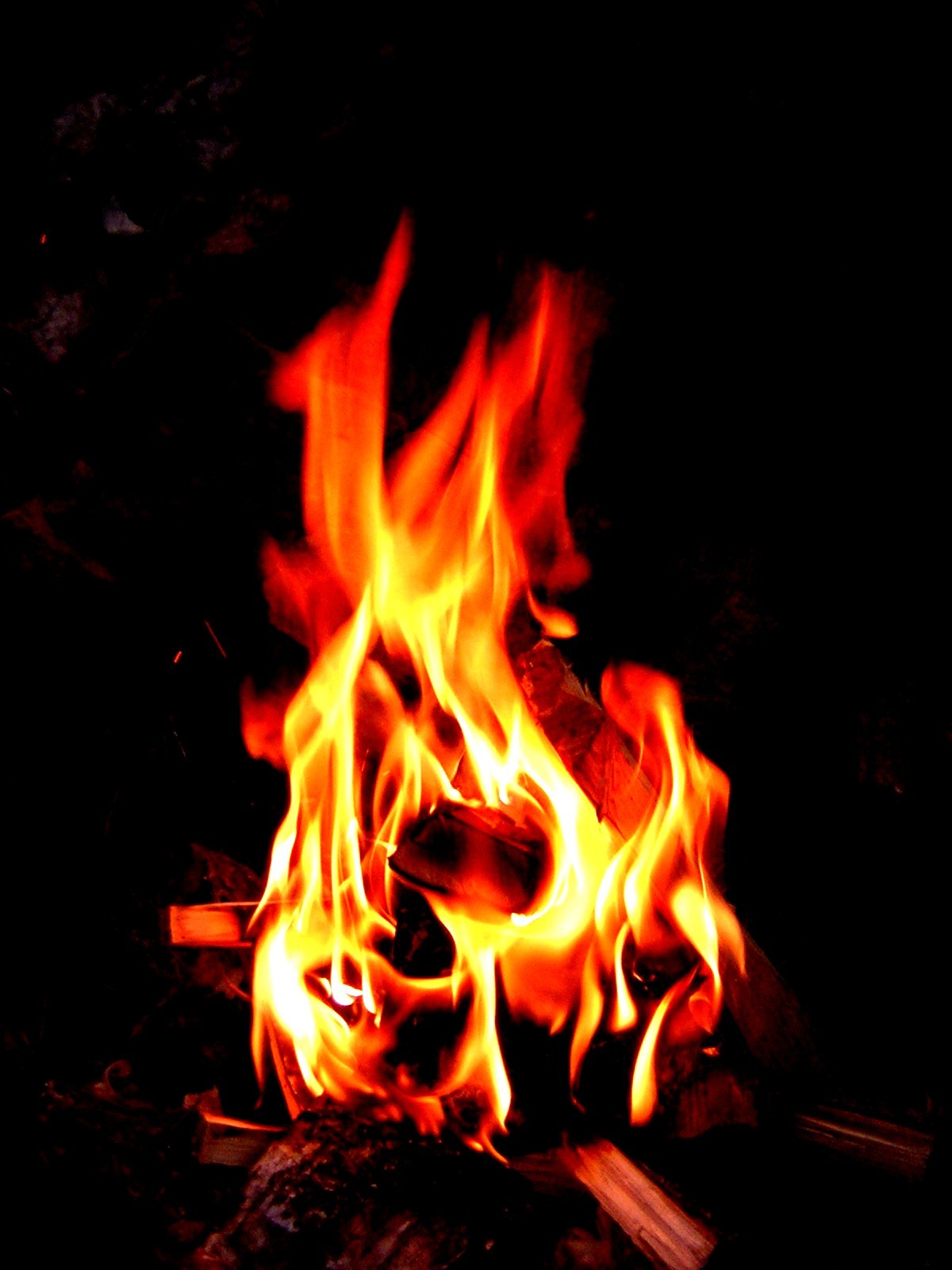
Which of these isn't in the fire triangle?
a)
Fuel
b)
Heat
c)
Oxygen
d)
Carbon dioxide
184.
Is the combustion reversable
a)
Yes.
b)
No.
185.
Another term for burning is
a)
Fire triangle
b)
Magnesium oxide
c)
Combustion
d)
Bustion
186.

Which of the following is not a cause of acid rain?

a)

Volcanic Eruptions

b)

Burning of fossil fuels

c)

electric cars

d)

combustion engins

187.

What human activity is the primary source of acid rain?

a)

Cars

b)

Deforastation

c)

Coal powerplants

d)

Volcanoes

188.
This symbol indicates that a reaction is ____________
a)
reversible
b)
irreversible
189.
Which of the following is incorrect? 
A dynamic equilibrium can be achieved...
a)
From 100% reactants
b)
From 100% products
c)
In a closed system
d)
In an open system
190.

2SO2(g)+O2(g)⇌2SO3(g)

Removing O2(g) will

a)

shift equilibrium forward

b)

shift equilibrium reverse

c)

no shift

191.

2SO2(g)+O2(g)⇌2SO3(g)

Adding O2(g) will

a)

shift equilibrium forward

b)

shift equilibrium reverse

c)

no shift

192.
When the rate of the forward reaction is equal to the rate of backward reaction, the system is said to be in
a)
Chemical Equilibrium
b)
Chemical Balance
c)
Chemical Constant
d)
Chemical Reaction
193.
Define chemical equilibrium.
a)
A reaction is reversible.
b)
The concentration of the reactants is equal to the concentration of the products.
c)
The rate of a forward reaction is equal to the rate of the reverse reaction.
d)
The reaction stops and no further change in concentration occurs.
194.
The idea that when a system at equilibrium is stressed, it will react to relieve that stress and return to equilibrium is known as:
a)
Boyle's Law
b)
Le Chatelier's Principle
c)
Charles Law
d)
Denninger's Law
195.
For the reaction...
N2 (g) +  3 H2 (g) <−> 2 NH3 (g)

If the pressure in the system is increased,  which substance will increase in concentration?
a)
N2
b)
H2
c)
N2 and H2
d)
NH3
196.
Changes in pressure will only affect substances that are in the __________ state.
a)
gaseous
b)
liquid
c)
solid
d)
plasma
197.

For the reaction...

N2 (g) + 3 H2(g) ⇌ 2 NH3 (g)


If the pressure in the system is increased, which substance(s) will increase in concentration?

a)

N2

b)

H2

c)

N2 and H2

d)

NH3

198.
For the reaction...
SO2 + O2 <=>  SO3
If the equilibrium position shifts to the right, the concentration of O2 will ___________.
a)
increase
b)
decrease
c)
remain the same
d)
double
199.

For the reaction...

N2 + O2 <=> 2NO: Δ H = +182 kJ mol-1. (Forward reaction is endothermic)

If the temperature is increased the equilibrium position will shift _______.

a)

to the left

b)

to the right

c)

to the left and right

d)

neither left nor right

200.

why is medium temperature used in the Haber process?

a)

low temperature will form more ammonia

b)

high temperature will form more hydrogen and nitrogen

c)

the rate slows down

d)

to increase the rate but not negatively affecting the yield

201.

What is the purpose of a catalyst on an equilibrium reaction?

a)

to increase the rate of forward reaction

b)

to increase rate of backward reaction

c)

in increase both forward and backward reaction rates

d)

no effect