
 Worksheets
2.5 Biomolecule Review 2023
Total questions: 197
Worksheet time: 2hrs 24mins
What do enzymes do?
(a)
How do enzymes speed up chemical reactions?
(a)

Enzymes are a form of which biomolecule?
Carbohydrates
Proteins
Nucleic Acids
Lipids

How many types of reactions can a specific enzyme direct?
a wide variety of reactions
only one specific reaction
exactly 5 different reactions
every reaction in the cell

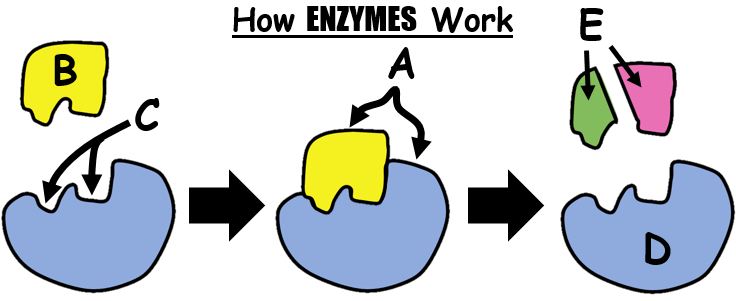
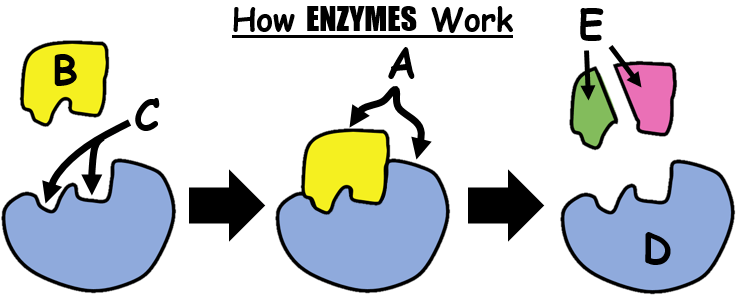
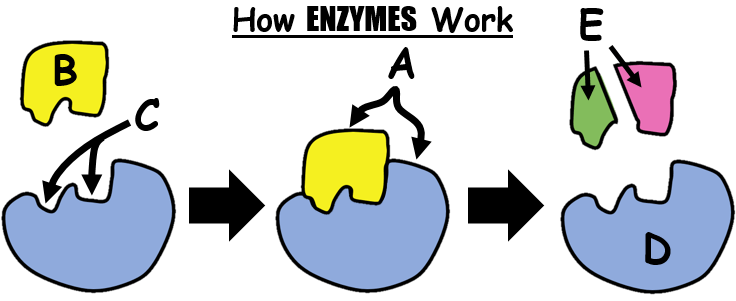
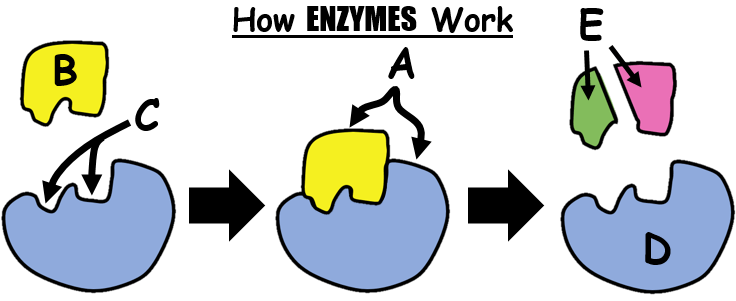
What does letter "A" represent in this diagram?
Enzyme
Substrate
Active Site
Products
What does letter "B" represent in this diagram?
Enzyme
Substrate
Active Site
Products
What does letter "C" represent in this diagram?
Enzyme
Substrate
Active Site
Products
What does letter "D" represent in this diagram?
Enzyme
Enzyme-Substrate Complex
Active Site-Enzyme Complex
Products
What does letter "E" represent in this diagram?
Enzyme
Enzyme-Substrate Complex
Active Site
Products

Enzymes are known as biological catalysts because they -
speed up chemical reactions
slow down reaction rates
increase the activation energy
reduce the polarity of water

What do we call the amount of energy required to
start a chemical reaction?
Beginning energy
Activation Energy
Connecting energy
Required Energy
How does the presence of an enzyme affect the amount
of energy needed to start the reaction?
Raises the amount of energy needed
Lowers the amount of Energy needed
Doubles the amount of energy needed
The enzyme does not affect the energy level
What are proteins made of?
Nucleic Acids
Amino Acids
Citric Acid
Hydrochloric Acid
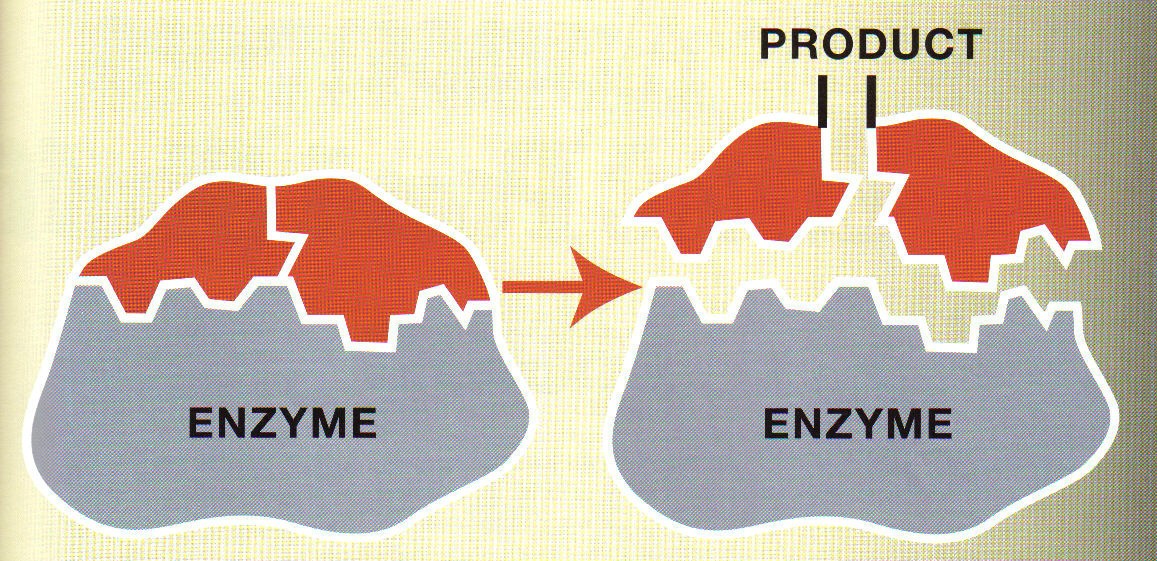
What is another name for an enzyme?
(a)
Enzymes: (2)
Speed up chemical reactions
are proteins
store energy
are made of nucleic acids
What do enzymes do?
Speed up chemical reactions
Slow down chemical reactions
Transport molecules through the cell membrane
Carry oxygen in chemical reactions
How do enzymes speed up chemical reactions?
By raising activation energy
By lowering activation energy
By breaking down large substances
By carrying oxygen in the blood
Enzymes are an example of
Lipids
Carbohydrate
Protein
Nucleic Acid

Enzymes perform which of the following functions within living cells?
inhibiting the translation of proteins
providing structural stability
transmitting ultraviolet rays
catalyzing chemical reactions
Starches and sugars are examples of what class of biomolecule?
Carbohydrate
Lipid
Nucleic Acid
Proteins
Which biomolecule's primary function is to store information?
Carbohydrate
Lipid
Nucleic Acid
Proteins
Which biomolecule is used for quick energy?
Carbohydrate
Lipid
Nucleic Acid
Proteins
What are proteins made of?
Nucleic Acids
Amino Acids
Citric Acid
Hydrochloric Acid
What are nucleic acids made of?
Amino Acids
Nucleotides
Deoxyribose
Ribose

The new substances formed by an enzyme are called its ______________________.
Substrate
Active site
Products
Complex

Enzymes bind to specific substrates. Because of this, each ______________ requires its own enzyme.
active site
reaction
substrate
cell
Organic compounds are chemical compounds that contain the element
hydrogen.
carbon.
oxygen.
nitrogen.
A small amount of enzymes can act on a large amount of substrate because
enzymes do not change after a reaction and can be used again.
a little enzyme can supply enough energy to carry out a reaction.
as the reaction is going on, more enzymes are produced.
enzymes act in a all or none situation.

A
B
C
D

F
G
H
J

F
G
H
J

F
G
H
J
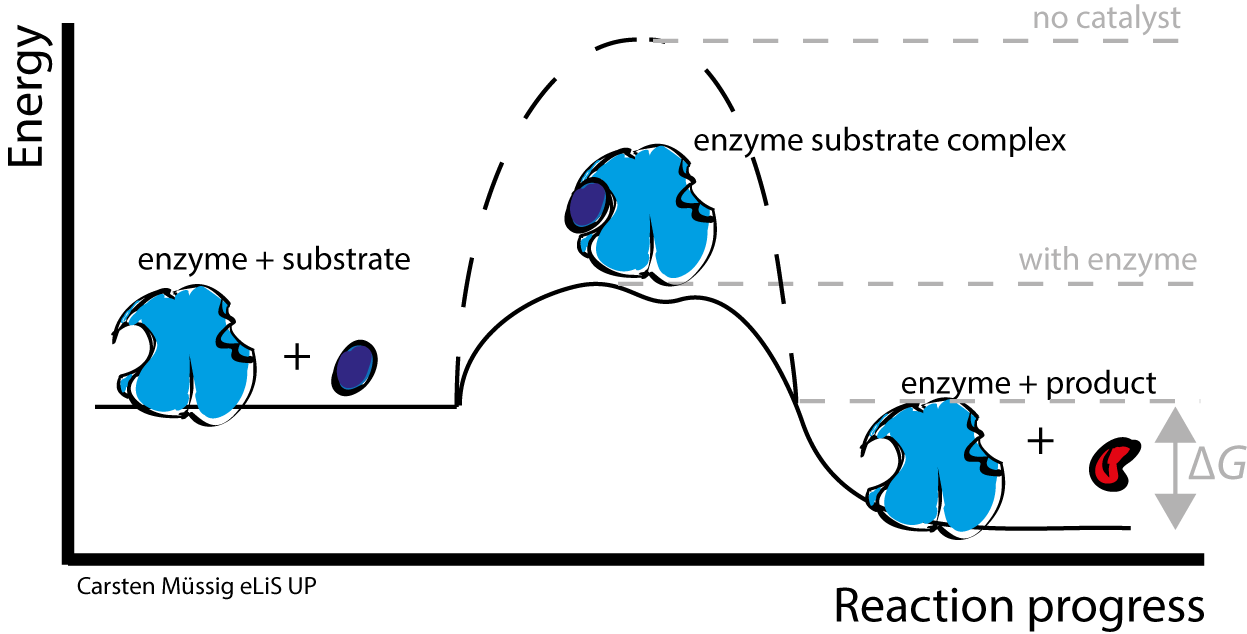
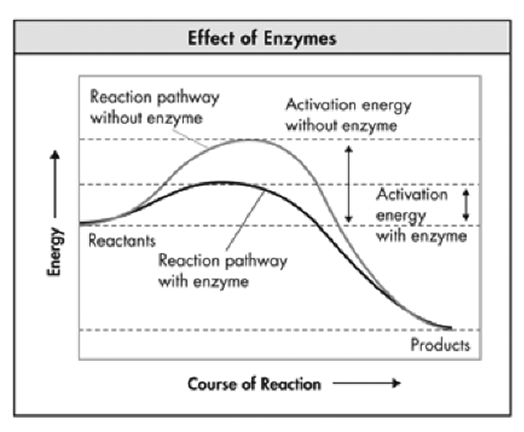
The graph shows how enzymes affect reactions in cells. Which statement best summarizes the information shown in the graph?
Enzymes increase the energy of the reactants.
Enzymes decrease the energy level of the products.
Enzymes decrease the activation energy of the reaction.
Enzymes reverse the direction of the reaction.
When an enzyme denatures it means it can______________.
function properly
no longer function
be okay
need oxygen
What does inhibit mean?
To change the shape of an enzyme
To slow or stop an enzyme from binding correctly with its substrate
To create new products
To destroy the substrate
An enzyme could denature due to extreme temperatures or pH. Denature means ______________
to unfold or change shape
to make bigger
to increase the function
to speed up

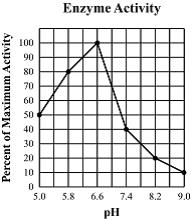
At what pH has the enzyme most likely becoming denatured?
6
7
8
9
What happens when enzymes are heated to a high temperature?
The enzymes die.
The shapes of the enzyme are altered.
The enzymes' amino acid sequence changes.
The enzymes remain the same

The enzyme on the left is working correctly. What is happening to the enzyme on the right?
It is being denatured
Nothing; it is working correctly
It is being inhibited
It is creating a product.
What happens when enzymes are heated to a high temperature?
The enzymes die.
The shape of the enzyme are changed and it denatures
The enzymes' amino acid sequence changes.
The enzymes remain the same
An enzyme is heated until its shape changes and it no longer fits its substrate. The enzyme has been:
(a)
An enzyme has a small molecule blocking its active site. The enzyme has been:
(a)
Tick all the properties of enzyme.
speed up metabolic reaction
remain unchanged at the end of reaction
made of fats
known as biocatalysts
Competitive inhibition involves a molecule, other than the substrate, binding to the enzyme’s _____ site.
BInding
Allosteric
Kinetic
Active
Which of the following correctly describes enzyme structure and function?
The shape of an enzyme is responsible for its function.
All enzymes can bind to all substrates.
The substrate is responsible for the shape of the enzyme.
The location of an enzyme determines its function.

Enzymes are biological ________________.
agitators
spurs
catalysts
stimulants

Enzymes _________________________ chemical reactions without being changed.
Speed up
Slow down
Stop
Start

The substance that an enzyme attaches to is called its _____________.
Active Site
Catalyst
Product
Substrate
The new substances formed by an enzyme are called its ______________________.
Substrate
Active site
Products
Complex
Enzymes bind to specific substrates. Because of this, each ______________ requires its own enzyme.
active site
reaction
substrate
cell

Each enzyme works best under specific conditions. Each enzyme works best at a specific _______________________.
Temperature, time
pH, time
Temperature, pH
Time, place

When temperature and pH change too much, enzymes become __________________ and stop working.
devalued
decomposed
denatured
debrided

________________________ bind to enzymes and keep substrates from attaching. This keeps enzymes from working.
Inhibitors
Catalysts
Active sites
Proteins

Enzymes often work together to complete processes. If even one enzyme stops working, the entire pathway is _____________.
Accelerated
Denatured
Activated
Disrupted

What is the optimum pH of this enzyme?
(a)

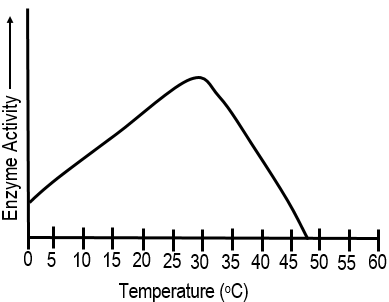
What is the optimum temperature of this enzyme?
(a)
Which Graph shows that an enzyme works best at a pH of 4?


Which Graph shows that an enzyme works best at a pH of 7?
Which Graph shows that an enzyme works best in a NEUTRAL pH?
Which graph shows that an enzyme works best at 15 degrees?


Which graph shows that an enzyme works best at 100 degrees?
Which graph shows that the enzyme works best at 100 degrees?


Which line shows that an enzyme works best at a pH pf 9?
A
B
C
Which line shows that an enzyme works best at an ACIDIC pH?
A
B
C

Which Enzyme works best at a temperature of 37?
Enzyme A
Enzyme B
Which Enzyme works best at a pH of 7.5?
Enzyme A
Enzyme B

What can we conclude from the graph? At a temperature of 62 ...
Enzyme activity is highest
Enzyme activity is low but working
Enzyme is denatured

Which substrate would this enzyme catalyze?


What can we conclude from the graph? At a a pH of 3..
Enzyme A works best
Enzyme B works best
Enzyme A works but low activity
Enzyme B works but low activity
What can we conclude from the graph? At a a pH of 8..
Enzyme A works best
Enzyme B works best
Enzyme A works but low activity
Enzyme B works but low activity
What can we conclude from the graph? At a a pH of 6...
Enzyme A works best
Enzyme B works best
Enzyme A works but low activity
Enzyme B works but low activity
What can we conclude from the graph? At a a pH of 10...
Enzyme A works best
Enzyme B works best
Both enzymes are denatured
What are the building blocks of nucleic acids such as DNA and RNA?

Biomolecules containing the genetic code for heredity.
Nucleic Acids
Proteins
Carbohydrates
Lipids

Which bond is present between two amino acids?
Glycosidic Bond
Phosphodiester bond
Ester Bond
Peptide Bond
Another word for a protein:
(a)
What are nucleic acids comprised of?
(a)
What is a long chain of amino acids called? (2)
Protein
Lipid
Carbohydrate
Polypeptide
Nucleic acid

Every living cell, DNA and RNA serve as the molecules that store and transmit genetic information throughout the cell. These molecules are both forms of which biomolecule?
Nucleic Acids
Carbohydrates
Lipids
Proteins

Which class of biomolecule is the most diverse and performs a variety of functions?
Carbohydrates
Nucleic Acid
Proteins
Lipids

Which biomolecule forms the cytoskeleton in cells?
Carbohydrates
Nucleic Acid
Proteins
Lipids

Which TWO molecules are used to store energy? (Two Answers)
Carbohydrates
Nucleic Acid
Proteins
Lipids

Which biomolecule is used to transport molecules through membranes?
Carbohydrates
Nucleic Acid
Proteins
Lipids

An advertisement for a health supplement for dogs claims to build muscle and strengthen ligaments and tendons, as well as provide energy. Which two biomolecules must the supplement contain to provide these benefits?
Carbohydrates and Lipids
Proteins and Carbohydrates
Nucleic Acids and Carbohydrates
Lipids and Nucleic Acids

What are the two kinds of nucleic acids? (check all that apply)
RNA
DNA
Amino Acids
5-Carbon Sugar
What are the three parts of a nucleotide?
a base
a protein
5-carbon sugar
a phosphate group
What is the function of DNA?
Tells you it is a nucleic acid and not a protein
Carrier of genetic information
Creates proteins
Allows things to enter and leave the cell
An example of a nucleic acid is
amino acid
DNA
sugar
wax
What is the function of nucleic acids?
store energy (long-term)
store energy (short-term)
build skin, hair, nails, muscles
store genetic information
Proteins are made of:
(a)
Amino acids make up:
(a)
Nucleic acids are made of:
(a)
Nucleotides make up:
(a)
What are the four biomolecules?
Nucleotides, Amino Acids, Sugars and Lipids
Lipids, Proteins, Nucleic Acids, and Carbohydrates
Lipids, Nucleotides, Proteins, and Carbohydrates
Nucleic Acids, Amino Acids, Proteins, and Carbohydrates
Which biomolecule is made of sugars?
(a)
Which answers are correct?
Carbohydrates are made of sugars
Carbohydrates are made of amino acids
Proteins are made of amino acids
Nucleic acids are made of nucleotides

Which describes the functions of proteins in living things?
structural, transport, signaling, catalysts, etc.
stores and transmits genetic information
stores energy and makes up cell membranes
quick energy and forming cell structure

Proteins are polymers of __________.
amino acids
fatty acids
carboxylic acids
nucleic acids
Proteins are made of many ____ bonded together.
amino acids
enzymes
polypeptides
sugars
Which components below are part of a nucleotide?
A peptide bond
A sugar
A phosphate group
A nitrogen base
A sugar, a phosphate group, and a nitrogen base make up a:
Protein
Carbohydrate
Nucleotide
Nucleic Acid
A sugar, a phosphate group, and a nitrogen base make up a:
(a)
What is the main job of a nucleic acid?
To store information
To provide energy
To insulate against the cold
To speed up chemical reactions
The NA in DNA stands for:
Nucleic Acid
Nucleotide Acid
Not Acid
Neoxyribo Acid
Which biomolecule is the most diverse, with the largest group of functions?
Nucleic Acids
Proteins
Carbohydrates
Lipids
Which biomolecule is the most diverse, with the largest group of functions?
(a)
Which are functions of a protein?
Store genetic information
Transport molecules through membranes
Create a cytoskeleton
Carry oxygen in the blood
Enzymes are a type of:
Lipid
Protein
Nucleic Acid
Carbohydrate
All four classes of biomolecule are carbon-based, which means they are classified as:
Organic
Alive
Biological
Polypeptides
All four classes of biomolecule are carbon-based, which means they are classified as:
(a)

F
G
H
J

A
B
C
D
What is the function of nucleic acids?
Energy
Energy Storage
Building Cell Structures
Information Storage
Which of the following is NOT part of a nucleotide?
Nitrogenous Base
Phosphate Group
Pentose Sugar
Fatty Acid
(Why do I need this before a workout?)

Both complex carbohydrates and lipids can provide energy to your body as they are broken down. However, only carbohydrates are broken down into which of the following subunits?
Sugars
Amino Acids
Nucleotides
Fats
Which of the following sets of organic molecules are most often used for energy storage in plants and animals?
proteins and carbohydrates
cholesterols and nucleic acids
carbohydrates and lipids
enzymes and hormones

If a complex molecule can be digested to produce sugars, then the original molecules should be classified as which type of biomolecule?
Lipids
Proteins
Nucleic Acids
Carbohydrates

Fats, oils and steroids are all examples of what class of biomolecule?
Carbohydrates
Proteins
Nucleic Acids
Lipids

Which class of biomolecule do sugars and starches belong to?
Carbohydrates
Nucleic Acid
Proteins
Lipids

Which biomolecule helps plants to retain water?
Carbohydrates
Nucleic Acid
Proteins
Lipids

Which biomolecule is used in the cell walls?
Carbohydrates
Nucleic Acid
Proteins
Lipids
Which TWO molecules are used to store energy? (Two Answers)
Carbohydrates
Nucleic Acid
Proteins
Lipids


What is another name for a carbohydrate?
(a)
Lipids store:
(a)
Carbs are for:
(a)
Which biomolecule is often used in the body's tissues as energy? (2)
This macromolecule is used for long term energy storage.
protein
simple carbohydrate
complex carbohydrate
lipid
Which of the following is NOT a function of lipids?
Long-term energy storage
Short-term energy storage
Insulation
Waterproof coverings
Carbohydrates are used for long-term energy storage
True
False
Why are carbohydrates considered a quick source of energy?
They are stored as fat
They taste good
They are easily digested by the cells
They store more energy than lipids
What are carbohydrates made of?
Fats
Sugars
Nucleic Acids
Amino Acids
What are carbohydrates made of?
(a)
What process produces sugars?
Cellular Respiration
Photosynthesis
Chemosynthesis
Fermentation
What process produces sugars?
(a)
Which organelle is made with carbohydrates?
Cell membranes
Cell Walls
Nucleus
Ribosomes
The element _______is found in all of the organic compounds.
Iron
Carbon
Nitrogen
Oxygen
The main function of a carbohydrate is
long term energy storage
stores genetic information
short term energy storage
regulates and controls all body proccesses
What suffix (word ending) is used in the names of most carbohydrates?
-ase
-yme
-ose
-nic
What is another name for a carbohydrate?
Saccharide
Photosynthesis
Deoxyribonucleic Acid
Amino Acid
Which of the following is a main function of a lipid?
source of quick energy
stores energy, insulates us, and makes up the cell membrane
transport substances in and out of the cell
stores genetic information

Is found in the cell membrane as a bilayer.
carbohydrate
protein
lipid
nucleic acid
Carbohydrates can be identified because they end in:
(a)
How are carbohydrates and lipids related to each other? (2)
They are both used for energy
They are both made of amino acids
They are both biomolecules
They are both used to keep the body warm
Carbohydrates are
responsible for cellular transport
the genetic material
the main source of energy for life
insulation
Short-term energy:
(a)
Long-term energy:
(a)
Stored in the body as fat:
(a)

A
B
C
D

F
G
H
J

A
B
C
D

F
G
H
J

