
 Worksheets
Test Corrections Unit 3/4
Total questions: 200
Worksheet time: 3hrs 13mins
1.
What are the reactants of cellular respiration in plants?
carbon dioxide and water
glucose and carbon dioxide
the reactants of the electron transport chain
oxygen and glucose
which of the following is a reactant to photosynthesis?
Oxygen
Carbohydrates
Glucose
Water
Why are plants considered autotrophs
They make their own food
They provide food for others
Why does chlorophyll make plants appear green?
Reflecting all colors expect green
Absorbing all colors and reflecting back green
Not absorbing any colors
Leaves aren't green, what do you mean?!

Which organelle is responsible making food (Glucose) using sunlight?
Cell Membrane
Nucleus
Chloroplast
Mitochondria
Select all that are raw materials for Photosynthesis.
Water
Carbon Dioxide
Oxygen
Sunlight (Light Energy)
Glucose (Sugar/food)
Select all that are products of Photosynthesis.
Water
Carbon Dioxide
Oxygen
Sunlight (Light Energy)
Glucose (Sugar/food)
What are the two parts of photosynthesis? Select both answers
light reaction
glycolysis
Calvin cycle
electron transport chain reaction
What is the main function of xylem tissue?
Storing water and nutrients
Producing energy for the plant
Transporting water and nutrients
Protecting the plant from pathogens
What is the process called when water moves from the roots to the leaves through xylem?
osmosis
respiration
photosynthesis
transpiration
True or False: Xylem transports water and minerals in both upward and downward directions.
Xylem transports only minerals
True
False
Xylem transports only water
What is the main function of phloem tissue?
Transportation of sugars and nutrients
Storage of water and minerals
Protection against pathogens
Production of energy
True or False: Phloem transports substances only in upward direction.
True
False
Phloem transports substances in both upward and downward directions.
Phloem transports substances only in downward direction.
Water moves to and from the Xylem and Phloem via...
Conjugation bridges
Aquaporins
Osmosis
Active Transport

The movement or growth of a plant in response to light
Thigmotropism
Geotropism
Phototropism
Hydrotropism

The growth response to touch
Thigmotropism
Geotropism
Phototropism
Hydrotropism

The movement of growth in response to water or moisture.
Thigmotropism
Geotropism
Phototropism
Hydrotropism

The growth of plants response to gravity
Thigmotropism
Geotropism
Phototropism
Hydrotropism

Which type of tropism is represented in the GIF?
Hydrotropism
Thigmotropism
Phototropism
Geotropism
What is the job of ANY flower in a plant?
to help make it pretty
to help catch insects
to help make nectar
to help make seeds

What are the female reproductive parts of this flower?
stigma
ovary
ovule
All the above

Which structure is represented by C?
Ovary
Stamen
Style
Anther
Which structure is represented by D?
Ovary
Stamen
Style
Stigma
Which structure is the female reproductive part?
Petal
Filament
Pistil
Anther
Phloem
Flows two ways (up and down) the stem and carries glucose and amino acids
Is the growth of an organism in response to touch
Flows one way up the stem and carries water and minerals
the growth of an organism in response to light
The structure of a pistil is made up of _____.
Filament and anther
Anther and stigma
Stigma, style, and ovary
Filament, stigma and ovary

This occurs in plants when the pollen from an anther is transferred to the stigma
Seeds
Asexual Reproduction
Sexual Reproduction
Angiosperms

What is the correct description of pollination?
Pollen grains are transferred from anther to the ovary
Pollen grains are transferred from the anther to the stigma
Pollen grains are transferred from the ovary to the stigma
Pollen grains are transferred from the stamen to the anther
The male reproductive system of the plant is made of which two organs?
Stigma
Anther
Style
Filament
Ovary
The female reproductive system of a plant is made of which 3 organs?
Stigma
Anther
Style
filament
Ovary

What is this a picture of?
Prokaryote
Eukaryote
Virus
Animal Cell

Which table headings should the student use for the two groups?
1. Animal cells………..2. Plant Cells
1. Prokaryotic cells…..2. Eukaryotic cells
1. Mobile cells………..2. Motile cells
1. Fungal cells………..2. Bacterial cells

Some students used information they gathered from lab investigation to prepare a table. They entered the table in their lab notebook.
Cell 1 is eukaryotic, and Cell 2 is Prokaryotic
Cell 1 is prokaryotic, and Cell 2 is Eukaryotic
Both cell 1 and Cell 2 are Eukaryotic
Both Cell 1 and Cell 2 are Prokaryotic

Based on the diagram, which organism(s) are eukaryotic and why?
Organism 2 and 3 only, because both use flagella
Organisms 1, 2, and 3, because they are all single-celled
Organisms 1 and 2 only, because they contain a nucleus
Organisms 1, 2, and 3, because they all have Ribosomes
Viruses can be transmitted through air, water, food, insect bites, and direct skin contact. Once a virus gains entry to the body, it invades a host cell in order to-
deactivate the host cell's defenses.
synthesize antibodies for defense.
metabolize host proteins and grow.
access cellular processes for replication.
Models of the human immunodeficiency virus (HIV) and an animal cell are shown below. What is the difference in the function of the glycoprotein structures of an HIV vision and the cilia of an animal cell?
The glycoprotein structures are used for ATTACHMENT, and the cilia are used to MOVE fluids surrounding the cell.
The glycoprotein structures are used to obtain NUTRITION, and the cilia are used to secrete proteins.
The glycoproteins structures are used to provide physical SUPPORT for the viral envelope, and the cilia STRENGTHEN the cell membrane.
The glycoprotein structures are used for DEFENSE, and the cilia are used for LOCOMOTION.


Which of the following is a virus?
A
B
C
D

This virus needs what in order to reproduce?
to undergo mitosis
to undergo meiosis
a virus of the opposite sex
a host cell

Lactobacillus bulgaris is a bacteria used to make yogurt. It breaks down the milk sugar lactose which causes lactose intolerance in people. We would conclude from this that lactobacillus bulgaris is
a disease causing bacteria
a beneficial bacteria
a danger to the public
one of the leading causes of premature death

These rectangular cells contain a nucleus and small organelles called chloroplasts. This information lets you know that these are
prokaryotic cells
bacteria cells
plant cells
animal cells
Surrounds the outside of ALL cells and controls what goes in and out of the cell
Nuclear Membrane
Cell Wall
Golgi Complex
Cell Membrane (phospholipid bilayer)
Protects the cell and maintains shape; plant and bacteria cells only
Golgi Apparatus
Cell Wall
Nuclear Membrane
Cell Membrane (phospholipid bilayer)
ribosome covered membrane that surrounds the nucleus; makes and transports proteins
Rough Endoplasmic Reticulum
Smooth Endoplasmic Reticulum
Golgi Apparatus (Golgi Bodies)
Vesicles
pulls chromosomes apart during cell division; animal cells only
Centrioles/Centrosomes
Chromosomes
Centromeres
Vesicles
membrane with no ribosomes that makes lipids, destroys toxins in liver cells and regulates calcium in muscle cells
Rough Endoplasmic Reticulum
Smooth Endoplasmic Reticulum
Golgi Apparatus (Golgi Bodies)
Vesicles
What happens in the lysogenic cycle?
Virus goes in and leaves the host cell
Virus quickly kills the host cell
Virus injects the nucleic acid into the host cell, and the nucleic acid integrates into the host cell DNA, and stays dormant for a long time
Bacteria injects DNA into a host cell

This infectious viral disease has many symptoms, from chills, fever, and aching muscles to coughing and sneezing to nausea and vomiting. The symptoms show up within 2-7 days after the cell is infected. This is an example of?
Lytic Cycle
Lysogenic Cycle
Meiosis
Reasons that viruses are considered to be nonliving is because
They are not cellular
They cannot reproduce on their own
They do not process energy
all of the above

A
B
C
D

A
B
C
D

A
B
C
D
A
B
C
D

A
B
C
D

A
B
C
D

A
B
C
D

A
B
C
D

A
B
C
D

A
B
C
D

A
B
C
D

A
B
C
D

A
B
C
D

A
B
C
D

A
B
C
D

A
B
C
D

A
B
C
D
What is the gel-like substance inside of cells called?
Cytoplasm
Cytoskeleton
Cell membrane
Vacuole

The diagram below shows a plant cell as seen under a microscope. Identify the two labels that are INCORRECT.
Nucleus and chloroplast
Vacuole and chloroplast
Vacuole and cytoplasm
Cell wall and cell membrane
Identify which of the following is a difference between a plant and animal cell.
Animal cells contain chloroplasts while plant cells do not.
Plant cells have a cell wall while animal cells do not.
Plant cells have a cell membrane while animal cells do not.
Plant cells do not have a nucleus while animal cells do.
Identify the part of the cell where respiration takes place.
Cell membrane
Mitochondria
Chloroplast
Nucleus
Where is DNA found within a cell.
In the nucleus.
In the cell membrane.
In the cytoplasm.
In the mitochondria.
Identify which of the following occurs during osmosis.
Water moves from high to low concentration
Large or oddly shaped molecules move across a cell membrane
Water moves when energy is used
Proteins are built
Passive transport requires no ...
concentration gradients
osmosis
motion
energy
An animal cell placed in a hypertonic (salty) solution will ...
Stay the same
Shrink- get smaller
Swell- get bigger
Carbohydrates in the plants are stored in the form of
Glycogen
Starch
Glucose
Maltose

A
B
C
D
What is the role of ribosomes in a cell?
Synthesize proteins
Store nutrients
Break down waste
Transport materials

The solution surrounding the cell in Diagram B, would be defined as:
hypertonic
hypotonic
isotonic

The solution surrounding the cell in Diagram C, would be defined as
hypertonic
isotonic
hypotonic


Osmosis is the movement of water. What will be the direction of the water movement?
From side A to side B
From side B to side A
The water will move in both direction at equal rates!
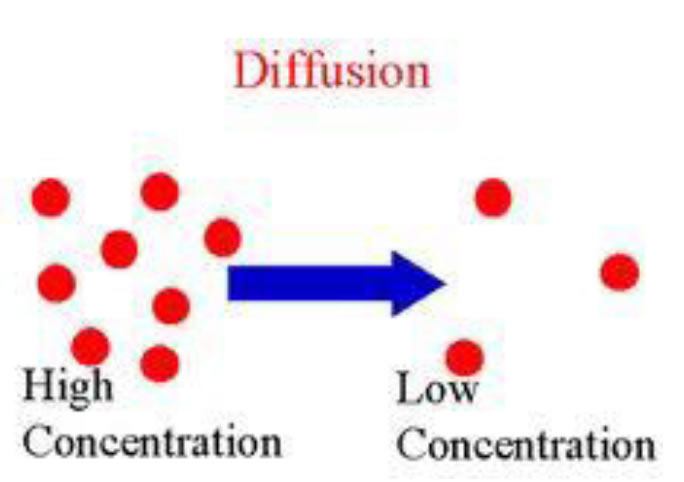


Which type of cellular transport moves from low concentration to high?
Active Transport
Osmosis
Passive Transport
Facilitated Diffusion

What are the products of photosynthesis?
Oxygen + H2O + Energy (ATP)
Oxygen + H2O
CO2 + H2O + Energy (ATP)
Oxygen + Glucose
Grapes contain very few salt molecules. If I put a grape into very salty water over night, what do you think would happen? ( Think about the egg osmosis demonstration)
The grape would shrivel up
The grape would swell up like a balloon
The grape would not change size or shape
The grape would develop a mutation which would start a chain of reaction ultimately resulting in a zombie apocalypse
For example, ions are moves from the side where there are few ions to the side where there are more ions.
Which best describes this process of moving ions against a concentration difference?
When vesicles REMOVE things from inside of the cell, this is called
endocytosis
exocytosis
deconstruction of the organelle
protein pumping

The function of the cell membrane's lipid bilayer
semipermable, allows only certain items in/out
generates ATP
packages items for transport
produces proteins

A virus can be classified by its type of
mitochondria
chromosomes
nucleic acid
carbohydrates

Which viral life cycle kills its host cell by lysing (exploding)?
lytic
mitosis
lysogenic
S phase

Which viral life cycle allows viral genetic material to lay dormant while the host cell reproduces?
lytic
mitosis
lysogenic
S phase
How do vaccines work against viruses?
Vaccines are like antibiotics, except they work against viruses.
Vaccines prepare the immune system to fight the virus without harming the host.
Vaccines make it impossible for a virus to enter a host cell.
Vaccines find viral DNA or RNA and cut it to pieces, making the virus unable to replicate.
This is what controls what goes into and out of the cell (helps maintain homeostasis). It is made of lipids and ALL CELLS have this.
Plasma Membrane
Cell Wall
Lysosomes
Vacuole

This is the organelle that helps move/transport ribosomes and other materials around the inside of the cell.
Endoplasmic Reticulum
Golgi (Body) Apparatus
Lysosomes
Nucleus
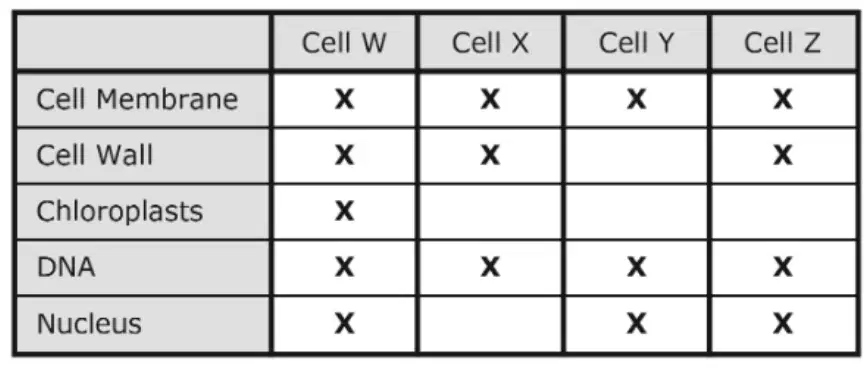
Students use a microscope to look for structures present in four different cells. The students placed an X for each structure that was viewed for each cell on the table shown.
Which cell that was viewed is most likely a prokaryote?
Cell W
Cell X
Cell Y
Cell Z
Severe acute respiratory syndrome (SARS) is an illness caused by a coronavirus. Symptoms including a high fever, headaches, and body aches typically occur two to seven days after infection by the virus. SARS is more serious in elderly patients. This information suggests that the reproductive cycle of the SARS virus is -
lysogenic, because the virus is a coronavisus
lytic, because the virus causes respiratory illness
lysogenic, because the virus primarily affects older people
lytic, because of the quick onset of symptoms after infection

A table comparing the characteristics of four samples is shown.
Which sample most likely contains viruses?
Sample 1
Sample 2
Sample 3
Sample 4

Check all that apply.
What are the differences between Plant and Animal Cells?
Plant cells have Chloroplasts
Plant cells have a cell wall AND a cell membrane
Animal cells have many small vacuoles and plant cells have one large vacuole
What is a virus?
A microscopic infectious agent that can only replicate inside the living cells of an organism.
A type of bacteria that causes infections.
A large organism that can survive in extreme conditions.
A chemical substance that can cure diseases.
Which of the following is a virus?


In 1898 two scientists found evidence that the cause of the highly contagious hoof-and-mouth disease in livestock was a microscopic infectious particle. It was discovered that this particle requires a host cell to reproduce. Which pathogen is most likely responsible for causing hoof-and-mouth disease in livestock?
A bacterium, because it is contagious
A fungus, because it infects livestock
A protist, because it is microscopic
A virus, because it requires a host cell to reproduce

H1N1 flu is a highly contagious viral infection caused by the influenza A (H1N1) virus. The symptoms of H1N1 flu are listed in the box. An antiviral agent administered within 48 hours of the appearance of symptoms can reduce the severity of the illness. Why is it important to administer an antiviral agent to an infected person within 48 hours of the appearance of symptoms?
The H1N1 virus will undergo mitosis.
The H1N1 virus replicates quickly.
The H1N1 virus does not mutate.
The H1N1 virus is transmitted through a vector host, such as a mosquito.


The diagram shows how carrier
molecules allow passive and active
transport. In the diagram of active
transport, the letter X represents
another molecule. This molecule
provides energy for active transport
but is not needed for passive
transport. Which molecule is most
likely represented by X?
ATP energy
Water
DNA
Oxygen

Some students used vinegar to dissolve away the shells of three eggs and used these eggs as models of human red blood cells. The students observed the changes in the eggs when they were placed in different solutions.
Which statement best describes the role of the cell membrane in this model?
The cell membrane is an impermeable barrier that prevents water from entering the cell.
The cell membrane allows solutes to enter the cell, which causes the cell to shrink.
The cell membrane allows water to enter and leave the cell.
The cell membrane removes solutes from the environment.
Which organism go through cellular respiration?
animals
plants
both animals and plants
none
The products of photosynthesis are ?
C6H12O6 and 6O2
6CO2 and 6H2O
Plants are ?
Autotrophs
Heterotrophs
What is a difference between aerobic respiration and anaerobic respiration in yeast?
Anaerobic respiration requires enzymes, aerobic respiration does not.
Anaerobic respiration requires glucose, aerobic respiration does not.
Anaerobic respiration produces ethanol, aerobic respiration does not.
Anaerobic respiration does not produce oxygen, aerobic respiration does.


What is cellular respiration?

The diagram below represents a structure involved in cellular respiration. The release of which substance is represented by the arrows?
glucose
carbon dioxide
oxygen
DNA


Viruses are...
prokaryotic
eukaryotic
non-living
living
Which organelle stores DNA?
ribosome
nucleus
cell membrane
cell wall
Which organelle helps ribosomes and makes lipids?
Golgi body
Ribosome
Endoplasmic reticulum
Vacuole
Where do bacteria store their DNA?
Nucleus
Nucleoid Region
Mitochondria
Chloroplast

What type of transport is shown in the diagram?
Protein pump
Facilitated diffusion
Endocytosis
Exocytosis
Carbon dioxide (CO2) is a waste produced by cells and does not require any energy to remove. Which cell process is involved in removing carbon dioxide (CO2).
Active Transport
Diffusion
Osmosis
Endocytosis

Which type of diffusion is represented?
Facilitated diffusion
Osmosis
Diffusion

Where does photosynthesis takes place?
The flower
The leaf
The stem
The root

What is NOT a function of the root system?
Anchor the plant to the ground
Absorb water and nutrients
Store energy for example in potatoes or carrots
Create food for the plant through photosynthesis

What is the vascular tissue that transports water up the plant?
Xylem
Phloem
Roots
Shoot

What vascular tissue carries organic nutrients "sugar" throughout the plant?
Xylem
Phloem
Cones
Leafs
What is a function of the root system
Anchor the plant
Protect the plant from viruses
Reproduce
Gas Exchange
The Anthers, Stigma and Ovaries are the...
The endocrine system of the plants
The nervous system of the plants
The reproductive system of the plants
The Digestive system of the plants

The part of the plant
that is generally above the ground including stems, leaves, buds and reproductive structures
Stem System
Leaf system
Shoot system
Xylem
The stomata and dermis in the cell as similar to which body systems in the human body?
respiratory and integumentary
respiratory and circulatory
circulatory and integumentary
integumentary and skeletal

Which of the following organelles are found ONLY in plants? Check all that apply.
Nucleus
Cell wall
Mitochondria
Chloroplast
Plants are _________________ which means they make their own food.
Heterotrophs
Chemotrophs
Autotrophs
Liveotrophs
Stamens are:
the female reproductive organ of a flower that produces pollen
the male reproductive organ of a flower that produces nectar
the male reproductive organ of a flower that produces pollen
none of the above
The Pistil is:
the male reproductive organ of a flower that can be fertilized by pollen
the female reproductive organ of a flower that can be fertilized by pollen
the male reproductive organ of a flower that can be fertilized by nectar
none of the above
Budding
a form of sexual reproduction in which a new individual organisms develop from two parents organism
a form of asexual reproduction in which a new individual organisms develop from one parent organism
a form of asexual reproduction in which a new individual organisms develop from two parents organism
A scientist is examining an unknown cell using an electron microscope. Which observed structure would indicate that the cell is MOST LIKELY prokaryotic?
Chloroplast
nucleus
mitochondria
free floating DNA

Beaker 2
Beaker 3
Beaker 1
Beaker 4
Which organ and tissue interact MOST DIRECTLY to absorb and transport water and dissolved minerals inside a plant?
Root and Xylem
Flower and Xylem
Flower and Phloem
Root and Phloem
Which two components are MOST LIKELY found in both viruses and prokaryotic cells?
Nucleic acids and carbohydrates
Carbohydrates and lipids
Lipids and proteins
Proteins and nucleic acids
What things must plants have in order to make food?
Oxygen, sunlight, carbon dioxide
water, sunlight, oxygen
leaves, roots, stems, petals
carbon dioxide, water, sunlight
What food do plants make?
sugar (glucose)
oxygen
seeds
carbon dioxide
What is a producer?
an organism that makes its own food
an organism that only eats meat
an organism that only eats plants
an organism that only eats ramen noodles
Why are humans and other animals unable to produce their own food through photosynthesis?
Because they do not have chloroplasts and cannot use the sun's energy to make food
Because they don't have stems to hold them upright
Because they don't have stomata to take in carbon dioxide

Which characteristic best distinguishes these cells as either prokaryotic or eukaryotic?
The organization of the genetic material
the location of the cytoplasm
the role of the cell membrane
The function of the flagella

Which sample most likely contains viruses?
1
2
3
4

The plant hormone response to touch
Thigmotropism
Geotropism
Phototropism
Transpiration

Which of the following do eukaryotes have that prokaryotes do not have? Check all that applly
Nucleus
Membrane Bound Organelles
Ribosomes
multicellular
DNA
Where can you find DNA (genetic material) inside a prokaryote?
Nucleus
Free Floating
Mitochondria
Endoplasmic Reticulum
Are bacteria multicellular or unicellular?
Multicellular
Unicellular

Plants curling around a pole or mailbox is an example of:
Phototropism
Germination
Turgor pressure
Thigmotropism
A change in an organism’s external environment that causes a response from the organism.
External Stimuli
Internal Stimuli
Energy Transformation
Turgor Pressure
Tonicity deals with the presence of solutes that cannot easily pass the cell membrane. Is water a solute?
yes
no
What is the difference between active and passive transport?
Active is high to low; Passive is low to high
Active uses no cell energy; Passive uses cell energy
Passive is high to low and uses no energy; Active uses energy and is low to high
Passive uses no cell energy
If there is 5 percent water inside a cell and 5 percent water outside a cell,
more water will move into the cell the cell is in a hypotonic situation
There will be no net movement of water into or out of cells - the cell is in an isotonic situation
more water will move out of the cell the cell is in a hypertonic situation

What are the products of Cellular Respiration?
Protein, Lipid, Robert Hooke
ATP, CO2,Water
Water, Sunlight, Oxygen
Oxygen, Glucose,Water

