wayground logo

Free Printable Worksheets

Font size

S
M
L
XL
Worksheets

Final Exam Review Semester 1

Total questions: 199

Worksheet time: 5hrs 28mins

Name
Class
Date
1.

Physical properties....

a)

change the matter when studied

b)

can be observed and measured without changing the matter being studied

c)

include the ability to burn and rust

d)

are useless unless studied in a lab

2.

Melting point is...

a)

The temperature at which a solid can change to a liquid

b)

The temperature at which a solid can change to a gas

c)

The temperature at which a gas can change to a liquid

d)

The temperature at which a liquid can change to a solid

3.

The melting point of water is...

a)

100 degrees Celsius

b)

14 degrees Celsius

c)

32 degrees Celsius

d)

0 degrees Celsius

4.

The boiling point is ...

a)

The temperature at which a liquid changes to a gas

b)

The temperature at which a solid changes to a gas

c)

The temperature at which a gas changes to a solid

d)

The temperature at which a liquid changes to a solid

5.

The boiling point of water is...

a)

32 degrees Celsius

b)

109 degrees Celsius

c)

100 degrees Celsius

d)

-29 degrees Celsius

6.

What word describes the relationship between the mass of a material and its volume?

a)

Volume

b)

Weight

c)

Height

d)

Density

7.

___________ is the ability to conduct electricity.

a)

Reprocity

b)

Conductivity

c)

Density

d)

Sublimation

8.

Color is a _________________.

a)

Chemical property

b)

Physical property

c)

Absence property

9.

____________ is the relative resistance of a material (usually a metal) to denting, scratching, or bending.

a)

Density

b)

Hardness

c)

Conductivity

d)

Color

10.

_____________ are usually magnetic.

a)

Compounds

b)

Nonmetals

c)

Metals

d)

Metalloids

11.

Which of the following does NOT describe metals?

a)

has luster

b)

malleable

c)

dull

d)

ductile

12.

If a substance has luster, it is ________

a)

shiny/reflective

b)

weak

c)

dull

d)

easily pulled into a wire

13.

The ability to be hammered into different shapes is __________.

a)

ductility

b)

malleability

c)

density

d)

volume

14.

If a substance is ductile, it can be _______________.

a)

very heavy for its size

b)

easily breakable

c)

used to insulate wires

d)

rolled into thin wires

15.

Nonmetals are usually brittle, or ____________.

a)

easily breakable

b)

strong

c)

shiny

d)

conductors

16.

Which of the following does NOT describe nonmetals?

a)

Dull

b)

Insulators

c)

Conductors

d)

Brittle

17.

______________________ can only be recognized when substances react or do not react chemically with one another.

a)

Physical properties

b)

Chemical properties

c)

Flammable properties

d)

Colorful properties

18.

Flammability means the ability to _______ and is a _________ property.

a)

melt; chemical

b)

rust; physical

c)

change; physical

d)

burn; chemical

19.

Rusting is when substances react slowly with _________.

a)

Water

b)

Oxygen

c)

Hydrogen

d)

Lithium

20.
A change that alters the physical properties of a substance without changing its composition.
a)
Physical Change
b)
Chemical Change
21.
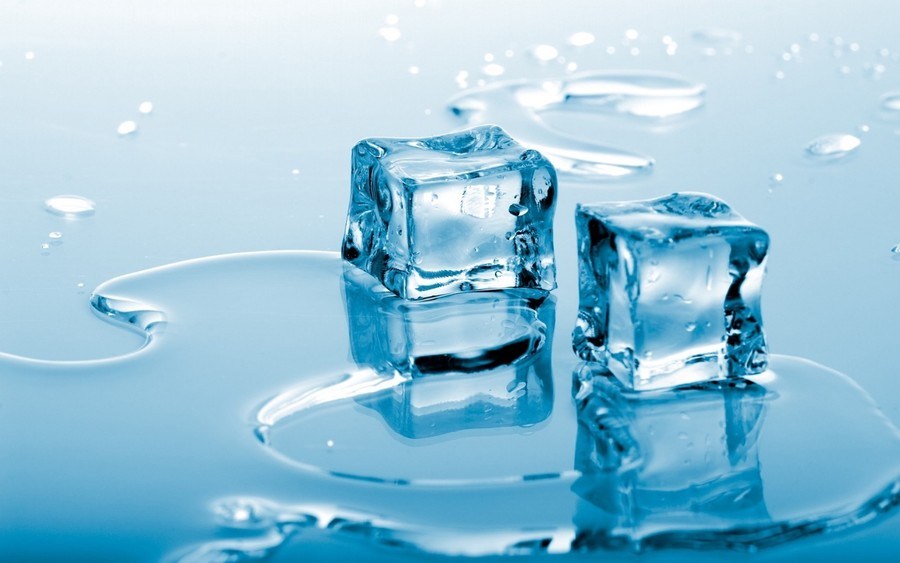
Water freezing into ice is an example of a...
a)
Physical Change
b)
Chemical Change
22.
Any change in the state of matter of a substance is a...
a)
Physical Change
b)
Chemical Change
23.
A change in matter that forms one or more new substances with new chemical properties is a/an...
a)
Physical Change
b)
Chemical Change
24.
Which of the following indicates a PHYSICAL change?
a)
Change in temperature
b)
Change in shape
c)
Formation of a precipitate
d)
Change in color
25.
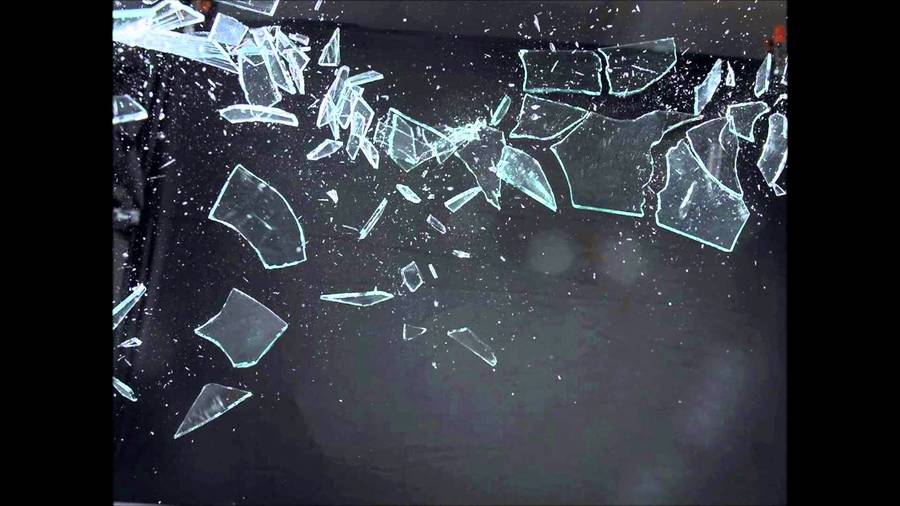
Chemical or Physical?  Glass breaking into tiny shards
a)
Chemical Change
b)
Physical Change
26.
Physical or Chemical Change?  Iron rusts
a)
Physical Change
b)
Chemical Change
27.
Physical or Chemical Change?  Cutting an orange into wedges.
a)
Physical Change
b)
Chemical Change
28.
Physical or Chemical Change?  Sodium metal burning in water.
a)
Physical Change
b)
Chemical Change
29.
melting ice cream
a)
physical change
b)
chemical change
30.
a)
physical change
b)
chemical change
31.
A group of students investigated physical and chemical changes using paper.  The students recorded their observations in a table.
Which student correctly recorded all the changes that took place?
a)
Student 1
b)
Student 2
c)
Student 3
d)
Student 4
32.
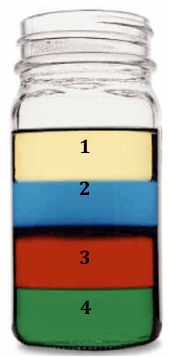
Put the liquids in order from most dense to least dense?
a)
4, 3, 2, 1
b)
1, 2, 3, 4
c)
3, 4, 2, 1, 
d)
4, 3, 1, 2
33.

Why do objects sink or float in H2O?

a)

Because their densities are higher or lower than compared to water

b)

Because their densities are using gravity to pull down

c)

Because their densities are heavier or lighter

d)

Because their mass and volumes are equal

34.
An object with which of the following densities will float on water?
a)
0.7 g/cm3
b)
1.2 g/cm3
c)
3.5 g/cm3
d)
11.4 g/cm3
35.
Calculate the density of the cube. (Hint: calculate the volume of the cube using V= Bh)
a)
0.33 g/cm3
b)
0.4 g/cm3
c)
0.6 g/cm3
d)
0.5 g/cm3
36.
What is the volume of Object X?
a)
10.0 cm3
b)
15.0 cm3
c)
20.0 cm3
d)
25.0 cm3
37.

What is the volume of 150 grams of lead if it has a density of 11.3 g/cm3?

a)

13.3 g

b)

13.3 cm3

c)

.075 g

d)

1695 cm3

38.
Find the volume of this piece of brass.  
a)
50 g
b)
10 cm
c)
6 cm3
d)
12 cm3
39.
Which box has a higher density?  
a)
Box A
b)
Box B
c)
cannot be determined
d)
they are the same
40.
Which box has a higher density?  
a)
Box A
b)
Box B
c)
cannot be determined
d)
they are the same
41.

What is the density of the object depicted in the graph?

a)

0.2 g/cm3

b)

5.0 g

c)

2 g

d)

5.0 g/cm3

42.

Ethanol has a density of 0.789 g/cm 3 .

What is the mass of 225 cm 3 of ethanol?

a)

178g

b)

285g

c)

0.004 g

d)

225.789g

43.
What two types of measurements make up DENSITY
a)
Mass and Volume
b)
Temperature and Mass
c)
Grams and Centimeters
d)
Volume and Weight
44.
Why do the liquids form different layers?
a)
They have different densities.  
b)
They have different masses.  
c)
They have different volumes.  
d)
They are different temperatures.  
45.
What units can be used to express density?
a)
g/mL
b)
grams
c)
millimeters
d)
milliliters
46.

Oil floats on water. The most accurate reason for this is

a)

oil is less dense than water

b)

oil is immiscible (does not dissolve) in water

c)

oil is both less dense and immiscible with water

d)

water is heavier than oil

47.

Subatomic particles with a negative charge

a)

Electrons

b)

Neutrons

c)

Protons

d)

Quarks

48.
subatomic particles found on the outermost shell & responsible for the atom's reactivity
a)
neutrons
b)
valence electrons
c)
isotopes
d)
ions
49.
Subatomic particles with a positive charge
a)
neutrons
b)
atomic mass
c)
protons
d)
isotopes
50.
Measure mainly of the nuclear particles: protons + neutrons
a)
Subatomic Particles
b)
Atomic Number
c)
Atomic Mass
d)
Gluons
51.
Value representing the number of protons in an element
a)
Atomic Mass
b)
Mass Number
c)
Valence Electrons
d)
Atomic Number
52.
Subatomic particles that are neutral in charge
a)
Neutrons
b)
Protons
c)
Nucleus 
d)
Electrons
53.
Atoms of the same element with a different number of neutrons
a)
Ion
b)
Gluons
c)
Isotope
d)
Quarks
54.
A charged atom
a)
Ion
b)
Isotope
c)
Electron Cloud
d)
Quark
55.
The smallest particle of an element that shows all the properties of that element.
a)
Subatomic Particles
b)
Atom
c)
Quarks
d)
Gluons
56.
A tiny but very dense, positively charged portion of the atom that holds most of the atomic mass
a)
Electron Shells
b)
Orbitals
c)
Electron Cloud
d)
Nucleus
57.
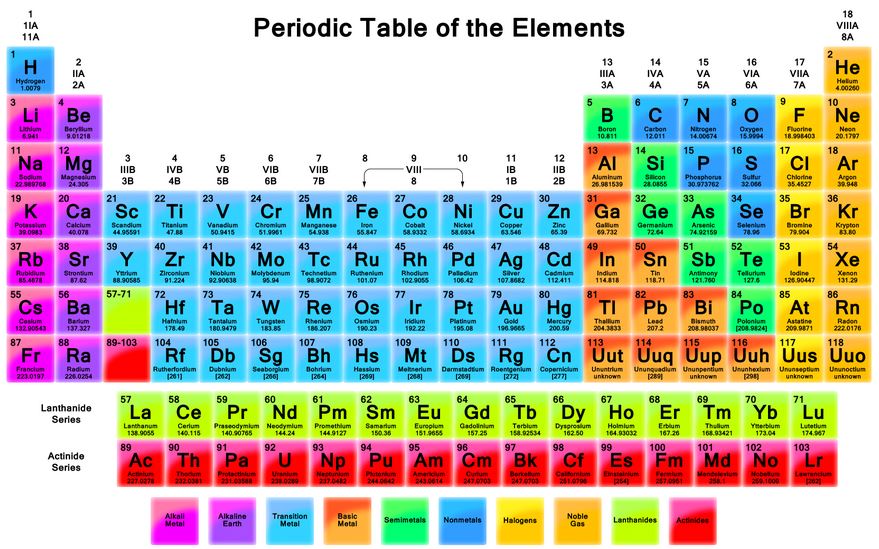
Arrangement of elements organized by atomic number
a)
Electron Cloud 
b)
Periodic Table 
c)
Electron Configuration
d)
None of these
58.
Calculation used to find the number of neutrons in an atom
a)
Atomic Mass - Atomic Number
b)
Atomic Number - Atomic Mass
c)
Atomic Mass - Electrons
d)
none of these
59.
The only element with no neutrons in its nucleus.
a)
Oxygen
b)
Helium 
c)
Hydrogen
d)
Lithium
60.
24.1% of all the isotopes of a an element have a mass of 75.23 amu, 48.7% have a mass of 74.61 amu, and 27.2% have a mass of 75.20 amu.
What is the average mass of this element?
a)
74.92 amu
b)
24.97 amu
c)
75.01 amu
d)
74.51 amu
61.
24.1% of all the isotopes of a an element have a mass of 75.23 amu, 48.7% have a mass of 74.61 amu, and 27.2% have a mass of 75.20 amu.
How many protons does this element have?
a)
32
b)
33
c)
34
d)
no way to know
62.
Calcium has three different isotopes. One has a mass of 35.00 amu; another has a mass of 41.00 amu; and another has a mass of 40.00 amu. Which isotope is the most abundant of the three?
a)
40.00 amu
b)
41.00 amu
c)
35.00 amu
d)
impossible to tell
63.
An element has three different isotopes. One has a mass of 35.00 amu; another has a mass of 36.00  amu; and another has a mass of 38.00  amu. What is the average atomic mass of this element?
a)
36.33 amu
b)
37.00 amu
c)
12.11 amu
d)
impossible to tell
64.
An element with 4.35% have a mass of 49.9461 amu, 83.79% have amass of 51.9405 amu, 9.50% have a mass of 52.9407 amu, and 2.36% have a mass of 53.9389amu.
a)
51.99 amu
b)
52.19 amu
c)
53.45 amu
d)
17.33 amu
65.
4.35% of all X atoms have a mass of 39.946 amu. 83.79% have a mass of 41.941 amu, 9.50% have a mass of 42.941 amu, and 2.36% have a mass of 43.939 amu. What is the average atomic mass of atom X?
a)
41.97 amu
b)
42.19 amu
c)
10.43 amu
d)
40.04 amu
66.
An isotope has three forms.  30% have a mass of 4 amu, 20% have a mass of 5 amu and 50% have a mass of 3 amu.  Average atomic mass will be closest to
a)
2 amu
b)
3 amu
c)
4 amu
d)
5 amu
67.
An element has two naturally occurring isotopes. One is 10.013 amu and is 19.9% abundant. The other is 11.01 amu and is 80.1% abundant. What is the average atomic mass? What element is it?
a)
9.012, Beryllium
b)
12.011, Carbon
c)
6.941, Lithium
d)
10.812, Boron
68.
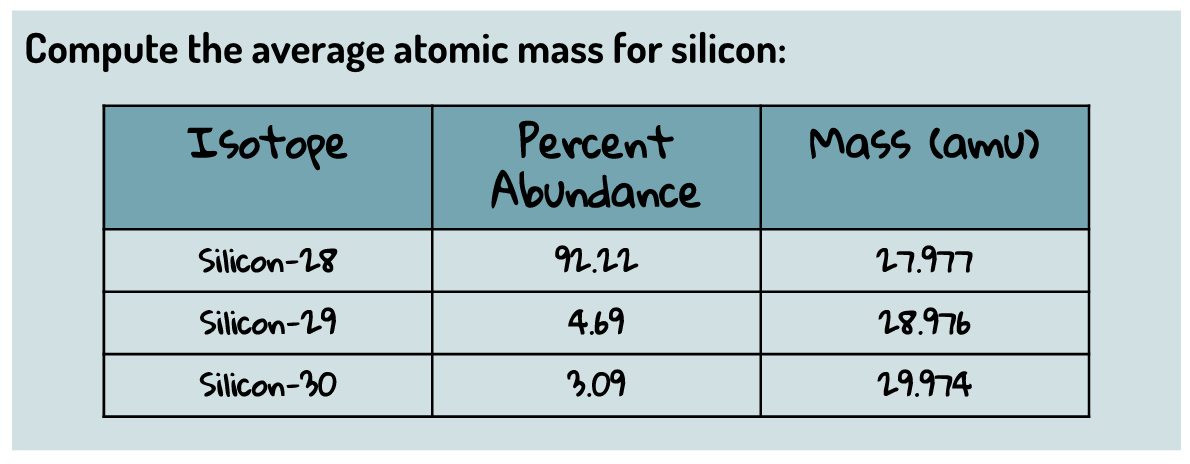
Compute the average atomic mass for silicon:
a)
27.977
b)
28.09
c)
28.976
d)
The average mass cannot be determined from provided information.
69.
If X is the symbol for an element, which of the following two symbols represent    isotopes of the same element?  
I. 7735X  II. 7733X  III. 8137X  IV. 8135 X
a)
I and II
b)
III and IV
c)
I and IV
d)
I and III
70.
What atom matches this electron configuration?
1s22s22p63s23p64s23d10
a)
Zinc
b)
Copper
c)
Nickel
d)
Germanium
71.
What electron configuration matches an oxygen atom?
a)
1s22s22p63s2, 3p64s23d104p5
b)
1s22s22p4
c)
1s22s22p6
d)
1s22s22p63s23p64s23d1
72.
The electron configuration of an atom is 1s22s22p6.  The number of electrons in the atom is 
a)
3
b)
6
c)
8
d)
10
73.
Which electron configuration belongs to Chlorine (Cl)?
a)
1s2s2p3s3p5
b)
1s2s2p3s3p6
c)
1s2s2p3s3p7
74.
Which electron configuration belongs to Chlorine (Cl)?
a)
1s2s2p3s3p5
b)
1s2s2p3s3p6
c)
1s2s2p3s3p7
75.
Identify the Electron Configuration for Aluminum (Al)
a)
1s2s2p3s3p1
b)
1s2s2p3s3p3
c)
1s2s2p3s4p1
76.
What atom matches this electron configuration?
1s2s2p3s2
a)
Neon
b)
Magnesium
c)
Aluminum
d)
Potassium
77.

What is this element?

1s22s22p63s23p64s23d104p6

a)

Argon

b)

Krypton

c)

Selenium

d)

Bromide

78.

How many electrons can the d sublevel(orbital) hold?

a)

8

b)

10

c)

2

d)

4

79.
Which of the following is a p block element?
a)
Ca
b)
Ar
c)
Re
d)
Au
80.
Which electron configuration belongs to Copper (Cu)?
a)
1s2 2s2 2p6 3s2 3p6 4s2 3d8
b)
1s2 2s2 2p6 3s2 3p6 4s2 3d9
c)
1s2 2s2 2p6 3s2 3p6 4s2 3d10
81.
Anions are _______ that form ____________ ions and __________ electrons.
a)
nonmetals, positive, lose
b)
nonmetals, negative, gain
c)
metals, positive, gain
d)
metals, positive, lose
82.
What is the electronic configuration of iron?
a)
1s22s22p63s23p64s23d6
b)
1s22s22p63s23p63d8
c)
1s22p63s23p64s23d6
d)
1s22s22p63s23p64s13d6
83.

What atom matches this electron configuration?

[Xe] 6s1 4f14 5d10

a)

Mercury

b)

Gold

c)

Platinum

d)

Thallium

84.

The orbital/sublevel FARTHEST from the nucleus in Chromium is

a)

4s

b)

3d

c)

3p

d)

1s

85.

Which of the following is the ground-state configuration for the atoms of a transition element?

a)

1s22s22p53s23p54s23d3

b)

1s22s22p63s23p64s23d5

c)

1s22s22p62d103s24s23p5

d)

1s22s22p63s23p5

86.

Which of the following is an impossible electronic configuration?

a)

1s22s22p53s23p5

b)

1s22s22p63s23p6

c)

1s22s22p62d103s23p6

d)

1s22s22p63s23p63d5

87.
Which of the following is the ground-state configuration of a negative ion of a halogen?
a)
1s22s22p53s23p5
b)
1s22s22p63s23p6
c)
1s22s22p62d103s23p6
d)
1s22s22p63s23p63d5
88.
What atom matches this electron configuration?
1s22s22p63s2
a)
Neon
b)
Magnesium
c)
Aluminum
d)
Potassium
89.

Which electron configuration belongs to a Chloride (Cl-) ion?

a)

1s2 2s2 2p6 3s2 3p5

b)

1s2 2s2 2p6 3s2 3p6

c)

1s2 2s2 2p6 3s2 3p7

d)

1s2 2s2 2p6 3p7

90.

Choose the correct shortcut configuration for iodine.

a)

[Ar]4s24d104p5

b)

[Kr]5s24d105p5

c)

[Xe]5s25d105p5

d)

none of the above

91.

Which element ends 4p4?

a)

sulfur

b)

arsenic

c)

selenium

d)

antimony

92.

What causes an atom to ABSORB light?

a)

photons take in energy and jump to a higher energy level

b)

electrons take in energy and jump to a higher energy level

c)

electrons release energy when falling to a lower energy level

d)

photons release energy when falling to a lower energy level

93.

What causes bright lines on an emission spectrum?

a)

electrons jumping to higher energy levels when absorbing light

b)

electrons falling to lower energy levels, releasing light

c)

protons jumping to higher energy levels when absorbing light

d)

protons falling to lower energy levels, releasing light

94.

Which electron is most likely ABSORBING violet light?

a)

A

b)

B

c)

C

d)

D

95.

What best describes what electron C is doing?

a)

absorbing red light

b)

emitting red light

c)

emtting violet light

d)

absorbing violet light

96.
What is a photon?
a)
When radiation burst through electric waves
b)
The emission of electrons from a metal caused by light striking the metal
c)
The rate at which a waves energy flows through a given unit of area.
d)
packets of electromagnetic energy
97.
Emission of light from an atom occurs when an electron
a)
drops from a higher to a lower energy level.
b)
   jumps from a lower to a higher energy level.   
c)
   moves within its atomic orbital.
d)
falls into the nucleus.
98.
For an electron to change from ground state to an excited stated it must...
a)
Absorb energy
b)
Release energy
99.
Which color has the least amount of energy?
a)
red
b)
orange
c)
green
d)
blue
100.
Which drawing represents the process by which an emission line is formed?
a)
A
b)
B
c)
C
d)
D
101.
Emission of light from an atom occurs when an electron
a)
drops from a higher to a lower energy level.
b)
   jumps from a lower to a higher energy level.   
c)
   moves within its atomic orbital.
d)
falls into the nucleus.
102.
Elements on the LEFT side of the periodic table will most likely form:
a)
Positive ions
b)
Negative ions
c)
Neutral Ions
d)
None of these
103.
An ionic bond forms when atoms ___________ electrons.
a)
gain
b)
share
c)
increase
d)
transfer
104.
Which type of bond has an equal sharing of electrons?
a)
Polar Covalent 
b)
Non Polar Covalent
c)
Ionic
d)
Metallic
105.
Which type of bond has an unequal sharing of electrons?
a)
Polar Covalent 
b)
Non Polar Covalent
c)
Ionic
d)
Metallic
106.
Which type of bond has a transfer of an electron from on atom to another?
a)
Polar Covalent 
b)
Non Polar Covalent
c)
Ionic
d)
Metallic
107.
Chemical bonds form when atoms
a)
combined nuclei
b)
give up neutrons
c)
gain protons
d)
share or transfer electrons
108.
Bonds that form between two metals are called ______________ bonds.
a)
ionic 
b)
covalent
c)
metallic
d)
pervasive
109.
If an atom loses two electrons what charge will it have?
a)
+ 2
b)
 - 2
c)
+1
d)
-1
110.
If an atom gains one electron what charge will it have?
a)
-2
b)
-1
c)
+1
111.
Covalent compounds
a)
Share electrons
b)
transfer electrons
c)
contain a sea of electrons
d)
conduct electricity
112.
What is the number of valence electrons for Oxygen?
a)
8
b)
6
c)
2
d)
1
113.
How many valence electrons in this structure?
a)
6
b)
5
c)
4
d)
7
114.
A bond that forms when electrons are transferred is called a/an
a)
ionic bond
b)
covalent bond
c)
hydrogen bond
115.
When electrons are shared unequally a/an ___________ bond is formed 
a)
ionic 
b)
hydrogen
c)
polar covalent 
116.
The chemical bond formed when two atoms share electrons  is called a(an) IONIC bond. 
a)
True
b)
False
117.
How are covalent bonds explained?
a)
When one atom takes the other atom's electron
b)
When the atom shares an electron with an another atom
c)
When the two nucleus merge
d)
When the neutrons leave the nucleus
118.
Atoms joined together by SHARING electrons are?
a)
Ionic bonds
b)
Covalent bonds
c)
Metallic Bonds
d)
James Bonds
119.
Which type of bond creates a "pool" of electrons between atoms?
a)
Ionic Bonds
b)
Covalent Bonds
c)
Metallic Bonds
d)
Saving Bonds
120.
What explains the very high melting and boiling point of water
a)
Strong dipole-dipole bonds between water molecules
b)
Strong hydrogen bonds between water molecules
c)
Dispersion forces which are present in all molecules
d)
Asymmetrical shape of the polar bonds.
121.
Hydrogen bonding occurs when hydrogen is bonded to N, O, or F.  Which of the following has hydrogen bonding?
a)
CBr4
b)
NO2
c)
H2S
d)
NH3
122.
Which is the second strongest intermolecular force, after hydrogen bonding?
a)
dipole-dipole attraction
b)
London forces
123.

Which substance would have the weakest intermolecular forces of attraction?

a)

CH4

b)

NaCl

c)

H2O

d)

MgF2

124.

________________________ have the strongest intermolecular forces of attraction.

a)

Dipole- Dipole

b)

Dispersion

c)

Hydrogen Bonds

125.
What is the basis of a metallic bond?
a)
the attraction of neutral metal atoms.
b)
the attraction between protons and neutrons.
c)
the attraction between positive metal ions and interlocking electrons.
d)
the attraction between positive metal ions and free floating electrons.
126.
Which of the following molecules would have the lowest boiling point?
a)
CH4
b)
C2H6
c)
C3H8
d)
C4H10
127.
Which of the following factors plays an important role in the identification of specific intermolecular forces in a molecule?
a)
bond type
b)
density
c)
solubility
d)
molecular polarity
128.
Propane is a gas at STP, while bromine is a liquid at STP. Which statement correctly explains these observations?
a)
Bromine has weaker intermolecular forces than propane does
b)
Bromine has greater molecular polarity than propane does
c)
Bromine has weaker molecular polarity than propane does
d)
Bromine has stronger intermolecular forces than propane does
129.
Which of the following molecules has hydrogen bonding?
a)
HCl
b)
HI
c)
HF
d)
HBr
130.
Which of the following statements correctly compares the behavior of a mixture of ethanol and water at STP?
a)
Water will evaporate first, because it has weaker intermolecular forces
b)
Ethanol will evaporate first, because it has weaker intermolecular forces
c)
Ethanol and water will evaporate simultaneously
d)
The aqueous solution will evaporate partially at a temperature between the boiling points of water and of ethanol
131.
Which of the following statements correctly explains why hydrogen bonding is such a strong intermolecular force?
a)
There is an attraction between a small, weakly electronegative hydrogen atom and a large, strongly electronegative atom of fluorine, nitrogen, or oxygen
b)
There is an attraction between a small, highly electronegative hydrogen atom and a large, highly electronegative fluorine atom
c)
There is an attraction between the hydrogen and oxygen atoms, only
d)
There is an attraction between the hydrogen and nitrogen atoms, only
132.

Define the term allotropes

a)

Atoms with same proton number but different number of neutrons

b)

Atoms with same proton number but different mass number

c)

Atoms in different arrangement but same structure

d)

Atoms in different arrangement and different structural form

133.
Which of the following will take the longest to evaporate?
a)
CH3CH2OH
b)
CH3OH
c)
CH3CH3
134.

A precipitate is a ___________ that forms when 2 liquids react together.

a)

solid

b)

liquid

c)

gas

d)

plasma

135.

Reactants are the chemicals that are present at the beginning of an experiment. Reactants react together to make the product.

We can know that a chemical reaction is occurring when we see ______.

a)

that the product looks just like the reactants.

b)

nothing new.

c)

that the product looks different from the reactants.

136.

Which of the following is evidence of a chemical reaction?

a)

Tearing paper.

b)

Change in color.

c)

Production of a gas.

d)

Change in temperature.

e)

Production of a precipitate.

137.
Which of the following examples shows that a chemical reaction has occurred? 
a)
A rock breaks into smaller pieces when it is struck with a hammer.
b)
Rust forms on a hammer that has been left outside to long. 
c)
A cup of water turns pink when a few drops of red food coloring are added. 
d)
A solid is formed when heat is removed from a sample of water. 
138.
A student places a piece of a potato into a container of hydrogen peroxide. One observation the student makes is that bubbles form around the potato. The presence of bubbles might indicate the formation of a new substance because bubbles - 
a)
could show that a gas is forming
b)
always rise to the top of a liquid. 
c)
are almost always perfectly spherical.
d)
usually burst after a few minutes.
139.
Four students performed four different investigations by combining different substances. Their results are shown in the table provided. In which experiment are new substances being formed?
a)
Experiment 1
b)
Experiment 2
c)
Experiment 3
d)
Experiment 4
140.
Hydrogen peroxide breaks down to form water and oxygen gas. Which observation is evidence that a chemical reaction has occurred?
a)
The mass of the solution remains the same.
b)
 Phase changes are observed.
c)
 The color of the solution remains clear.
d)
The temperature of the solution increases. 
141.
A clear liquid from a flask is poured into another clear liquid in a beaker. Which of the following results of this procedure would indicate a new substance was formed?
a)
The level of the substance in the beaker is higher after the other liquid is added.
b)
A yellow solid forms and then settles to the bottom of the beaker.
c)
Small white crystals are left behind in the flask that held the first liquid.
142.
Which of the following is an example that includes evidence of a chemical reaction?
a)
A sample of zinc is placed in water and it settles to the bottom
b)
A solid block of ice is heated and it completely melts into a liquid. 
c)
Sugar that is burned gives off an odor and turns brown and then black.
d)
A tomato is placed into a blender and chopped up into smaller pieces.
143.
In a container, a solid consisting of clear crystals is combined with a blue liquid and the following observations are obtained.
 How many of the listed observations indicate a new substance was formed?
a)
1
b)
2
c)
3
d)
4
144.
Evidence of a chemical reactions is anything that shows - 
a)
a new substance has formed
b)
a solid dissolved in a liquid
c)
interaction between 2 gases
d)
a change in the state of matter
145.
In the equation,          2Mg + O2 ---> 2MgO, which are the reactants?
a)
Mg and O
b)
MgO
c)
Mg and MgO
d)
O and MgO
146.
Which of the following equations demonstrates an actual chemical reaction that forms a new substance?
a)
A
b)
B
c)
C
d)
D
147.
Coal contains carbon and other elements. Carbon dioxide forms when coal burns in the presence of oxygen. Which of these is the best evidence that a chemical reaction occurs when coal burns?
a)
The shape of the coal changes
b)
Oxygen is present
c)
A new substance is produced
d)
Coal is made up of more than one element
148.

Which of these is NOT a sign that a chemical change has occurred?

a)

A loss of transparency

b)

An unexpected color change

c)

A temperature change

d)

The formation of a precipitate

149.
A student places a piece of a potato into a container of hydrogen peroxide. One observation the student makes is that bubbles form around the potato. The presence of bubbles might indicate the formation of a new substance because bubbles - 
a)
could show that a gas is forming
b)
always rise to the top of a liquid. 
c)
are almost always perfectly spherical.
d)
usually burst after a few minutes.
150.
Hydrogen peroxide breaks down to form water and oxygen gas. Which observation is evidence that a chemical reaction has occurred?
a)
The mass of the solution remains the same.
b)
 Phase changes are observed.
c)
 The color of the solution remains clear.
d)
The temperature of the solution increases. 
151.
A scientist performed four investigations using eight different liquids. In each investigation, the scientist combined two of the liquids under a fume hood and recorded observations in the table below.In which investigation is it least likely that the liquids reacted chemically?
a)
1
b)
2
c)
3
d)
4
152.

Which compound is formed as a precipitate in this reaction?

a)

Pb(NO3)2

b)

KI

c)

PbI2

d)

KNO3

153.
Which of the following equations demonstrates an actual chemical reaction that forms a new substance?
a)
A
b)
B
c)
C
d)
D
154.

Look at the picture of the equation provided. Which of the following indicate that a chemical reaction may be present?

a)

Precipitate formation

b)

Gas evolution

c)

Color change

d)

Changes in energy to system

155.

Look at the picture of the equation provided. Which of the following indicates that a chemical reaction may be present? (CHECK STATES OF MATTER)

a)

Gas evolution

b)

Water production

c)

Precipitate formation

d)

Changes in energy to system

156.

Look at the picture of the equation provided. Which of the following indicate that a chemical reaction may be present (CHECK ALL THAT APPLY)?

a)

Precipitate formation

b)

Gas evolution

c)

Water production

d)

Changes in energy to system

157.

In the reaction below, what evidence of chemical change do you see?

a)

Precipitate formation

b)

Gas evolution

c)

Color change

d)

Water production

158.

In the reaction provided, what evidence of chemical change do you see?

a)

Gas evolution

b)

Precipitate formation

c)

Color change

d)

Change in energy

159.

Look at the picture of the equations provided. Which of the following indicate that a chemical reaction may be present?

a)

Water production

b)

Color change

c)

Gas evolution

d)

Changes in energy to system

160.
_P4+_O  _P2O3
a)
3 P4+1 O→ 2 P2O3
b)
1 P4+1 O→ 2 P2O3
c)
1 P4+ 3 O→ 2 P2O3
d)
1 P4+ 2 O→ 3 P2O3
161.
_AgNO3 + _Cu _Cu(NO3)2 + _Ag
a)
2 AgNO3 + 2 Cu → 3 Cu(NO3)2 + 1 Ag
b)
2 AgNO3 + 1 Cu → 1 Cu(NO3)2 + 2 Ag
c)
1 AgNO3 + 2 Cu → 2 Cu(NO3)2 + 1 Ag
d)
3 AgNO3 + 2 Cu → 3 Cu(NO3)2 + 2 Ag
162.
_BaS + _PtF2  _BaF2 + _PtS
a)
1 BaS + 1 PtF2 → 1 BaF2 + 1 PtS
b)
4 BaS + 2 PtF2 → 1 BaF2 +  1 PtS
c)
1 BaS + 2 PtF2→ 2 BaF2 +  2 PtS
d)
1 BaS + 3 PtF2 →1 BaF2 +  2 PtS
163.
_AlBr3 + _K2SO _KBr + _Al2(SO4)3
a)
6 AlBr3 + 1 K2SO4 → 6 KBr + 1 Al2(SO4)3
b)
2 AlBr3 + 3 K2SO→ 6 KBr + 1 Al2(SO4)3
c)
1 AlBr3 + 1 K2SO→ 2 KBr + 3 Al2(SO4)3
d)
2 AlBr3 + 3 K2SO→ 1 KBr + 2 Al2(SO4)3
164.
_SO2 + _Li2Se _SSe2 + _Li2O
a)
1 SO2 + 2 Li2Se → 1 SSe2 + 2 Li2O
b)
1 SO2 + 1 Li2Se → 2 SSe2 + 2 Li2O
c)
2 SO2 + 2 Li2Se → 2 SSe2 +  2 Li2O
d)
2 SO2 + 2 Li2Se → 1 SSe2 + 1 Li2O
165.
_Al + _HCl →_H2 + _AlCl3
a)
2 Al + 2 HCl → 2 H2 + 6 AlCl3
b)
3 Al + 3 HCl → 6 H2 + 2 AlCl3
c)
1 Al + 1 HCl → 3 H2 + 1 AlCl3
d)
2 Al + 6 HCl → 3 H2 + 2 AlCl3
166.
_K + _Cl2 _KCl
a)
2 K + 16 Cl2 → 8 KCl
b)
2 K + 1 Cl2 → 2 KCl
c)
3 K + 4 Cl2 → 3 KCl
d)
1 K + 1 Cl2 →1 KCl
167.
_NaF + _Br2 _NaBr + _F2
a)
1NaF + 2 Br2 →1 NaBr + 2 F2
b)
2NaF + 2 Br2 → 2 NaBr + 2 F2
c)
2 NaF + 3 Br2 → 1 NaBr + 2 F2
d)
2 NaF + 1 Br2 → 2 NaBr + 1 F2
168.
Balance this equation,            Al2O3 ---> Al + O2 
a)
Cannot be balanced
b)
2Al2O3 ---> 2Al + 3O2 
c)
2Al2O3 ---> 4Al + 3O2 
d)
3Al2O3 ---> 2Al + O2 
169.
Balance this equation:  H2 + N2 → NH3
a)
 H2 + 4N2 → NH3
b)
 H2 + 3N2 → 2NH3
c)
 3H2 + N2 → 2NH3
d)
 2H2 + 2N2 → 2NH3
170.
In every balanced chemical equation, each side of the equation has the same number of ____.  
a)
coefficients
b)
moles
c)
molecules
d)
atoms of each element
171.
Balance this equation:
MgCl2 --> Mg4+ Cl2
a)
It's already balanced.
b)
4MgCl2 --> Mg4+ 4Cl2
c)
4MgCl2 --> Mg4+ 5Cl2
172.

A student mixes 125 grams of sugar, 250 grams of water and 5 grams of flavoring. The solution weighs...

a)

250 grams

b)

380 grams

c)

375 grams

d)

400 grams

173.
If reaction starts with 20g of reactants it should produce 
a)
a total of 40g of products
b)
a total of 10g of products
c)
a total of 80 g of products
d)
a total of 20g of products
174.
What will weigh more when a chemical change is complete?  The reactants before the chemical reaction, or the product after the reaction is complete?
a)
They both will weigh the same
b)
The product always weighs more than the reactant
c)
The reactant will weigh more than the product
d)
They both will loose mass after the reaction
175.
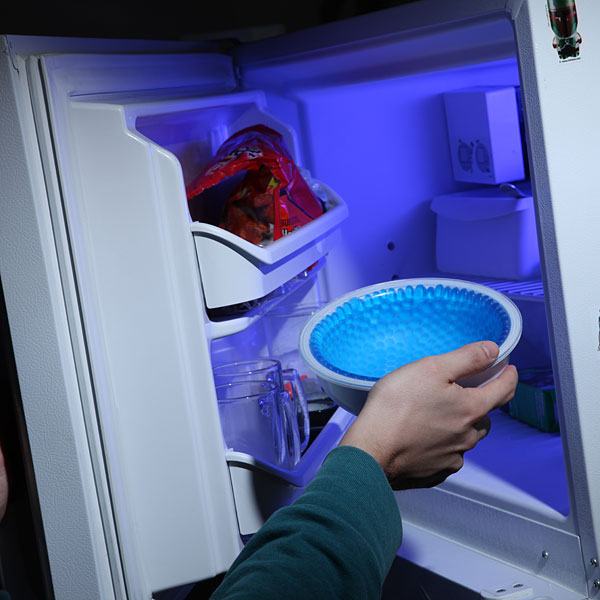
Maria fills a bowl with 200 g of water. She puts the bowl of water in the freezer, and the water freezes. Which will most likely be the mass of the frozen water?
a)
50 g
b)
100 g
c)
200 g
d)
400 g
176.
The number in front of a compound or element is a 
a)
Subscript
b)
Coefficient
c)
Superscript
d)
Charge
177.
In a reaction A + B ----> C,  reactant A has 5g and product  C has 9g. How many grams does reactant B should have? 
a)
4g
b)
5g
c)
9g
d)
14g
178.

Fill in the blank. (Copper has a charge of +2)

Cu+ AgNO3--> Ag + _____

a)

Cu(NO3)2

b)

CuNO3

c)

CuAg

d)

Cu

179.

Predict the products for this equation.

(Zn with a charge of +2)

Zn + H2SO4 -->

a)

Zn(SO4)2 + H

b)

ZnSO4 + H2

c)

ZnSO4 + H4

180.

Complete the balanced equation for this Double Replacement reaction.

3 NaOH + Fe(NO3)3 -->

a)

NaFe + OH(NO3)3

b)

2NaNO3

c)

3 NaNO3 + Fe(OH)3

181.

Predict the products for the this Single Replacement reaction:

K + HCl -->

a)

KCl + H2

b)

KHCl

c)

KH + Cl2

182.

Predict the products for the this Single Replacement reaction:

Mg + CuCl2 -->

a)

MgCl2 + Cu

b)

Mg + Cu

c)

MgCu + Cl2

183.

If an element is diatomic it should have a subscript of___

a)

1, always

b)

2, only when it is by itself

c)

it shouldn't have a subscript, it should have a coefficent

184.

What is the charge of Iron in this compound. (Hint: think swap drop method):

Fe3(PO4)2

a)

3+

b)

2+

c)

1+

d)

6+

185.

Predict the products for the this Double Replacement reaction:

AgNO3 + KCl →

a)

AgCl + KNO3

b)

AgK + ClNO3

c)

KAg + NO3Cl

d)

AgCl + 3 KNO

186.

Complete the balanced equation for this Double Replacement reaction.

3 NaOH + Fe(NO3)3

a)

NaFe + OH(NO3)3

b)

NaNO3 + Fe(OH)3

c)

3 NaNO3 + Fe(OH)3

d)

3 NaFe + 3 (OH)NO3

187.

Predict the products of this single replacement reaction: Na + H2O →

a)

NaO + H2

b)

NaOH + H2

c)

NaH + O2

d)

ONaH

188.

Predict the product(s) of this reaction (Don't worry about balancing)

Pb(NO3)2 + KI →

a)

PbK(s) + INO3(aq)

b)

No Reaction

c)

PbI2(s) + KNO3(aq)

d)

PbI2(aq) + KNO3(s)

189.

Predict the product(s) of this reaction (Don't worry about balancing)

Pb(NO3)2 + KI →

a)

PbK(s) + INO3(aq)

b)

No Reaction

c)

PbI2(s) + KNO3(aq)

d)

PbI2(aq) + KNO3(s)

190.
What will be the result of :  Zn + AuCl2->
a)
ZnCl2 +Au
b)
ZnAu + Cl2
c)
no reaction
d)
ClAu + Zn
191.

Predict the products of the following reaction.


H2SO4 + BaCl2 =>

a)

BaSO4(s) + HCl(aq)

b)

BaSO4(aq) + HCl(s)

c)

No Reaction

d)

ClSO4(aq) + BaH(s)

192.

Predict the products:

NaOH + Fe(NO3)3

a)

NaFe(s) + OH(NO3)3(aq)

b)

NaNO3(s) + Fe(OH)3(s)

c)

No reaction

d)

NaNO3(aq) + Fe(OH)3(s)

193.
What  will be the result of the following: 
Li + NaF ->
a)
Li will replace F
b)
Na will replace Li
c)
Li will replace Na
d)
no reaction will occur
194.
What will be the result of :  Zn + AuCl2->
a)
ZnCl2 +Au
b)
ZnAu + Cl2
c)
no reaction
d)
ClAu + Zn
195.

Predict the products of the following reaction and balance.

NiF2 (aq) + Al (m) →

a)

NiF2 (aq) + Al (m) → AlF2 (aq) + Ni (m)

b)

3 NiF2 (aq) + 2 Al (m) → 2 AlF3 (aq) + 3 Ni (m)

c)

2 NiF2 (aq) + Al (m) → 2AlF (aq) + 2 Ni (m)

d)

no reaction

196.
Predict the products:
RbOH + H3PO4
a)
Rb3PO4 + H2O
b)
Rb(PO4)3 + H2O
c)
H3Rb + PO4OH
d)
RbPO4 + H2O
197.
Predict the products:
CaCl2 + Na2CO3  
a)
Na2Cl2 + CaCO3
b)
NaCl + CaCO3
c)
NaCl + CaCO
d)
NaCl2 + CaCO3
198.
Predict the products:
Pb(OH)2 + H2CO3 →
a)
PbCO3 + H2O
b)
Pb(CO3)+ H2O
c)
PbCO3 + H2O2
d)
Pb(OH)2 + H2CO3 
199.
Preict the products:
HC2H3O2 + NaOH →
a)
H2O  +  NaC2H3O2 
b)
NaHC2H3O2 + H2O
c)
H2O  + NaOH
d)
HC2H3O2 + NaOH