
 Worksheets
U3 Q1 (s,v,a)
Total questions: 32
Worksheet time: 8hrs 0mins
An object that appears to stay in place (like a building or a tree) and that helps you detect motion in another object
acceleration
average speed
motion
reference point
If a drone goes 30m/s for 30 seconds, how far did the drone travel?
90 m
90 m/s
900 m
900 m/s
Chase drove for 4 hours and went 240 miles. What was Chase's speed?
100 mph
75 mph
60 mph
45 mph

Describe the object's motion from A to B:
Speeding Up
Constant Speed coming back
Constant Speed going away
Not Moving
Describe the object's motion from B to C:
Speeding Up
Slowing Down
Constant Speed
Not Moving
Describe the object's motion from C to D:
Speeding Up
Slowing Down
Constant Speed
Not Moving
Describe the object's motion from E to F:
Speeding Up
Constant Speed Coming Back
Constant Speed Going Away
Not Moving

A student walks 2.0 km in a time of 30 minutes. The student then stop for 15 minutes to eat a snack then travels 1.0 km in 15 minutes.
Which graph shows the journey described?
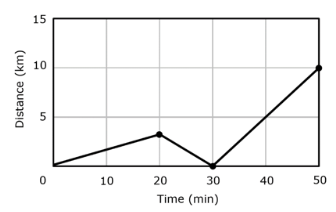
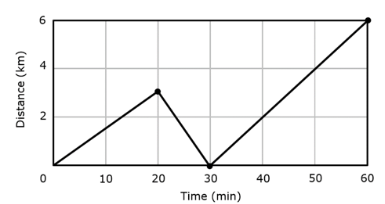
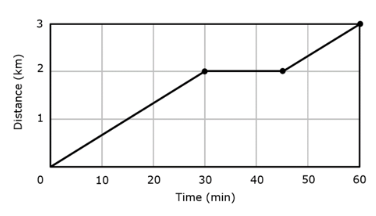
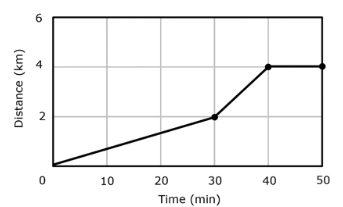


Which description matches the graph?
Green object is moving at a faster constant speed than Red
Green object is accelerating while the red object is moving at a constant speed
Green object is moving at a slower constant speed than Red
Red object is moving 2 times faster than Green

Which graph represents zero acceleration (constant velocity)?
A
B
C
D
When a car goes around a corner at 20 mph, why do we say it accelerates?
The car is accelerating because of the velocity is constant
The car accelerates because it's going 20 mph
Cars always accelerate when they are in motion
The car is accelerating because it's changing direction
Tom ran from his home to the bus stop and waited. He realized that he had missed the bus so he walked home. Which graph matches this situation?


60 s

Students slid a small wood block along a flat tabletop for a distance of 1.6m. The data show the motion of the block of wood.
Which graph displays the motion of the wood block?


The three vehicles shown below are all traveling at a speed of 15 m/s, but only the pickup truck has a changing velocity. The pickup truck has a changing velocity because the pickup truck...
can accelerate faster than the other two vehicles
is traveling in the opposite direction from the other two vehicles
is traveling on a curve in the road
needs a large amount of force to move
What is the difference between the velocity and the speed of an object?
velocity is the change in distance over time, while speed is the change in velocity over time.
velocity has a direction associated with it, while speed has no specific direction.
velocity has no direction associated with it, while speed has a specific direction.
velocity is the change in speed over time, while speed is the change in distance over time.
A car travels at a constant speed of 15 m/s for 2 minutes. The car increases its speed from 15 to 25 m/s during the next minute and then travels at a constant speed of 25 m/s for 2 more minutes. Which of the following graphs best represents the car's motion during this 5-minute period?


A hobbyist collected data about the motion of a toy train on a straight track and then recorded the data in the graph. Which of these accurately describes the motion of the toy train?
The toy train speeds up while going forward and then slows down.
The toy train slows down while going forward and then moves backward.
The toy train moves forward at a constant speed, slows down, and then stops.
The toy train moves forward at an increasing speed, stops, and then moves forward.
Match the following
Speed
m/s
Velocity
m/s east
Acceleration
m/s2 east

Which of the following statements regarding the car's motion is true?
The speed of the car changed, but not the velocity
The speed and velocity of the car changed.
The velocity of the car changed, but not the speed.
The velocity and the speed of the car stayed the same.
A student walks 2.0 km in a time of 30 minutes. The student then stop for 15 minutes to eat a snack then travels 1.0 km in 15 minutes.
Which graph shows the journey described?

This motion graph represents:
A cat walking away from home, pausing to read a text, and then walking further away.
A cat walking home, pausing to eat a garden gnome, and then walking further away.
A cat running up a flight of stairs.
A hundred cats singing, "Rainbow in the Dark" by Ronnie James Dio. Yeah, that's cool!

This motion graph represents:
an octopus hiding before swimming home.
an octopus pausing before pausing some more.
an octopus resting before swimming out to sea, far, far from home.
an octopus waving all of its tentacles in a mad, happy flurry of holiday cheer!

What does this motion graph represent?
I went home and then slept.
I walked home and then drove my car to the store.
I left home and ran to the store.
The store came to me!

What does this motion graph represent?
Emily walked home and Zara did too!
Emily walked away from home and Zara walked to home.
Emily and Zara went to the library to study for the science test that is scheduled.
Seriously, you should study for the unit 3 test.

What does this motion graph represent?
I walked home, played Brawl stars for a while, then ran away as fast as I could.
I walked home, played Brawl stars for a while, then I decided to buy a new game- one that wasn't you know, lame!
I walked home, played Brawl stars for a while, then cried for all the time and money I've wasted on such a terrible game...
I walked home, played Brawl stars for a while, then studied for my science test.

