
 Worksheets
10. The Nervous System
Total questions: 46
Worksheet time: 35mins
The nervous system has two parts:
The (a) nervous system (brain, brain stem, spinal cord)
The nervous system has two parts:
The (a) nervous system (all other nerves, connecting to muscles, skin etc)
The 4 key roles of the central nervous system:
Control of the body's ______ ______ to maintain 'homeostasis'
(a)
The 4 key roles of the central nervous system:
Example of control of the body's internal environment to maintain 'homeostasis'
The regulation of body temperature
The stretch reflex which protects us from injury
Sending messages to the muscle to move
Repetition to learn key functions including movement
The 4 key roles of the central nervous system:
Programming of _______ _______ _______
(a)
The 4 key roles of the central nervous system:
Example of programming of spinal cord reflexes
The regulation of body temperature
The stretch reflex which protects us from injury
Sending messages to the muscles to move
Repetition to learn key functions including movement
The 4 key roles of the central nervous system:
Voluntary _______ ______ ______
(a)
The 4 key roles of the central nervous system:
Example of voluntary control of movement
Sending messages to the muscles to move
The stretch reflex which protects us from injury
Repetition to learn key functions including movement
The regulation of body temperature
The 4 key roles of the central nervous system:
________ _______ ________
(a)
The 4 key roles of the central nervous system:
Example of memory and learning
The stretch reflex which protects us from injury
Regulation of body temperature
Repetition to learn key functions including movement
Sending messages to the muscles to move
The 3 roles of the peripheral nervous system:
________ ________ via the senses (somatic)
(a)
The 3 roles of the peripheral nervous system:
Example of collect information via the senses (somatic)
The brain runs critical processes that don't depend on your thinking about them
The PNS is how your brain gets information about the outside world
The peripheral nerves deliver command signals to muscles in your body that you can consciously control
The 3 roles of the peripheral nervous system:
Deliver ______ ______ ______ (somatic)
(a)
The 3 roles of the peripheral nervous system:
Example of deliver movement command signals (somatic)
The PNS is how your brain gets information from the outside world
The brain runs critical processes that don't depend on your thinking about them
The peripheral nerves deliver command signals to muscles in your body that you can consciously control
The 3 roles of the peripheral nervous system:
Perform ______ ______ (automonic)
(a)
The 3 roles of the peripheral nervous system:
Example of perform unconscious processes (autonomic)
The brain runs critical processes that don't depend on your thinking about them
The peripheral nerves deliver command signals to muscles in your body that you can consciously control
The PNS is how your brain gets information about the outside world
The 3 key roles of the nervous system in relation to movement:
Sensory information afferent feedback
(a)
The 3 key roles of the nervous system in relation to movement:
Integrating of input, information or input processing
(a)
The 3 key roles of the nervous system in relation to movement:
Neural drive, motor drive, activate muscles
(a)
The Autonomous Nervous System (ANS) has two key states; which one is referred to as the 'fight or flight' state?
The Sympathetic state
The Parasympathetic state
The Autonomous Nervous System (ANS) has two key states; which one is referred to as the 'rest and digest' state?
The Sympathetic state
The Parasympathetic state
Exercise affects the ANS in that it stimulates the sympathetic nervous system (fight or flight) and will induce an integrated response from the body;
This response works to maintain an appropriate level of (a) for the increased demand in physical, metabolic, respiratory and cardiovascular efforts.
Nerve cells are called (a) and are responsible for sending electrical messages throughout the body
Nerve cells and exercise:
They are responsible for sending electrical messages throughout the body
Increases in muscle strength occur with strength training, but much of the initial improvements occur because of alterations in the functions of the nervous system rather than any significant change in muscle size and cross-sectional area.
Strength training improves the effectiveness of neural recruitment and excitability.
Nerves are bundles of _____. Nerves transmit ______ ______. These are known as nerve _______ or _______ _______.
neurons, electrical waves, endings, action potentials
axons, electrical signals, impulses, action potentials
axons, electrical waves, impulses, nerve receivers
neurons, electrical signals, endings, nerve receivers
Nerve impulses are ______ signals. Nerve impulses enable ______ between nerve cells. These signals facilitate the transmission of _______ ______ and ______ ______.
chemical, connection, axon synapses, sensory perception
electrochemical, connection, neuron bodies, motor control
chemical, communication, axon synapses, neuron bodies
electrochemical, communication, sensory perception, motor control
Key sensory nerves:
The ______ ______ is a sensory nerve. Functionally, ______ ______ are stretch detectors, i.e. they sense how much and how fast a muscle is lengthened and shortened. They act to protect the muscle from over-stretching and injury.
(a)
Key sensory nerves:
The _______ _______ _______ is a sensory nerve. The ______ ______ ______ is the sense organ that tells how much tension the muscle is exerting. If there is too much muscle tension the ______ _______ _______ will inhibit the muscle from creating any force.
(a)
(a) are automatic, involuntary reactions to an internal or external stimulus on the body.
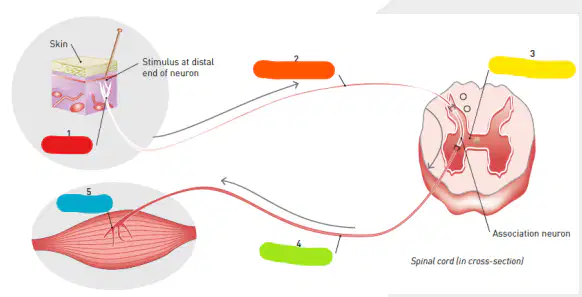
What is stage 1 of the reflex arc (red)?
Receptor
Sensory neuron
Integration centre
Motor neuron
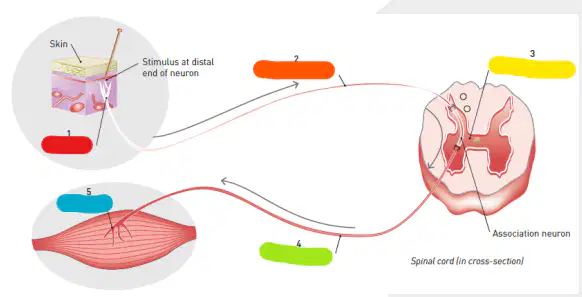
What is stage 2 of the reflex arc (orange)?
Integration centre
Association neuron
Sensory neuron
Effector
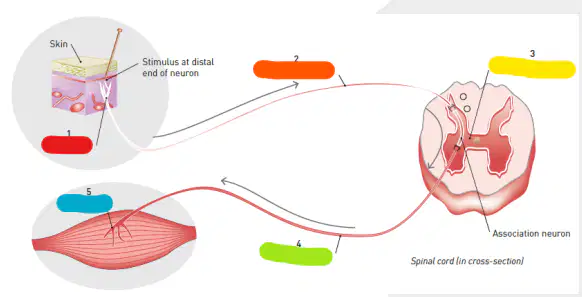
What is stage 3 of the reflex arc (yellow)?
Motor neuron
Sensory neuron
Receptor
Integration centre
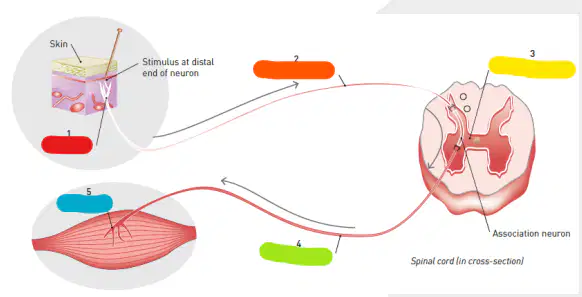
What is stage 4 of the reflex arc (green)?
Sensory neuron
Motor neuron
Integration centre
Effector
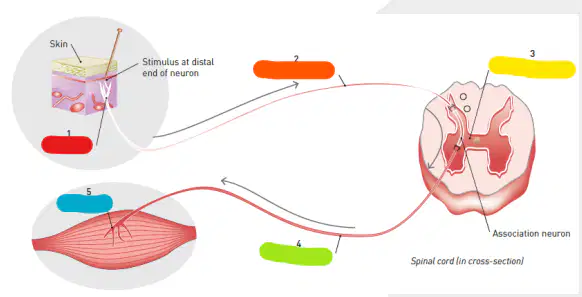
What is stage 5 of the reflex arc (blue)?
Receptor
Integration centre
Motor neuron
Effector
Types of reflexes:
When a muscle is stretched, the muscle spindle immediately reacts and triggers the muscle to contract and resist the stretch - this helps to prevent injury
(a)
Which of the following are true for progressions?
They should be logical, aiming for small steps rather than giant leaps
Each progression should be given adequate time (weeks or months) to achieve mastery before progressing
Progressions in balance often require a reduction in resistance
Progressions are always offered to clients who are not ready for them
Progressions will generally:
make a movement more complex
gradually challenge coordination
require increased strength due to balance and coordination requirements, even with a reduced resistance / weight
require greater core / postural muscle strength, and also develop these muscles further
Additional strategies for progressing with clients:
integrate specific balance drills such as single leg standing, wobble board etc
use some simple hand-eye coordination activities such as catch, throw etc
use different stances and movement drills i.e. walking lunges, agility ladder etc
use tools such as a Swiss ball or BOSU to challenge stability and demand greater balance
Short term effects (acute response) of exercise on the nervous system in resistance exercise: Pt. 1 of 2
Increased neural drive
Enhanced motor unit recruitment
Increased neural plasticity
Improved motor unit synchronization
Short term effects (acute response) of exercise on the nervous system in resistance exercise: Pt. 2 of 2
Increased muscle activation
Increased neural efficiency
Increased muscle fibres firing rate
Increased coordination
Long term effects (chronic adaption) of exercise on the nervous system in resistance exercise: Pt. 1 of 2
Increased neural plasticity
Increased inter-muscle coordination
Increased coordination
Increased neural efficiency
Long term effects (chronic adaption) of exercise on the nervous system in resistance exercise: Pt. 2 of 2
Increased 'muscle memory'
Increased muscle activation
Improvement in proprioception
Increased CNS adaptations
Short term effects (acute response) of exercise on the nervous system in aerobic / cardiovascular exercise: Pt. 1 of 2
Increased blood flow to the brain
Increased release of neurotropic factors
Enhanced cognitive function
Enhanced cerebral blood flow
Short term effects (acute response) of exercise on the nervous system in aerobic / cardiovascular exercise: Pt. 2 of 2
Enhanced mental health / mood
Enhanced cognitive function
Increased neurotransmitter release
Temporary reduction in pain perception
Long term effects (chronic adaption) of exercise on the nervous system in aerobic / cardiovascular exercise: Pt.1 of 2
Increased blood flow to the brain
Enhanced cerebral blood flow
Increased neural plasticity
Improvements in neural efficiency
Long term effects (chronic adaption) of exercise on the nervous system in aerobic / cardiovascular exercise: Pt.2 of 2
Enhanced cognitive function
Enhanced mood and stress reduction
Improved sleep quality
Enhanced mental health / mood

