
Font size
 Worksheets
GP61 MIDTERMS REVIEWER
Total questions: 50
Worksheet time: 30mins
It is a physical quantity that has a magnitude and direction.
scalar
velocity
distance
vector
Which of the following is NOT an example of vector quantity?
30 m/s, North
4 N, upward
4 meters at 350 N
35 minutes
What is the resultant vector of displacement 100 m, east and 25 m, west?
75 m, west
75 m, east
125 m, west
125 m, east

Determine what physical quantity is this.
scalar
vector

Determine what physical quantity is this.
scalar
vector
A ball which has a mass of 2 kilograms.
SCALAR QUANTITY
VECTOR QUANTITY
A paper plane travelling at 30 m/sec, East
A scalar has a magnitude _____.
Wind blowing at 20 mph.
direction
Which of these are vector quantities?
The students are arguing over the differences between speed and velocity. One student says, “Speed is a vector because it describes how fast an object traveling. Velocity is a scalar because it tells how fast and what direction an object is traveling.” Which of the following statements is correct?
The students' understanding of all four terms (speed, velocity, scalar, and vector) is correct.
The students' understanding of all four terms (speed, velocity, scalar, and vector) is incorrect.
The students' understanding of speed and velocity is incorrect but their
understanding of scalar and vector is correct.
The students’ understanding of speed and velocity is correct but their understanding of scalar and vector is incorrect.
it is a quantity that can only by described by its magnitude
scalar
vector
acceleration
velocity
This is also known as the tail-to-tail method of vector addition
the parallelogram method
the polygon method
the analytical method
the component method
This is also known as the head-to-tail method of vector addition
the parallelogram method
the polygon method
the analytical method
the component method
The process of combining or adding two or more vectors to get the resultant vector.
Vector addition
Resultant
Pythagorean theorem
Trigonometric functions
The single vector or the sum of two or more vectors
Pythagorean Theorem
Resultant
Polygon Method
Parallelogram Method
When adding two vectors graphically, a+b=c. Does b+a produce the same resultant vector c?
Yes, two vectors added together always produce the same resultant vector
No, because order matters
Yes, but c will be pointing in the opposite direction
No, because you can't add two vectors
In the __________ law of addition, the sum or resultant would still be the same regardless of how the individual vectors are grouped.
Associative
Commutative
Distributive
Imperative
When using the head-to-tail method to draw a vector addition diagram, the resultant is drawn from the ________ .
head of the first vector to the tail of the last vector
tail of the first vector to the head of the last vector
head of the last vector to the tail of the first vector
tail of the last vector to the head of the last vector
A resultant vector is
equal to the sum of one vector.
equal to the sum of two or more vectors.
equal to the difference of one vector.

What is the resultant of these two vectors?
+17 m
+3 m
-17 m
-3 m

If two vectors to be added are at right angles, in getting the resultant, you will need to....
Multiply
Divide
use Pythagorean Theorem
Use cosine function

51
Jeremy hikes to a campsite where he will spend the evening. He hikes 6.0 km, north and 3.0 km, west. The magnitude of his displacement is ___km
3.0
4.5
6.7
45

Which of the following describes the vector above?
45 cm
45 cm at 30 degrees North of East
45 cm at 30 degrees East of North
45 cm North East

Describe the direction of the vector above.
30 degrees
30 degrees North East
30 degrees North of East
30 degrees East of North

If vector A has an y component of 12 units and a x component of 7 units, which would allow you to solve for the MAGNITUDE of vector A?
122−72
122+72
tan−1(712)
tan−1(127)
If vector A has an y component of 12 units and a x component of 7 units, which would allow you to solve for the ANGLE of the DIRECTION of vector A?
tan(712)
122+72
tan−1(712)
tan−1(127)

What is the resultant of the two vectors shown above?
+5
-5
+15
-15

What vector gives the sum of these two vectors?


Which of the following statements is true in determining the resultant of two or more vectors acting together in the same direction?
Add the given vectors and take the common direction.
Subtract the given vectors and take the common direction.
Get the product of the given vectors and take the two directions.
Add the given vectors and take the two directions.
This formula is used in obtaining the magnitude of the resultant in the component method.
Pythagorean Theorem
polygon method
arc tangent
SOH CAH TOA
A car moving east at 45 km/h turns and travels south at 30 km/h. What is the magnitude and direction of the resultant velocity?
54.1 km/h at 33.7 degrees south of east
75 km/h east
54.1 km/h at 56.3 degrees south of eat
75 km/h south
15 km/h at 47 degrees east of south
What are the components of a vector of a magnitude of 1.5 m at an angle of 35 degrees north of east.
x: 0.9 m; y: 1.2 m
x: 0.4 m; y: 0.5 m
x: 0.8 m; y: 0.6 m
x: 0.5 m; y: 0.4 m
x: 1.2 m; y: 0.9 m
Find the horizontal and vertical components of a force with a magnitude of 17 N at an angle of 67 degrees west of north
x: -6.6 N; y: 15.6 N
x: -15.6 N; y: 6.6 N
x: 15.6 N; y: -6.6 N
x: 0.02 N; 0.5 N
x: 0.9 N; y: 0.4 N

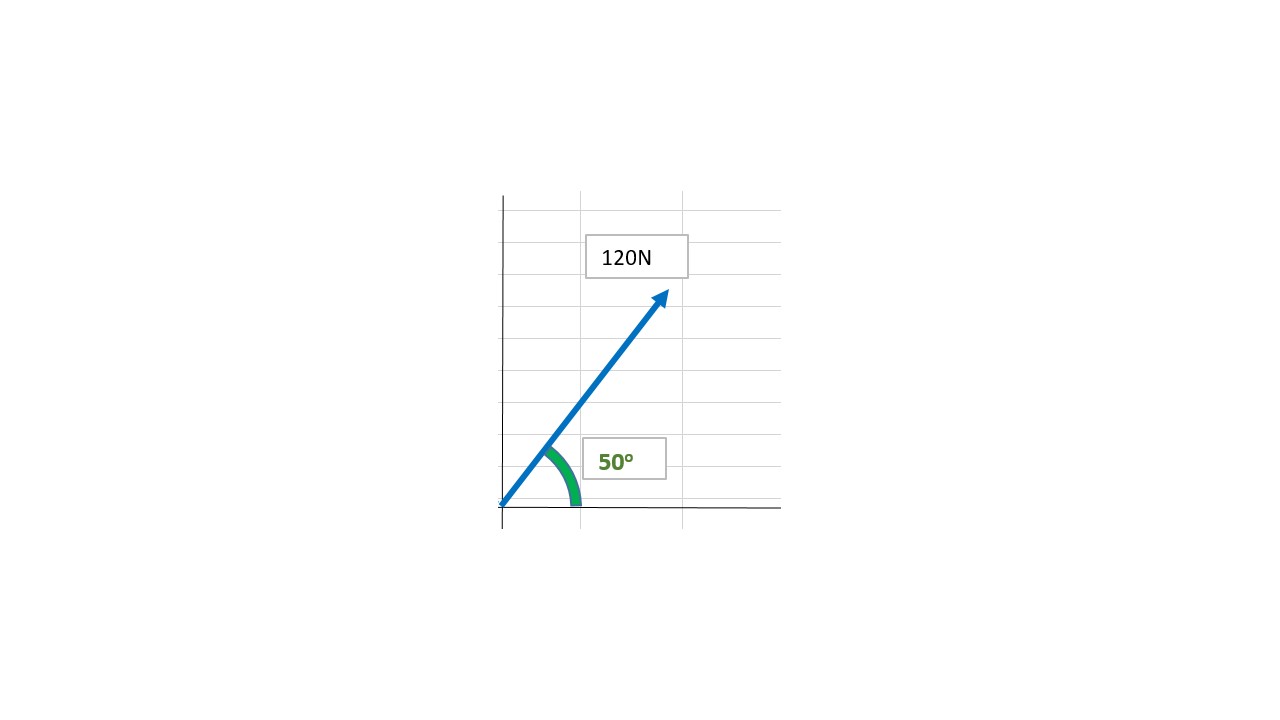
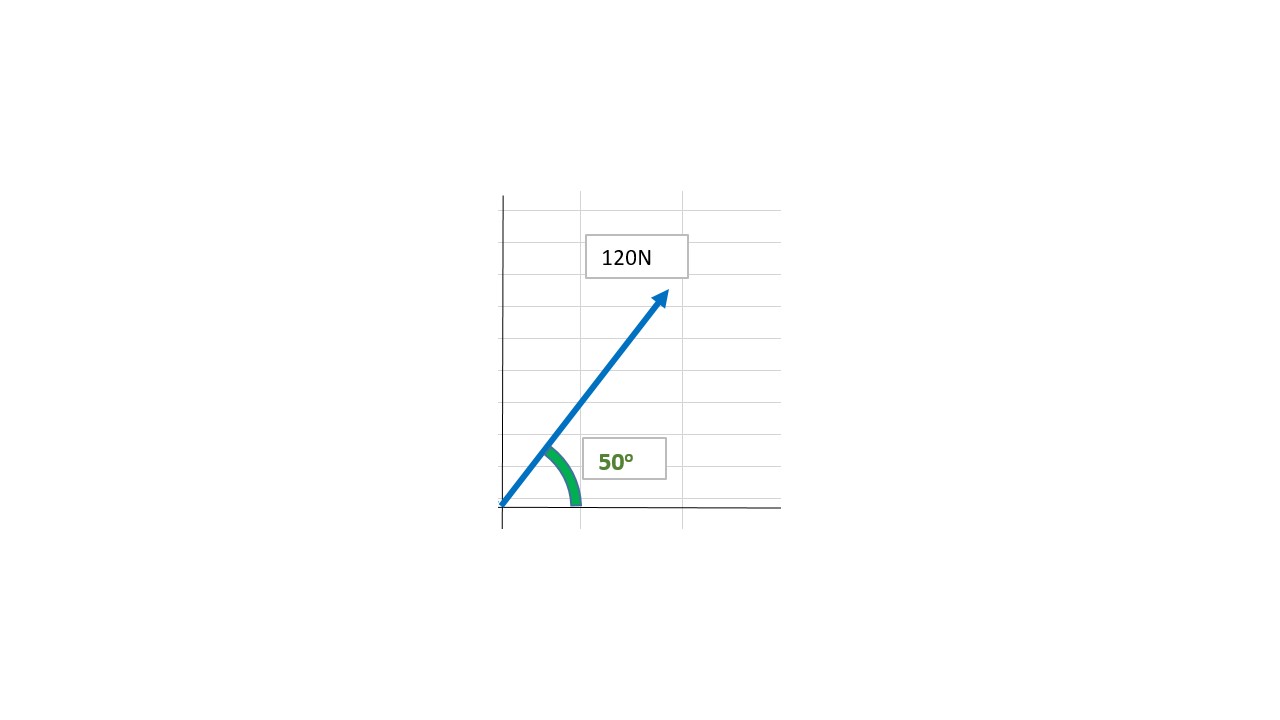
What is the x component of the vector?
14cos(30)
14sin(30)
14tan(30)
14tan-1(30)


Vector A (15 m, N), Vector B (9.0 m, E), and Vector C (11 m, 60O SE) combine to form Vector R. Which of the following describe Vector R?
15 m, 69O NE
15 m, 21O SE
16 m, 69O SE
16 m, 21O NE

What is the name of the 2nd method?
Parallelogram method of vector addition
Polygon method of vector addition
Pythagorean Theorem
Composition of vectors

What is the name of this method?
Parallelogram method of vector addition
Polygon method of vector addition
Pythagorean Theorem
Composition of vectors

Is this a scalar quantity or a vector quantity?
A deer running 15 meters per second due west
Scalar
Vector

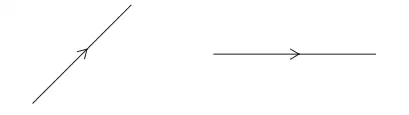
The diagram shows arrows representing two vector quantities. Which diagram shows the resultant R of these two vectors?


What is the net force and the direction of the block?
14 N due to the right
14 N due to the left
38 N due to the left
38 N due to the right

