
 Worksheets
Georgia Studies Government Review
Total questions: 47
Worksheet time: 48mins
Just like the United States Constitution, the Georgia Constitution begins with a paragraph that introduces the purpose of the document. What is this paragraph called?
Introduction
Invitation
Preamble
Postamble
What is the MAIN purpose of the Georgia State Constitution?
Provide questions for tests in Georgia Government classes
Set up a framework for the government of Georgia
To provide the people of GA a means of escape when Thanos comes.
To create a identical, but miniature version of the U.S. government for our state.
The Preamble of the Constitution of the State of Georgia says this document will "insure justice to all". Which branch of Georgia government interprets laws and administers justice?
Executive
Judicial
Legislative
Financial
There are a lot of similarities between the U.S. and Georgia State Constitutions. Which of these is NOT a similarity?
Both documents have a preamble, articles, and amendments.
Both documents establish a government with three branches and a clear separation of powers
Both documents have a Bill of Rights
Both the U.S. and GA are on their second constitution
Which branch of Georgia's government makes the laws that ensure the rights of citizens?
Judicial
Executive
Legislative
For a bill to become a law, it has to
Be voted on and passed by ONE of the chambers of the General Assembly
Be voted on and passed by BOTH chambers of the General Assembly
Be vetoed by the Governor at least once
Have been approved by the Supreme Court of Georgia
Which of the following is the first step in the process of a bill becoming a law?
Introduction- bill is introduced to the house it was submitted to
Chamber Vote- the bill is voted on in the house where it was introduced
Committee- bill is assigned to a committee where it is researched and improved
Draft- A senator or representative drafts a bill and submits it to the clerk of their house
If the governor vetoes a law, what can the General Assembly do to check the governor's power?
Override his veto with a 2/3 vote.
Take the law to the Supreme Court and have them sign it.
Threaten not to write the state budget law.
Override his veto with a 1/2 vote
The governor is head of the Executive Branch. Which of these is NOT one of his powers?
vetoing a law passed by the General Assembly
appointing heads of executive agencies
presenting the state budget
declaring a law unconstitutional
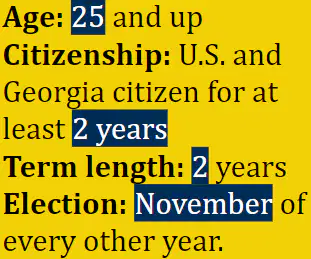
The image shows the requirements to run for a position in Georgia's government. Which position are these requirements for?
GA State Senator
Lyons, GA City Council
GA State Representative
GA Governor
Which of these is NOT one of the jobs of Georgia’s lieutenant governor?
Appointing Senate committee chairs and members
Acting as President of the Senate
Vetoing laws passed in the Senate
Acting as Governor when the Governor is out of state
Legislators meet in smaller groups throughout the year. They review and revise bills so that they are ready to be discussed during the legislative session. What are these small groups called?
commissaries
commissions
committees
councils
The Georgia Constitution sets the limit for a legislative session. How long is the legislative session each year?
21 minutes
25 days
40 days
180 days
Oh, no! There's a flood on the coast and people need help! The GA legislature is not in session to vote on aid funds. What can the governor do to help?
As commander in chief, the governor can order the Georgia National Guard to mobilize
The governor can call a special session of the legislature to meet and vote for emergency funds to spend on relief.
Both of these
(SS8CG2b) Who is the leader of the House of Representatives?
This group of judges is the highest court within Georgia's judiciary system.
Court of Appeals
Municipal Court
Superior Court
Supreme Court

Using this graph, what can you conclude about Georgia's tax revenue?
Sales Taxes have increased.
Corporate Income taxes have decreased.
The state has too many revenue sources.
The state has many revenue sources.
Which of the following is required by the Georgia
state constitution?
Personal income tax increases must be
approved by voter referendum.
The state must maintain a balanced budget and
cannot spend more money than it takes in.
Cuts to state welfare programs must be
approved by the Georgia Supreme Court.
All non-tax revenue that the state receives is
used exclusively to fund education.
Which of these is one of the requirements to run for GA Governor?
at least 21 years old
A resident of Georgia for 6 years
Born in the United States of America
Available for at least 3 terms
How are juvenile court judges selected?
They are appointed by superior court judges.
They can be either elected or appointed
Which Georgia court is described below:
"This type of trial court is found in every county and issues marriage licenses and firearm licenses. They have no jury and their judges are elected for four year terms."
Court of Appeals
Magistrate Court
Juvenile Court
Probate Court
Which of the following is a responsibility of all Georgia's citizens?
Voting
Freedom of Religion
Bearing arms
Obeying laws
A bill is passed in the General Assembly and then signed into law by the Governor. What can the Judicial Branch do to check the other branches in this scenario?
The State Supreme Court can review the law and rule it unconstitutional
The State Supreme Court can send the Law to the Court of Appeals for judicial review.
The State Supreme Court can impeach the governor.
The five trial courts can form a committee to review the new law and declare it unstable
Who oversees the daily operations of a county's government?
Mayor
City Council
City Manager
County Commissioner
Which type of government would provide the following services? Education, water and sewer, street repair, and police and fire protection?
state and city
city and county
district and region
county and state
An example of a special-purpose government agency would be
local church
grocery store chain
MARTA
veterinarian
County governments help the state government collect state taxes and conduct elections.
True
False
The Georgia Constitution of 1983 (the current one we use) set a limit to the number of counties in GA. How many counties are there?
8
159
over 500
More than Texas has

In what way does the structure of county and city governments DIFFER?
Only city governments provide law enforcement protection.
Only county governments provide law enforcement protection.
Only county governments are able to cast votes for state offices.
Mayors usually lead city governments, while commissioners lead counties.


