
 Worksheets
East Asia Review
Total questions: 130
Worksheet time: 5hrs 21mins
What continent is China a part of?
Europe
Asia
Africa
Australia


The Himalayas are located ________.
northwest of China
west of Pakistan
northeast of India
east of Myanmar

Largest continent in the world
Asia
China
Japan
Europe

Which region stretches from China to Mongolia and is the largest desert in Asia?
Sahara
Gobi
Atacama
Nile Basin

Which mountain is part of the Himalayas and the tallest mountain in the world?
Mount Everest
Mount McKinley
Mount Fuji
Mount Ranier

Country at #1
China
India
Japan
Vietnam

Country at #2
Korea
India
Mongolia
Vietnam

Country at #3
Korea
India
Mongolia
Vietnam

Country at #5
Korea
China
Japan
Vietnam
Country at #6
Vietnam
Taiwan
Japan
China
Body of water at #8
Yellow Sea
South China Sea
East China Sea
Sea of Japan
Body of water at #9
Bay of Bengal
South China Sea
East China Sea
Yellow Sea
River at #12
Huang He River
Chang Jiang River
Mekong River
Geographical feature at #16
Altai Mountains
Taklimakan Desert
Himalaya Mountains
Gobi Desert
Geographical feature at #19
Altai Mountains
Taklimakan Desert
Himalaya Mountains
Plateau of Tibet
Geographical feature at #20
Altai Mountains
Taklimakan Desert
Himalaya Mountains
Plateau of Tibet

What is this country?
China
Mongolia
Taiwan
Japan

What country is this?
China
Japan
North Korea
Mongolia

What physical feature is this?
Himalayas
Ural Mountains
Gobi Desert
Korean Peninsula

What body of water is this?
Mississippi River
Nile River
Ganges River
Huang He (Yellow) River

What body of water is this?
Pacific Ocean
Arctic Ocean
Atlantic Ocean
Indian Ocean

What physical feature is this?
Gobi Desert
Himalayas
Ural Mountains
Mount Fuji

What country is this?
North Korea
Taiwan
Japan
Mongolia
What country is this?
North Korea
Taiwan
Japan
Mongolia

What body of water is between mainland Asia and Japan?
Black Sea
Philippian Sea
Sea of Japan
Caspian Sea

What is the capital of China?
Shanghai
Beijing
Chongqing
Guangzhou

What is the capital of Japan?
Tokyo
Osaka
Sapporo
Nagoya

What physical feature are North and South Korea located on?
archipelago
isthmus
volcano
peninsula

Japan is an example of....
a peninsula
an archipelago
an isthmus
a desert
_______________________ are seasonal winds that blow moisture into India and other South Asian countries.
typhoons
cyclones
monsoons
tsunamis
Which of these BEST describes "loess"?
lava damage
air pollution
silt deposits
water erosion
It is the largest desert in Asia.
It covers parts of northern China and southern Mongolia.
It was formed because the Himalayan mountain range blocks rain from reaching the area.
Which geographic feature of Asia is being described?
the Gobi Desert
the Sayan Desert
the Taklimakan Desert
the Lop Nor Desert
Which nation is made up of four main islands (Honshu, Hokkaido, Kyushu, and Shikoku) and thousands of smaller islands?
Indonesia
Japan
Oceania
Thailand
Choose ALL of the rivers that are found in China.
Indus
Tigris River
Ganges River
Yangtze River
Huang He River
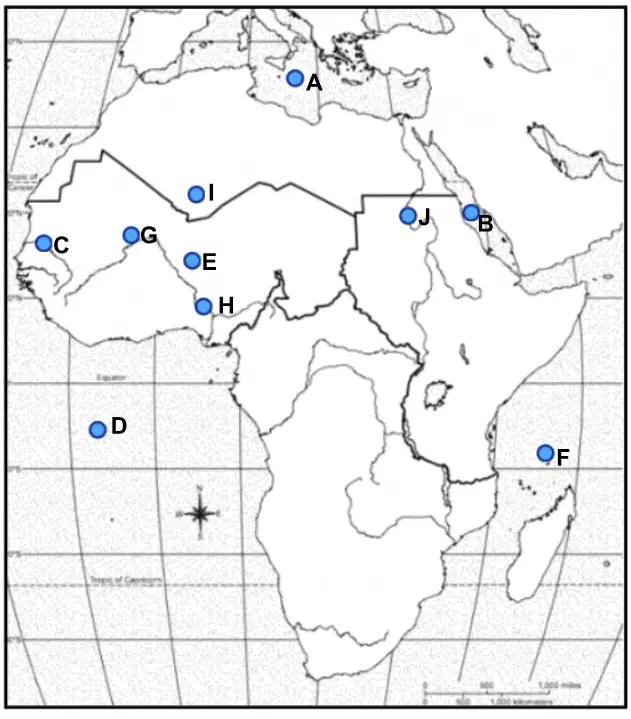
Which body of water is letter B?
(a)
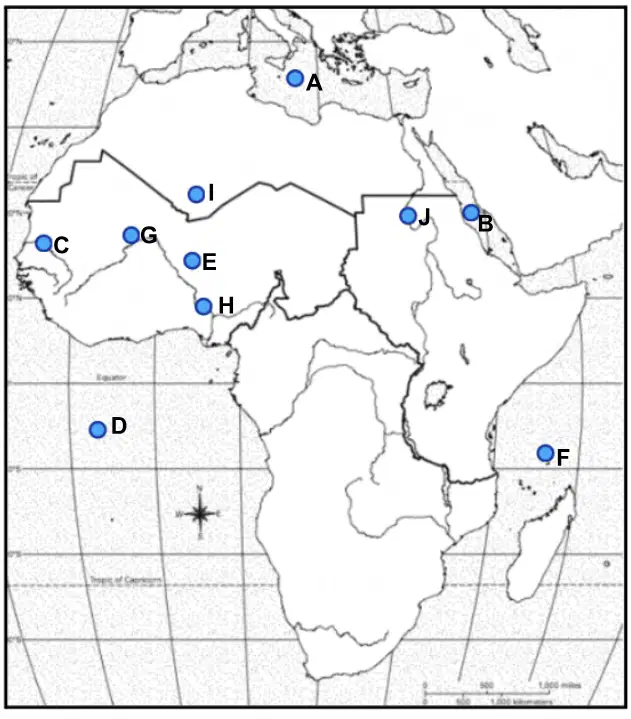
Letter F is which body of water?
(a)
What river was the Kingdom of Mali centered around?
Niger
Nile
Congo
Senegal
Mali became rich due to control of what product?
Salt
Diamonds
Coal
Gold
What did Africans mine that helped them flavor food?
Sugar
Salt
Potato chips
What was the Niger river used for?
Trade and transportation
Competitive swimming
Fishing only
What is the largest desert in the world?
Kalahari
Sahara
Death Valley

According to the chart, in which caste do most Indians belong?
brahmans
kshatriyas
vaisyas
sudras

TKI the map to answer the question that follows: According to the map, what is the second most popular religion in South Asia?
Buddhism
Hinduism
Islam
Janism
In the end, this term below is the end goal for Buddhists...
Nirvana
reincarnation
Moksha
good karma
People suffer because they desire some things that may or may not be attainable.

Nomad
unchanging in condition
to establish in residence
a person who moves from place to place, often in search of water and vegetation
incapable of being moved

Khan
relating to ancient barbarians
a native or inhabitant of Mongolia
Mongol ruler
the language of the Mongols

Tribute
payment or gift to a strong power
an award involving special praise
something regarded as a rare opportunity
the quality of being honest and having strong moral principles
A peasant is a _________
rich farmer
poor family
farmer
poor farmer
In 618, the Tang Dynasty reunited China, and ruled for the next 300 years. The word reunite means...
to separate
to come together
to cut in half
burn
Dynasty is a line of rulers from the same family
True
False
To obtain a good job a citizen needed to pass an ________
health test
eye exam
exam
To obtain a good job you must do the following ______ and ______.
study
go to a good school
pass an exam
pay someone to give you a good job
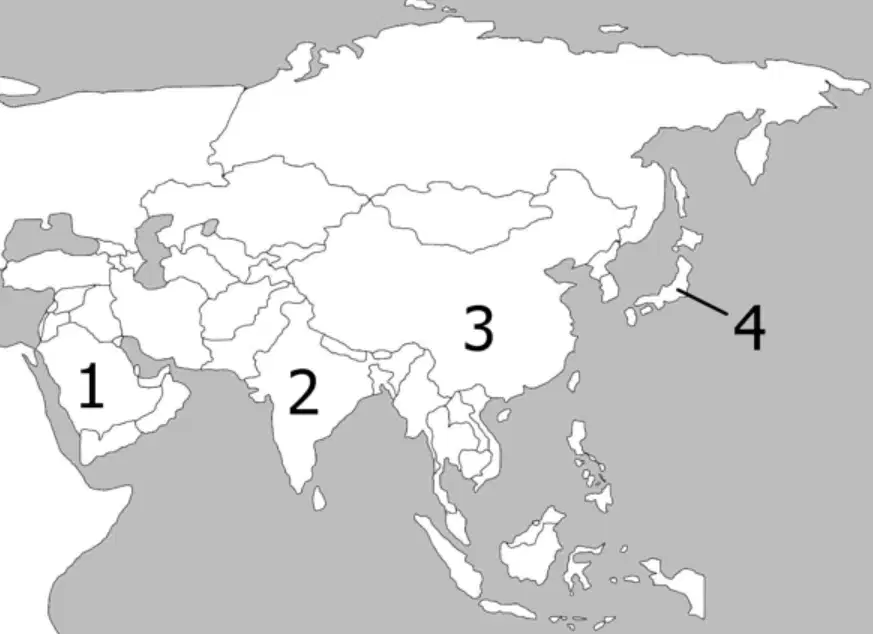
This is a map of Asia. Which number correctly identifies China?
1
2
3
4
Which geographical feature created a natural boundary for Ancient Chinese civilizations?
Arctic Ocean
Himalaya Mountains
Mediterranean Sea
Nile River
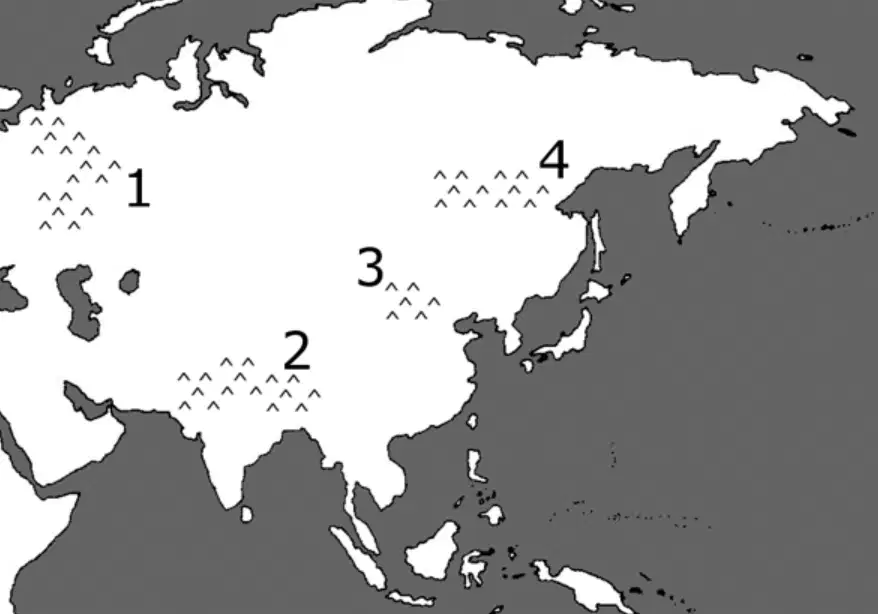
This is a map of Asia. Which number correctly identifies the Himalayan Mountains?
1
2
3
4

This chart lists several geographic features of Asia. Which geographic feature completes this chart?
Congo Rainforest
Mount Kilimanjaro
Gobi Desert
Southern Alps
What is the name of the desert that lies on the China and Mongolia border?
Arabian
Sahara
Gobi
Mojave

This is a map of China. Which number correctly identifies the location of the Gobi Desert?
1
2
3
4

This is a map of Asia. Which letter correctly identifies the location of the Plateau of Tibet?
A
B
C
D
Which rivers flow through East Asia?
Euphrates River
Niger River
Yangtze River
Tigris River
Yellow River

This is a map of Asia. Which number correctly identifies the location of the Korean Peninsula?
1
2
3
4

The map shows various water features of Asia. According to the numbers on the map, choose the correct answer below that lists these features in the right order.
1. Tigris River
2. Sea of Japan
3. Pacific Ocean
4. South China Sea
5. Euphrates River
1. Yangtze River
2. Sea of Japan
3. Pacific Ocean
4. South China Sea
5. Yellow River
1. Yellow River
2. Sea of Japan
3. Pacific Ocean
4. South China Sea
5. Yangtze River
1. Amazon River
2. Sea of Italy
3. Atlantic Ocean
4. Gulf of Mexico
5. Mississippi River

This is a map of China. According to the map and what we have learned in class, what physical features would help China avoid being invaded?
deserts and mountains
rivers and rainforests
Mongolia and seas
Manchuria and rivers

This map shows the cultural diffusion of Buddhism. How did Buddhism come to China?
Buddhist leaders and politicians from Japan influenced China.
Buddhist merchants and teachers traveled to China from India.
Buddhist warriors invaded China from Russia.
Buddhist scholars invented the religion in China.
How did the reunification of China prior to the Tang Dynasty help to spread Buddhist beliefs?
The Mongols respected people's freedom of religion
The Grand Canal prevented trade
Confucianism discouraged a belief in Buddhism
People and ideas moved more freely in a unified China
The use of Chinese goods like the compass and gunpowder in Europe is proof of what?
European economies were too weak to trade.
Chinese inventions were traded across the world.
European scientists did not invent new goods.
Chinese governments refused to interact with other cultures.
How did advancements in agriculture impact the Song Dynasty? Select ALL that apply.
Religious leaders became more powerful
The military was broken up
Political systems were weakened
The economy became stronger
The population increased
“Neo-Confucianism” is a term that is used to describe the form of Confucianism that became popular during the Song dynasty in China. Which of these most influenced Neo-Confucianism?
Islam
Hinduism
Buddhism
Catholicism
Identify three examples of agricultural achievements in the Song Dynasty.
Champa Rice & drought resistant rice
Magnetic Compass
Paper Money
Chain Pump & Water wheel irrigation
Iron Plow
Which of the following are technological advancements of the Song Dynasty?
Canals
Champa Rice
Coal & steel
Moveable Type
Gunpowder
Complete the cause & effect relationship below:
Cause: Farmers import new types of rice.
Effect: ?
Many people converted to Buddhism out of thanks for the new rice.
Farmers were now able to grow rice along the Yellow River.
Rice grows very efficiently, resulting in conflict because of the competition.
Rice grows more efficiently, increasing the population.

This unique good was by merchants traded in China, although it isn't originally Chinese.
woodblock printing
porcelain
terracotta
vase
Which Song advancement likely helped the spread of ideas through books and writing?
paper money
canals
moveable type
gunpowder
Which philosophy/philosopher most influenced the Song Dynasty?
(a)

Confucianism stressed...
morality and ethics
growth in agriculture
infrastructure growth

Which of the following did the Song Dynasty invent?
(2 answers)
Gunpowder
calculators
Compass
the lightbulb
Which one of these inventions was developed in medieval China?
gunpowder
magnetic compass
porcelain
block printing

Which European's explorations are shown on this map?
Robert LaSalle
Christopher Columbus
Marco Polo
Ferdinand Magellan

Which innovation allowed information to spread?
iphone
printing press
gunpowder
Merchants and missionaries brought this to China.
Hinduism
Christianity
Taoism
Buddhism
Chinese invented_________________, ____________________, and _______________________.
Spoons, knives, and forks
Wheels, gears, and levers
Talcum, shampoo, and soap
Block Printing, gunpowder, and compass
What was the Grand Canal?
System of waterways connecting 2 major rivers. Making it easier to ship products throughout China
A series of roads connecting major cities
A network of tunnels connect two mountains
A system connects two countries
Under Sui emperor Yangdi, China was able to build the ___________. This allowed for the Chinese to ship goods from North to South China, greatly increasing China's overall economy.
Grand Rapids
Grand Canal
Great Wall of China
Great Wall of Panda Express
During the Song dynasty, this thin, beautiful style of pottery was traded on the Silk Road sea routes.
fur
glass bottles
porcelain
compasses
What did the invention of gunpowder lead to?
Long distance sailing voyages.
Population growth
Firearms and fireworks
Printed books
Advances in agriculture during the Tang and Song dynasties led to
A period of disunion
development of paper money
population growth
the decline of Buddhism
What was the name the Mongol Temujin changed his name to when he became leader? (The name means Universal Ruler”.)
Genghis khan
Kublai Khan
Zhu Yianzhang
Zheng He
What linked China to the rest of the world for trade?
The Great Wall of China
The Pacific Ocean
The invention of paper
The Great Silk Road
What is the world's longest fortification?
The Great Silk Road
The Great Barrier Reef
The Great Wall
The Himalayas
The population of China grew rapidly in the Tang and Song dynasty because of
a widespread system of education and better rice.
Better rice and advantages of farming technology.
Irrigation and a bureaucracy of educated officials.
Trade throughout Asia and Europe and lower rates.
Government officials were hired using ________________________.
Interviews
Civil Service Exams
Applications
Physical Agility Tests
The Chinese built armor, weapons, and tools using ______________.
Steel/Iron
Coal
Plastic
Wood
In what country was Marco Polo born?
England
Portugal
France
Spain
Italy
What is Marco Polo most known for?
Exploring South Pacific
Traveling to China and the Far East
The game kids play in the Pool
What was the first trade route between China and Eastern Europe called?
The Desert Road
The Spice Trail
The Silk Road
Who was the leader of China during Marco Polo's travels?
Emperor Zhaozong
Empress Wu
Genghis Khan
Kublai Khan


Which Mongol (Yuan Dynasty) ruler accepted Marco Polo into their court?
Genghis Khan
Kublai Khan
Empress Wu
Emperor Wendi
Kublai Khan was able to maintain control of China by...
allowing religious freedom for the people of China.
placing wise leaders in power, a practice of Confucianism.
creating a stable economy by protecting the Silk Road.
enforcing harsh laws against all non-Mongol citizens.
Which actions contributed to Kublai Khan's control of the Yuan Empire?
reorganizing the military and rebuilding the Great Wall
creating social equality and redistributing lands
respecting all religions and allowing cultural diversity
favoring Confucianism and using the civil service exams
Which geographical feature is not located in East Asia?
Gobi Desert
Nile River
Sea of Japan
Himalayan Mountains
The Ming Dynasty followed the collapse of the Mongol ___________ dynasty.
Yuan
Song
Tang
Han
The Forbidden City is located in the heart of China's capital-
Beijing
Nanjing
Tokyo
New Delhi
What was the purpose of the Forbidden City ?
To prevent the Mongols from attacking the Emperor
To keep the riches of the Empire in one place
To provide extra protection for the Emperor from the common people
To symbolize the power and might of the Emperor
Which statement is not true regarding the Forbidden City?
Located in the center of the Imperial City
Had beautiful gardens and palaces with 1000's of rooms
Only the Emperor and the court could live there
Any Chinese citizen could enter
Still exists today

The Ming emperors built what for themselves, families, members of the court, and government?
Forbidden City
a new capital city
new pleasure boats like the Sui
new weapons
Zheng He's voyages took him to
the Americas.
Europe.
Japan and Korea.
Southeast Asia, India, and East Africa.
In the early 1400s, during the Ming Dynasty, Zheng He was sent by his emperor on sailing voyages to
search for gold and other riches in Africa
defeat the Mongol navy in the East China Sea
show China's interest in trade and display the power and splendor of China
discover an ocean route to North America
The belief that it is best for a nation to protect its borders and stay away from other countries is-
nationalism
Confucianism
isolationism
capitalism

The Ming Dynasty believed the best way to deal with the constant threat of Mongol invasion was to-
create a strong navy to defend China's coast
negotiate a peace with their enemies to the North
rebuild and improve the Great Wall
invade Mongolia

This is an example of?
ceremonial drinking bowl
Main Chinese import
Ming porcelain
All of the above
All of the above

Who did the Ming Dynasty overthrow?
Tang Dynasty
Song Dynasty
Yuan Dynasty
Qing Dynasty

Where was the government located?
In the Ming
The Forbidden City
China Town
In the capital of Bejiing
Zheng He
was great Mongol leader
was the greatest Ming emperor
defeated the Mongols in China
great Chinese explorer
What was the purpose of the Seven Voyages?
To show off the Chinese prestige, power, and riches
To find more trade routes to Europe
To make money for the Chines
To find a lost treasure
Why was the census created?
to control the people
to put officials in charge
to help collect taxes
to divide the land

