
 Worksheets
Pure Substances and Mixtures
Total questions: 30
Worksheet time: 15mins
Which of the following is a characteristic of a compound?
Physically combined
Chemically combined
Variable proportions
Components retain properties
What is a characteristic of a mixture?
Chemically Combined
Fixed proportions
Made of elements
Variable proportions
Which of the following describes how components in a mixture behave?
Components retain properties
Components change properties
Fixed proportions
Made of elements
What is true about the components of a compound?
Fixed proportions
Variable proportions
Physically combined
Components retain properties
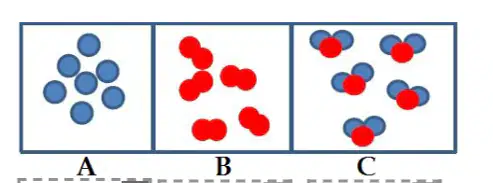
Identify each of the images as an element, molecule, or compound.
A: Element, B: Compound, C: Molecule
A: Compound, B: Element, C: Molecule
A: Molecule, B: Compound, C: Element
A: Element, B: Molecule, C: Compound
Compounds are formed when two or more ______ are chemically combined.
compounds
atoms
elements
molecules
An element is a ______ substance that cannot be separated into simpler substances by physical or chemical means.
pure
combined
original
complex
When two or more elements are ______ combined, a new substance is formed with new chemical and physical properties.
chemically
physically
loosely
randomly
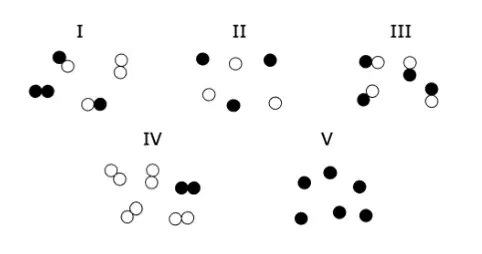
Which image(s) would be considered pure substances?
V
I and II
II and IV
III and V
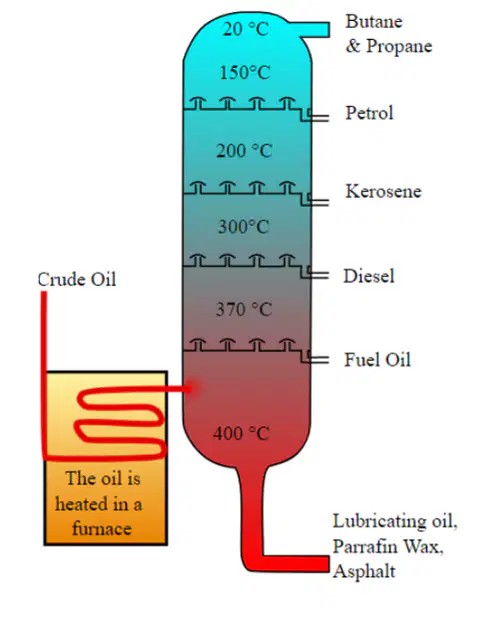
Using the diagram, justify the source of data used to develop the technology for refining the crude oil.
Different fuel components have different densities, allowing them to be separated.
Different fuel components have different melting points, allowing them to be separated.
Different fuel components boil at different temperatures, allowing them to be separated.
Different fuel components combust at different temperatures, allowing them to be separated.
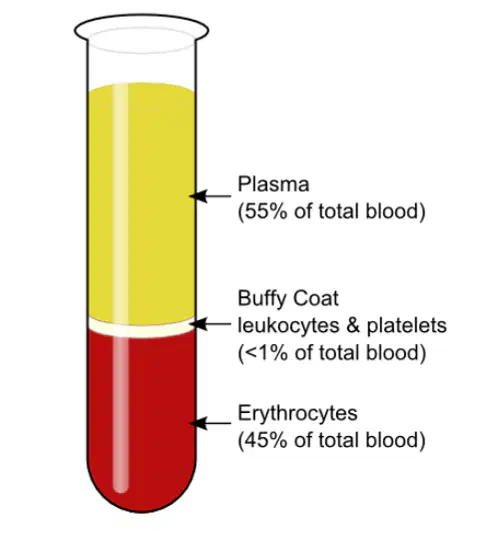
What experimental design was most likely used to provide evidence for the success in blood fractioning?
Blood donations were collected and separated by their different sizes.
Blood donations were collected and separated by the temperature at which they boil.
Blood donations were collected and separated by their attraction to a magnetic field.
Blood donations were collected and separated by their different densities in the mixture.
In science, Jill is learning about solids such as brass, bronze, and steel. How should she classify these materials?
Pure substances
State compounds
Homogeneous mixtures
Heterogeneous mixtures
Which of the following explains why saltwater is considered a mixture?
It is composed of two or more substances that have combined chemically to have new properties.
It is composed of two elements that have become a compound.
It is composed of two or more substances retaining their original properties.
It is composed of one atoms from a single element.
When two or more substances combine, but each keeps its own properties, the new combination is called a(an)
element.
mixture.
compound.
homogeneous substance.
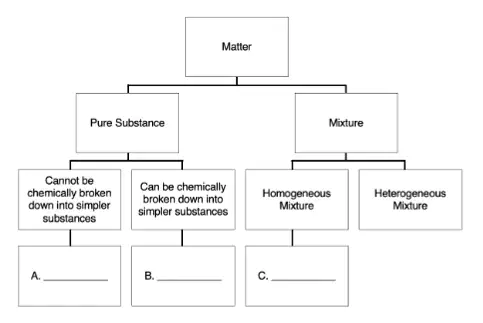
In the classification of matter chart, letter A. would be a(n)
acid.
compound.
element.
mixture.
One difference between mixtures and pure substances is that
mixtures can be physically separated.
mixtures are made of one type of atom.
pure substances have no chemical bonds.
pure substances can be physically separated.
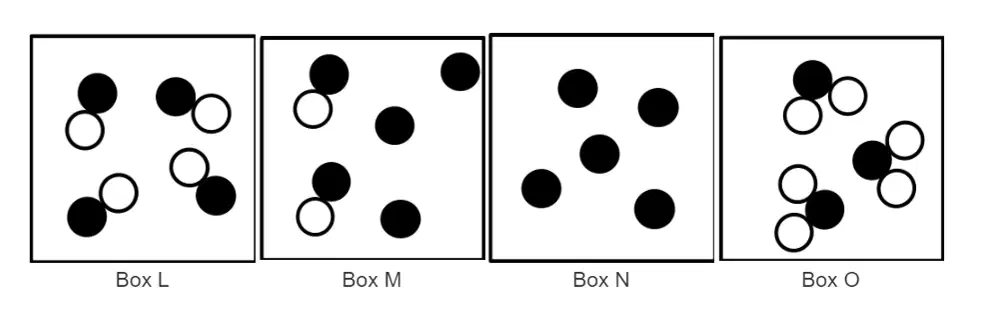
Which box contains a heterogeneous mixture?
Box N
Box M
Box L
Box O
Which of the following is a compound?
Nitrogen (N₂)
Hydrogen (H₂)
Helium (He)
Hydrochloric acid (HCl)
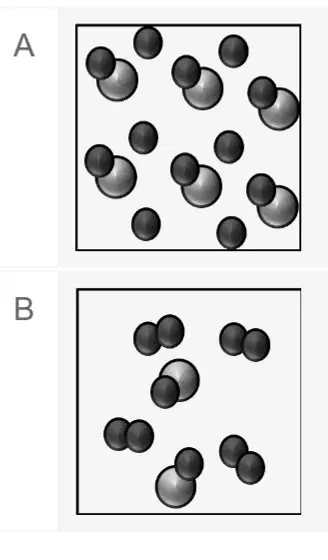
In the following diagram, the spheres represent particles. Different shadings represent different particles. Which of the following contains a homogeneous solution?
Option A
Option B
Steel is a metal that is made from iron and carbon. The iron and carbon do not chemically react with each other. Which of the following best describes steel?
Heterogeneous mixture
Pure substance
Homogeneous mixture
Compound
A student made a snack after school by combining pretzels, peanuts, and raisins together in a bowl. What statement describes the student’s snack?
It is a heterogeneous mixture
It is a homogeneous mixture
It is a pure substance
It is a compound
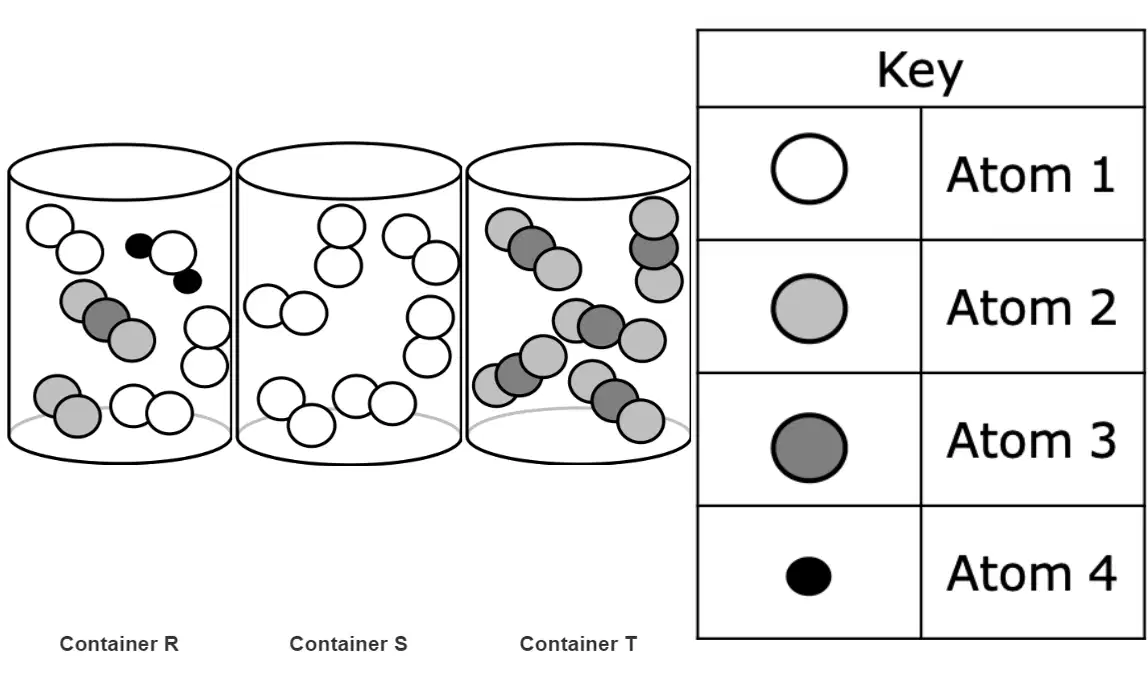
The diagram below shows three containers of gas. Which list correctly describes the gases in containers R, S, and T?
R: element, S: compound, T: mixture
R: compound, S: element, T: mixture
R: mixture, S: element, T: compound
R: element, S: mixture, T: compound

From the list, determine which property is NOT associated with compounds.
I
II
III
IV
A solution is a mixture that looks exactly the same everywhere. Which of these mixtures is a solution?
a fruit salad
a chocolate chip cookie
a mixture of sugar and salt
a mixture of sugar and water
Mixtures occur when two or more materials are combined and each material keeps its own properties. All of the following are mixtures EXCEPT:
salad
pizza
water
chocolate milk
Water, H₂O, is made up of different elements, hydrogen and oxygen. Is this type of combination a mixture or a pure substance?
Mixture
Pure substance
Solution
Colloid
When magnesium (Mg) metal is burned in the presence of oxygen (O₂), magnesium oxide (MgO) is produced. The properties of magnesium oxide are different than the individual properties of magnesium and oxygen because magnesium oxide is –
A homogeneous mixture
A compound
A different substance
A heterogeneous mixture
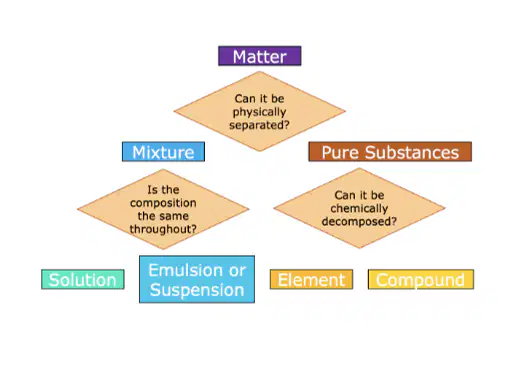
Use the model provided to determine which substance is a suspension.
Ocean Water
Sandy water
Pure water
Iced Tea
Which of the following is a characteristic of a compound?
It is composed of two or more elements
It can be separated into its components by physical methods
It retains the properties of its constituent elements
It is always a liquid at room temperature
Glucose (C6H12O6) is considered a compound because it is made up of two or more
molecules
elements
gases
soilds

