
Font size
 Worksheets
Unit 1 Kinematics Study Guide
Total questions: 134
Worksheet time: 4hrs 51mins
I have 5 apples is an example of....
A scalar
A vector
I am walking 4 miles per hour and heading north is an example of:
A scalar
A vector
Scalars have ____ but no ____
Magnitude -
Direction
Direction - Magnitude
Speed - Space
Measurement - scale
Vectors have ____ and ____
Magnitude - Direction
Value - Speed
Acceleration - Mass
Mass - volume
Speed is a ____ quantity
Scalar
Vector
Velocity is a ____ quantity
Scalar
Vector
Acceleration is a ____
Vector
Scalar
Mass is a ____ quantity
Scalar
Vector
Volume is a ____ quantity
Scalar
Vector
The grade you receive is a___ quantity
Vector
Scalar
The students are arguing over the differences between speed and velocity. One student says, “Speed is a vector because it describes how fast an object traveling. Velocity is a scalar because it tells how fast and what direction an object is traveling.” Which of the following statements is correct?
The students' understanding of all four terms (speed, velocity, scalar, and vector) is correct.
The students' understanding of all four terms (speed, velocity, scalar, and vector) is incorrect.
The students' understanding of speed and velocity is incorrect but their
understanding of scalar and vector is correct.
The students’ understanding of speed and velocity is correct but their understanding of scalar and vector is incorrect.
17 m/s, East
Vector
Scalar
10 mph
scalar
vector
Which would be used for the situation, scalar or vector:
How fast a car travels when it reaches top speed
scalar
vector
Which would be used for the situation, scalar or vector:
Describing how fast and in which direction a deer is running
scalar
vector
Two cars are travelling at 10 m/s, in different directions. Select the sentences that are true.
Their speeds are the same.
Their speeds are different.
Their velocities are the same.
Their velocities are different.

An old lady rolls down a hill at 3 m/s. The hill is 36 m long. How many seconds does it take the old lady to reach the bottom of the hill?
39 s
12 s
15 s
33 s
How long will it take to go 150,000 m traveling at 50 km/h ?
3000 h
3000 s
3 h
3 s

Which is true about their motions?

Which statement is true about velocity?
Must have measurement of speed.
Must have a measurement of speed and direction.
Must have only direction.
Has neither a measurement of speed or direction.


Which is true about their motions?
Which statement is true about velocity?
Must have measurement of speed.
Must have a measurement of speed and direction.
Must have only direction.
Has neither a measurement of speed or direction.



Georgia is jogging with a velocity of +4 m/s when she accelerates at +2 m/s2 for 3 seconds. How fast is Georgia running now?
10 m/s
2.6 m/s
9 m/s
3.5 m/s
A cat was moving at +6 m/s after it accelerated at +4 m/s2 for 2 seconds. What was the cat's starting velocity?
2 m/s
7 m/s
12 m/s
6 m/s
A race car is traveling at +76 m/s when is slows down at -9 m/s2 for 4 seconds. What is his new velocity?
-36 m/s
40 m/s
-4 m/s
28 m/s
Pete is driving down 7th street. He drives 150 meters in 18 seconds. Assuming he does not speed up or slow down, what is his speed in meters per second?
8.3 m/s
150 m/s
18 m/s
1,200 m/s
A roller coaster is moving at 25 m/s at the bottom of a hill. Three seconds later it reaches the top of the hill moving at 10 m/s. What was the acceleration of the coaster?
-5 m/s2
5 m/s2
9.33 m/s2
-9.33 m/s2
Mark slams on the brakes after traveling 25 m/s. It takes him 3 seconds to come to a complete stop. What is his acceleration?
8.33 m/s2
-8.33 m/s2
75 m/s2
-75 m/s2
How much time did it take Matthew to slow down to a complete stop, after traveling at 30 m/s. His acceleration is -12 m/s2
2.5 s
360 s
.4 s
-2.5 s
If Anthony was running for 300 s after starting at rest, what was his final velocity if he had an acceleration of 0.05 m/s2
.25 m/s
.01 m/s
100 m/s
15 m/s

The elevators in the Landmark Tower, in Yokohama, Japan are among the fastest in the world. They accelerate upward at 3.125 m/s2 for 4.0 s to reach their final speed. If these elevators start from rest, what is their final speed?
0.781 m/s
7.125 m/s
1.28 m/s
12.5 m/s
Justine is ice-skating at the Lloyd Center. What is her final velocity if she accelerates at a rate of 2.0 m/s for 3.5 seconds?
1.5 m/s
5.5 m/s
7 m/s
1.75 m/s
Kaya is riding her dirt bike eastward on a dirt road. She spots a pothole ahead. Kaya slows her car from 14.0 m/s to 5.5 m/s in 6.0 s. What is her acceleration?
-1.4 m/s2
+ 1.4 m/s2
0.7 m/s2
14.5 m/s2
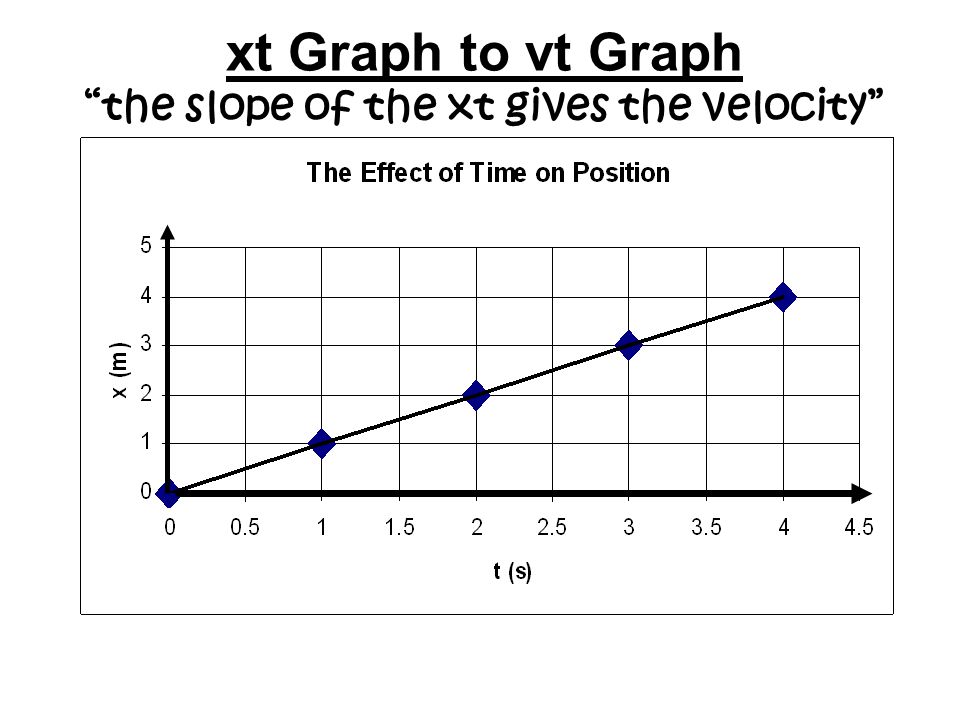
How fast is this object moving?
1 meter
1 meter /second
2 meters/second
4 seconds

Which is true about plot c?
position is negative
velocity is positive
position is changing

At what time does this object have a negative velocity?
3 seconds
7 seconds
11 seconds
never

Consider the position vs. time graph below for cyclists A and B.
Do the cyclists start at the same point?
Yes
No

At t= 7s, which cyclist is ahead?
A
B

Which cyclist is travelling faster at t = 3s? (You need to know that both cyclists are traveling at constant speed, meaning that both x(t) lines are straight)
A
B

What is happening at the intersection of lines A and B?
The cyclists stop
The cyclists speeds are equal
The cyclists are at the same position at the same time.
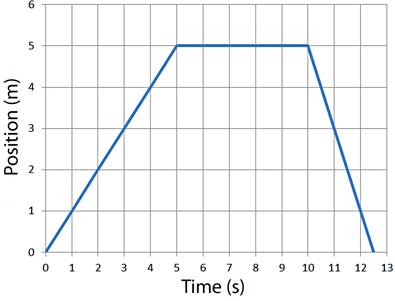
At 7 seconds, this object's velocity is:
positive
zero
negative
can't tell from the plot
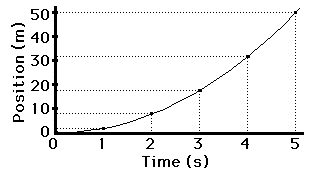
Horizontal line on a Position Time graph indicate that the object is
Speeding up
Slowing down
at Rest
moving at a constant speed
Slope of a Position -Time graph gives
Velocity
Displacement
Acceleration
Distance
Straight line with a slope indicates that the object is
moving with constant speed
speeding up resting
slowing down
resting

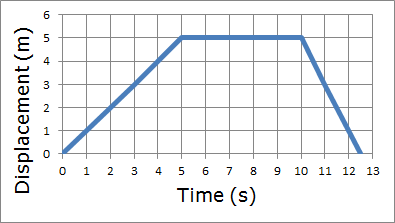
What is the speed of the object between 25 to 60 seconds?
4 m/s
2m/s
0 m/s
5 m/s

What is the speed pf the object in section A?
0 m/s
30 m/s
0.5m/s
2 m/s

What is the speed in the section B?
2 m/s
5 m/s
0 m/s
3 m/s

In which section object is travelling fastest?
A
B
C

In which segment the object stopped?
A
B
C

Line A indicates that the object is
Speeding up in positive direction
Speeding up in negative direction
moving at constant speed in negative direction
moving at constant speed in positive direction

Around What time object is turning and moving in the opposite direction
2 sec
10 sec
4 sec
6 sec

How would you describe the persons motion from 40 seconds to 55 seconds?
moving negative towards the origin
moving negative away from the origin
moving positive towards the origin
moving positive away from the origin

How would you describe the persons movement from 15 seconds to 40 seconds?
moving in a positive direction towards the origin
moving in a positive direction towards the origin and then away from it
moving in a negative direction towards the origin
moving in a negative direction towards the origin and then away from it.

What is the person doing from 40 seconds - 60 seconds?
standing still
moving at a constant speed in a positive direction
slowing down rapidly
moving at a constant speed in a negative direction

What section of the graph shows changing speed?
A - B
B - C
C - D
D - E

What section of the graph shows constant speed in motion?
A - B
B - C
C - D
D - E

When is the object at rest?
A - B and B - C
A - B and C - D
C - D and D - E
B - C and C - D

Explain the motion from 0-1s
Stationary
Constant speed
Constant acceleration
Non-constant acceleration
Explain the motion from 1-3s
Stationary
Constant speed
Constant acceleration
Non-constant acceleration
Explain the motion from 3-5s
Stationary
Constant speed
Constant acceleration
Non-constant acceleration
Explain the motion from 5-7s
Stationary
Constant speed
Constant acceleration
Constant deceleration

Where is the acceleration the highest?
0-1s
1-3s
3-5s
Where is the deceleration the highest?
5-7s
7-8s


Which section of this velocity-time graph shows the man not moving?
Section A
Section B
Section C
None of the sections

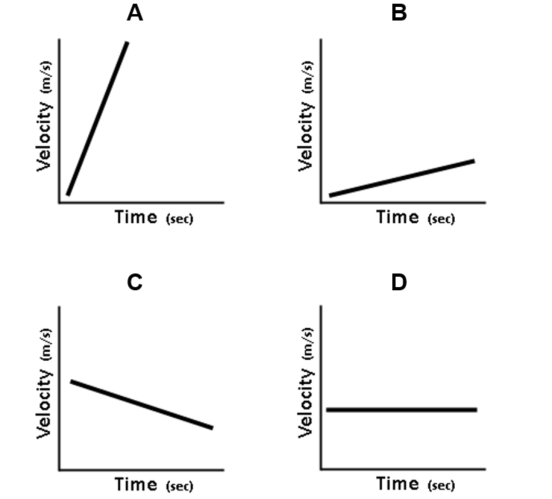
Which line shows the fastest velocity? (choose all that apply)
Line A
Line B
Line C
Line D
None of them
Which section of this velocity-time graph shows the man moving the fastest?
Section A
Section B
Section C
Section A and C
None of the sections

Which line does not show a constant velocity? (choose all that apply)
Line A
Line B
Line C
Line D
None of them

For the graph of the story : a student is walking home from school and stops to talk to a friend. While talking, he realizes that he forgot his bike at school and goes back to get it. He then rides his bike home. Which part matches up with Line segment A?
Walking home from school
Stops to talk to a friend
Goes back to school
Rides his bike home
None of them
Match the graph to the description:
"The car is accelerating."
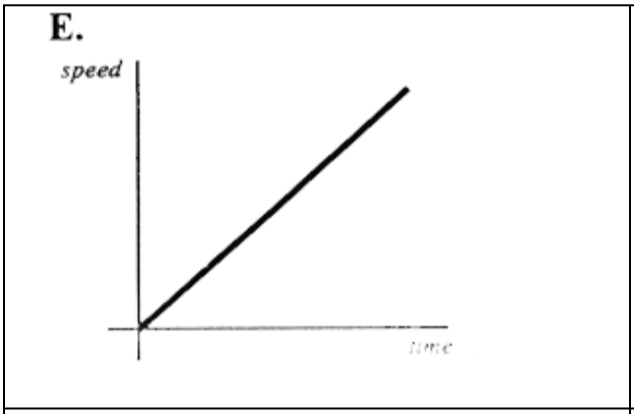
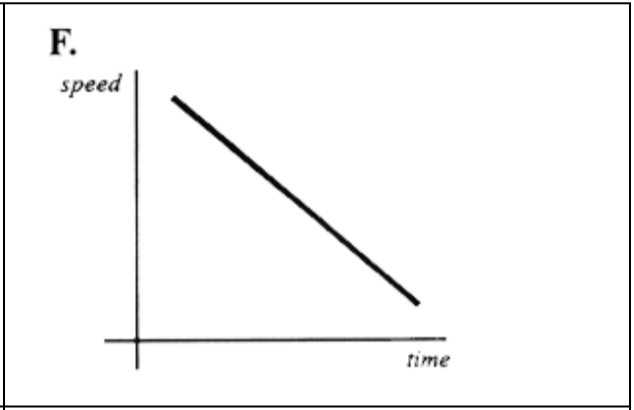
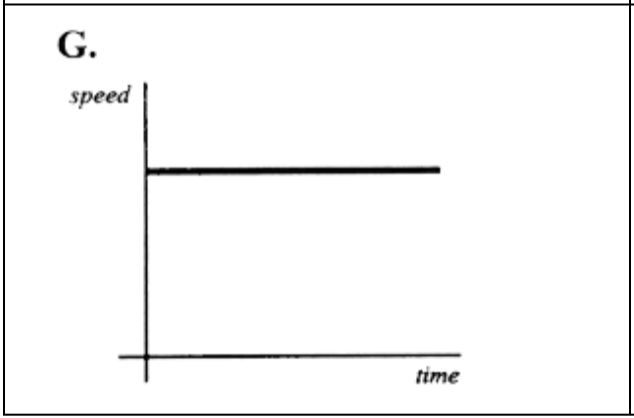
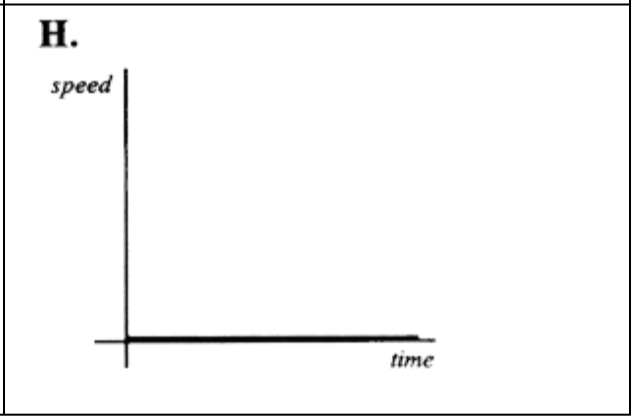
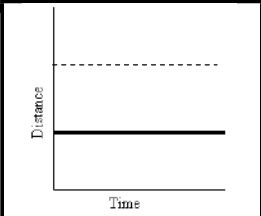
Match the graph to the description:
"The car is slowing down."
Match the graph to the description:
"The car is stationary."


Five stages - labeled A, B, C, D, and E - of an object's motion are represented by the position-time graph below. During which stage(s) is the object moving towards its starting point?
A
B
C
D
A downward moving elevator is slowing down. What is the direction of the elevator's acceleration?
Down
Up
No acceleration
Not enough information
The velocity-time graphs represent the motion of four different objects. Identify any object that is changing its velocity or accelerating. Check all that apply.


The velocity-time graphs represent the motion of three different objects. Identify any object that is changing directions. Check all that apply.


None of the above
The velocity-time graphs represent the motion of four different objects. Identify any object that is moving in the + direction and speeding up. Tap on all that apply.


Which is NOT an example of Acceleration?
An object speeds up
An object slows down
An object changes direction
An object is in constant motion.
Acceleration is a speeding up, slowing down or a change in direction. Is the following acceleration and if so, which one?
A dancer is warming up. She turns on music with a good beat and does 10 pirouettes in a row perfectly on the beat. (pirouette is a body spin in ballet)
Yes, this is acceleration since the dancers is going a certain speed.
Yes, this is acceleration since the dancer is changing direction when she spins.
No, this is not acceleration since there is no speeding up, slowing down, or change in direction.

When did the object have the highest average speed?
Between 0 and 30 seconds
Between 30 and 60 second
Between 60 and 120 seconds
Between 120 and 180 seconds
When did the object have the lowest average speed?
Between 0 and 30 seconds
Between 30 and 60 second
Between 60 and 120 seconds
Between 120 and 180 seconds

What is the average speed between 40 and 50 minutes?
20 mi/min
2 mi/min
80 mi/min
100 mi/min
It took 2 hours for a car to drive 140 miles. How fast was the car traveling?
240 mph
75 mph
70 mph
50 mph
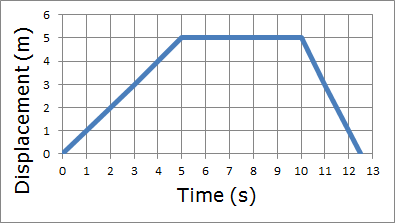
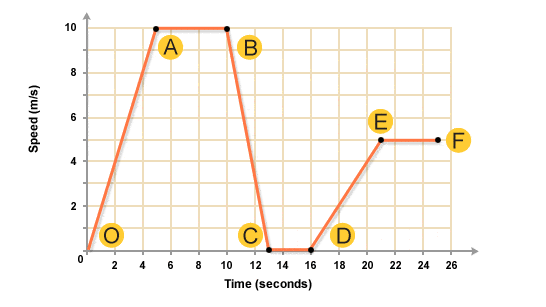
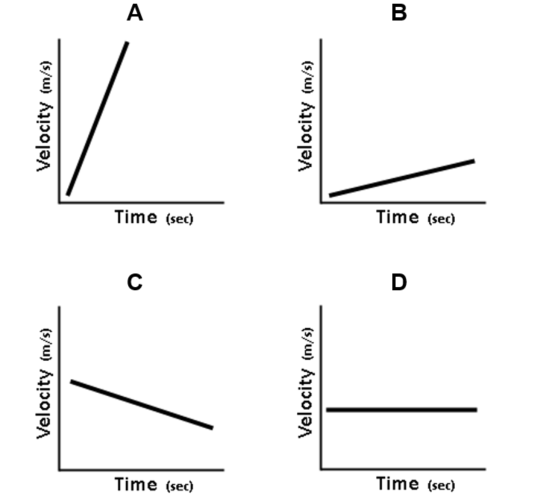

Calculate the displacement traveled in section B. Hint: Remember the area under a v-t graph = displacement!
150 m
50 m
100 m
200 m

Calculate the displacement traveled in section C. Hint: Remember the area under a v-t graph = displacement and you will need to use TWO shapes!
200 m
100 m
50 m
400 m
The area under a velocity-time graph represents __________.
displacement
velocity
acceleration
length x width
The slope of a velocity-time graph represents __________.
acceleration
displacement
speed
distance

Select the description of motion from A - B.
Slowing down away from the origin
Speeding up away from the origin
Constant velocity away from the origin
Constant velocity towards the origin

What segment of the graph shows no motion, or standing still?
A - B
B - C
C - D
None

Which segment of this v-t graph show a constant velocity.
AB
BC
CD
DE

Describe motion of C - D.
Constant velocity away from the origin
Slowing down away from the origin
Slowing down away from the origin and then slowing down towards the origin
Slowing down away from the origin and then speeding up towards from the origin

Describe the motion from B - C.
Standing still
Constant velocity of 60 m/min
Constant velocity of 0 m/min
Accelerating
Calculate the displacement traveled in section D. Hint: Remember the area under a v-t graph = displacement!
250 m
50 m
100 m
200 m
150 m
Calculate the displacement traveled in section A. Hint: Remember the area under a v-t graph = displacement!
75m
50 m
100 m
125 m
150 m

