
 Worksheets
Level Precal Unit 2 Review Mixed Practice
Total questions: 46
Worksheet time: 3hrs 34mins

How many zeros are shown in the picture?
0
1
2
3
How many zeros does the polynomial function f(x)=x4−13x2 −36 have?
2
3
4
6

Which root has a multiplicity of 2?
-1
2
4
-4
Which zero will "bounce" off (where you see tangent line) of the x-axis for x(x - 1)2(x + 2)(x + 3)
-1
1
-2
-3
zeros of the polynomial
y = 3(x + 4)(x + 1)(x - 3)?
Which one of these is NOT a zero of f(x)=x2(x−1)2(x+5) ?
0
1
-5
-1

What are the x-intercepts of
y= x2 - 9x + 14 ?
(-7,0) and (-2,0)
(7,0) and (-2,0)
(7,0) and (2,0)
(9,0) and (-14,0)
Let f(x) = 4x2−33x−27 Is x = 9 a zero of the function?
Find all zeros: x3 + 3x2 = 6x + 8
One zero of 4x3-17x2-150x-189 is 9.
What are other zeros? Select TWO correct answers
-1.75

Given x=2 is a zero of h(x).
What are all the zeros of the polynomial h(x)?
x=−5, x=0, x=2
x=−5(multi:2) x=0, x=2
x=−5, x=0, x=2 (multi:2)
x=5, x=0, x=−2(multi:2)
Which is a list of all zeros of x3+7x2+18x=10x+16
x=−4 and x=1
x=4, x=−1
x=−4, x=1 (multi:2)
x=−4(multi:2) x=1
Given one of the zero is -2, which of the following is the correct factors of polynomial x3+x2−10x+8
(x−4)(x+1)(x+2)
(x−4)(x+1)
(x+4)(x−1)(x−2)
(x−1)(x−2)

Which of the following are correct factors of the polynomial f(x)
f(x)=(x−5)(x−2)(x+4)
f(x)=(x−5)(x+4)
f(x)=(x+5)(x+2)(x−4)
f(x)=(x+5)(x+2)2 (x−4)

Which is the following is NOT a factor of the polynomial shown in the graph?
(x+1)
(x-2)
(x-4)
(x-1)
Which of the following is NOT a factor of x4+3x3−3x2−11x−6
(x−2)
(x+4)
(x+3)
(x+1)

Identify the x-intercepts and write an equation.
x=−3, x=1; f(x)=(x+3)2(x−1)
x=3, x=−1; f(x)=(x−3)2(x+1)
x=−3, x=1; f(x)=−(x+3)(x−1)2
x=−3, x=1; f(x)=−(x+3)2(x−1)
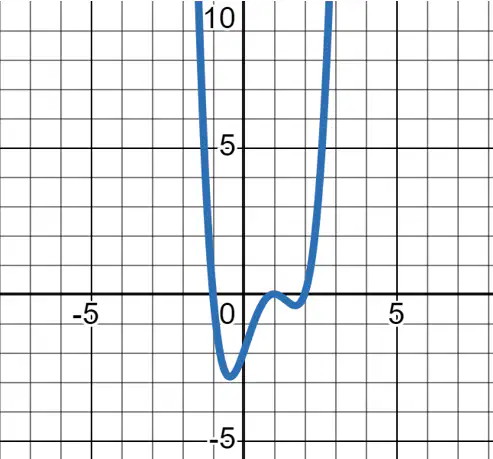
Which of the following function best describes the graph?
f(x)=(x+1)(x−1)(x−2)
f(x)=(x+1)(x−1)2(x−2)
f(x)=−(x+1)(x−1)(x−2)2
f(x)=(x−1)(x+1)2(x+2)
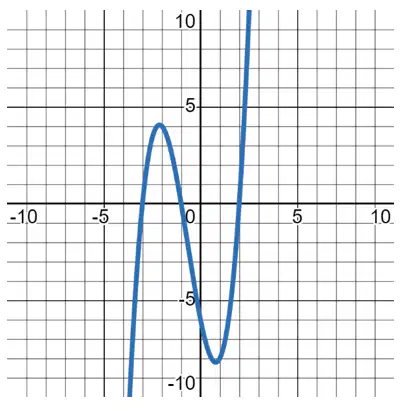
Which of the following could be a possible equation for the function shown?
f(x) =(x-3)(x-1)(x+2)
f(x)=(x+3)(x+1)(x-2)
f(x) = -(x-3)(x-1)(x+2)
f(x) = -(x+3)(x+1)(x-2)
Which of the following graph best represents the polynomial function:
f(x)=a(x−b)(x−c)(x−d). where a<0, a=b=c
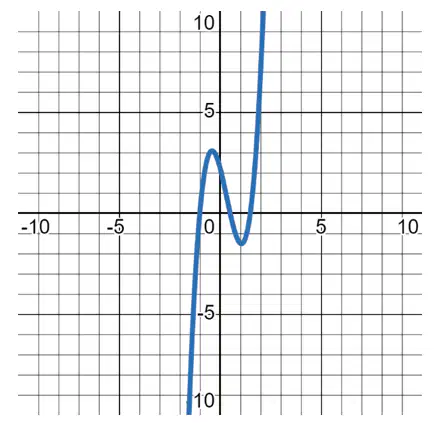
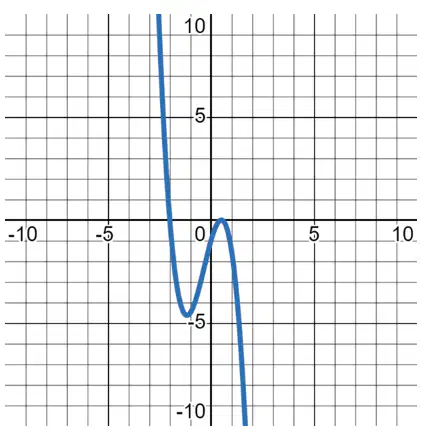
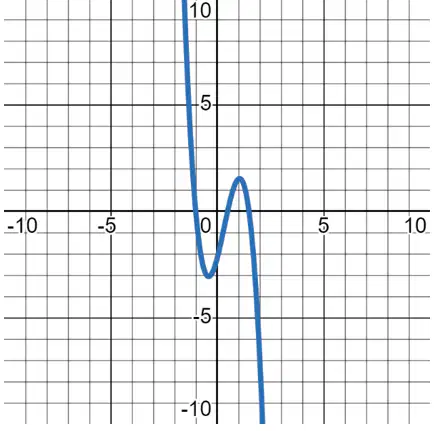
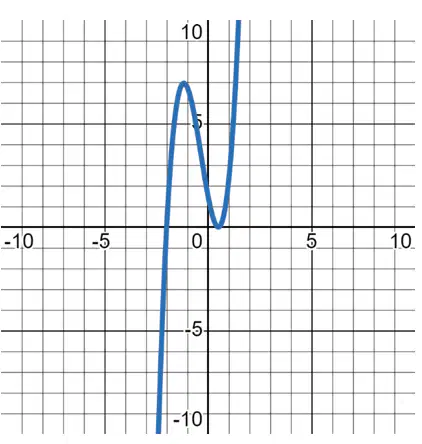
Given polynomial function f(x)=a(x−b)(x−c)(x−d)(x−e), where a>0, a=b=c=d
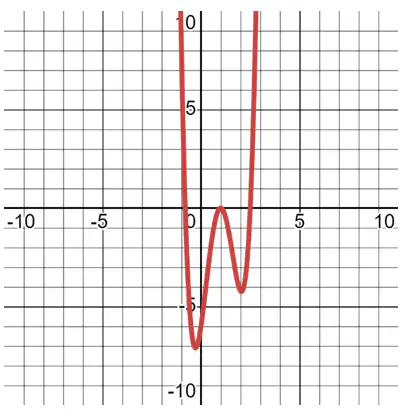
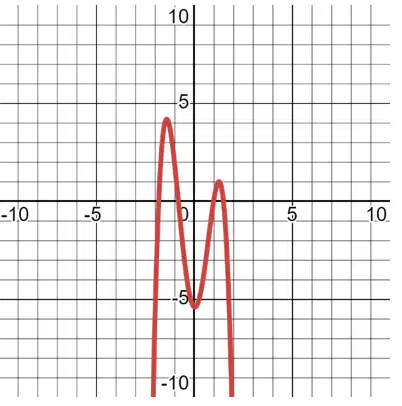
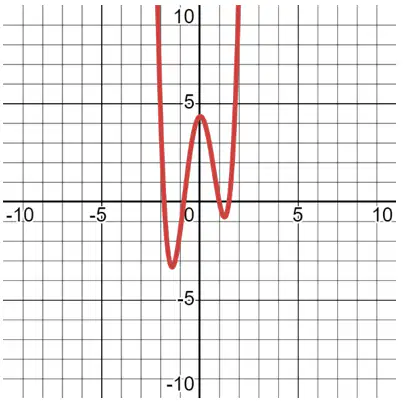
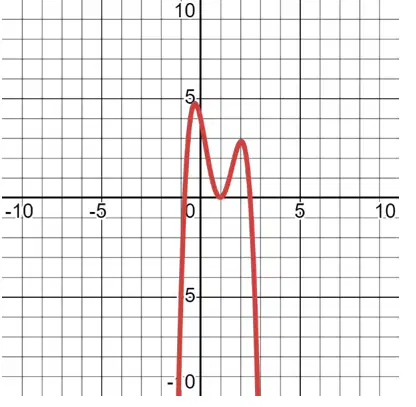


Which of the following notations are correct for the end behavior of the polynomial? Select TWO correct answers
x→∞, f(x)→∞
x→∞, f(x)→−∞
x→−∞, f(x)→∞
x→−∞, f(x)→−∞

Which of the following statement is true for the end behaviors of the polynomial? What is the end behavior as x → -∞ f(x)→ ?
x → -∞ f(x)→∞
x → ∞ f(x)→∞
x → -∞ f(x)→-∞
x → ∞ f(x)→-∞
x → -∞ f(x)→∞
x → ∞ f(x)→-∞
x → -∞ f(x)→-∞
x → ∞ f(x)→∞

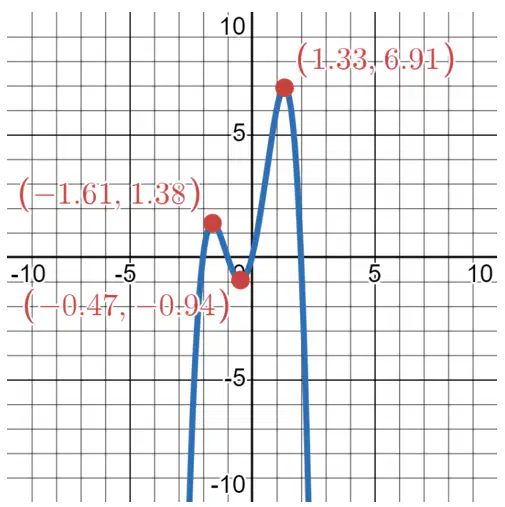
For the pictured polynomial, at which intervals is it increasing? Select TWO correct answers.
(-1.61, -0.47)
(-0.47, 1.33)
(1.33, ∞)
(−∞,−1.61)
(-0.94, 6.91)


For the pictured polynomial, which of the following are the relative minimums? Select ALL correct answers.
(-3, -2)

For the pictured polynomial, which is NOT a relative maximum?
(-5, 1)
(0, 3)

On the interval of (0, 2) what is happening?
the graph is decreasing
the graph is increasing
the graph remains constant

How would you describe the point at (0,6)?
Relative Minimum
Absolute Minimum
Relative Maximum
Absolute Maximum
Which statement correctly describes a function with EVEN symmetry ?
An EVEN function is symmetric with respect to the x-axis.
An EVEN function is symmetric with respect to the y-axis.
An EVEN function is symmetric with respect to the origin.
An EVEN function is symmetric with respect to the line y = x.
A function g(x) is an ODD function. If g(-3) = 4, which other point lies on the graph g(x)?
(3 , -4)
(-3 , -4)
(4 , -3)
(-4 , 3)
A function f(x) is an EVEN function. If f(4) = 2, which other point lies on the graph of f(x)?
(4 , -2)
(-4 , 2)
(-4 , -2)
(-2 , -4)

Which of the following statements are true about the polynomial function shown in the graph? Choose TWO correct answers
Domain: (-4, 4)
Range: (−∞,∞)
Function has two relative maximums
Function is ONLY increasing on interval (-0.2, 2.2)
Function has no vertical or horizontal asymptotes
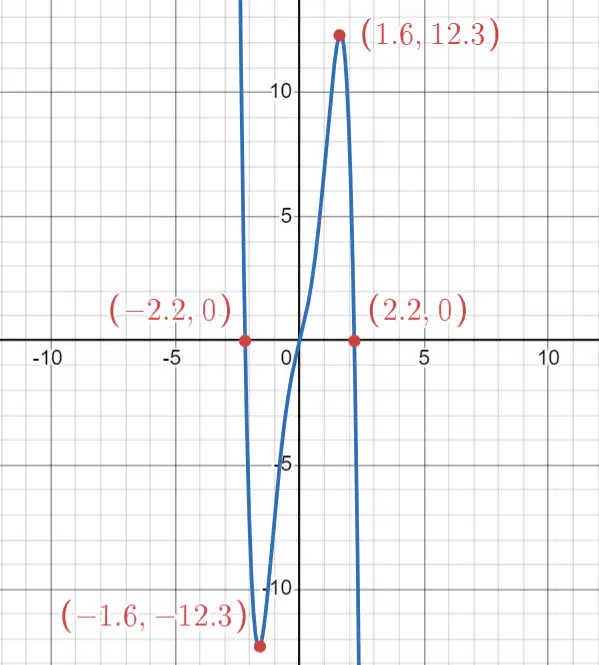
Which of the following statements are true for polynomial f(x)=−x5+4x3+4x Select THREE correct answers
Domain: (-3, 3)
Range: (−∞, ∞)
f(x) is ONLY decreasing on interval (−∞,−1.6)
f(x) is increasing on interval (-1.6, 1.6)
f(x) has odd symmetry
Given the graph of an ODD degree polynomial function with a negative leading coefficient, Which of the following statement is true?
The left and right ends of the graph will both lead to negative infinity.
The function is symmetric along origin
The left end of the graph will lead to positive infinity.
Given the graph of an EVEN degree polynomial function with a POSITIVE leading coefficient, Which of the following statement is true?
The right end of the graph will lead to negative infinity.
The function is symmetric along y-axis
The left and right ends of the graph will both lead to positive infinity.
The function will intersect will x-axis at least once
Which of the following statements are true about the symmetry of the polynomial: f(x)=3x5−4x3+x Select TWO correct answers.
Notation: f(x)=f(−x)
Notation: f(x)=−f(−x)
Reflection symmetry along y-xis
Rotational symmetry along origin
no symmetry
Which of the following statements are true about the polynomial function:
f(x)=−5x4+3x2−8 Select TWO correct answers.
Notation: f(x)=f(−x)
Notation: f(x)=−f(x)
Notation: f(x)=−f(−x)
reflectional symmetry along y-axis
Rotational symmetry along origin
Which of following of the solution of inequality:
−(x−4)(x+1)(x−2)<0
(−∞, −1) and (2, 4)
(−∞,−1] and [2, 4]
(−1, 2) and (4, ∞)
[−1, 2] and [4, ∞]
k(x)=x3+4x2 and h(x)=11x+30 Find the solution of k(x)>h(x)
(−∞, −5)and(−2, 6)
(−5, −2) and (3, ∞)
(−∞, −2)
(3, ∞)
[−5, −2] and [3, ∞)
Find the solution of the inequality: x4+x3 ≥16x2−20x
(−∞,0]
(−∞, −5] and [0, 5]
[−5, ∞)
(−∞, −5) and (0, ∞)
(−∞, −5] and [0, ∞)
f(x)=x3+3x2 and g(x)=18x+40 . What is the solution when f(x)≤g(x)?
(−∞, −5] and [−2, 4]
[−5, −3] and [4, ∞)
(−∞, 4)
(−∞, −5) and [−2, 4]
[−2, 4]

