
 Worksheets
Unit 2 AP Bio Review
Total questions: 40
Worksheet time: 23mins
Explain the role of mitochondria in cellular function.
Mitochondria help in the process of photosynthesis.
Mitochondria regulate the movement of materials into and out of the cell.
Mitochondria produce energy in the form of ATP through cellular respiration.
Mitochondria store genetic information for the cell.
Describe the structure and function of chloroplasts in plant cells.
Chloroplasts are responsible for cellular respiration in plant cells.
Chloroplasts are membrane-bound organelles responsible for photosynthesis in plant cells.
Chloroplasts are found in animal cells and not in plant cells.
Chloroplasts are not involved in any specific function in plant cells.
What is the function of lysosomes in a cell?
Regulation of cell growth and division
Synthesis of proteins
Digestion of waste materials and cellular debris
Production of energy for the cell
Facilitated diffusion occurs when what kind(s) of molecules require a channel or carrier protein to enter the cell membrane?
small, non-polar
large, non-polar
small, polar
large, polar
Which substance would most easily pass through the cell membrane?
Oxygen
Glucose
Sodium ions
Water

What is the role of ribosomes?
To store genetic information.
To produce glycolipids.
To synthesize proteins.
To hydrolyze waste materials.

Which of the following is a difference between smooth and rough endoplasmic reticulum (ER)?
Smooth ER exists in a part of the cell near the cell membrane, while rough ER exists in a part of the cell near the nucleus.
Smooth ER is not studded by ribosomes, while rough ER is studded by ribosomes.
Smooth ER is meant to compartmentalize the cell, while rough ER detoxifies and synthesizes lipids.
Smooth ER is made without the additional help of proteins, whereas rough ER is made with the help of special proteins called reticuloproteins.

Which of the following is a function of the Golgi apparatus?
Detoxification of the cell and lipid synthesis.
Protein and rRNA synthesis.
Synthesis of chemical energy (adenosine triphosphate).
Chemical modification of newly synthesized proteins before they are packaged for trafficking to other parts of the cell or outside of the cell.
Which of the following is a reason that cells are so small?
Cells are small because they want to maximize their surface area-to-volume ratio.
Cells are small because they want to maximize their volume-to-surface area ratio.
Cells are small because they need to produce extremely small macromolecules.
Cells are small because they prefer to work together in clusters of many thousands that wouldn't otherwise fit anywhere.
Which of the following is one way that cells increase their surface area without increasing their size?
Cells will often include perfectly spherical membranes.
Cells will often include folds in their membranes.
Cells will often include holes in their membranes.
Cells will maximize their volume.
Which of the following would need assistance moving through the plasma membrane?
Nitrogen gas (N2)
Oxygen gas (O2)
Carbon Dioxide gas (CO2)
Water
Which of the following is a difference between passive and active transport?
Passive transport moves molecules against their gradient, while active transport moves molecules with their gradient.
Passive transport moves molecules with a direct input of energy, while active transport moves molecules without a direct input of energy.
Passive transport moves molecules non-spontaneously, while active transport moves molecules spontaneously.
Passive transport moves molecules without a direct input of energy, while active transport moves molecules with a direct input of energy.
What is the primary role of aquaporins?
To transport water across the membrane.
To change the state of water from gas to liquid.
To pump water into the mitochondria for cellular respiration.
To use water for hydrolytic purposes.
Which of the following describes the endosymbiotic theory?
A prokaryotic cell engulfed several other types of smaller prokaryotic cells, and eventually its compartmentalization made the cell eukaryotic.
A eukaryotic cell engulfed several other types of smaller prokaryotic cells, and eventually its compartmentalization made the cell prokaryotic.
A prokaryotic cell engulfed several other types of smaller eukaryotic cells, and eventually its compartmentalization made the cell eukaryotic.
A eukaryotic cell engulfed several other types of smaller eukaryotic cells, and eventually its compartmentalization made the cell prokaryotic.
Which of the following is true about the fluid mosaic model of the cell membrane?
It consists of a rigid, static structure.
Proteins are embedded in a phospholipid bilayer.
Cholesterol is absent from the membrane.
The membrane is impermeable to all substances.
when some molecules can cross the membrane while others cannot.


When particles move from low to high concentration
Passive Transport
Active Transport


Where are lipids formed?
Rough ER
Smooth ER
Nucleus
Ribosomes
Explain the role of ATP in active transport.
ATP is not involved in active transport
ATP is only used in passive transport
ATP is only used in plant cells for active transport
ATP provides the energy needed for active transport.
How does membrane permeability affect the movement of molecules across the membrane?
It allows all molecules to pass through at the same rate
It only affects the movement of water molecules
It has no effect on the movement of molecules
It determines which molecules can pass through the membrane and at what rate.
Fusion of membrane-bound vesicle with membrane and dumping contents outside cell is known as
endocytosis
diffusion
osmosis
exocytosis
Increase the surface area available for ATP synthesis
cristae
matrix
inner membrane
outer membrane
True or False. As organisms increase in size, the surface area-to-volume ratio of their cells decreases.
True
False
True or False. It is better for a cell to have more membrane folds in order to exchange materials with the outside environment.
True
False
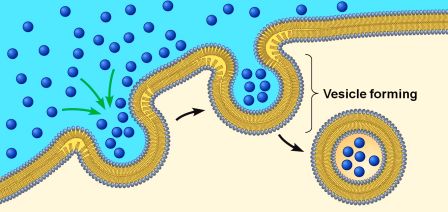
What is the function of the increased surface area in Golgi Bodies?
More sites for ATP synthesis
More sites for lysosome formation
More sites for protein modification
More sites for protein synthesis
Which of the following is evidence to support the endosymbiotic theory?
Mitochondria and chloroplasts have their own DNA, which is similar to prokaryotic DNA.
Fossil evidence shows that the first forms of life were prokaryotic cells.
All eukaryotic cells have a double-layered membran composed of phosplipids and proteins.
Prokaryotes have the same number and types of enzymes as eukaryotes.
Why is the inner membrane of the mitochondria highly folded?
Increase volume of mitochondria
Increase in surface area for oxidative phosphorylation
Decrease volume of mitochondria
Decrease in surface area for oxidative phosphorylation
Cellular eating, use pseudopod to engulf food
Exocytosis
Phagocytosis
Pinocytosis
Receptor Mediated Endocytosis

