
 Worksheets
Isolation and Dental Caries
Total questions: 40
Worksheet time: 20mins
Name
Class
Date
1.
While isolating premolar teeth, which of the following protocol should be followed?
a)
Isolate teeth from first molar to opposite lateral incisor
b)
only tooth to be treated should be isolated
c)
as far as distally and anteriorly lateral incisor of the opposite side
d)
one to two teeth distally, and extend anteriorly to include the opposite lateral incisor
2.
What is the indication of rubber dam placement?
a)
Asthmatic patient
b)
Mouth breather
c)
Epileptic patient
d)
Moisture control
3.
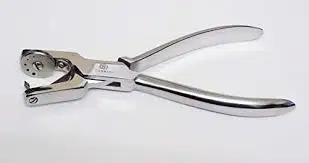
What is the purpose of this instrument?
a)
Hold rubber dam
b)
Hold clamp
c)
Punch rubber dam
d)
Help in rubber dam retention
4.
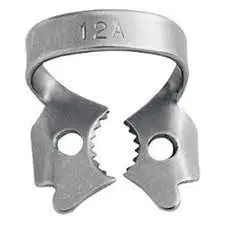
Following clamp is used for which tooth isolation?
a)
For Anterior
b)
For Molars
c)
For Premolars
d)
For Canine
5.
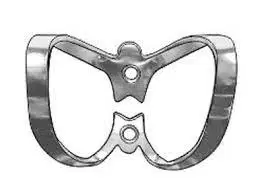
Following type of dental clamp is used for which tooth isolation?
a)
For Anteriors
b)
For Premolars
c)
For Molars
d)
For upper Molars
6.
Which of the following materials is not prevented from aspiration by rubber dam isolation?
a)
Hand Files
b)
Clamps
c)
Porcelain crowns
d)
Wedges
7.
Which of the following situations precludes rubber dam isolation?
a)
Nasal breathers
b)
Wisdom tooth isolation
c)
Endodontic treatment
d)
Latex allergy
8.
What is the thickness of a medium rubber dam sheet?
a)
0.15 mm
b)
0.20 mm
c)
0.25 mm
d)
0.30 mm
9.
While placing rubber dam on a patient, you notice that the holes are pulling away from the teeth causing leakage. Which of the following might be a cause of this error?
a)
Holes are punched too close together
b)
Holes are punched too far apart
c)
Holes position too low on the dam
d)
Holes position too high on the dam
10.
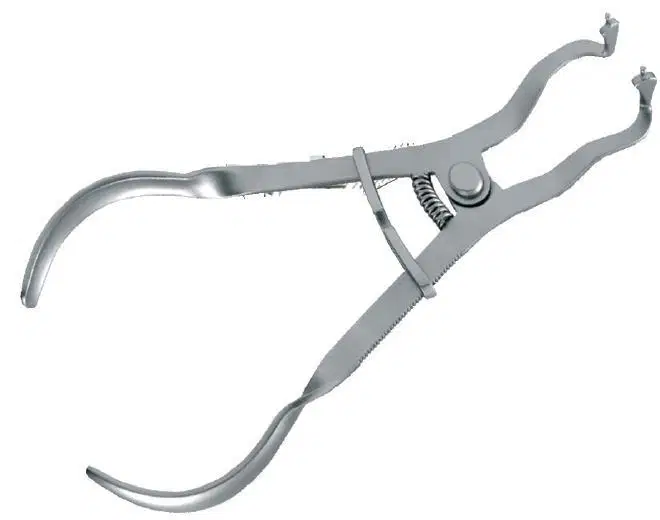
Which of the following clamp forcep is depicted in the picture shown?
a)
Brewer
b)
Stockes
c)
Ivory
d)
Plamer
11.
What is the function of lubricant during rubber dam placement?
a)
Helps clamp slide over teeth easily
b)
Helps instruments move easily over dam
c)
Allows dam to slide over teeth easily
d)
Reduces friction between clamp and sheet
12.
What is the general rule for limited isolation?
a)
Only isolate the tooth which is to be operated on
b)
Include one tooth anterior and one tooth posterior to the tooth being operated
c)
Include one tooth anterior and two teeth posterior to the tooth being operated
d)
Include two teeth anterior and one tooth posterior to the tooth being operated
13.
In dam over clamp technique, which of the following steps is carried out first?
a)
Clamp is placed first
b)
Dam is placed first
c)
Clamp and dam are carried together
d)
Clamp, dam and frame are carried together
14.
Which of the following is an indirect method of providing isolation from moisture?
a)
Absorbent wafers
b)
Cotton rolls
c)
Local anesthesia
d)
Rubber dam
15.
Which of the following is a disadvantage of rubber dam placement?
a)
Attachment loss around isolated teeth
b)
Risk of cross contamination
c)
Salivary build-up in mouth
d)
Microscopic damage to prosthetic crown margins
16.
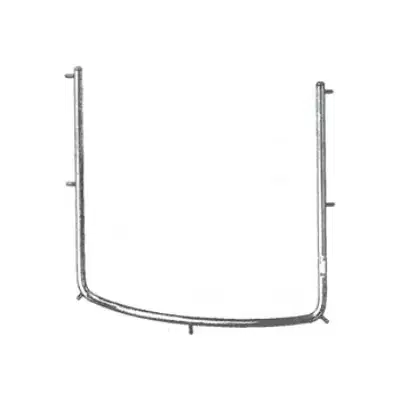
Which frame is depicted in the picture below?
a)
Nygaard-Ostby frame
b)
Young’s frame
c)
Star visi frame
d)
Articulated frame
17.
For which of the following procedures cotton roll isolation provides acceptable dryness?
a)
Root canal procedure
b)
Composite restoration
c)
Amalgam restoration
d)
Sealant placement
18.
Which of the following is the most appropriate method to provide isolation for a bridge?
a)
Cotton rolls
b)
Rubber dam
c)
Split dam
d)
Svedopter
19.
Which of the following acts as a tongue retractor in addition to providing moisture control?
a)
Rubber dam
b)
Tongue depressor
c)
Svedopter
d)
Hygofomic saliva ejector
20.
Which of the following provides a combination of retraction, protection, aspiration and illumination?
a)
Hygofomic saliva ejector
b)
Isolite
c)
Rubber dam
d)
Svedoptor
21.
The dietary carbohydrate most likely involved in etiology of dental caries is
a)
Glucose
b)
Sucrose
c)
Dextran
d)
Polysaccharides
22.
A acute fulminating type of carious process, which is characterized by simultaneous involvement of multiple number of teeth in multiple surfaces is
a)
Active caries
b)
Rampant caries
c)
Nursing bottle caries
d)
Secondary caries
23.
A caries lesion adjacent to an existing restoration.
a)
Secondary caries
b)
Recurrent caries
c)
Primary caries
d)
Both a and b
24.
Arrested caries in enamel is
a)
Chalky when air dried and opaque translucency
b)
Feels rough when tip of the probe is moved gently across the surface
c)
Mostly on plaque stagnation areas
d)
Lesion has shiny surface when air dried
25.
Caries affecting pits and fissure on occlusal third and occlusal two-third of molars and premolars, and lingual part of anterior teeth
a)
Class I
b)
Class II
c)
Class III
d)
Class IV
26.
Regarding carious lesions, which statement is most appropriate?
a)
Caries cannot be remineralised
b)
Caries is a bacteriological disease
c)
Caries always results in the formation of a perapical abscess
d)
Caries is a natural consequence of aging
27.
What is the primary reason of cavitation in a carious lesion?
a)
Bacteria destroy the enamel surface
b)
Micro trauma occurs to enamel that is demineralised
c)
Acid causes removal of mineral from the dentine
d)
The pulp becomes inflamed resulting in weakened tooth structure
28.
What is the starting point of formation of caries?
a)
Plaque bacteria
b)
Absence of fluoride and saliva
c)
Intake of fermentable carbohydrate
d)
Intake of non-fermentable carbohydrate
29.
According to G.V Black’s classification, Carious lesion on gingival 3rd of tooth surface is:
a)
Class I
b)
Class II
c)
Class IV
d)
Class V
30.
What are the type of caries present around and under restoration?
a)
Primary caries
b)
Secondary caries
c)
Tertiary caries
d)
Rampant caries
31.
What is the pH at which initiation of caries occurs?
a)
4.3 – 4.5
b)
5.2 - 5.5
c)
4.9 – 5.1
d)
3.5 – 4.5
32.
Caries involving the proximal surface of anterior teeth without involving incisal edge are termed as:
a)
Class II
b)
Class VI
c)
Class III
d)
Class IV
33.
Which bacteria are responsible for initiation of caries?
a)
Actinomyces
b)
Streptococcus mutans
c)
Lactobacillus
d)
Streptococcus viridians
34.
What are Class IV caries as explained by G.V Black?
a)
Caries involving the cusps of posterior teeth
b)
Caries on the proximal surface of anterior teeth without involving incisal edges
c)
Caries on the proximal surface of anterior teeth involving incisal edges
d)
Caries on the proximal surface of posterior teeth
35.
In which part of the tooth does caries spread rapidly?
a)
Enamel
b)
Dentine
c)
Pulp
d)
Cementum
36.
Which of the following factor in the Stephen’s curve is related to the caries incidence and sugar intake?
a)
Physical form of sugar
b)
Frequency of sugar
c)
pH of plaque
d)
quality of sugar intake
37.
Bacteria free zone of dental caries is:
a)
Zone of decomposed dentine
b)
Zone of bacterial invasion
c)
Zone of decalcification
d)
Zone of dentinal sclerosis
38.
Regarding caries, which statement is most appropriate?
a)
Lactobacillus is the main caries causing organism in plaque
b)
Smooth surface caries occurs due to Streptococcus mutans
c)
Pits and fissure caries cannot be prevented
d)
Fluoride has no role in reducing caries incidence
39.
Which of the following organisms are found in deep carious lesions?
a)
Streptococci
b)
Bacteroids
c)
Veilonella
d)
Lactobacilli
40.
Lateral spread of dental caries is facilitated mostly by:
a)
Enamel spindle
b)
Enamel lamellae
c)
Dentinoenamel junction
d)
Striae of retzius
100 %

