
Font size
 Worksheets
#16 Quizizz: Exploring Earth's Dynamic Layers
Total questions: 30
Worksheet time: 15mins
Austin and Lily are studying the Earth in their geography class. They are trying to determine which layer of the Earth is responsible for the movement of tectonic plates. Can you help them?
Crust
Outer core
Mantle
Inner Core
JJ and Ali are working on a project about the theory of continental drift. Evaluate the evidence supporting the theory and identify which type of evidence was crucial in Alfred Wegener's hypothesis.
Fossil evidence
Ocean floor mapping
Satellite imagery
Seismic activity
During a field trip, Zoey and Carmine are examining rock formations. Using your understanding of stratigraphy, determine how they can use rock layers to understand Earth's history.
By examining the color of rocks
By analyzing the sequence and position of rock layers
By measuring the temperature of rocks
By observing the size of rocks
During a science class, Farrah and Marcos were discussing the role of convection currents in the mantle. How do these currents contribute to the movement of tectonic plates?
They cause the Earth's rotation.
They create magnetic fields.
They drive the movement of tectonic plates.
They stabilize the Earth's temperature.
During a geography class, Soraiya and Amani were discussing how the breakup of Pangea has influenced the current distribution of continents. Analyze their discussion.
It caused the continents to merge into a single landmass.
It led to the formation of the Pacific Ocean.
It resulted in the continents drifting to their present positions.
It had no impact on the current distribution of continents.
MJ and Jayden are studying the impact of plate tectonics on the formation of mountain ranges. Discuss their findings.
Mountain ranges form due to erosion.
Mountain ranges form when tectonic plates collide.
Mountain ranges form from volcanic activity alone.
Mountain ranges form due to the Earth's rotation.
During a geology class, Paitynn and Nikolai are discussing the role of subduction zones in the recycling of Earth's crust. Evaluate their discussion.
Subduction zones create new crust.
Subduction zones are areas where crust is destroyed and recycled.
Subduction zones are stable and unchanging.
Subduction zones prevent earthquakes.
Mason and Jess are studying the relationship between earthquakes and plate boundaries.
Earthquakes only occur in the middle of tectonic plates.
Earthquakes are unrelated to plate tectonics.
Earthquakes occur only in volcanic regions.
Earthquakes are most common at plate boundaries.
McKenzie and Skylar are studying geological and fossil records to evaluate the evidence for the existence of Pangea. What conclusion can they draw?
Pangea is a myth with no scientific evidence.
Similar rock formations and fossils found on different continents support Pangea's existence.
Pangea was only a theory with no supporting evidence.
Pangea's existence is supported by the current shape of continents alone.
During a geography class, Aliyah and Max were discussing how volcanic activity is related to the movement of tectonic plates. Can you analyze their discussion?
Volcanic activity often occurs at plate boundaries where plates diverge or converge.
Volcanic activity is unrelated to tectonic plates.
Volcanic activity only occurs in the middle of tectonic plates.
Volcanic activity is caused by the Earth's magnetic field.
During a geography class, Levea and Jacob were discussing the significance of the Ring of Fire in understanding plate tectonics. What did they conclude?
The Ring of Fire is a myth with no geological basis.
The Ring of Fire is unrelated to tectonic activity.
The Ring of Fire is an area with high volcanic and earthquake activity due to plate boundaries.
The Ring of Fire is a region of stable geological activity.
During a science class, Evan asked why the plates on Earth are moving. The reason plates are moving, is because _______
Magma is semi-liquid and moves under the crust.
The earth is spinning.
The weather systems in the atmosphere.
The Earth's core is spinning very fast.
During a geography class, Abbie and Jairon learned that the Earth's crust is composed of semi-rigid plates that move in various directions. On average, these plates move a few _______ in a year.
kilometers
miles
yards
centimeters
During a geography class, Levi and Kyleigh were discussing what happens when tectonic plates move towards each other. What is the result?
Plates move towards each other
Plates move away from each other
Plates slide past each other
Plates collide and one goes beneath the other
During a geography class, Kherrington and Chase learned that tectonic plates:
can move towards each other
can move away from each other
can slide past each other
All of the above
True or false: Mission and Isabella learned that the tectonic plates will never stop moving during their geography class.
True
False
During a science class, Amaiyah asked, 'What makes tectonic plates move?'
Convection currents
Wind
Earthquakes
Gravity
True or False: Logan and Sophia learned in their geography class that the tectonic plates are still moving today.
True
False
Brianna and Harrison were discussing the types of fossils noticed by Wegener to be found on two different continents. What type of fossils were they?
leaves and flowers
ice and mountains
plants and animals
dinosaurs and reptiles
Holden and Keniya found a picture of a rock formation that looks similar to one found on another continent. This picture is an example of which type of evidence?
matching fossil
climate change
matching land formation
memorial movement
Cornell and Maria are studying the Evidence of Continental Drift. Can you help the 3 types of evidence from the options below?
fossils of the same animal found on different continents
marine fossils found on the top of mountains
continents fit together like a puzzle
matching rock layers in different continents
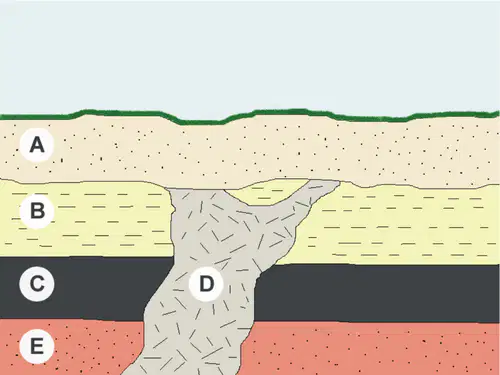
In what order (from oldest to youngest) were these rock layers formed?
E, D, C, B, A
E, C, B, D, A
A, B, C, D, E
A, D, B, C, E
During Science class, Adrian and Aspen learned that subduction means...
one plate goes under another plate
two plates collide and form folded mountains
two plates slide past each other
one plate is subtracted from the other
Ava and Khloe are studying a map of the Himalayan mountains.
Which of the following identifies the geologic process that caused this mountain range to form?
two continental plates converging
a tectonic plate moving over a hot spot
an earthquake in a subduction zone
movement at a transform fault boundary
When Carrie and Scott learned about how plates converge and form mountains, scientists call it _______.
subduction
elevation
uplift
none of the above
During Mrs. VanHorn's science class, Niles and Aubrey learned that molten rock is rising up along the _____.
titanic
deep-sea trench
mid-ocean ridge
all of the above
Faith and Keith are studying the process that creates new seafloor as plates move away from each other at the mid-ocean ridges. What is this process called?
stressing
subduction
shearing
seafloor spreading
During a science class, Tristan and Coraline are discussing why seafloor spreading occurs. What is the reason?
Plates are smashing together and oozing apart
Magma below the Earth's crust is forced up toward the surface after plates move apart
Maui is trying to break out of his prison
The Earth's magnetic poles are reversing
Summerlin and Matix are studying geology and they learn that sea-floor spreading explains how.....
new crust is created at a divergent boundary
volcanoes are formed on continents
deep sea trenches are formed
During a science class, Hayden and Dallin learned about sea-floor spreading. They discovered that molten material rises from the mantle and erupts...
along the edges of all the continents.
in deep-ocean trenches.
along mid-ocean ridges.
at the north and south poles.

